Every Name a Story
James Leadbitter Knott
Every Name a Story
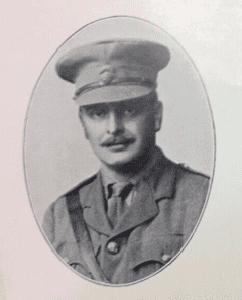
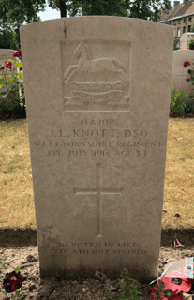
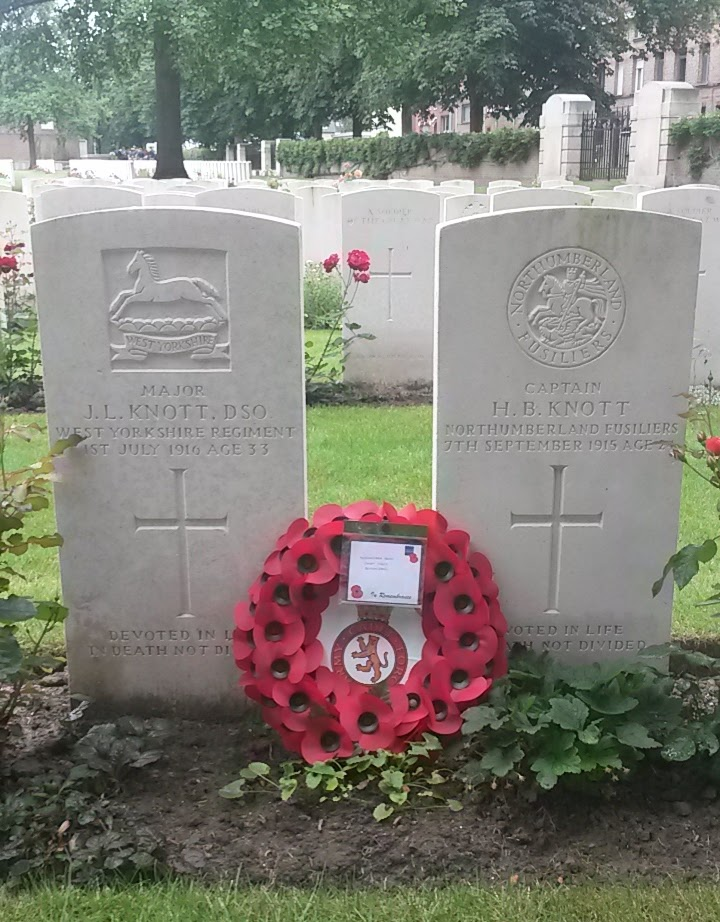
In Ypres Reservoir Cemetery, Belgium is the Commonwealth War Grave of Major James Leadbitter Knott, D.S.O., MiD., serving with the 10th Battalion Prince of Wales’s Own West Yorkshire Regiment who died 01/07/1916.
Pauline Priano has submitted the following:-
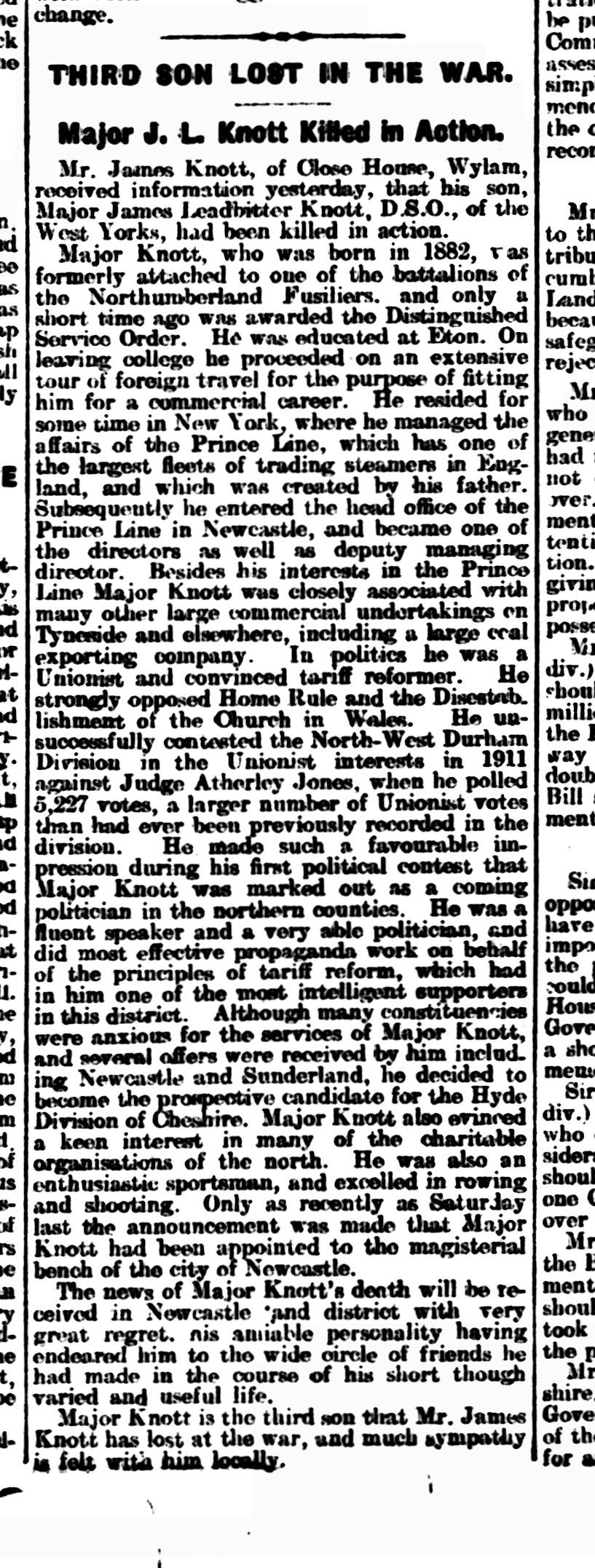
James Leadbitter Knott, one of three sons, was the second born child of James Knott, born at Howden, Northumberland, born January 31st 1855, baptised at St. Peter, Wallsend, March 4th 1855. and Margaret Annie Garbutt of Holmfirth, Yorkshire, also born 1855, she was the daughter of Reverend Thomas Garbutt.
James Knott was a man of humble beginnings, the son of a grocer. Educated at the Scotch School in North Shields, he left at the age of 14 to start work as a shipping clerk on Newcastle upon Tyne quayside and by the age of 20 began his own business as a shipbroker. Having borrowed money from a friend at the age of 23 he bought an old collier, Pearl, ship number 23195, of Scarborough for £186. On September 17th 1878, he and Margaret Annie were married at Tynemouth, Northumberland. Their eldest son, Thomas Garbutt Knott, was born July 14th 1879 at North Shields. In 1881 they were living next door to Margaret Annie’s widowed mother, her sister, brother and his wife, at 1, Frank Place, North Shields.
By the time James Leadbitter was born at North Shields, December 2nd 1882, his father had bought a steam ship from Swan Hunter named Saxon Prince, ship number 79247, and founded the Prince Line Ltd., which became one of the biggest shipping lines in the world with a fleet of over 40 ships, with distinct slate grey hulls, black and red funnels with white Prince of Wales’s feathers.
The family enjoyed a wealthy lifestyle and became well known. They left North Shields and moved to Manor House, Jesmond, a suburb of Newcastle upon Tyne and it was here that youngest son Henry Basil Knott was born, February 5th 1891 and baptised April 18th at St. George’s Church, Newcastle. The house was run by 47-year-old Annie Hindmarsh with the assistance of a butler, cook, a kitchen maid and 2 housemaids. James Leadbitter (8) and Henry Basil (3 months) were looked after by a certificated nurse, a nursemaid and were schooled by a live-in tutor. Their elder brother Thomas (11) was living as a boarder at The Manse, Thirston, Northumberland, the home of Presbyterian minister James Lemon, his wife and son.
By 1901 they had moved to 4, Sydenham Terrace, Jesmond, which was fully staffed. James Leadbitter Knott (18) was the only son still living at home. His brother Thomas Garbutt, not wanting to join the family business, had departed to South Africa; Henry Basil (10) was a boarder attending Langley Place School, Horsemore Green, Langley, Buckinghamshire. He had returned to the family home at Close House, Wylam, by 1911.
James Leadbitter Knott was deputy managing director in his father’s company which had extended beyond shipping and now incorporated ownership of several collieries. When war was declared with Germany on August 4th 1914 he had been offered a safe position on a shipping board stationed in England but he refused, instead wanting to fight at the front. Offered a commission as 2nd Lieutenant, on January 7th 1915 he was gazetted as a temporary Captain and transferred from the 4th Battalion Northumberland Fusiliers to the 9th Battalion.
He served during WW1 as Captain with the Northumberland Fusiliers and as Major with the 10th Battalion Prince of Wales’s Own West Yorkshire Regiment.
The 10th Battalion was raised at York in September 1914 as part of Kitchener’s Second New Army joining the 50th Brigade, 17th (Northern) Division. After initial training near home they were moved to Dorset to continue training then, in 1915, moved to Winchester. Originally destined for Home Defence duties this decision was reversed and they departed to France, landing at Boulogne, July 14th 1915, concentrating near St Omer. They were sent to the Ypres salient for trench familiarisation and then took over the area in their own right. In Spring 1916 they saw action at the Bluff, near Ypres, on the Comines canal before moving south to the Somme, participating in the opening battle at Albert.
Major Knott was second in command on July 1st 1916. Just before 7.30 a.m. on the morning of July 1st, three mines were detonated which trapped him and his men, who had been ordered to advance, between the enemy lines and the second positions. When the enemy emerged from their dugouts and opened fire, over 700 men from the battalion, including 33-year-old Major James Leadbitter Knott were killed that day.
On that fateful morning, prior to the commencement of the battle, he had written a letter to his parents, only to be opened in the event of his death. It reads as follows: “Dearest Father and Mother, If you are reading this it means that this war has demanded the extreme sacrifice from me it is not in my sense a message from the grave whatever I may or may not doubt, I have complete faith in the Life Eternal. Momentous events are looming and I have a premonition that I may not return to you. I have been dreaming of Basil recently. My medals are yours but I would like them destroyed when you both join me. My clothes, furniture and motor car must be immediately disposed of, everything which reminds you of my death must be removed. This is my urgent desire and wish. Your devoted son, Jim.”
Prior to his death Major James Leadbitter Knott had been awarded the Distinguished Service Order medal in the Birthday Honours of His Majesty The King. He also received the 1914-15 Star, British War Medal and Victory Medal. His effects in the sum of £104,350 pounds 2 shillings were assigned to his father James Knott, shipowner, September 15th 1916.
Major Knott was initially buried in France, his brother Captain Henry Basil Knott had died of wounds some nine months prior to his brother, September 7th 1915 and was buried near Poperinghe, Belgium. Their father tried to use his influence to have their bodies repatriated to England, but was denied this on the grounds of logistical difficulties, sanitary challenges and equality in death as each soldiers was to be buried where he fell, however, it was conceded that their bodies be buried alongside each other within Ypres Reservoir Cemetery, Ypres, Belgium, graves V. B. 15 and V. B. 16 respectively. Both bear an identical inscription which reads, “DEVOTED IN LIFE IN DEATH NOT DIVIDED.” Their brother Thomas Garbutt Knott also served and it was feared that he too had perished until news was received that he had been taken a Prisoner of War. At the conclusion of WW1 he returned safely to England.
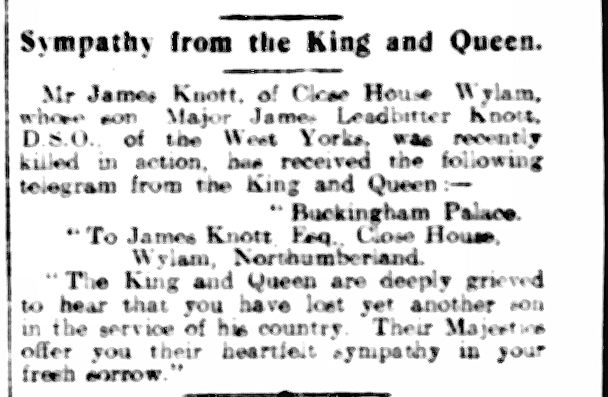
After the loss of his sons James Knott retired in 1916. In 1917 he received a Baronetcy which bestowed upon him and his wife the title of Sir James Knott and Lady Margaret.
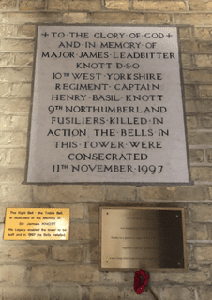
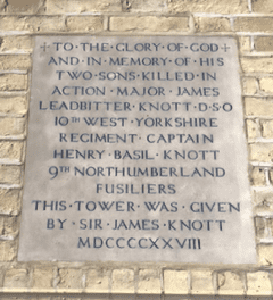
He and his wife donated the money to build a bell tower at St. George’s Memorial Church in Ypres, Belgium, where the bell was rung and still rings in memory of his sons. They also financed the building of St James and St Basil Church, at the corner of Fenham Hall Drive and Wingate Road, Fenham, Newcastle upon Tyne, consecrated in 1931. The tenor bell is inscribed, “We ring in memory of James and Basil Knott, God knows.” There is also a beautiful stained glass window dedicated to and depicting their fallen sons.
In 1924 Sir James and Lady Margaret settled on the island of Jersey, Channel Islands at Samares Manor. Lady Margaret Annie Knott, nee Garbutt, died March 8th 1929, aboard their yacht in Cannes, France, having suffered poor health since the loss of her sons. Sir James Knott 1st Baronet, remarried in 1932 at Monte Carlo, Elizabeth Chystie Gauntlett, the 25-year-old daughter of Colonel V.C. Gauntlett. Sir James died aged 69 years at St. Clements, Jersey, Channel Islands, June 8th 1934 and was interred June 12th. Elizabeth Chystie Knott nee Gauntlett, who had married for a second time, also in Jersey, died November 23rd 1998. Sir James’ only surviving son, Thomas Garbutt Knott, inherited the family title.
In God’s safe keeping. Rest In Peace.
Acknowledgements: Colin Cresswell
James Leadbitter Knott is remembered at Cullercoats on C68.01, at Fenham on F31.03 and F31.11, at Heddon on the Wall on H35.01, H35.02, H35.03, H35.04, and H35.05, at Newcastle upon Tyne on NUT043, NUT052 and NUT147, at Tynemouth in T36.14 and at Wylam on W73.01 and W73.02.
He is also remembered at York Minster.
First Name: James Leadbitter
Last Name: Knott
Which War: First World War 1914-18
Died: 01/07/1916
Age: 33
Rank: Major
Regiment: West Yorkshire Regiment (Prince of Wales's Own)
Served in: Army
Unit/Ship: 10th Battalion
Decorations: Distinguished Service Order, Mentioned in Dispatches
Links to Source Material