Every Name a Story
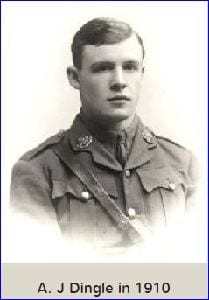
Arthur James Dingle
Every Name a Story
On the Helles Memorial, Turkey (including Gallipoli) is the name of Captain Arthur James Dingle, serving with the 6th Battalion, (Service) The East Yorkshire Regiment who died 22/08/1915.
Arthur James Dingle was born on the 16th October 1891, the eldest son of the Reverend Arthur Treham Dingle and his wife Beatrice, daughter of John Robson at Silksworth Rectory, the family moving to Egglescliffe Rectory in 1904, when his father became Rector of Egglescliffe. In 1901 the family were still at Silksworth Rectory and in 1904 they moved to Egglescliffe. As well as his only brother Hugh John born 1893 Arthur had two sisters Mary Caroline born 1897 and Beatrice Margaret born 1907.
Arthur was educated at Bow School, then Durham School 1905-10. In School Football Fifteen 1907-10, and occasionally in Cricket Eleven 1908-09. Rowed in first Four in 1910 (the winner’s of Wharton Challenge Cup at Durham), and won the Senior Gymnasium Medal the same year.
Finally at Keble College, Oxford. Entered College in Michaelmas Term, 1910. A member of the University Contingent of the ‘Officers’ Training Corps.
In 1913 he became a master at Durham School.
Arthur James Dingle was also a well known International Rugby three quarter back, he represented Durham, Oxford University and England against Ireland at Dublin in 1913, and against Scotland and France in 1914.
His nickname was “mud” which his team mates called him.
He gained his Blue at Oxford in 1911 “Held at the Queens Club on December 12th the emphatic nineteen points to nil victory over Cambridge was a result of the relative experience of the Oxford side over a young Cambridge, whose attempts to nullify Oxford rather than play their own game failed disastrously. Their defence had no answer to the strong Oxford backs and, as the Times put it… AJ Dingle settled matters by scoring between the posts”.
After leaving them, he played regularly with the Hartlepool Rovers Club, and the Durham County Team. His fine scoring powers were largely instrumental in enabling Durham to reach the final stage of the County Championship in Season 1913-14. On the pitch he scored fifty five tries during the course of the 1913-14 season and also Captained Hartlepool Rovers in 1914.
His club form made him an obvious choice for international honours, and his debut cap came on February 8th 1913 in the match against Ireland held in Dublin. At this time Dingle was still up at Oxford, and gained his first cap despite being held out of the varsity side that year. The match started as a close affair before England asserted themselves and pulled away to a fifteen points to four victory with the English pack playing well and giving their backs every chance to capitalize against a relatively ineffective Irish back line. Dingle himself did not have the best of matches in this victory, described by the Times correspondent as “Strong in defence, but was not altogether a success.” As the competition for England selection was no less strong, and probably more volatile than that at Oxford Dingle was dropped for the remainder of the international season, but had still played his part in what was to become England’s first grand slam season.
Despite this international set back, and no doubt on the back of his continuing good club form, Dingle was recalled to the England side half way through the following season to play Scotland at Inverleith on March 21st 1914. Poor weather that had prevailed for the previous week cleared on the morning of the match, although high winds made kicking difficult. To counter this England played a wide game, although this was not without its problems. As the Times recorded At the opening of the game Dingle missed a pass with the goal line undefended 10 yards away. Despite this England steadily drew away until with twenty minutes to play they were ten points in the lead. At this point they became so engrossed in attack that they almost forgot to defend and in a nail biting finish Scotland fought back just failing to overcome the English whom won by sixteen points to fifteen, claiming the triple crown as well as the Calcutta Cup.
Dingle’s efforts were appreciated, despite the missed pass, and he was picked for England s final match of the international season on April 13th against France at the Stade de Colombes. In an easy victory England’s backs outclassed their French opponents by thirteen points to thirty nine. The match was marred by rough play from some of the French team as well as the poor behaviour of the home crowd who heckled the players throughout. England started slowly before their strength began to show. This was particularly true of Dingle who again failed to show his best and replicate his club form on the international stage. Discussing the English back line the Times correspondent said of him “AJ Dingle was the weakest of the four. He failed to take the passes and was very slow getting into his stride.”
This easy victory, however unsatisfactory it may have been, also gave England a second consecutive grand slam, and the players must have drawn some comfort from this far from easy achievement.
His younger brother Hugh John Dingle also played for Durham, he too was killed in action.
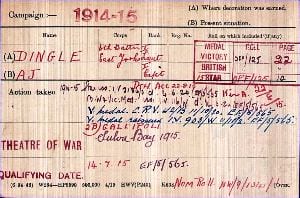
Arthur James Dingle volunteered on the outbreak of war and was gazetted a 2nd Lieutenant in the East Yorkshire Regiment on the 29th August 1914. Then promoted a Lieutenant on the 8th December 1914.
On the 9th August 1915 he was promoted to Captain and was sent to the Dardanelles on the 1st July 1915.
He was killed in action while defending a captured trench against overwhelming odds at Sulva Bay on the 22nd August 1915.
In an effort to break the deadlock forces were to be landed at Suvla bay, in a campaign starting on August 6th 1915 that was planned to force a breakout that would join up with the besieged ANZAC forces some five miles to the south. The 6th Battalion of the East Yorkshire Regiment, including Dingle, were to form part of this task force. From the start the campaign was badly mismanaged. Their commanders, Lieutenant General Sir Francis Stopford and Major General Frederick Hammersley, were imprecise in their orders, requiring only that the high ground should be taken if possible. Made at night the landings resulted in chaos for the allied forces. The sixth East Yorkshires did manage to drive the Turks off the small hillock of Lala Baba, but at great cost and generally the allied forces achieved little more than actually getting ashore. Despite light initial opposition this hiatus allowed the Turks to realign and claim the tactically vital high ground. By August 9th the expeditions overall commander, General Sir Ian Hamilton, pressed for an attack to kick start the failing campaign and the sixth East Yorkshire Regiment were ordered to attack Scimitar Hill as a prelude to a larger attack the following day on the Teke Tepe ridge. Met by strong Turkish resistance they took severe casualties before they took the hill, subsequently being forced to relinquish their gains as Brigade staff ordered a change of attack to the Sulajik Wells. After this the fighting at Suvla Bay largely descended in to the trench warfare that it had been designed to replace. One final push was planned to break the stalemate on August 21st 1915. Dingle, with his battalion, was to again attack Scimitar Hill, control of which would unite the allied forces as had been originally planned. The largest battle of the Gallipoli campaign the attack failed, essentially ending any hope of an allied victory. In the aftermath of the battle he was posted as missing presumed killed. His body was never found.
There is a Memorial Trophy in his name called the Veterrimi IV.
Sources:-
De Ruvigny Roll of Honour;
The Complete Who’s Who of England Rugby Union Internationals“, R Maule, Breedon 1992
History of North Durham Rugby Football Tom Millen (Private Collection)
The Rugby History Society
1st Portrait photo By kind permission of the Warden and Fellows of Keble College, Oxford.
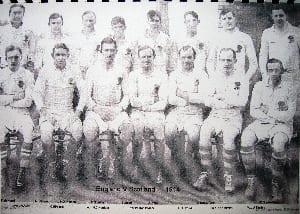
The group photograph shows both of the Dingle brothers on the 28th March 1914. Leicester v Northern Counties. A. J. Dingle, 2nd from right Middle Row and brother H. J. Dingle sitting far right bottom row.
Arthur James Dingle is remembered at Durham D47.020, D47.043, D47.057 and in D47.091 at Egglescliffe on E59.01, E59.02 and in E59.03, page 5, at Hartlepool on H115.10, at Silksworth on S111.02 and at Sunderland in S140.048 part 10 and S140.048 part 14.
First Name: Arthur James
Last Name: Dingle
Which War: First World War 1914-18
Died: 22/08/1915
Age: 23
Rank: Captain
Regiment: East Yorkshire Regiment
Served in: Army
Unit/Ship: 6th Battalion