Every Name a Story
Samuel Leslie Liddle Gover
Every Name a Story
In Meteren Military Cemetery, France is the Commonwealth War Grave of 10947 Private Samuel Leslie Liddle Gover serving with the 2nd Battalion Honourable Artillery Company who died 21/10/1917.
He was the son of J. C. Gover and M. J. Gover, of Gosforth and the husband of Isabel M. Gover, of 39, Sanderson Road, Jesmond, Newcastle upon Tyne.
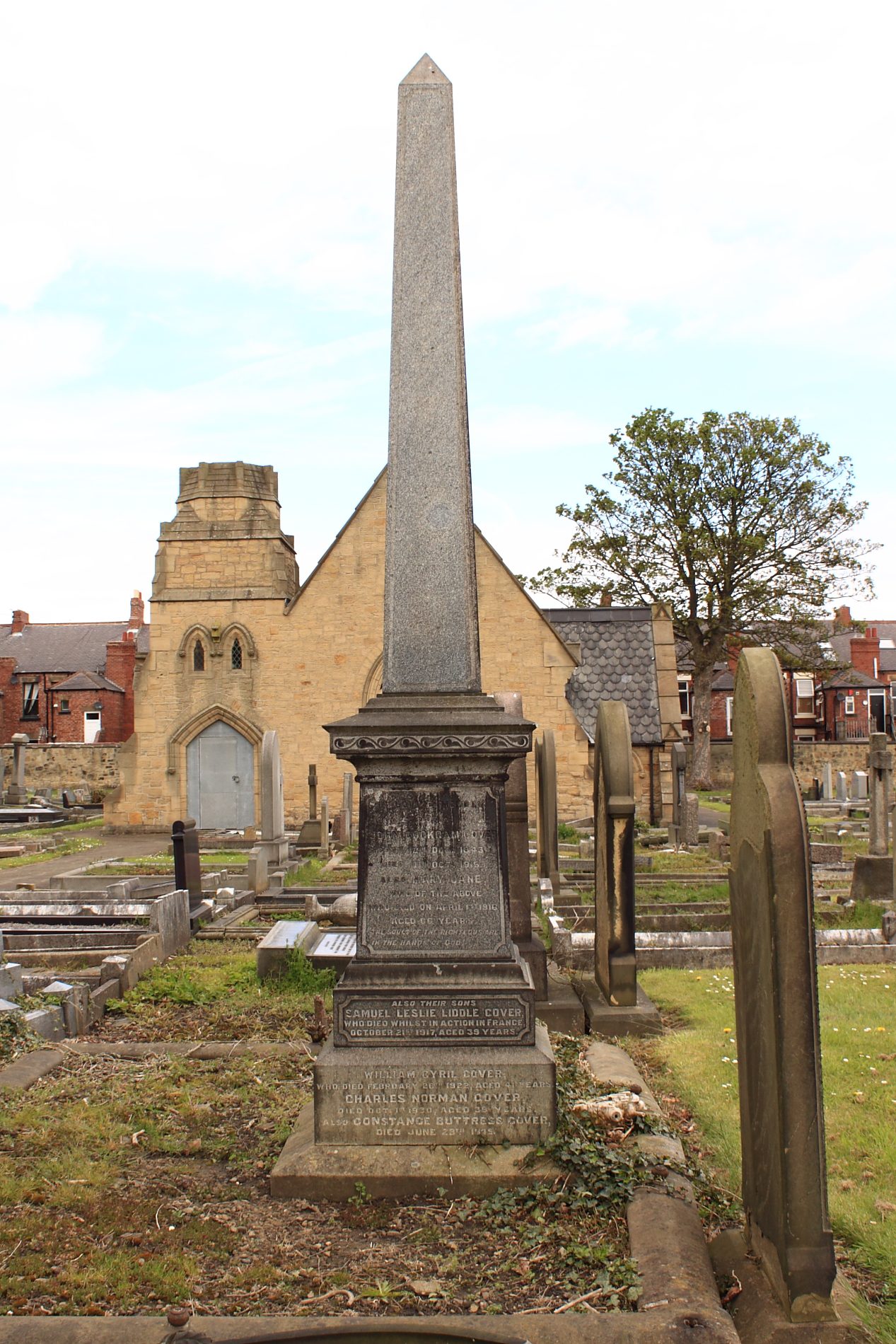
In Newcastle (St. Andrew’s & Jesmond) cemetery is a headstone, the first few lines of which are obscure, which reads:
John ?Cockram Gover
?born ? Decr. 1843
died ?10th Oct. 1915
Also Mary Jane
wife of the above
who died on April 1st 1916
aged 66 years.
The souls of the righteous are
in the hands of God.
Also their sons
Samuel Leslie Liddle Gover
who died whilst in action in France
October 21st 1917, aged 39 years.
William Cyril Gover
who died February 26th 1922 aged 41 years.
Charles Norman Gover
died Oct. 1930 aged 35 years.
Also Constance Buttress Gover
died June 29th 1875.
Pauline Priano has submitted the following:-
Samuel Leslie Liddle Gover was one of 8 children, offspring of John Cockram Gover and Mary Jane Maxwell.
John Cockram Gover was born in 1843 in the town of Crediton, near Exeter, Devon. He was the son of tin plate maker, Samuel Gover and his wife Mary Ann. At the age of 17 John was living as a lodger at 9, Alma Terrace, Chester, serving an apprenticeship as a currier, a specialist in the leather processing trade. Fully qualified, ten years later he was a boarder at 3, Southville Place, in the district of Bedminster, Bristol, Somerset. Between 1871 and when he was married to Mary Jane Maxwell in 1876, he had moved to Newcastle upon Tyne. Mary Jane was a native of Newcastle upon Tyne born in 1849, the daughter of butter and bacon factor/merchant, John Maxwell and his wife Ann, both of whom originated from Cumberland.
John Maxwell Gover was born, February 23rd 1877, Samuel Leslie Liddell Gover 1878, Alfred Ernest 1879, and William Cyril in 1881 whilst they were living at 205, Portland Road, Newcastle. John was supporting his family as a leather merchant, to assist his wife and children he employed a domestic servant and a nurse. Their eldest son John Maxwell was living with his widowed maternal grandmother, Ann Maxwell, at 3, Windsor Crescent, Jesmond.
Over the next 10 years they had a further 4 children, daughter Annie Maxwell in 1882, Florence Mary 1883, Constance Buttress 1886 and a son Charles Norman 1890. Ten years later they had left the city for the quieter suburb of Jesmond and occupied Priorsdale, Fernwood Road, but transferred to Springfield, Coxlodge, Gosforth by 1901.
Samuel (22) was employed as a merchant’s clerk, as were his younger brothers Alfred (21) and William (20), their sisters Anne (18) and Constance, as yet unmarried, were still living at home Charles (10) although of school age is not listed as a scholar. The house was run with the help of a cook, a housemaid and a nursemaid. John Maxwell, who had studied in Edinburgh and qualified as a Bachelor of Medicine was an assistant medical practitioner in Alnwick. Alfred Ernest Gover died in 1908, aged 28 years.
September 12th 1907 at All Saints Church, Gosforth, Samuel Leslie Liddell Gover was married to Isabella Marchbank Grabham. Born at Whickham, Gateshead, historically in County Durham, November 23rd 1877, she was the daughter of wholesale draper John Grabham and Catherine Dorothy Marchbank, resident at Coxlodge, Gosforth.
Samuel and Isabella’s daughter Isabella Monica was born, August 9th 1908, Brian Leslie Gover, December 26th 1910, whilst they were living in a 9 roomed home, assisted by 2 servants, at 39, Sanderson Road, Jesmond. Samuel had followed in his father’s footsteps and was a leather merchant/broker.
Britain declared a state of war existed with Germany on August 4th 1914 and all regiments were ordered to raise new battalions in answer to Kitchener’s call to arms. Men from all walks of life volunteered to serve their Country. Samuel Leslie Liddell Gover enlisted November 28th 1915 as a volunteer just prior to the passing of the Military Service Act in January 1916 bringing in conscription. The following day he was sent to the Army Reserve and was not mobilised until May 22nd 1917. Samuel was posted to the Honourable Artillery Company, May 23rd and two days later to the 1st Reserve.
The Honourable Artillery Company had been a part of the Territorial Force since 1907, but was greatly expanded during WW1 and fought as infantry. As Private 10947 Samuel L. L. Gover he remained with the 1st Reserve until June 21st 1917 when he was posted to the British Expeditionary Force where he was trained and departed to France, September 17th 1917, disembarking at Le Havre.
Private Gover joined “B” Company, 2nd Battalion Honorary Artillery Company in the field which had been in France since September 1916 attached to the 22nd Brigade, 7th Division. At the time they were fighting on the Ypres salient in Belgium participating during the 3rd Battle of Ypres also known as the Battle of Passchendaele which raged from July 31st-November 10th 1917.
The 2nd Battalion H.A.C. had been relieved and was in billets near Meteren in France, 17.5 kilometres south west of Ypres when Private Gover had reported sick October 19th 1917 and was excused duty for one day but did not report sick the next day.
Private 10947 Samuel Leslie Liddell Gover died of a self-inflicted wound to the head, October 21st 1917. By order of Lieutenant-Colonel R. W. O’Connor Commanding the 2nd Battalion H.A.C. Infantry, a Court of Inquiry was assembled at the H.Q. 2nd H.A.C. later that same day. Several depositions were given and transcribed at the assembly as follows;
1st Witness. No. 6596 Sergt. A. G. Jackson “B” Coy 2/H.A.C. states.
“About 6.20 a.m. on the morning of 21/10/17 I was lying in my billet when I heard a report & found Pte. Gover had blown out his brains with a rifle, I summoned the M. O. I examined the rifle and found one empty shell case in the breech, remainder of clip being in pocket of deceased, cut-off was closed. Rifles were inspected the night before when the rifles were unloaded. No correspondence of any kind was found on the man.”
2nd Witness. No.10392 Pte. H. J. Suffolk “B” Coy. 2/H.A.C. states.
“I was awakened about 6.15 on the morning of 21/10/17 by a report near me. On examination I found that Pte. Gover in the bed next to me had blown out his brains with a rifle. Sgt. Jackson, the platoon sergeant, immediately came over and inspected the rifle, and found one empty case in the breech, the remainder of the slip being in Pte Gover’s pocket, cut-off was closed.”
3rd Witness. Capt. A.E. Roberts, R.A.M.C. states
“I saw Pte. Gover about 7 a.m. on the morning of 21/10/17 and found him with the front part of the right side of his head blown away. He reported sick on 19/10/17 & was excused duty for the day. He complained of slight headache. He did not report sick again the next day. Pte. Gover was quite dead when I came to him this morning 21st.”
The documentation was forwarded by Captain B. W. Brunswick D.A.A.G. Second Army to the Director of Medical Services for his opinion. His response was as follows, “I agree that this is a case of suicide. There is no evidence as to his mental condition before he committed the act. I consider that Pte. Gover S. L. L. No. 10947 shot himself in the head with the intention of killing himself.”
It should be said and in no way underestimated the mental stress to which a combatant is subjected and the lack of comprehension of combat fatigue and shell shock during WW1, dismissed in many cases and often considered as cowardice, add to this the fact that Private Gover prior to his departure had twice been bereaved, his father John Cockram Gover had died, October 11th 1915 and within 6 month also his mother Mary Jane Gover nee Maxwell, April 1st 1916. The Register of Soldiers Effects state only, “killed.”
Isabella was officially informed at her home address of 39, Sanderson Road, Newcastle upon Tyne of her husband’s death by the Infantry Records Office, 4, London Wall Buildings, London, E. C. 8, November 7th 1917, the letter reads as follows, “Madam, It is my very painful duty to inform you that a report has been received from the War Office notifying the death of No,10947 Pte. S. L. L. Gover, 2nd. Battalion Honourable Artillery Company 21.10.17. The report is to the effect that he died from a gun shot wound. If any articles of private property left by the deceased are found, they will be forwarded to this office, some time will probably elapse before the receipt, and when received they cannot be disposed of until authority is received from the War Office. Some delay is therefore inevitable. Any application the disposal of any such personal effects, or any amount that may be eventually be found to be due to the late soldier’s estate should be addressed to, The Secretary, War Office, Imperial Institute, South Kensington, S. W. 7. I am, Madam, Your obedient servant, for Col. Infantry Records Office, London.”
The letter to Isabella makes no reference to the circumstance of her late husband’s death, she may well have been given details by others in his Company but hopefully she would have been spared the gruesome details.
Isabella received all monies due to her late husband from the Army, his awards of the British War Medal and Victory Medal. Under article 15 of the Royal Warrant as of May 13th 1918, she also received a pension for herself and their two children, until each in turn reached the age of 16 years, of 15 shillings awarded April 29th 1918 to be received weekly. The pension document states that Private Gover died from self inflicted wounds. In due course the War Office released her late husband’s personal items consisting of, coins 2, discs 2, letter, photo, pocket wallet. cigarette case, cigarette holder 2, split ring and 2 keys, metal watch and strap, shaving brush, cheque book.
Samuel’s personal assets in the sum of £9446 16 shillings 11 pence were assigned, March 25th 1918 to his widow Isabella and his younger brother William Cyril Gover, solicitor.
Private 10947 S.L.L. Gover Honourable Artillery Company was initially laid to rest at map reference Sh. 27. X. 15. D. 7. 5. Meteren Churchyard, close to where his regiment was billeted and used during 1917 by the Field Ambulance and the fighting units in the sector.
After the Armistice of November 11th 1918 and the signing of the Treaty of Versailles, July 28th 1919, which officially brought WW1 to a close, at the request of the French and Belgian Governments the clearing of the battlefields began. Isolated graves and small concentrations were brought into larger cemeteries.
Isabella Gover was informed that it was necessary to exhume the body of her late husband for reburial and assured this would be undertaking with all reverence and honour in the presence of an Army Chaplain. Private Gover was taken from the churchyard together with one British burial from 1914 and 10 others from 1917 and is now at rest within Meteren Military Cemetery, Nord, France grave V. O. 1 in a communal plot with Private Albert Henry Williamson, grave V. O 1 also of the 2nd Honourable Artillery Company, who died October 14th 1917, however, they have separate headstones. Works completed July 24th 1923. At the time of his demise in 1917 Private Gover was 39 years of age.
Major William Cyril Gover also served during WW1. Whilst serving at the headquarters of the 6th Division, Victoria Barracks, Cork he died at the Central Military Hospital, Cork, Ireland, February 26th 1922. He is not considered a casualty of war by the C.W.G.C. as his demise occurred after the cut-off date of August 31st 1921. John Maxwell Gover and Charles Norman Gover both served with the R.A.M.C. and survived the conflict.
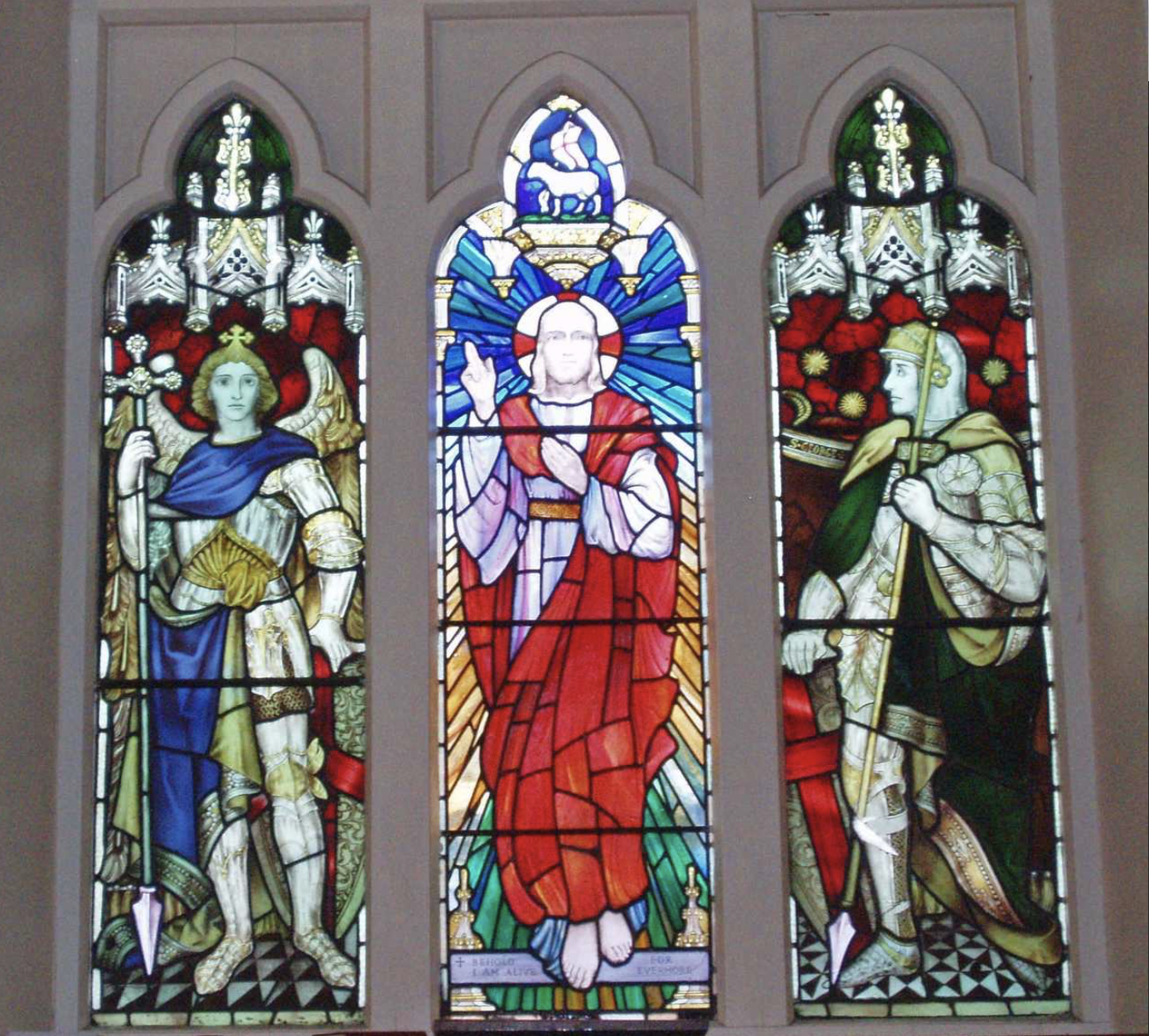
March 14th 1920 a stained glass window commissioned by public subscription was unveiled by Lieutenant-Colonel John Maxwell Gover D.S.O. in remembrance of his brother Private Samuel Leslie Liddle Gover at Gosforth United Methodist Church and dedicated by Reverend H.L. Shingles.
Isabella did not remarry, in 1939 she and her daughter were living at the same address in Jesmond and employed a domestic servant.
Samuel and Isabella’s daughter Isabella Monica Gover died at the General Hospital, Newcastle upon Tyne, September 15th 1944 leaving her personal effects in the sum of £4797 5 shillings 10 pence to her mother.
Isabella Marchbank Gover nee Grabham of Leamington Hospital died January 20th 1967, her effects passed to her only son Brian Leslie Gover, contract engineer, May 3rd 1967, in the sum of £6768.
Brian Leslie Gover was married in 1939 to Margaret Constance Ruddick who was born at South Shields, County Durham, November 14th 1911. In the census of that year they were living at 61, Larkspur Terrace, Jesmond, on the outskirts of Newcastle. Brian Leslie’s occupation is described as foreman engineer armature winding shop.
Brian Leslie Gover resident at 3, Dalkeith Avenue, Bilton, Rugby, died May 19th 1977 and left effects in the sum of £53318 to his widow.
Margaret Constance Gover nee Ruddick of the Manor House, Bawnmore Road, Bilton, Rugby, Warwickshire, died June 20th 1995. Probate, Oxford, August 8th 1995 in the sum of £264980 to person or persons unknown. BMD record for England has no record of any children born from their union.
In God’s safe keeping. Rest In Peace.
Samuel Leslie Liddle Gover is remembered at Gosforth on G9.26 and G9.37 and at Jesmond on J1.06.
First Name: Samuel Leslie Liddle
Last Name: Gover
Service Number: 10947
Which War: First World War 1914-18
Died: 21/10/1917
Age: 39
Rank: Private
Regiment: Honourable Artillery Company
Served in: Army
Unit/Ship: 2nd Battalion
Links to Source Material