Every Name a Story
Raymond Forster Pratt
Every Name a Story
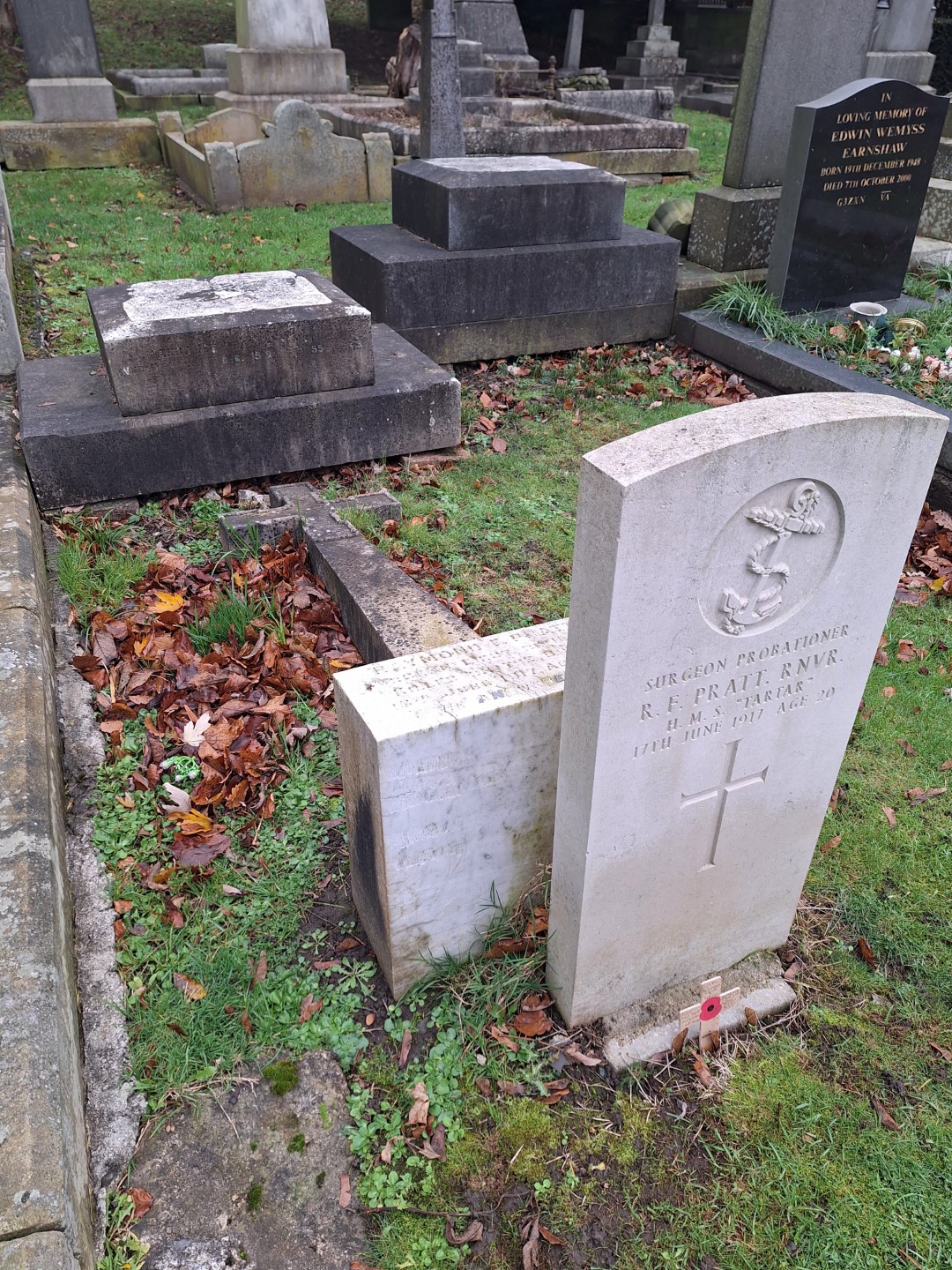
In Longbenton (Benton) Cemetery is the Commonwealth War Grave of:
Surgeon Probationer
R.F. Pratt, R.N.V.R.
H.M.S. “Tartar”
17th June 1917 Age 20.
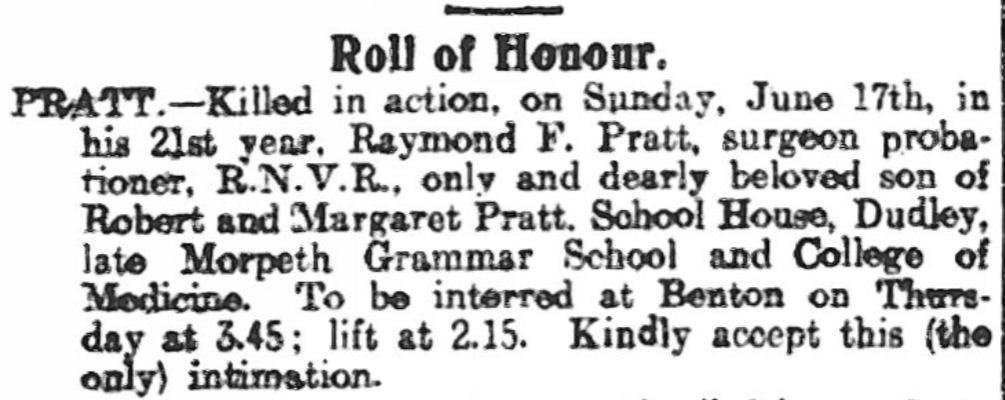
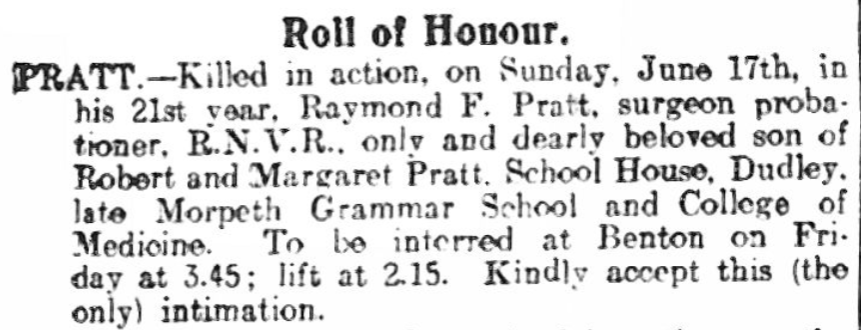
The son of Robert Pratt, of Dudley, Northumberland, and the late Margaret Pratt.
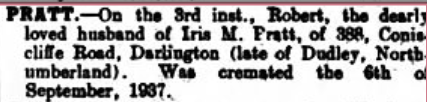
Raymond Forster Pratt was born on the 8th December 1896 at Oakfield Terrace, Forest Hall, Long Benton, Newcastle upon Tyne, the only son of Robert Pratt, born 1865, Ryton, died 3rd September 1937, and his wife Margaret, nee Stephenson, Pratt, born 1864, died 11th December 1919, she was the daughter of a John and Jane Stephenson, from Easington. They were married in July 1894 at Newcastle upon Tyne. She was a Music Teacher before marrying.
Raymond’s paternal grandparents were Robert James Pratt (1837-1910) and Mary (nee Eltringham (1839-1914). They married on the 13th February 1864 in Newcastle upon Tyne and had a large family of eight children, their eldest was his father Robert Pratt (1865 to 1937), later to become the headmaster of Dudley School. His aunts and uncles were William born 1859, George born 1868, Mary D, born 1871, Isabella born 1873, Frederick John born 1874, Thomas Edmund born 1876, Margaret Anne born 1878 and Jane born 1879 (also an Elementary School Mistress on the 1911 Census). Robert James Pratt was a widower in 1861 and was living with his sister Sarah and a daughter Sarah age 2. His son William born 1859 may have been his late wife’s son. He was a Steam Engine Maker Fitter by trade.
His maternal grandparents were John Stephenson (1809 – 1866) and Jane Forster born 1830, the sons were mainly butchers or grocers by profession, and his grandfather had settled in Easington running a farm and butchers shop. They had quite a sizeable family of seven children with three sons and four daughters, one of the youngest being his mother, Margaret (1864-1919), her brothers and sisters, William (1854-1892), Mary born 1857, Robert born 1859, George born 1860, Elizabeth born 1862 and the youngest, Jane (1866-1937).
Raymond’s grandfather, John Stephenson, also had other children from a previous marriage, his wife Mary (nee Robson) (1811-1852), they had two sons and two daughters, Thomas (1833-1906), Hannah born 1835; John (1841-1898) and Ann born 1850.
Robert in 1891 was an Elementary School Master residing at 76 Tynemouth Road, then in the Byker area of Newcastle upon Tyne. In 1881 he was residing at 35 Harle Street, Gateshead as a Pupil Teacher.
Margaret Stephenson was born in 1864 in Easington and was one of seven children to John Stephenson and his second wife, Jane Forster. Her father died in 1866 leaving her mother to bring up seven children and a further four step children from her husbands first marriage.
In 1871 she was 7 years old and living with her widowed mother, four sisters and three brothers, her mother was working as a butcher. Their address was recorded simply as village in Easington and also in the house was a 24 year old man who was a butcher’s assistant and a 17 year old girl who was their servant.
By 1881 she appears to have moved out and is now living in Stells Row in Haswell. She was 17 years old, single and living in a house which she shared with her 19 year old sister, Elizabeth and a 40 year old servant, neither of the women have any occupation.
1891 census shows she was living at an unspecified cottage number at West End, Easington. She was sharing the cottage with Margaret Lynn, a border two years older than her. Margaret was working as a teacher of music while her border was an assistant school mistress.
She married Robert Pratt in the parish church at Jesmond know as the Clayton Memorial church in 1894. She was his second wife, his first wife had died a few years earlier.
By 1901 they were living in Oakfield Terrace in Killingworth. Her husband, Robert, was a schoolmaster and they had a four year old son, Raymond.
In 1911 they had moved and were now living in the school house, Dudley. Robert was still a schoolmaster while Raymond was at school.
In 1906 on the 17th December, an R.F. Pratt was playing in a Violin Trio, at the Co-Operative Hall, at Dudley for the annual Dudley County School annual Concert. Which was introduced by his father Mr. R. Pratt.
From 1909, Raymond attended the King Edward School until 1914. [Morpeth Grammar School].
King Edward VI School, Morpeth is a voluntary controlled academy high school in Morpeth, Northumberland, England. It was established by a royal charter as Morpeth Grammar School and later as King Edward VI Grammar School. The school became a comprehensive school in the 1970s and an academy in December 2011.
In 1910, Robert Pratt [his father], was headmaster at Dudley Council School, which was built in 1878 for 700 children.
Dudley was described as a colliery village with a station on the North Eastern railway called Annitsford from the adjacent village of that name and is about 7 miles north from Newcastle.
In 1911, the family resided at the School House, Dudley, Northumberland.
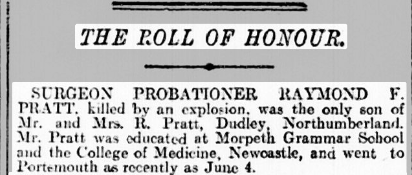
Raymond Forster Pratt was educated at Morpeth Grammar School then afterwards at the Durham University College of Medicine, Newcastle upon Tyne. He had a brilliant school career as a scholar and an athlete. He also played in the school orchestra as a violinist. Raymond secured a blue for cricket and football, and was an outstanding shot, in which he captained the shooting team.
In August 1913 the Morpeth Herald announced that he had passed the Oxford Local Examinations, an early form of GCSE/A level, with 3rd class honours at Morpeth Grammar School.
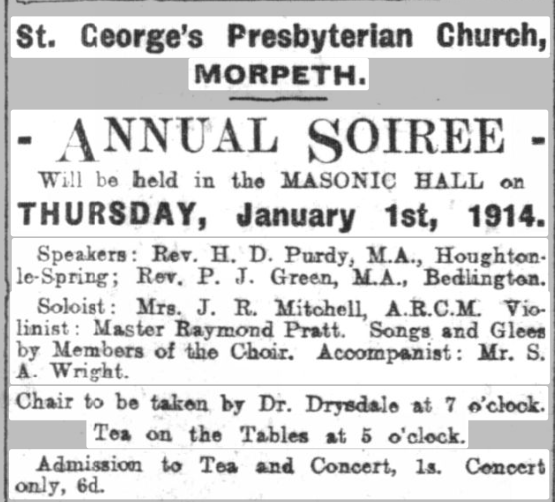
On the 1st January 1914, Raymond Forster Pratt was the guest playing violin at St Georges Presbyterian Church in Morpeth at their Annual Soiree.
In August 1914 Raymond was mentioned for passing the Oxford Local Examinations with a Pass in the Senior Division at Morpeth Grammar School. He also joined the Officer Cadet Training unit at the Grammar school and competed in the rifle shooting, scoring 5 bullseyes out of 5.
At University he became football secretary and one of his years’ representative on the University Students’ Council. Also was captain of the rifle team.
Raymond studied at the College of Medicine from the 1st October 1914 until 1915, leaving his studies to join the war effort. He registered as a Medical Student on the 9th October and started his Medical Studies on the 1st October 1914. He had passed the Oxford Senior Exam in July 1914, commencing the course in July 1913. Raymond joined the Royal Navy on the 29th November 1915, for the duration of the Hostilities, he was 5 feet four and a half inches tall, light Brown Hair, Grey eyes with a fresh complexion, official number M17875.
He trained at Pembroke I, [HMS Pembroke was the name given to a shore barracks at Chatham. It was commissioned in 1878, moved ashore in 1903 and was paid off in 1983. The buildings, designed by Sir Henry Pilkington, now house the Universities at Medway].
From the 30th November 1915 he was in the Junior Auxiliary Sick Berth Reserve at Chatham Hospital until the 31st January 1916, at the end of 1915 his character was described as [V]ery [G]ood.
From the 1st February 1916, he is back at Pembroke 1, then transferred on the 5th February 1916 to the Garth Castle, ship number 129078, Garth Castle was built in 1910 by Barclay, Curle & Co. at Glasgow with a tonnage of 7612grt, a length of 452ft 7in, a beam of 54ft 4in and a service speed of 13 knots. Sister of the ‘Grantully Castle’ ship nu 129058, she spent most of her career on the Intermediate service. In 1915 she was requisitioned by the Royal Navy for use as a supply ship and moving naval personnel to places like Scapa Flow where they would join their ships. She was later used as a hospital ship and on 24th June 1917, during a fleet inspection, the surgeons and nursing staff were presented to HM King George V. She was broken up in 1939.
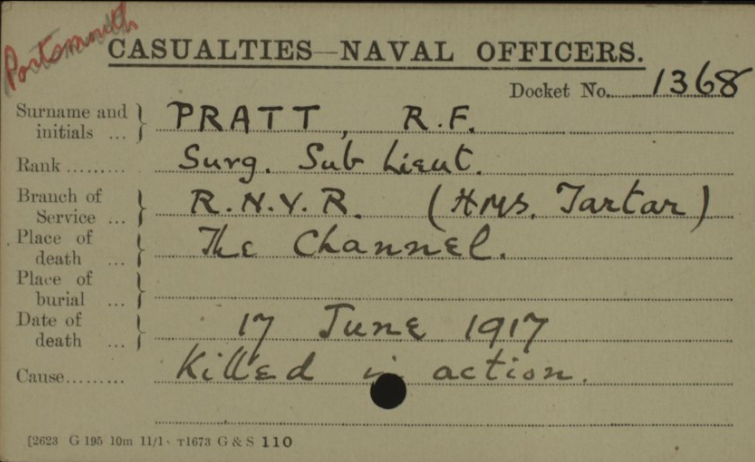
Raymond was now a Senior Reserve Attendant from the 11th January 1917, and was now a member of the crew the HMS Tartar. He is commissioned with seniority a Lieutenant (temporary) Surgeon Probationer from the 11th May 1917.
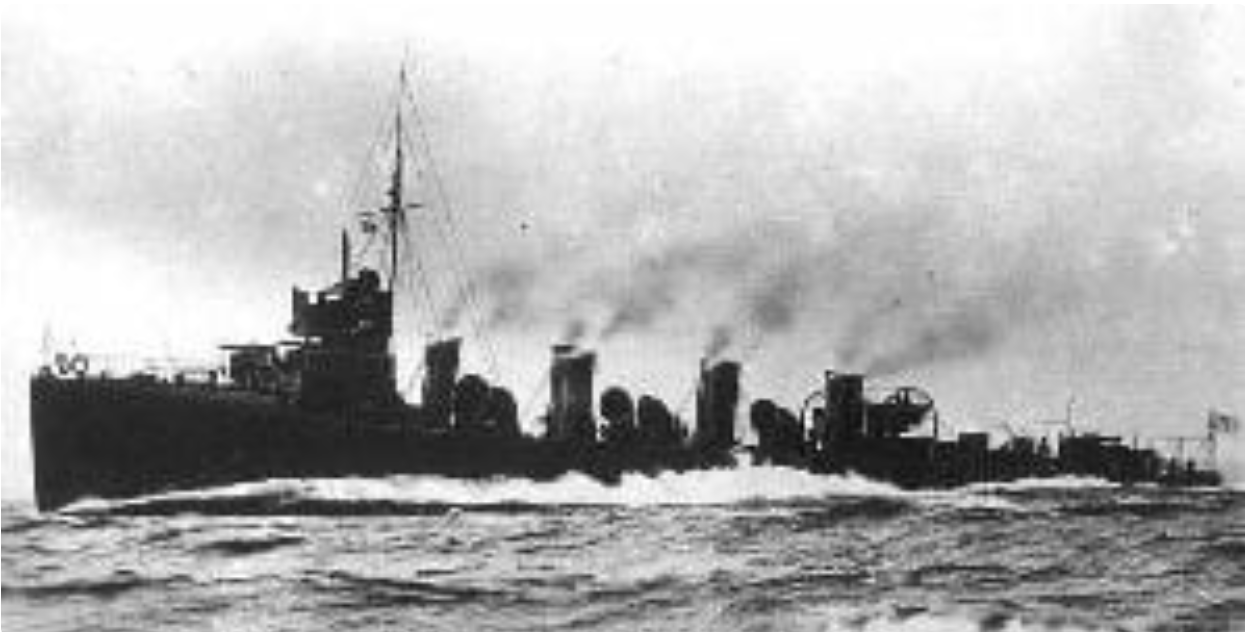
He was on board HMS Tartar, which was a Tribal class destroyer of the Royal Navy launched in 1907 and sold in 1921. During the First World War she served in the North Sea and the English Channel with the 6th Destroyer Flotilla.
On the night of 26/27th October 1916, German torpedo boats of their Flanders Flotilla carried out a large scale raid into the English Channel, hoping to attack the drifters watching the anti-submarine nets of the Dover Barrage, and to sink Allied shipping in the Channel. Six Tribal-class destroyers (Tartar, Mohawk, Viking, Nubian, Amazon and Cossack) were being held at readiness at Dover as a fast response force, at readiness in Dover harbour, and when the German 5th Half Flotilla attacked the drifters and sank the old supporting destroyer HMS Flirt, they were ordered to intervene. The destroyers split up as they left Dover harbour, with Viking leading Mohawk and Tartar from the Western entrance to the port, while the other three destroyers left by the Eastern entrance and failed to join up with Viking’s group. Nubian and Amazon separately ran into the German 17th Half Flotilla, on its way home after sinking the merchant ship Queen, ship number 123993, with Nubian, ship number 131431, first being badly damaged by a torpedo and Amazon, ship number 120715, then heavily hit by German shells. Viking’s group then encountered a third German formation, the 18th Half Flotilla. Mohawk, second in line of the three British destroyers, was hit by German shells which caused her steering to jam, and turn out of line. Tartar followed Mowhawk’s turn, while Viking’s attempts to pursue the German torpedo boats were thwarted when her course was blocked by Mohawk. All the German torpedo boats that took part in the nights operations escaped successfully.
H.M.S. Tartar struck a German mine on the 24th June 1917, killing 43 of her crew, including her newly appointed Captain, G. K. Twiss, but was towed to safety. By November 1917, Tartar had joined the 11th Destroyer Flotilla, based at Blyth, Northumberland. Raymond was killed by the explosion, his body was landed at Dover when the Tartar returned to Dover. Raymond had been home on leave for about three weeks, until the 4th June.
On the 18th February 1918, Tartar collided with the merchant ship Ardgantock off West Hartlepool, sinking the merchant ship. Tartar still served with the 11th Submarine Flotilla on 11th November 1918, when the Armistice ended fighting between the Allies and Germany.
Raymond’s father, Robert, went to Dover to bring him home for burial.
The Morpeth Herald states that the whole village of Dudley was in mourning when news of his death reached them. He had been of kind and gentle disposition and held in the highest esteem which was demonstrated by the very large gathering at his funeral and window blinds being drawn everywhere as a sign of respect.
It goes on to say: On the 22nd Friday June 1917 his coffin was draped in a Union Jack and carried shoulder high by soldiers of the South Stafford Regiment from his parents’ home at the school house to St. Paul’s Mission Church where the service was held and that the route was lined by pupils from the Dudley Council school.
After the service his coffin was carried to Benton church yard where 100 soldiers from the South Staffords lined each side of the road. Three volleys were fired over his grave and the last post was sounded by buglers.
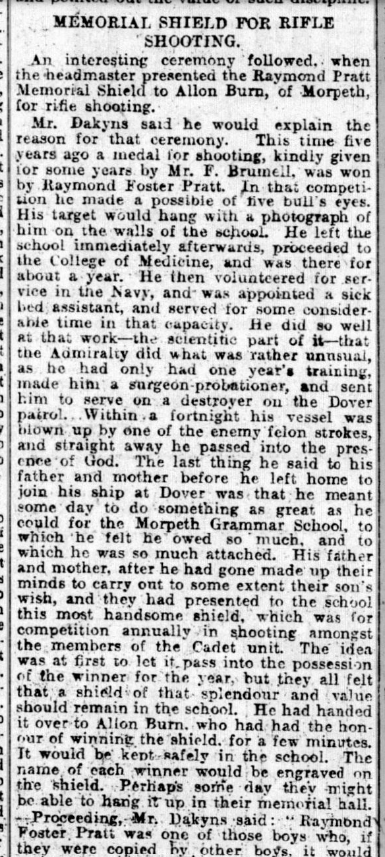
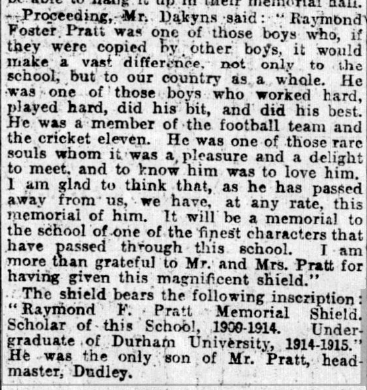
There was a Raymond F. Pratt Memorial Shield given by Morpeth Grammar School to the winners of the shooting competition held annually by the cadets in memory of Raymond. Raymond in the last year at Morpeth Grammar School achieved 5 bull’s eyes out of 5, his target plus his photograph would hang on the schools walls.
The last winner in 1919 was Allon Burn of Morpeth. The Shield was paid for and handed over by Raymond’s father and mother as a response to Raymond’s wish, and last words to his parents, ‘he wanted do something as great as he could for the Morpeth Grammar School to which he felt he owed so much’. It was decided the Shield is to be kept by the school and the winners names engraved on it each year.
The shield, see M17.30 has been recently rediscovered at the school 2025.
In Northumberland Record Office: (Dudley School Project) a photocopy of photograph showing the Headmaster of Dudley School standing next to his son Raymond, also the headmaster’s entry in the log for June 18th 1917 which reads ‘Master received word that his son has been killed in The Channel and will therefore be absent the remainder of the week in order to visit Dover and bring home the body for burial‘.
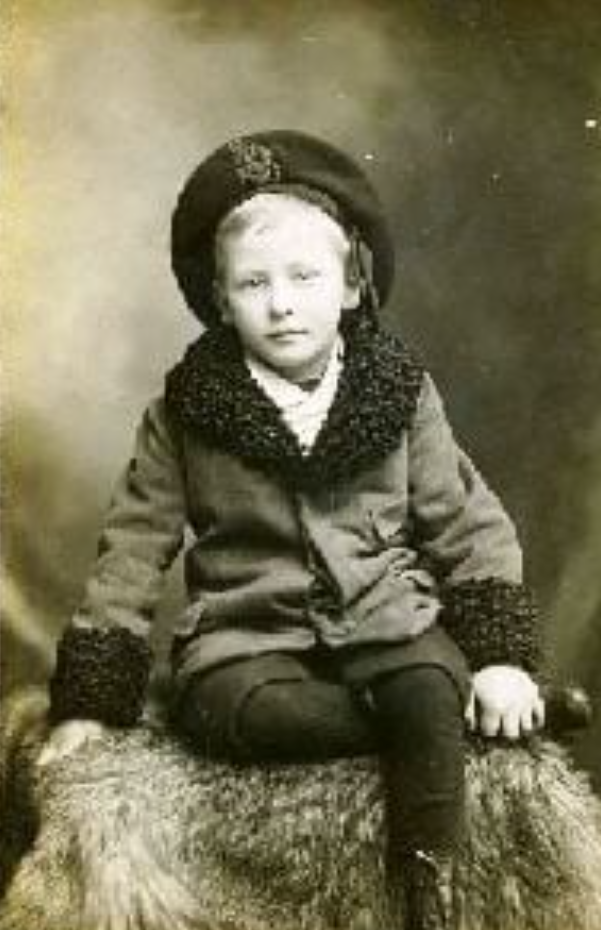
An old photograph shows Raymond Pratt as a child. On the back are the words ‘Raymond Pratt. Mother used to work for Mrs. Pratt, wife of headmaster of Dudley School. (Raymond was killed in the war)’.
Margaret was suffering from a heart condition following rheumatic fever, but her son’s death had an extremely severe effect on her mental health as well.
She began to suffer from what we would now call depression and became delusional. She began to imagine German agents were all around and trying to poison her and by late 1919 said that she being hypnotised. She began to see a doctor, presumably for her heart condition but in that time little mental help would have been available. On the 1st of November 1919 she attempted to take her own life.
At the recommendation of her doctor she was admitted to Morpeth Lunatic Asylum where she stayed for just over a month before finally succumbing to her injuries on the 11th of December 1919.
The depression caused by the loss of her son ultimately led to her death.
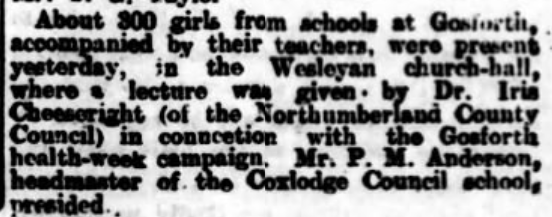
Her widowed husband, Robert re-married a Dr Iris Marjorie nee Cheeseright, Pratt born Skipsea, 26th December 1892, in 1924. Iris had matriculated as a student from London University in September 1910, then Durham University in September 1914, commenced her studies on the 1st October at Durham University as a Medical Student, but had registered on the 9th October. She was a Medical Practioner. By 1921, she was employed by the Northumberland County Education Committee as a Medical Practioner at Moot Hall , Newcastle upon Tyne and was residing at 69 Bewick Road, Gateshead. On the 14th October 1921, Iris gave a lecture at the Wesleyan Church Hall in Gosforth to about 300 girls from Gosforth schools for their Health week. In 1925, she is on the Medical Register, address Dudley, Northumberland, she qualified on the 30th April 1919 from Durham University with a M.B., and a M.S. In 1939, now a widow, she was residing at ‘Beaumarie’ Gateshead as an Assistant Medical Officer. In 1963, she was residing at Brighton at 152 Valley Drive, with a Mabel V Butcher. She died 5th January 1982 at Aliblasters Nursing Home, Rudgwick, Horsham.
Sources: Cynthia Kent/James Pasby; British Newspaper Archive; Western Front Association; ‘Geordie’; Longbenton Parish Council; Naval History Net; The National Archives; Family relative; Michael Dale; GRO:
Raymond Pratt is remembered at Dudley on D34.01 and D34.03, at Durham in D47.151, page 78, at Morpeth on M17.06, M17.12 and M17.30, at Newcastle on NUT051 and NUT066, and in our List of Ships’ Crews.
First Name: Raymond Forster
Last Name: Pratt
Service Number: M17875
Which War: First World War 1914-18
Died: 17/06/1917
Age: 20
Rank: Lieutenant Surgeon Probationer
Regiment: Royal Naval Volunteer Reserve
Served in: Navy
Unit/Ship: H.M.S. Tartar (Portsmouth)
Links to Source Material