Every Name a Story
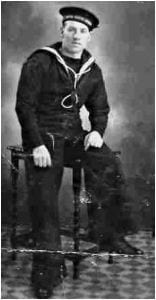
John Robert Clay
Every Name a Story
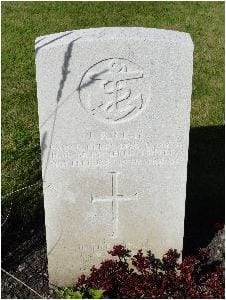
In Tynemouth (Preston) Cemetery is the Commonwealth War Grave of:
J R Clay
Seaman PNPPS. LT/X 19262A
HM Minesweeper Firefly
3rd February 1940 Age 32
He lives with us
in memory still
not just today
but always will.
The son of John Robert and Isabella Clay, of North Shields and the husband of Margaret Ann Clay, of North Shields.
John Robert Clay junior was born at 4 Dockwray Street, Tynemouth on the 5th September 1907, the son of John Robert Clay senior, [born at 3 Thames Street, South Shields on the 24th May 1880, baptised 20th June 1880 at St. Hilda’s, South Shields, Durham, died 28th May 1957], a Fish Labourer, [son of Thomas and Ellen Clay], and his wife Isabella nee Henderson Clay, [born 5th July 1883, died 4th July 1943], of North Shields. They were married on the 16th July 1904, at St. Peter’s Church, Tynemouth, Northumberland.
In 1891 they were residing at 17 Beacon Street, then by 1901 at 9 Birds Yard, North Shields.
John Robert Clay junior, married Margaret Ann Davison, (born 15th December 1907), in 1927, and they had five children, John Robert, born 6th July 1929, died 1979, Irene, born 23rd October 1930, [married a Phillips], Dennis, born 16th June 1932, died 1988, Edward, born 27th May 1936 and Ann. They were all residing at 18 Linskill Street, Tynemouth in September 1939.
He was educated at the Eastern Board School, North Shields.
In September 1939, John Robert and Isabella were residing with their daughter Isabella, born 13th May 1905, and their son Thomas, at 180 Linskill Street, Tynemouth.
John Robert Clay junior was a fisherman.
John Robert Clay senior, was in WW1, and he enrolled on the 18th October 1917 at North Shields, he was 5 feet 5 inches, blue eyes, fresh complexion, and was residing at 180 Linskill Street, with the number DA 18587, he was a second hand. He was demobilised on the 11th April 1919, then based at HMS ‘Victorious II’. Before the war, he was awarded a competency certificate for being a 2nd Hand on the 6th October 1910.
John Robert Clay junior, enrolled in the Navy on the 23rd January 1937, he was 5 feet 6 and a half inches tall, blue eyes, brown hair with a fair complexion. Butterfly tattoo on his right hand. He enrolled for the Patrol Service, X19262. John was posted to ‘Victory 1‘ at Portsmouth, on the 27th January 1937, for 42 days training. From the 24th February 1937 until the 9th March 1937 he was based on the Guracoa, before returning to North Shields. His efficiency was [Sat]isfactory and his Conduct [V]ery [G]ood.
Whilst training John injured his eye and asked for compensation for this injury.
On the 29th August 1939 he was posted to Lowestoft, and arrived on the 29th September. He was drafted to the Patrol Service based at Lowestoft. He was a non-swimmer.
The Royal Naval Patrol Service has its origins in the Great War when the threat of mine warfare was first realized by the British Admiralty. The pre-war Commander-in-Chief of the Home Fleet, Admiral Lord Charles Beresford, is credited with recommending the use of Grimsby trawlers for mine sweeping operations following visits he made to various East Coast Ports in 1907. Grimsby, with its impressive docklands and trawler fleet was seen as ideal, with the Commander-in-Chief arguing that the fishing fleet would be inactive in times of war as fishing grounds became war zones. It was also thought that trawlermen would be more skilled than naval ratings with regards to the handling of the sizeable warps and winches that would be required for mine sweeping as they were already accustomed to using them with the working of the trawl. The Admiralty Minesweeping Division remained active throughout the remainder of World War I until the end of the war when the trawlers were returned to their owners to resume fishing operations and the division was disbanded.
The need for a skilled minesweeping force was recognised to be a part of modern naval warfare and the Royal Navy later commissioned one flotilla of fleet minesweepers for the instruction of ratings and junior officers. Three trawlers were then added to the group along with the re-introduction of training in the Trawler Section of the Royal Naval Reserve and, under the new name of the Royal Naval Patrol Service courses in training began at Portland. As tensions mounted in the years before the Second World War training intensified for officers and ratings and experiments and developments in sweeping methods and equipment were carried out, including improvements made to the Oropesa Sweep, named after the trawler that first tried the method in 1918.
In the summer of 1939 the Admiralty purchased 67 trawlers with a further 20 newly constructed and at the outbreak of World War II every available minesweeper of the Royal Navy and Royal Naval Patrol Service was at her war station. HMS Europa, usually known as Sparrow’s Nest, became the Central Depot of the Royal Naval Patrol Service, located at Lowestoft, the most easterly point of Great Britain, and then the closest British military establishment to the enemy until decommissioned in 1946. The Lowestoft War Memorial Museum in the town is housed in the old Royal Naval Patrol Service headquarters building.
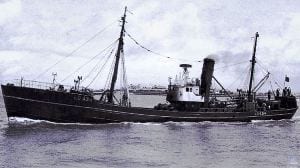
John Robert Clay was a crew member of H.M. Minesweeper Firefly. Royal Naval Reserve (Patrol Service).
HM M/S Trawler Firefly: 3rd February 1940; damaged by a mine detonating whilst being recovered north of West Gunnet Buoy.
HMT Firefly was firstly based at Great Yarmouth, later in 1940, she worked out of Wildfire III, Queenborough for two years before being transferred to Harwich.
The early part of her service in the Royal Navy was certainly eventful. Shortly after being requisitioned on the 2nd December 1939 the Firefly took part in the rescue of survivors from the Swedish Ship S.S. Rudolf, which was torpedoed by U-46, commanded by Korvettenkapitän Herbert Sohler, and sunk 30 miles North-East of St. Abbs Head, on the 21st December 1939. The S.S. Rudolf lost nine of her crew with the Firefly and Cardew rescued fourteen survivors.
Only a few months later and just five months after being requisitioned on the 3rd February 1940 the Firefly would be devastated by a mine.
The Firefly was sent from Leith (near Edinburgh) to neutralize a mine which had broken away from a British Minefield and was floating in the Firth of Forth. As they attempted to deactivate the mine it exploded killing 13 of her crew and wounding most of the rest. The entire upper structure of the Firefly was destroyed, but she did not sink and would later be rebuilt to serve at Wildfire III, Queenborough.
Shield Daily News Thursday 08/02/1940.
2 Shields Men Drowned
One Father of Children
Two North Shields men – the father of five children are reported to have been at sea. It is believed that the bodies were washed ashore.
They are Henry Edward Beavers, (21), of 127 Grey Street; and John Robert Clay, (32) of 18 Linskill Street.
Both men had been serving in trawlers since they were 16, and joined minesweepers at the outbreak of the war.
Beavers was the eldest son of H. K. Beavers and the late Mrs Beavers. He had been married just over a year and had no children. He was educated at the Royal Jubilee School, North Shields.
Clay a native of the borough was married and leaves five children, a trawlerman for more than 16 years fishing from the Tyne, he was a member of the Royal Naval Reserve when the war started and took work in a minesweeper.
He is the eldest son of Mr and Mrs J.R. Clay, also of Linskill Street and was educated at Eastern Board School, North Shields.
Both men are to be buried at Preston Cemetery tomorrow at 1.15pm.
Shield Daily News Friday 09/02/1940.
No Naval Honours at Burials of Shields Seaman who died on Active Service.
Two North Shields naval seaman who lost their lives while on active service, were buried in adjoining service graves at Preston Cemetery, today.
They were John Robert Clay, aged 32 of 18 Linskill Street, and Henry Edward Beavers, aged 21, of 127 Grey Street.
Both were married men. The corteges met in Tynemouth Road, and proceeded together to the cemetery, that of Clay being in the lead. A large number of people saw the double funeral procession. The Rev. T. Douglas, Vicar of St Augustin’s Church officiated at the joint services in the cemetery church and at the gravesides.
Neither coffin was draped with a Union Jack and no naval honours were recorded, although several sailors attended in a private capacity.
There was a large number of mourners round the gravesides.
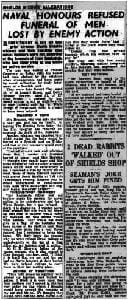
Shield Daily News Monday 12/02/1940.
Shields Widows Allegations
Naval Honours Refused Funeral of Men Lost By Enemy Action
Resentment is felt by two grief stricken North Shields widows and their families that naval honours were not accorded at the funerals of their husbands, who lost their lives at sea while on active service.
The men were buried at Preston Cemetery on Friday after the bodies had been claimed by the relatives when arrangements had been made by naval authorities for their internment as a Scottish port.
They were John Robert Clay, aged 32, of 15 Linksill Street, and Henry Edward Beavers, 21, [Beavers, Henry E, Seaman, RNR (PS), LT/X 21451 AR], of 127 Grey Street. A request for naval ratings to act as underbearers at each funeral and for a white ensign to drape each coffin is alleged to been refused.
Married a Year
Mrs Beavers, who was only married a year ago and has no family, informed The Evening News today that the first telegram she received announced the death of her husband.
Another telegram was received later which stated that the body would be buried at a Scottish port on Friday and that private mourners would be at the mortuary.
I wired straight back and informed them that I wanted my husband buried at home. said Mrs Beavers.
‘I thought they should have sent him home instead of making other arrangements which were not satisfactory to me. I received a wire by return which read ‘Body of Henry Edward Beavers will arrive North Shields at 7.48 this (Thursday) evening. Request you instruct undertakers in consultation with local naval authorities and suggest burial tomorrow’. (Friday).
Disgusting Comment
‘My husband’s father and my brother made the request for naval ratings to be underbearers and for a White Ensign, but it was refused. I wanted naval men present and had built my hopes up that men in uniform would carry my husband and that others would walk behind. They would not even give us a flag. If my husband had been buried at the Scottish port, they would have given him a real Naval Funeral, but I preferred to bring him home. We don’t know the reasons why we were refused Naval ratings as underbearers or the use of a flag. After all, my husband died in action.’
Joined Up Together
‘They both joined up together, were picked up together, and buried together. I think it is very hard that four brothers and I served in the last war under the flag which I thought would have covered the remains of my son and his pal. We thought they would have had the same Naval Honours that they would have had if buried at the place where they were picked up.
Instead they had private funerals which the widows have to pay for.
Mrs Clay, left with five young children, receiving similar telegrams to Mrs Beavers, and expressed the opinion that they were callous.
Got Nothing
Mr Beavers Senr. went to the naval authorities on behalf of Mrs Beavers, and I for pall bearers and naval honours, but we got nothing. She said.
If my husband had been buried in Scotland he would have had full naval honours, but because I claimed his body, we were refused. It was as little as they could have done to accord naval honours when they had the best out of him. It makes you think that when they get the best out of men, they are finished with them. I lost my father in the last war and now I have lost my husband. All we asked for was four sailors to carry the coffin yet they refused.
Shield Daily News Monday 19/02/1940.
North Shields Tribute to Navymen
Mission Memorial Service
A memorial service for Mr Henry E. Beavers of 127 Grey Street, North Shields and Mr John Clay, 18 Linskill street, North Shields, of H.M. Patrol service, two victims of enemy action in the North Sea, whose funeral took place at Preston Cemetery on Feb. 9 was held yesterday afternoon at the Royal National Missions to Deep Sea Fisherman’s Mission, Union Quay.
The small congregation included Mrs Beavers, widow Mrs Beaver’s mother, Mrs Southern, mother-in-law, Mr and Mrs Southern, brother-in-law and sister, and other relatives of Mr H. E. Beavers; Mrs Clay, widow, Mrs Clay, mother, and other relatives of Mr John Clay.
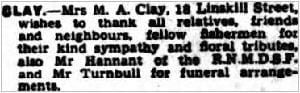
Mr M. M. Storer represented the Tyne Tugboatmen’s and Fishermen’s Society.
The service, which was of a simple character, was conducted by Mr H. Hannant, superintendent of the mission.
The hymns included “Eternal Father strong to save.” Mrs Southern rendered a solo and Mrs Burton played the organ accompaniment.
Acknowledgements: Maureen Clay; Sources: The British Newspaper Archive; National Archives.
John Robert Clay is remembered at North Shields on N34.23 and in our List of Ships’ Crews.
.
First Name: John Robert
Last Name: Clay
Service Number: LT/X 19262A
Which War: Second World War 1939-45
Died: 03/02/1940
Age: 32
Rank: Seaman
Regiment: Royal Naval Reserve (Patrol Service)
Served in: Navy
Unit/Ship: H.M. Minesweeper Firefly
Links to Source Material