On the Pozieres Memorial, France is the name of Second Lieutenant Arthur Roland Burn, serving with the 14th Battalion attached 6th Battalion Durham Light Infantry who died 26/03/1918.
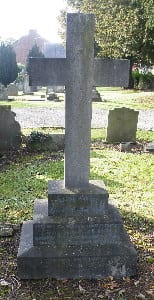
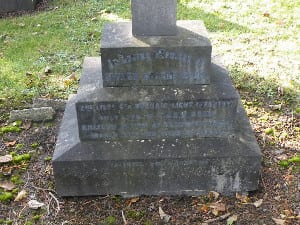
In Barnard Castle (St. Mary) Church Cemetery is a family headstone which reads:-
In loving memory of
Arthur Roland Burn
2nd Lieut. 6th Durham Light Infantry
only son of T. & S.A. Burn
killed in action at Rozieres France
March 27th 1918 aged 31 years
Faithful unto death
Peter Wise and Brenda McMahon have submitted the following:-
Arthur, the son of Thomas and Sarah Alice (nee Barker) in 1897 was born at Barnard Castle. The couple married in 1891 but only had the one child.
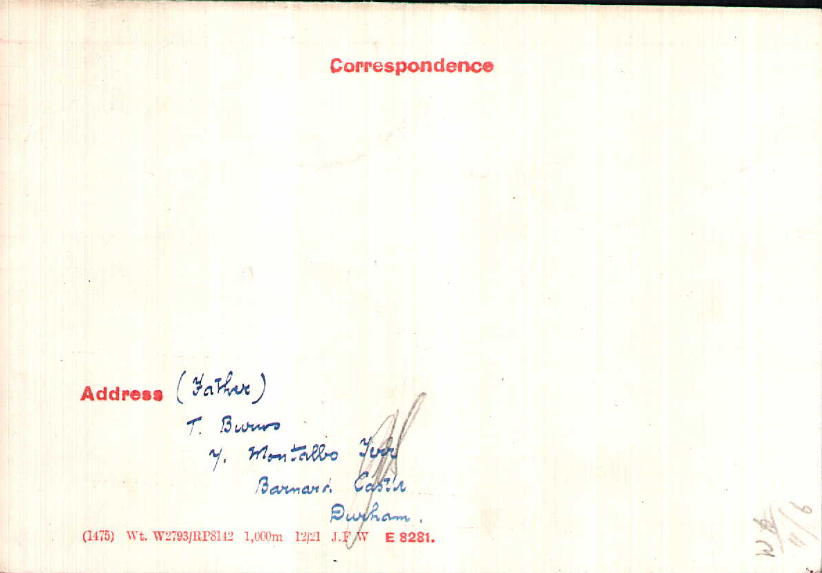
The 1901 shows the family living together at 1 Montalbo Terrace, Barnard Castle. His father is missing on this census probably because his occupation was a marine engineer so it can be assumed he was at sea in 1901. The couple were able to afford a servant.
By 1911 little had changed in the family life although his father, Thomas, was at home probably on leave. Between 1908 and 1913, Arthur attended the North Eastern County School at Barnard Castle as a day boy, where he was a member of the Officer Training Corps (OTC).
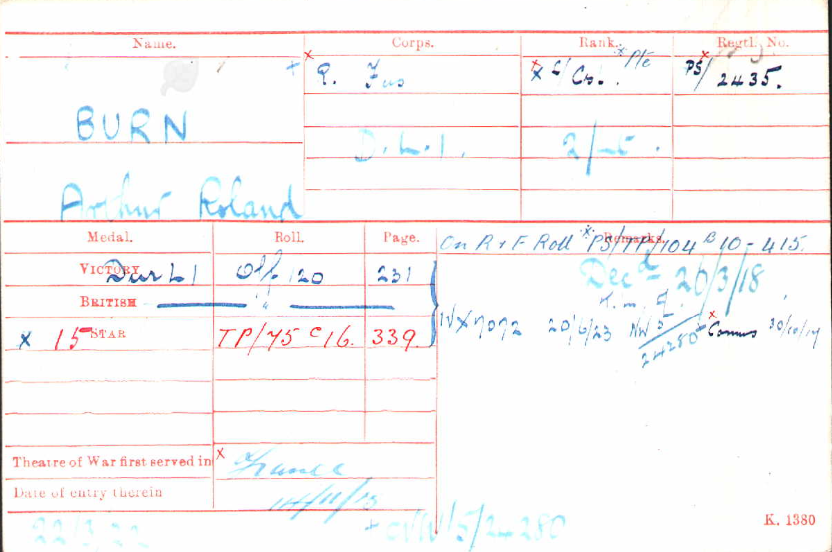
Arthur enlisted directly after leaving North East Counties School. At first he served with the 21st Public Schools Battalion Royal Fusiliers, City of London Regiment. His service number was PS/2435. At that time he was a Lance-Corporal but before too long he started up the promotion ladder and at the time of his death was a 2nd Lieutenant with the 14th (Service) Durham Light Infantry.
He was posted to France 14th November 1915 and was killed in action 26th March 1918.
On the day of his death he had been asked to stem a German advance. In the retreat towards a shallow trench he was heard to say “I’ve got one (been shot). Can you do anything for me?2
The parents of Second Lieutenant Arthur R. Burn received a letter from Captain G.E. Cardew after his death. It included the following: “The deceased had only been with the battalion a few days before being hurriedly moved out of rest billets to stem the German advance but during the few days that he was with the company during that terrible retreat he had shown himself thoroughly reliable and capable of leading his men anywhere. It was just as they reached the support line posts – shallow trenches dug overnight as cover for three of four men that your son was hit. He was barely able to stumble towards me for assistance and I heard him say, “I’ve got one, can you do anything for me?” But that was all. He died almost immediately, without pain…I had to push on with the attack…We had to withdraw from the position we had recaptured, after holding it for many hours, so that I had no opportunity of burying our dead. It has been a terrible time for us all and I cannot tell you how much we all feel the loss of your son. His conduct that day was magnificent and I could only wish that he had come through it to receive the honour he deserves. Only one other officer besides myself is left in my company and our Colonel was killed too. But at least we have the consolation of knowing that we drove the enemy back that day, and held up his advance, though at the cost of your son’s life. I trust it may be some consolation to you in your great loss to know how gloriously your son died.”
The following obituary was published in the Teesdale Mercury: “Great sympathy is extended to Mr and Mrs T. Burn of this town on the death in action of their heroic and only son, who was killed in action on the 26th March in France. Official confirmation of the melancholy intelligence reached the intrepid young soldier’s parents on Saturday night, from the War Office.”
He left £84 7s. 3d to his father who by this time appears to have retired and is listed as being a corn and seed merchant.
Arthur Roland Burn is remembered at Barnard Castle on B135.02, B135.04, B135.10, B135.12, B135.20, B135.23 and B135.25, also at Durham in the D.L.I. Book of Remembrance, page 60.