Every Name a Story
James Harry Edwards
Every Name a Story
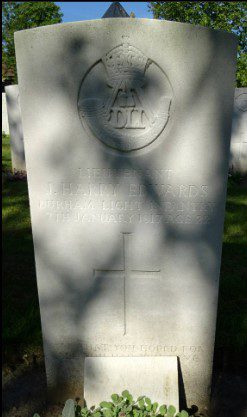
In Cambrin Churchyard Extension, Pas De Calais, France is the Commonwealth War Grave of Lieutenant James Harry Edwards, serving with the 14th Battalion Durham Light Infantry who died 07/01/1917.
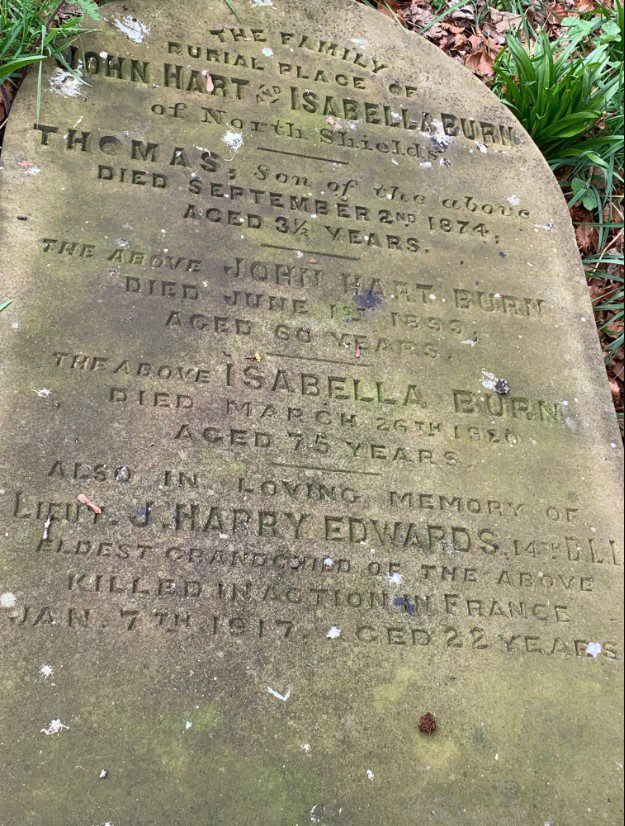
At Preston Cemetery is the family headstone which reads:-
The Family
Burial Place of
John Hart Isabella Burn
of North Shields
Thomas, son of the above
died September 2nd 1874
aged 3½ years.
The above John Hart Burn
died June 1st 1893
aged 60 years.
The above Isabella Burn
died March 26th 1920
aged 75 years.
Also in Loving Memory of
Lieut. J. Harry Edwards 14th D.L.I.
Eldest Grandchild of the above
killed in action in France
Jan 7th 1917 aged 22 years.
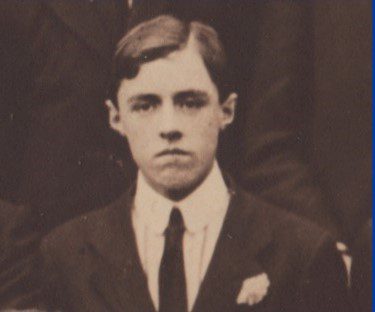
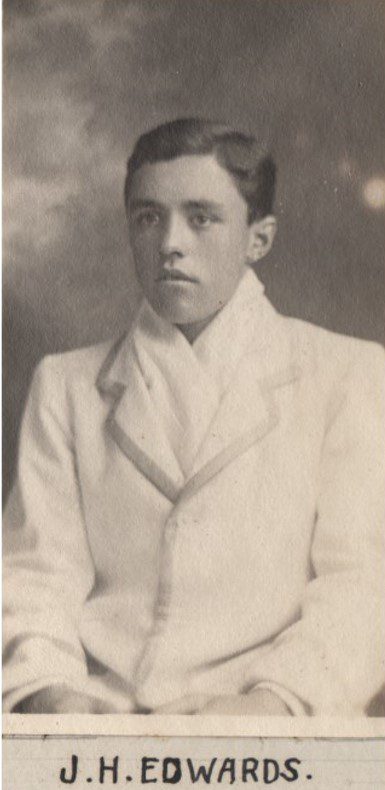
James Harry Edwards (junior), was born the eldest son of two children, on the 11th July 1894, at ‘Belmont’ Westoe village, South Shields, the son of James Harry Edwards and Mary Annie, nee Hart-Burn), of Roseworth East, The Grove, Gosforth.
They had another son called Lawrence Edwards, who also was in WW1. {He was born the 21st December 1896, Lawrence was initially educated at home, and then joined the South Shields High School on the 3rd June 1904, at the age of 7. Residing then at ‘Belmont’ Westoe Village, South Shields. Then, In March 1910, like his brother, James, he went to Uppingham School. After only a few months at Uppingham, Lawrence was “invalided home” and re-joined the High School on the 4th September 1910. He left again on the 11th December 1910, and is believed to have returned to Uppingham School. Lawrence joined the Northumberland Fusiliers, and served in Palestine in 1917. He gained his commission as a 2nd Lieutenant in February, 1915, and was promoted to Temporary Lieutenant in June. In August, 1916, he became Temporary Captain, which was later made substantive. Lawrence is believed to have survived the war, and to have died in Newcastle in 1968}. Source: South Shields Grammar School/Mike Todd.
James Harry Edwards senior was a director of a Ship repair company also a director of the Commercial Permanent South Shields Building Society, then located at Barrington Street, South Shields. Born at South Shields in 1870, he was residing with his wife and his children at 5 Linden Gardens, Harton, South Shields in 1901. He then became the Managing Director of Middle Docks at South Shields.
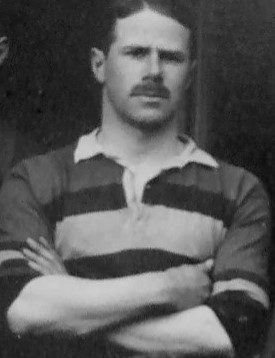
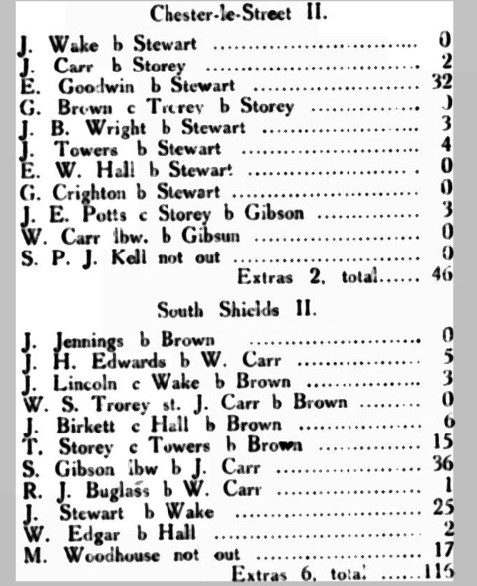
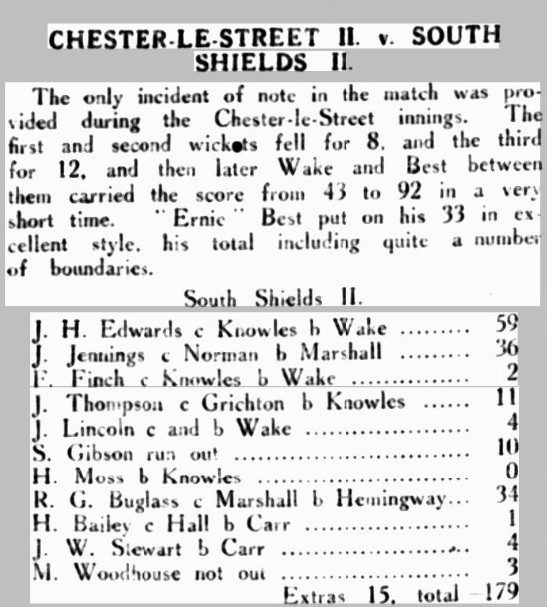
James Harry Edwards (Junior), was educated at the South Shields High School from the 19th April 1903, to April 1908, before leaving for Uppingham School from May 1908 to 1911, Meadhurst House. James was a keen cricketer and was in the 1st XI. He also played for the Sunderland Ashbrooke Rugby football Club based at Ashbrooke in Sunderland. He was apprenticed at Southwick, to Messrs. Richardson Westgarth and Co at the Sunderland branch where he was considered to have a promising career ahead of him. James was also a member of the Westoe Cricket Club first XI. When the family was residing at Westoe, James played for the Westoe Rugby Football Club as a Forward for several seasons, and then after Sunderland Rugby Football Club.
The family resided at ‘Belmont’ Westoe Village, South Shields in 1914.
James enlisted on the 19th August 1914 at Fenham Barracks at Newcastle upon Tyne. He was 5 feet eleven inches, 156lbs. He was gazetted a temporary 2nd Lieutenant on the 22nd September 1914. By September 24th he was at Aylesbury training with the 14th (Service) Battalion Durham Light Infantry. On the 11th September 1915, James with his Battalion crossing to France from Folkestone to Boulogne. They then entrained on the 12th for the St Omer district. The 14th Battalion were in the 64th Brigade, 21st Division.
James was involved in the Battle of Loos. The Battalion was selected to reinforce Chalk Pit Wood. A note arrived at 9.44am saying his (Nickalls’) right on the southern corner of the small rectangular wood, was pressed by a German counter-attack and asked for a Battalion to reinforce him there. At 10.30am they were nearing the western edge of the wood under very heavy shell and machine-gun fire. The Battalion nevertheless moved up the slope towards Bois Hugo. Just as it reached the Lens highway: An extraordinary thing happened. Without any apparent attack, or change in the situation, the 63rd Brigade troops holding the line northward of the house at the northern end of the wood, suddenly rose and retired from their trenches.
The 14th Durham Light Infantry found themselves under attack by their own troops. In a state of panic, 63rd Brigade believed that they had been outflanked around the south and west outskirts of Bois Hugo. The 63rd had mistaken them for Germans, realising their mistake, they starting to withdraw infecting the 14th Durham Light Infantry Battalion as well. The 14th Battalion rallied and with the 15th Battalion Durham Light Infantry, to support and advance eastwards. For no apparent reason the Battalion advanced south east in short rushes up the slopes of Hill 70. With casualties mounting the lines began to falter, those would could ran back to where they started. 277 men were lost in the Battalion. James was shell concussed on the 26th September, near Hill 70, buried by a shell exploding and destroying the trenches, unconscious for 24 hours. He was taken to the 18th Casualty Clearing Station at La Pugnoy suffering from nervous shock. On the 30th September he is sent to the UK from Le Havre to Dover by Hospital Ship. James was at the 2nd London General Hospital.
On the 2nd October 1915, the first of a series of Medical examinations are undertaken to determine his fitness. This wass held at the 2nd London General Hospital.
James was medically on leave from the 5th October 1915. On the 29th November 1915, he was examined at the Northumberland War Hospital at Gosforth. 10th January 1916, again at the Northumberland War Hospital.
In February 1916, the family move to Roseworth East, The Grove, Gosforth. James was again medically checked at The Northumberland War Hospital at Gosforth.
On the 11th February 1916, 2nd Lieutenant James Harry Edwards was transferred into the 16th (Service) Battalion, Durham Light Infantry, and was ordered to report to the Battalion based at Rugeley Staffordshire. He underwent another 3 medical examinations. He was declared fully fit.
On the 27th May 1916, James re-joined the 14th Battalion Durham Light Infantry. He was promoted to a Temporary Lieutenant on the 1st December 1916, but seniority backdated to the 1st September 1916. On the 15th August James was at the no 1 Training camp based at Calais. Prior to this he was at Etaples training reinforcements.
On the 19th August 1916, James was at the 25th Infantry Base Depot. In December 1916, James was at Etaples, (Eat Apples). Then went on leave back to the UK and returned on the 3rd January 1917. The Battalion were located just south of the La Brassee canal at Cambrin. Temporary Lieutenant James Harry Edwards was shot by a sniper on the 7th January 1917.
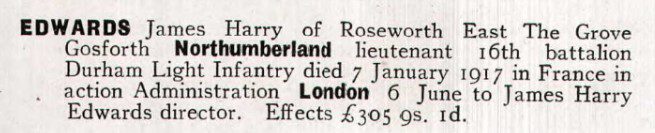
He was unmarried and in his will he left effects of £305 9s 1d to his father. His personal effects were sent to his father and consisted of 1 Pocket Book, 1 Pipe, 1 Fountain Pen, 1 Wrist Watch and guard, 1 Electric Torch, Snapshots, 1 Extra guard for wrist watch, 1 Officer’s Advance Book, Letters etc, Cheque Book, 4 Tubes for pipe, 3 Pencils and 1 Iodine Capsule and were delivered on the 18th February 1917.
Acknowledgments: Uppingham School, Can you do nothing to mend my broken heart? The Ashbrooke Boys – A sports club at war 1914-18, Keith Gregson B.A. M.Litt.; Club archivist, Battleground Series. Loos Andrew Rawson.
Pauline Priano has submitted the following:-
James Harry Edwards was the eldest of 2 sons, the offspring of James Harry Edwards Snr born June 9th 1870 and Mary Annie Burn, August 28th 1869, both natives of South Shields, historically in County Durham. Mary Annie was the daughter of sea pilot John Hart Burn and Isabella Robson.
The young couple were married at Christ Church, Tynemouth, in 1893, settling at Heaton, a suburb of Newcastle upon Tyne, birthplace of James Harry Jnr in 1894 before returning to South Shields where Lawrence was born, December 26th 1896. In 1901 they were living at 5, Linden Gardens, Harton, in the suburbs of South Shields, James Harry Edwards Snr, who hailed from a family of shipbuilders, was a ship repairer.
On the census eve of 1911 James Harry Snr was residing in the home of his cousin, shipbuilder, George S. F. Edwards and his wife Florence at their 33 room mansion at Nunthorpe, South Yorkshire. Mary Annie and Lawrence (14) were residing in the 10 room home of her mother in law, widow Victoria Edwards, at Tynedale View, Hexham, Northumberland. James Harry Jnr (16), who had previously attended South Shield Grammar Technical High School, was a boarder at Wisteria House, Uppingham, Rutland, in the Midlands. Upon his return to the north east he went on to serve an engineering apprenticeship at Southwick in the suburbs of Sunderland, historically in County Durham. Whilst studying in Sunderland he played as a forward for Sunderland Rugby Football Club and was, amongst others, a member of the 1913/14 1st XV.
When Britain declared a state of war existed with Germany, August 4th 1914, there was a rush of volunteers from all walks of life in answer to Kitchener’s call to arms. James Harry Edwards enlisted at Newcastle upon Tyne and was assigned to the newly formed 14th Battalion Durham Light Infantry, raised at Newcastle, September 4th 1914, part of Kitchener’s New Armies.
Taken over by the War Office the battalion was attached to the 64th Brigade, 21st Division and moved for initial training to Aylesbury, Buckinghamshire. Whilst in training the Bucks Herald reported that James Harry played as part of the Army side.
With the onset of winter the division which had moved in October 1914 to Halton Park, then transferred from their tented camp into billets at High Wycombe in November 1914 until the spring of 1915. They returned to the newly built billets at Halton Park in April 1915 then moved to Witley in July for final training. June 1915 James Harry Edwards was offered a temporary commission for the duration of the war and departed to France, September 11th 1915, with the rank of Temporary Lieutenant.
The division landed at Boulogne and once at full strength marched across France where they were in reserve during the Battle of Loos, which raged from September 25th until October 8th 1915. On the very first day, September 25th 1915, Lieutenant Edwards, who was in the trenches, was buried when the trench took a direct hit from enemy shelling and knocked unconscious, remaining so for some 24 hours. He regained consciousness in hospital and was diagnosed as suffering from shock. Once sufficiently recovered he was given 8 weeks leave and repatriated to the U.K. returning to his parents home. They had left South Shield and now occupied 22, Windsor Terrace, Newcastle upon Tyne.
The health of Temporary Lieutenant Edwards rather than improve over the next 8 weeks worsened, he was suffering from what in today’s terms would be classed as mild traumatic brain injury, post traumatic stress disorder and depression. Temporary Lieutenant Edwards was repeatedly examined by the Medical Board, it was noted, “ he is suffering from nervous shock, insomnia, headaches, uncertain appetite and tremulous muscles,” and still found to be unfit for active service or home service.
That changed May 16th 1916, when the Medical Board was ordered to pass him as fit and James was posted to the British Expeditionary Force. He returned to France, May 26th 1916, where he remained for a time at the Infantry Base Depot at Etaples. In October 1916 he was once again hospitalised but having returned to his regiment, December 1st 1916, he was promoted to full Lieutenant.
His regiment had been transferred to the 6th Division in November 1915 and in December 1916 had moved from the battlefields of the Somme, where they had not been heavily involved, the to the Cambrin sector. The 14th Battalion was spending its second winter in the trenches, subjected to heavy shelling. During their tour as of January 1st 1917 they had put wire out along the whole front line at Boyau, pumped and drained the trenches and cleared parapet falls at Railway Alley, Lewis Alley and Munster Parade. Patrols went out each night to examine No Man’s Land and enemy wire.
The 14th Battalion D.L.I. War Diary reports the death of Lieutenant James Harry Edwards, January 7th 1917, as follows, “A little shelling near Munster Parade, Old Boots, Back Street and Simms Keep. T Ms on Back Street. Enemy snipers active. Lieut. J. H. Edwards and 1 O.R. killed. Capt. R. Ie G. Kyre and 2 O.R. wounded.”
The body of Lieutenant James Harry Edwards was retrieved and taken for burial to Cambrin Churchyard Extension, Pas de Calais, 800 yards behind the front line it was used for battlefield burials until February 1917. Lieutenant J. H. Edwards Durham Light Infantry is at rest grave T. 12, he was 22 years of age and single. Buried in grave T. 14 is Private Thomas Crummey D.L.I. native of Gateshead, County Durham.
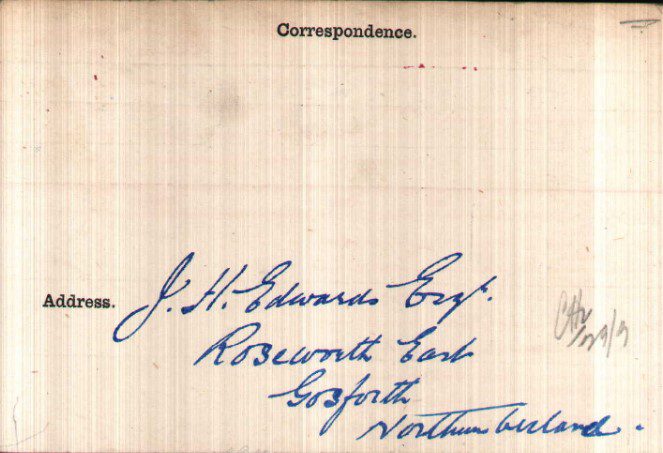
His family were not immediately aware of his demise as the Records Office, York, had sent the communication to Windsor Terrace, Newcastle upon Tyne, which was now unoccupied as Mr & Mrs Edwards had moved to Roseworth East, The Grove, Gosforth a leafy suburb of Newcastle upon Tyne.
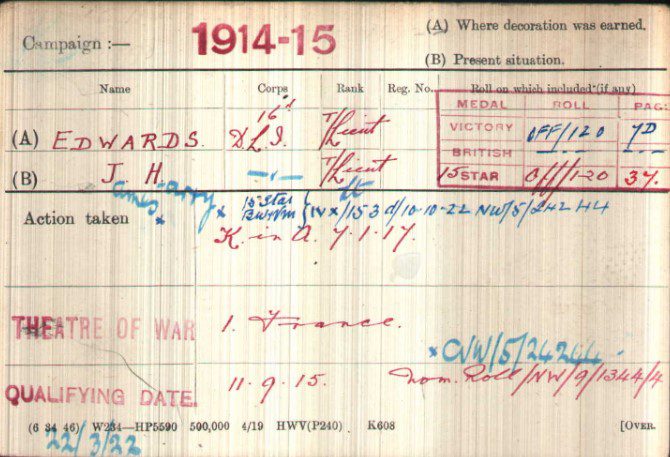
As the administrator of Lieutenant Edward’s Will, James Harry Edwards Snr received all monies due to his late son from the Army, his awards of the 1915 Star, British War Medal and Victory Medal, also his personal items consisting of; pocket book, pipe, fountain pen, wristwatch and guard, 1 extra guard for wristwatch, 1 officer’s advance book, letters etc, 1 cheque book, 4 tubes for pipe. His father was also administrator of his private assets and received his effects in the sum of £305 9 shillings 1 pence.
His father commissioned at a cost of 9 shillings 9 pence an additional inscription to be added to James’ military headstone, it reads, “ALL THAT YOU HOPED FOR ALL THAT YOU HAD YOU GAVE.”
James’ brother, Lawrence Edwards affectionately known as Lawrie, also served during WW1 and survived the conflict.
James Harry Edwards Snr died in 1945, his widow Mary Ann Edwards nee Burn in 1948, both registered at Newcastle upon Tyne.
In God’s safe keeping. Rest In Peace.
James Harry Edwards is remembered at Gosforth on G9.06 and G9.21, at Stanley (Derwentside) on S135.07, at Sunderland on S140.144, at Westoe on W101.12 and in the D.L.I. Book of Remembrance page 3.
First Name: James Harry
Last Name: Edwards
Which War: First World War 1914-18
Died: 07/01/1917
Age: 22
Rank: Lieutenant
Regiment: Durham Light Infantry
Served in: Army
Unit/Ship: 14th (Service) Battalion
Links to Source Material