Every Name a Story
Dennis Donnini
Every Name a Story
In Sittard War Cemetery, Limburg, Netherlands, is the Commonwealth War Grave of 14768011 Fusilier Dennis Donnini, serving with the 4/5th Battalion Royal Scots Fusiliers who died 18/01/1945.
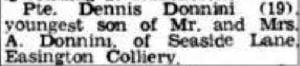
The son of Alfred and Catherine Donnini, of Easington Colliery, Co. Durham.
Dennis ‘Denny’ Donnini was born on the 17th November 1925, one of ten children of Alfredo Pellegrino Donnini, [born 11th October 1883, Castelnuovo, Italy, died 27th February 1950], and Catherine, nee Brown, [born 11th August 1889 at Sacriston, died 1965], at 8 Seaside Lane, Easington Colliery. They had married in 1907.
Alfredo Pellegrino Donnini emigrated to England in 1899, with his sister Mira Donnini (born 1892, Castelnuovo, Italy, married John C. Allen in 1916, died 1939). He was a confectioner and a billiards saloon proprietor. Alfredo was naturalized on the 17th August 1948.
The family originally resided at Front Street, South Moor, where they occupied an ice-cream shop, with two assistants Piani Plessandoa and Fontana Settino. Inside the shop was a [sic] French or German billiard table, which was fixed upright at one end of the counter. On the 6th April 1907 the premises was visited by Sergeant Turnbull and P.C. Harrison, where there was a crowd of 23 people, including 15 aged between 13 to 18 years inside the shop. Alfred[o] Donnini was in court under a gaming charge. Alfredo in his defence stated that ‘he did not think it was gaming as he seen similar machines in other shops, and there was no harm in it’.
The court had to decide if it was a game of skill or chance. The Chairman asked Alfredo if it was either, and Alfredo replied back and said You only get to know that by trying it. The court decided that it was a school for educating juveniles in the practice of gambling, he was fined 20s [shillings], and costs and his two staff 10s each and costs. The machine was confiscated by the police.
By 1911 the family had moved to 11 Main Street, Ferryhill. Mira Donnini, now aged 19, [died June 1939], Deno Louis, born 1907, died 1st May 1944, married Ethel nee Foley, resided at 7 Seaside Lane, Veronica, born 1908, {married Celestino Passerotti in 1927}, died 1989, Caterina, born 1908, baptised 9th August 1908, Edward, born 1910, died 2nd July 1931, Doris, born 1914 died 1915, Alfredo Guiseppe, born 28th February 1918, [he was in the 9th Battalion Northumberland Fusiliers, service number 4275815, was captured at Dunkirk in 1940], died 1990, Rinalda N, born 1920, died 1920, Silvia, born 23rd December 1921, {married a Donald Putsman in 1946}, died 2004, she was in the Woman’s ATS, in WW2, army number W/247632 and Corrina Madalena born 22nd August 1923, died 1993, she also served in the ATS, army number W/268219.
In 1931 Alfredo had a confectioner’s shop in Station Road, Easington, and on May 17th, Constable Henderson stated that on Sunday at 12.40 am, he saw William Sheahan and Christopher Evans trying shop doors. They were afterwards joined by John Greenwell. They were trying to force the door, but unable to do this they assisted the other up to the fanlight. When the constable showed himself, Greenwell ran away, but he caught Sheahan, who said I was only watching out, it was the other two were going to break in.
In court the 3 defendants pleaded drunken daftness. William Sheanan, 29, Paradise Avenue, Christopher Evans, 36, Burns Terrace, Shotton Colliery and John Greenwell, 24, Station Road, were charged with loitering for the purpose of committing a felony. All pleaded guilty, Sheanan and Evans were fined 40s [shillings], each and Greenwell, [first time offence], was fined 20s [shillings].
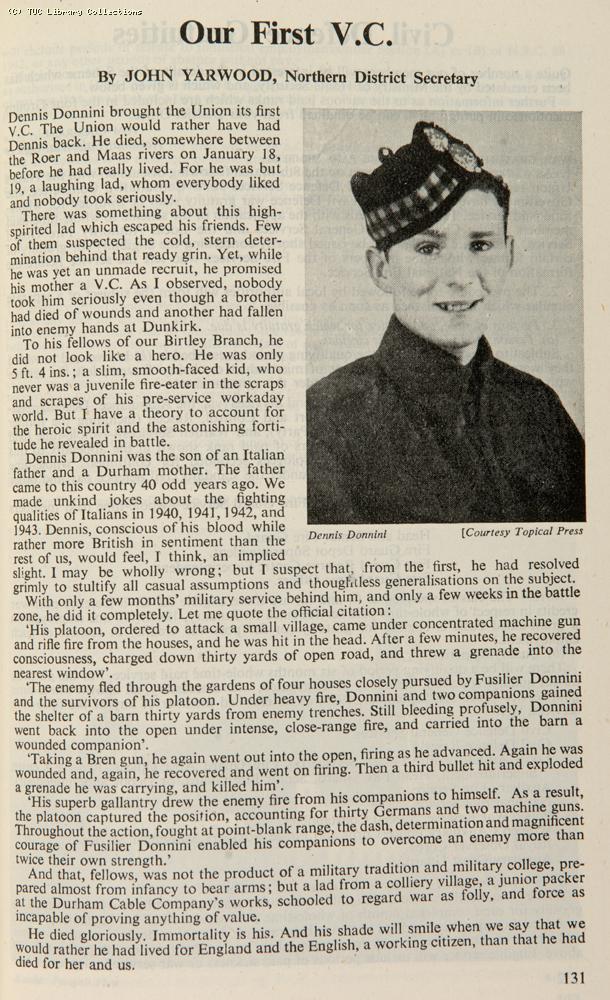
Dennis Donnini was educated at the Easington Colliery Infants School at Easington Colliery for five years, and was also an altar boy at the Easington Colliery Roman Catholic Church, afterwards a pupil of St Anne’s School in Wolsingham, and then Corby Hill Roman Catholic School, [now St Aidans], Sunderland. He was employed by Durham Cables Ltd at Birtley as a cable packer labourer. Dennis was in the Army Cadet force at Easington Colliery and also at Birtley.
Dennis enlisted on the 18th May 1944, into the General Service Corps, 5 feet two and five eights inches high, [not 5 feet four as other sources state], 102lb, Brown eyes, black hair,’was known as the lad for ever smiling’, army number 14768011, rank private. Dennis was posted to the 54th Primary Training Wing located at Perham Down. [Primary Training Wings (PTWs), later often referred to as Primary Training Centres (PTCs), were responsible for the initial six-week basic military training (General Military Training) of new recruits before they moved on to more specialised training].
After completing his training in the North of England and Scotland, he was given two weeks leave in November. Dennis was posted to the Royal Scots Fusiliers on the 29th June 1944 at the 10 Infantry Training Camp. He embarked on the 19th November 1944 and joined the 4/5th Battalion Royal Scots Fusiliers on the 2nd December 1944, saying to his mother When I get out there I will finish the war. His sister remarked on him that He was like a little drum major. His mother stated that Dennis had said to her on his last leave, Don’t worry. Mum. If I have to die, I die fighting. But remember one day you will get the V.C.,.
The family by this time were residing at 8 Seaside Lane, Easington Colliery.
His battalion was in the 156th Brigade, one of the three Brigades in the 52nd (Lowland) Infantry Division.
The 52nd (Lowland) Infantry Division was an infantry division of the British Army that was originally formed as the Lowland Division, in 1908 as part of the Territorial Force. It later became the 52nd (Lowland) Division in 1915. The 52nd (Lowland) Division fought in the First World War before being disbanded, with the rest of the Territorial Force, in 1920. The Territorial Force was later reformed as the Territorial Army and the division was again raised, during the inter-war years, as the 52nd (Lowland) Infantry Division – a 1st Line Territorial Army Infantry Division – and went on to serve during the Second World War. After the war, the division was merged with the 51st (Highland) Infantry Division in 1948. The history of the division was carried on by the 52nd Lowland Brigade, and later the 52nd Lowland Regiment.
In January 1945, the 52nd Division, now serving under XII Corps, participated in Operation Blackcock, the clearing of the Roer Triangle between the rivers Meuse and Roer. During the operation, 19-year-old Fusilier Dennis Donnini of the 4th/5th Battalion, Royal Scots Fusiliers, part of the 156th Infantry Brigade, was posthumously awarded the Victoria Cross.
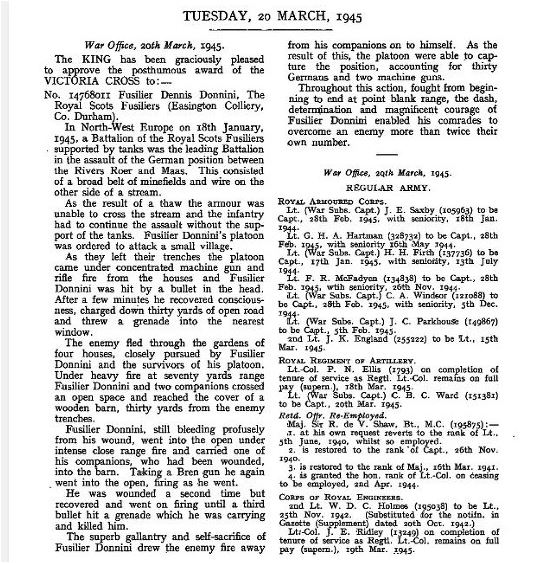
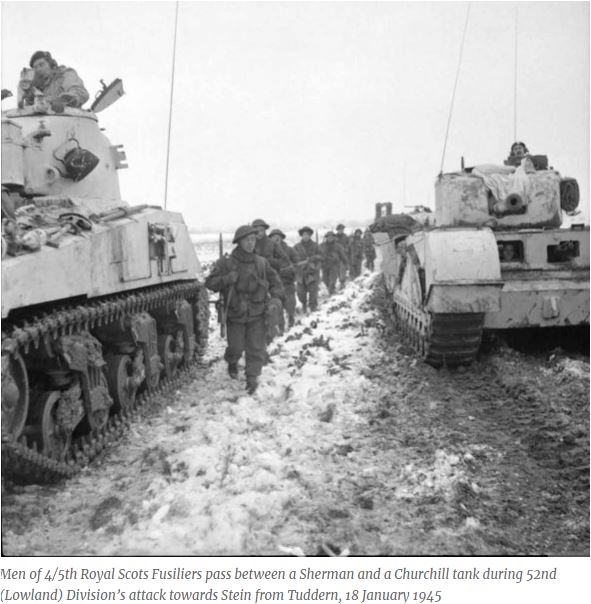
His battalion supported by tanks, lead the assault on the German positions between the River Roer and Mass on January 18th at a village called Stein in Selfkant, near the Dutch border. This consisted of a broad belt of minefields and wire on the other side of a stream. As the result of a thaw the armour was unable to cross the stream and the infantry had to continue the assault without the support of the tanks. [In addition three Flail tanks got mined and other support tanks got bogged, which was due to the state of the ground resulting from the thaw. The villages of STEIN and LIND took some time to capture. The RSF, who were carrying out this task suffered comparatively heavy casualties, (75), because of the skilful house to house defence and use of cellars by the enemy. Each house was connected to its neighbour by a communication trench – and the enemy were able to dart from house house to with comparative impunity, firing bursts of small arms here and there. A few Germans in this way threw, some grenades amongst our wounded lying in the street. These particular Germans were quickly killed. If the support tanks and Crocodiles as planned had been able to accompany the inf, our casualties would not nearly have reached the above dimensions.]
Source : Ike Skelton Digital Library
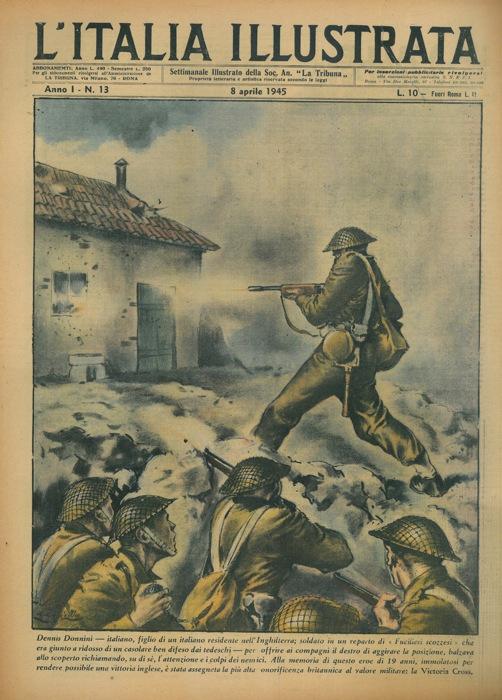
Donnini’s platoon, were ordered to attack a small village but came under a concentrated machine-gun and rifle fire from the houses. Dennis was hit in the head and lost consciousness, a few minutes he regained consciousness and then charged down the open road 30 yards and threw a grenade into the nearest window. The enemy fled through the gardens of 4 houses, being closely pursued by Donnini and the survivors of his platoon. He reached the cover of a Barn, with two others, located about 30 yards away from the enemy trenches. Bleeding profusely from his earlier wounds, Donnini went into the open under intense fire for 70 yards into the barn, and carried one of his wounded companions into the barn. He picked up a Bren Gun and went out again firing as he went. He was wounded a second time, but continued firing. A third bullet hit a phosphorus grenade, which ignited, with horrendous burns, that he was carrying which killed him. His body was carried into a Barn.
His superb gallantry and self sacrifice drew the enemy fire from his companions on to himself. As the result the platoon captured the position accounting for 30 Germans and two machine-guns. Throughout the action fought from beginning to end at point blank range, the dash determination and magnificent courage of Fusilier Donnini enabled his comrades to overcome and enemy more than twice their own number.
He was the youngest recipient of the Victoria Cross in the Second World War.
Dennis personal effects consisted off 1 Devotional Beads (9 rosaries), which were returned to the father on the 17th June 1945.
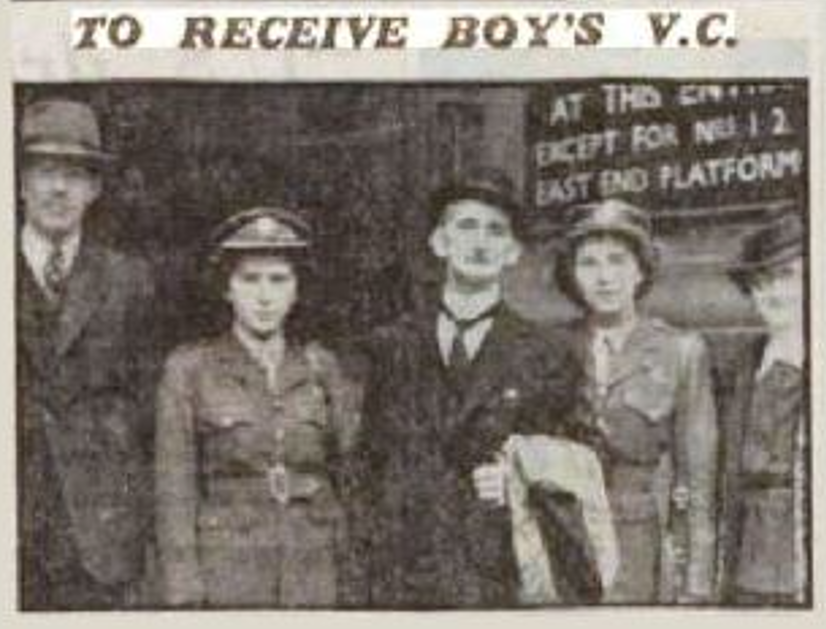
During the war Alfredo Pellegrino Donnini was interned as an ‘enemy alien’. He was released on King George VI’s command when he had to go to Buckingham Palace to receive his son’s medal. Mr Donnini had planned to take his two daughters Silvia and Corrina, both serving in the A.T.S., but the command from the King states that only one other relative can attend the Investiture. So Alfredo decided to put Sylvia’s name forward, but made an application for Corrina to attend as well.
The Newcastle Journal, dated the 17th July 1945 showed a photograph (see bottom right) of Mr Alfred Donnini and his daughter (with handbag), outside Newcastle Station on their way to Buckingham Palace to receive the V.C. Others in the photo are left to right Mr Charles Passerotti (brother-in-law) Miss Carrina Donnini (sister) and Mrs Passerotti sister.
Mrs Donnini stayed at home when interviewed said Father and Silvia will attend at the Palace. Silvia is our eldest daughter so we thought she should go. It is sad as well as a proud occasion for us. ‘Denny’ was also such a happy boy, and we miss him very much. I felt that I could not face the journey.
There was a letter from Alfredo Donnini’s sister Elleta, who still was residing at Castelnouve, in Italy, stating that her husband had been brutally shot by the Germans at the same time as Dennis was winning his VC.
On the 17th July 1945, Alfredo received his son’s VC, from the King, he was accompanied to the Investiture by his three daughters, Mrs Veronica Passerotti with her husband Mr Charles Passerotti, Private Sylvia Donnini and Private Corrina Donnini.
Alfredo Pellegrino died on the 27th February 1950 leaving effects of £14,452 0s 1d to Catherine his wife and Robert George Wilson Gallant incorporated accountant. He was interred at Easington Colliery Cemetery.
Dennis had two older brothers, Alfred and Deno Louis. Both served, but Deno died 1st May 1944, whilst serving in the Royal Army Service Corps as a driver. His two sisters, Corrina and Sylvia, served with the Auxiliary Territorial Service.
By 1954 the address 8 Seaside Lane was taking enquiries for a driving school, called the Modern School of Motoring based at 6 Mary Street, Sunderland.
Roger Morris has added a post script:
My father, Lieutenant Tom Morris was with Donnini in Stein and witnessed the whole sad story. He told me how brave he was. My father was subsequently wounded at Wesel and returned home. He lived until he was 88. I recall him saying ‘Donnini was the son of an ice cream salesman’!!
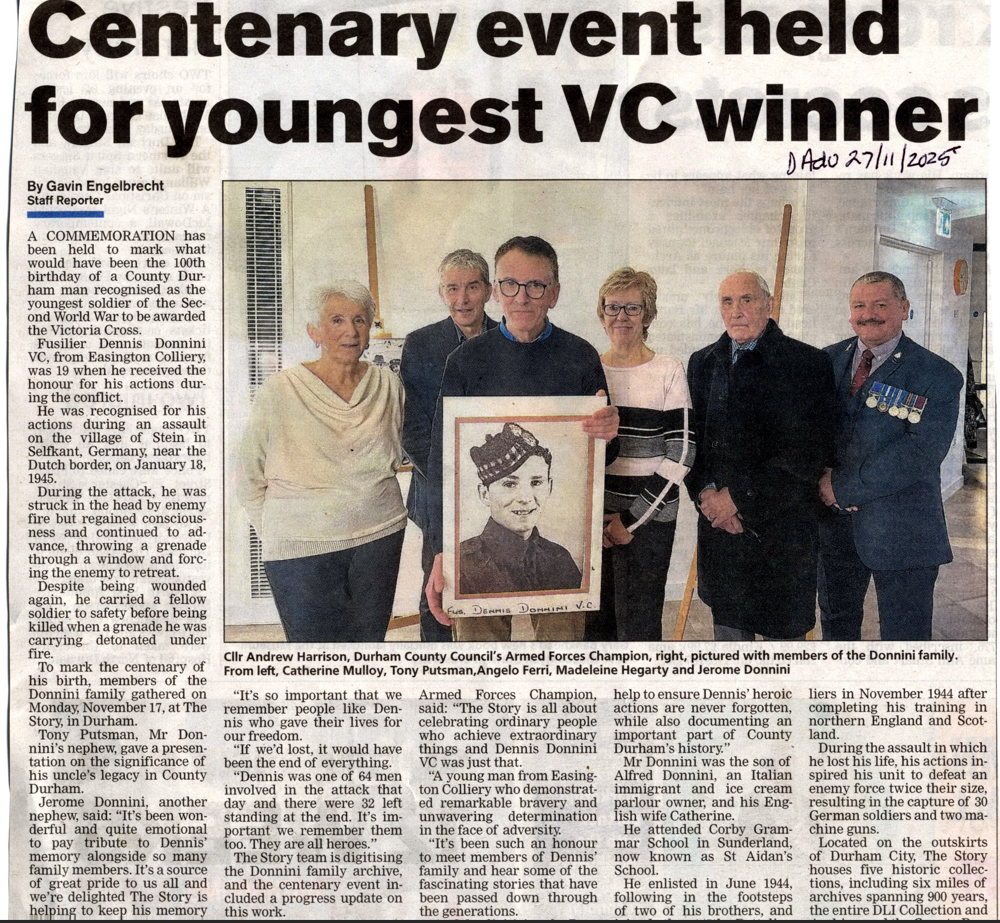
On the 17th November 2025 an event was held at The Story Durham to commemorate the 100th Birthday of Dennis Donnini. Members of the extended family were present.
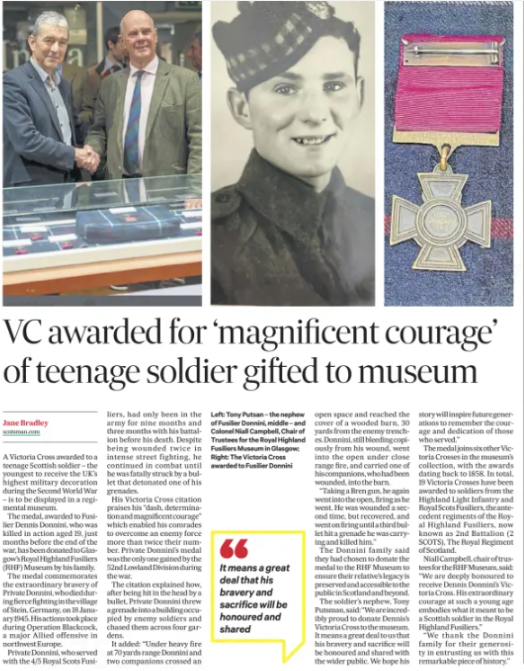
The VC has been gifted to the Royal Highland Fusilier Museum in Glasgow as of 2026. See News Article.
Sources: The British Newspaper Archive; Ministry of Defence; IWM; Jerome Donnini; Donnini family; War Diary; Gazette; Service Record; The National Archives; Jean Atkinson;
Dennis Donnini is remembered at Birtley on B127.07, at Durham on D47.076, and at Easington Colliery on E52.01, E52.05 and E52.06.
First Name: Dennis
Last Name: Donnini
Service Number: 14768011
Which War: Second World War 1939-45
Died: 18/01/1945
Age: 19
Rank: Fusilier
Regiment: Royal Scots Fusiliers
Served in: Army
Unit/Ship: 4/5th Battalion
Decorations: Victoria Cross