Every Name a Story
James Coates
Every Name a Story
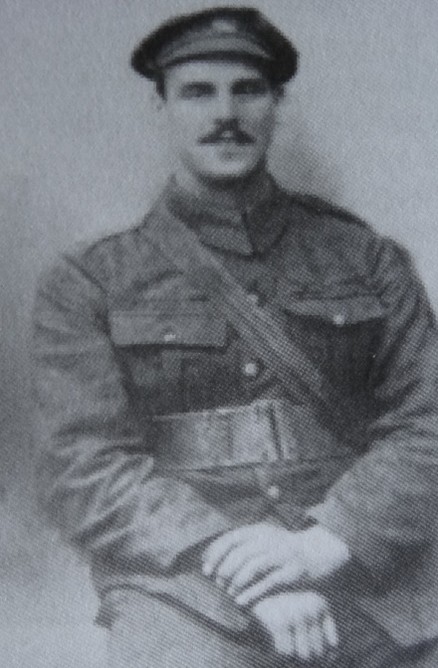
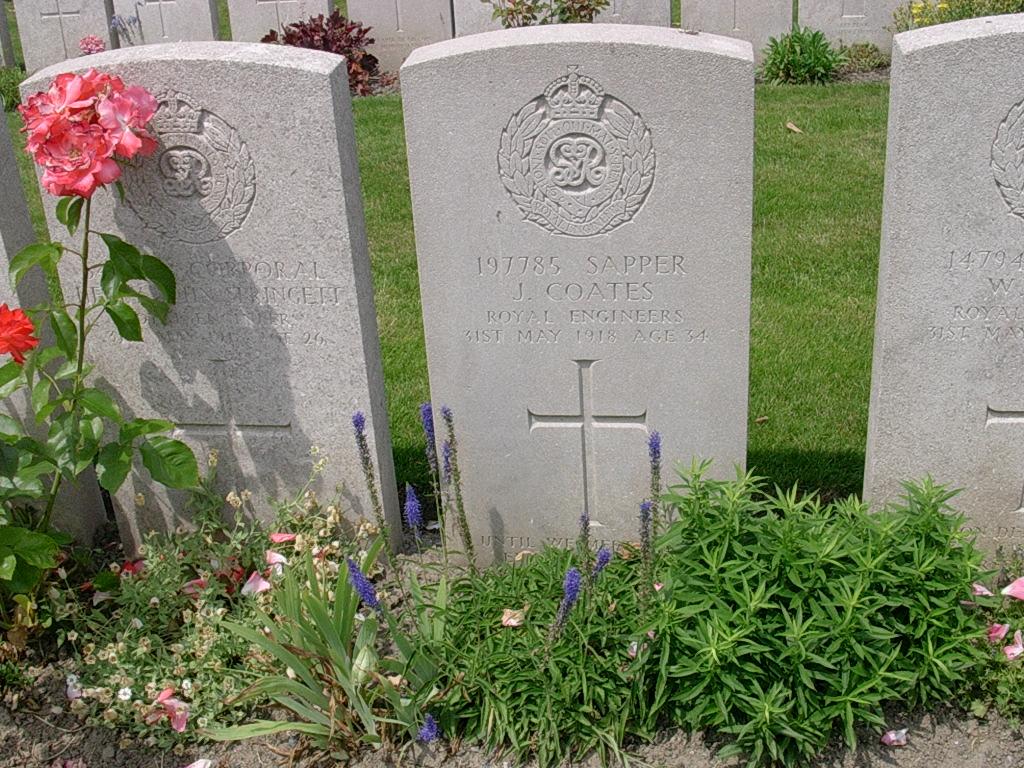
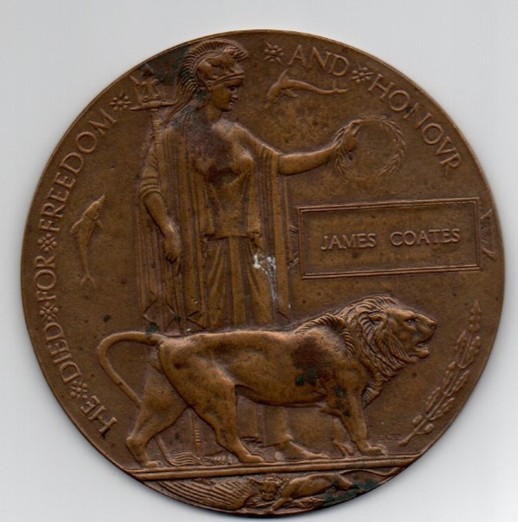
In Lijssenthoek Military Cemetery, West-Vlaanderen, Belgium, is the Commonwealth War Grave of 197785 Sapper James Coates serving with the 255th Tunnelling Company Royal Engineers, who died 31/05/1918.
Until we meet again
Ever Remembered
His loving wife and children
The husband of Hannah Coates, of 8, Low Row, North Beechburn, Howden le Wear, Co. Durham.
Jean Longstaff has submitted the following:
James was born on 6th May 1884 at Witton le Wear, County Durham, the son of William and Mary (nee Colling, nee Taylor) Coates, who had married in Grinton, North Yorkshire in June 1873. James had three older half siblings from his mother’s first marriage, Francis, John and Elizabeth Taylor, and full siblings Thomas (b.1870), Mary (b.1876), Leonard (b.1878) and Jane Ann (b.1881), all born at Crackpot in North Yorkshire.
The Coates family originated from Crackpot in Swaledale and Mary came from nearby Arkengarthdale, a lead mining area to the north. By 1891, the family lived at High Grange, Howden le Wear in County Durham, where 48 years old William worked as a coal miner as did his oldest son Thomas, while the three youngest children were still at school. Mary died in 1892 and by 1901 16 years old James was also working as a coal miner.
On 31st July 1906 James married Hannah Mills, originally from Willington, and by 1911 they were living at Constantine Road, North Bitchburn, Howden le Wear, with daughters Mary (b.1907) and Doris (b.1908). They later had two sons, William (b.1911) and Ralph (b.1913). In 1915, the family lived at Valley Terrace, Howden le Wear, and later, Hannah lived at 8 Low Row, North Bitchburn with her four children.
Kevin Richardson has provided the following information:
James Coates enlisted into the 8th Battalion Yorkshire Regiment (Princess Alexandra’s Own) and joined “B” Company with the regimental number 19457. At a later date he transferred to the Royal Engineers, 255th Tunnelling Company and given a new regimental number, 197785 . Since, the details of his service record are unknown, it is assumed that being a miner, he volunteered for a transfer when the new tunnelling companies were being established in 1916. An incentive was higher pay.
The 8th Battalion Yorkshire Regiment was formed at Richmond, Yorkshire as part of Kitchener’s New Army and was attached to 69th Brigade, 23rd Division. On 27th August 1915 Private Coates entered France with his Division, landing at Boulogne and proceeding to concentrate near Tilques. After trench familiarisation with the 20th and 27th Divisions, on 14th September the Division took responsibility for a front line sector for the first time, taking over between Ferme Grande Flamengrie to the Armentieres-Wez Macquart road, holding the front at Bois Grenier, and remaining in this area for a considerable time.
In 1916, the newly formed 255th Tunnelling Company spent some time in the Red Lamp-Neuve Chapelle sector and then at Leventie-Fauquissart. In early 1917, it was posted to the Calonne-Souchez sector and was engaged in digging subways named Marble Arch, Bully Subway, Gum Boot and Rotten Row to the Vimy front. At this time, the 255th also constructed two 50,000 gallon underground water reservoirs for the supply of forward troops in the Vimy attack of April 1917. Later in the year, part of the company worked in tunnels near the Sunken Road, Givinchy.
The German Offensive, spring 1918 – an overview
Russia made peace with Germany and as a result, Germany could now transfer troops from the Eastern Front to the Western Front. Thus, the Germans now held superiority in numbers.
The German High Command needed victory to be gained before the American Forces arrived in Europe in huge numbers, the first US troops had arrived in France 26 June 1917. The strength of the British infantry had fallen from 754,000 in July 1917 to 543,000 in June 1918 producing a manpower crisis. The German Spring Offensive was launched 21 March 1918 and took 5 phases, Operation Michael, the Battle of Picardy (otherwise known as the First Battle of the Somme 1918) against the British, Operation Georgette, the Battle of Lys against the British sector near Armentieres, Operation Blucher-Yorck, the Third Battle of Aisne against the French sector, Operation Gneisenau, the Battle of the Matz against the French sector between Noyan and Montdider, Operation Marne-Rheims, the final phase known as the Second Battle of the Marne.
The Germans enjoyed spectacular territorial gains particularly during the initial phases of the offensive which led the Kaiser to declare a “victory holiday” for German schoolchildren. But, the cost in manpower was enormous.The strength of the German Army had fallen from 5.1 million to 4.2 million men in the 6 months of the offensive. To add to this dilemma, in June 1918, the first outbreak of Spanish Flu laid low nearly 500,000 German soldiers.
Often called “the Kaiserschlacht” the offensive was Germany’s last big effort to win the war before the arrival of huge numbers of American troops. The German plan, Operation Michael was to punch through the British and French Armies at St. Quentin, cut through the Somme and then wheel north-west to cut the British lines of communication behind the Artois fronts to bottle up the BEF in the narrow neck of Flanders. The British Army would be surrounded with no means of escape and would inevitably surrender. The target of the first phase of the offensive was the British Army who the German High Command believed to be exhausted by the four major efforts of 1917, namely Arras, Messines, Passchendaele and Cambrai. The German Army enjoyed a numerical superiority of 56 Divisions against 16 British. Enemy superiority was overwhelming. The main weight of the attack was between Arras and a few miles south of St. Quentin. German superiority was approx. 4.5 to 1 and their success was spectacular:
However, “only” 2/3rds of the German casualties were wounded so a substantial number would return to the fighting at a later date. By contrast, 28,000 of the British would not return, 7,000 were dead and 21,000 had been taken prisoner. By 27 March, the Germans were able to cross the Somme and turn their attention to the area to the north, the area around Arras.
When the German attack, Operation Georgette, commenced in April 1918 the 255th Tunnelling Company was in the Ypres sector, centred on Armentieres. By 15th May the 255th was at Fortnight Siding, believed to be near Abeele, where their work was “Trenches and wiring in accordance with French Army Instructions”.
A report signed by W.H. Morgan, Major RE OC 255th Coy. RE. read “Shortage of material causes some delay in working of trenches. Loss of 35 ORs due to shelling of camp night of 30/31 May ’18. Half of section grave digging on 31st”.
Sapper James Coates was killed in action on 31st May 1918, one of 15 men of 255th Tunnelling Company killed in action or died of wounds on that day. The additional 20 deaths are presumed to be attached infantry troops.
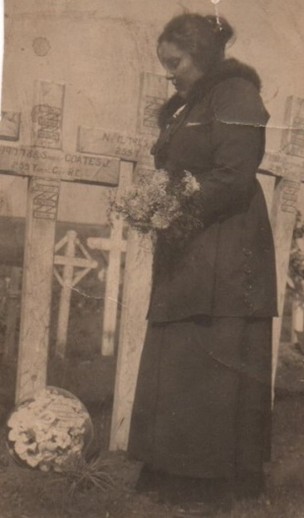
James’ wife Hannah received a letter from the Battalion Chaplain, Sergeant A.G. Marriott on 2nd June 1918. It reads: It is with the deepest sympathy that I write to you at this sad time that you are experiencing in the death of your dear husband. He was a good, trustworthy man whom everybody who knew him esteemed and respected. Under the painful circumstances please accept all the consolations his comrades and myself send you. I know you will be brave, also you know where to look for comfort and consolation, unto the one who gave his life for us. Whose words are – greater love hath no man than this, that he lay down his life for his friends. We went to a service together the night he was called away, Jim always paid great attention to the things that matters most [the spiritual part] His good influence will live on as he always tried to let his light shine before his fellow men. I cannot write and tell you any particulars except that he did not suffer but was called suddenly away to his maker. It may be of some slight comfort to know, he was buried quite decently and the last rights performed by [myself]. If there is anything that you think I could do please let me know. Give my love to Mary and the other children and my best wishes and prayers to yourself. May God bless you and help you to bear your burden.
James Coates is remembered at Howden le Wear on H139.01, H139.02 and H139.07 (as J.Coats).
First Name: James
Last Name: Coates
Service Number: 197785
Which War: First World War 1914-18
Died: 31/05/1918
Age: 34
Rank: Sapper
Regiment: Royal Engineers
Served in: Army
Unit/Ship: 255th Tunnelling Company
Links to Source Material