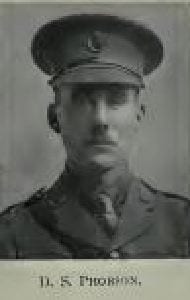
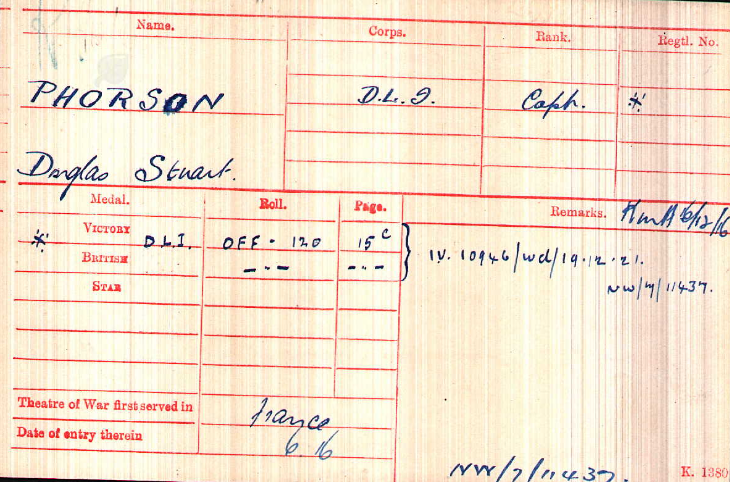
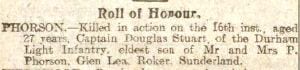
In Sailly-Au-Bois Military Cemetery, France is the Commonwealth War Grave of Captain Douglas Stuart Phorson, serving with the 18th (Service) Battalion Durham Light Infantry, who died 16/12/1916.
The son of Peter and Ann Phorson, of Roker, Sunderland.
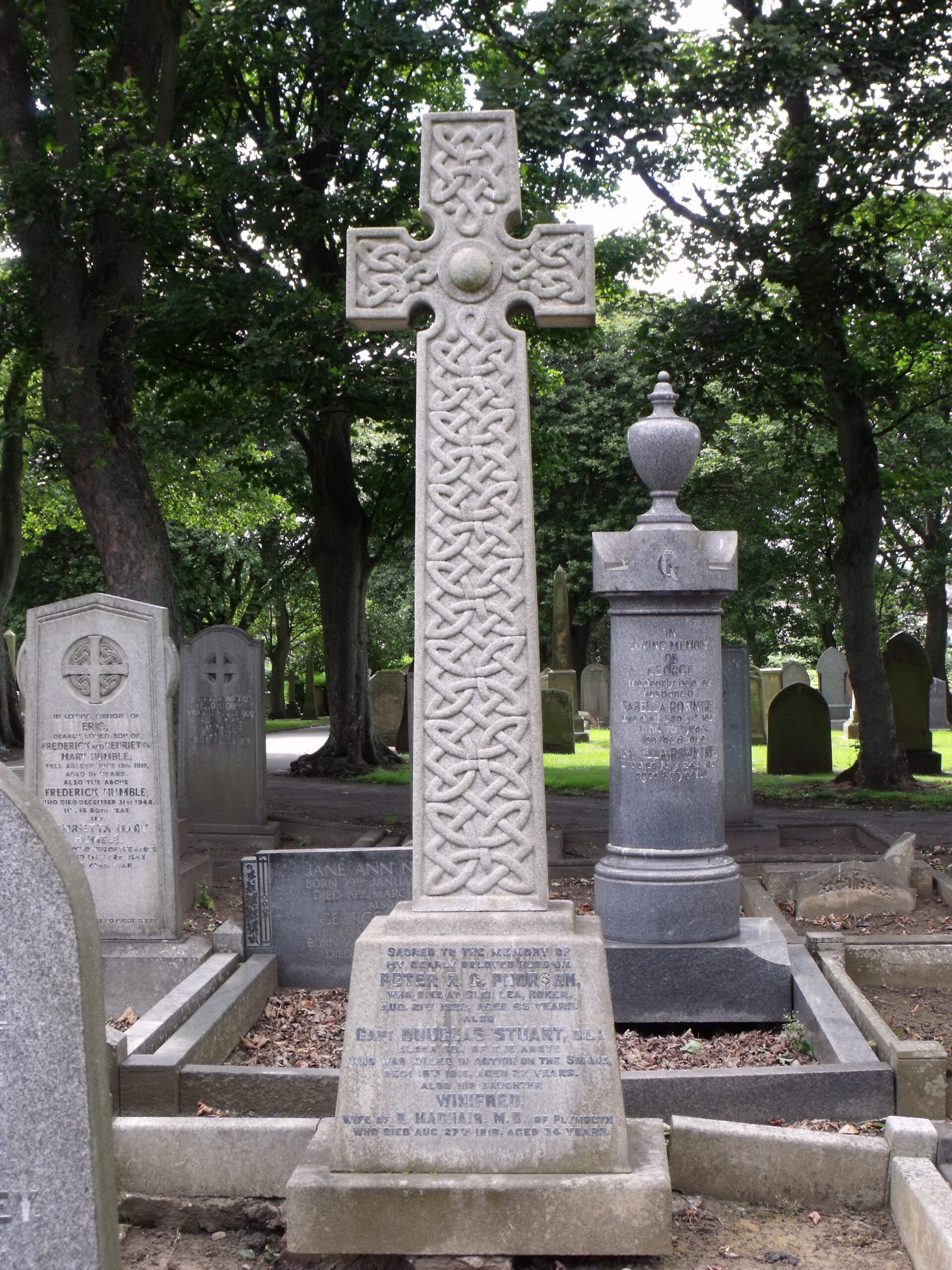
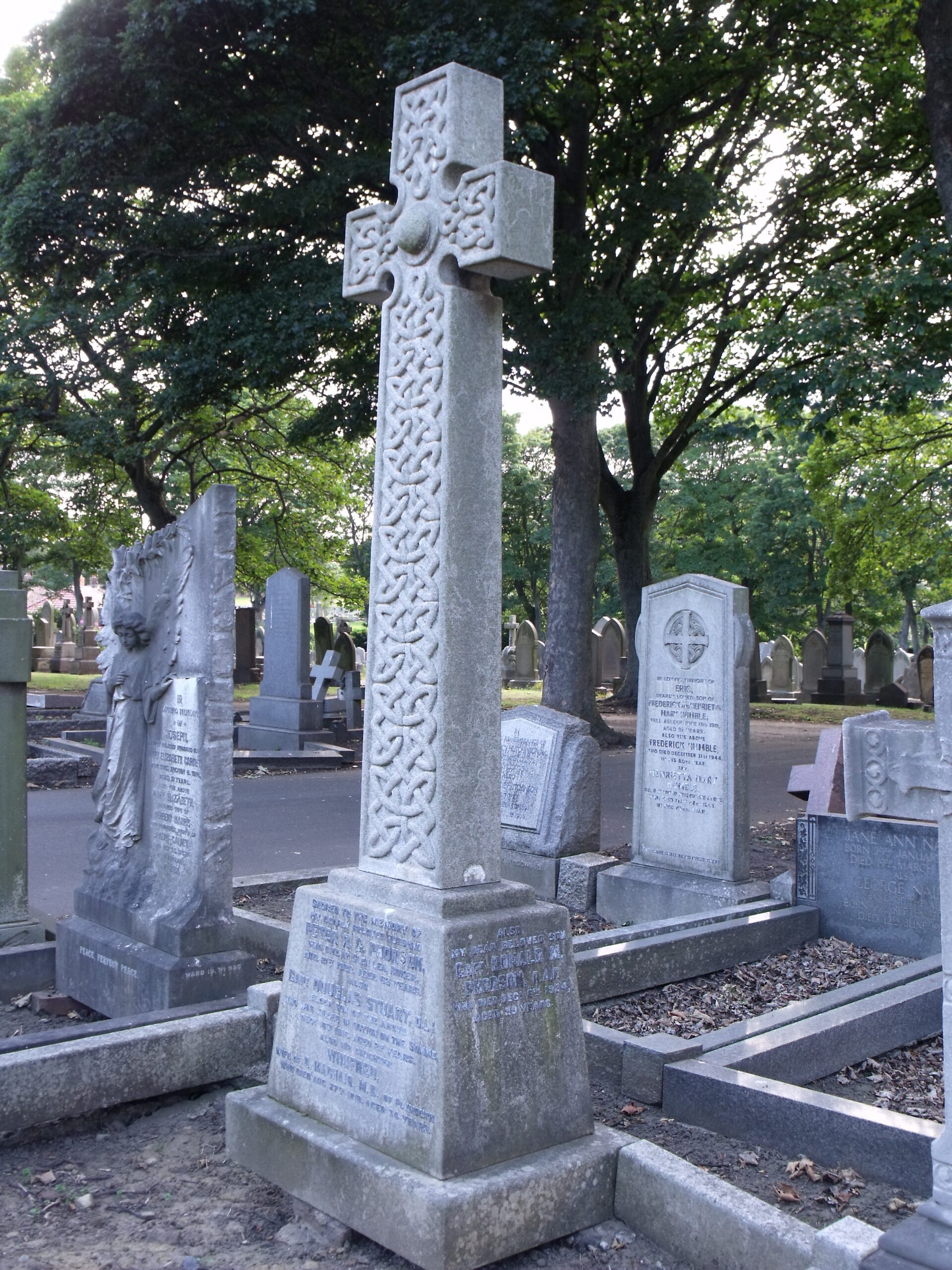
In Sunderland Mere Knolls Cemetery is a family headstone which reads:
Sacred to the memory of
my dearly beloved husband
Peter R. G. Phorson
who died at Glen Lea, Roker
Aug. 21st 1922, aged 65 years.
Also
Capt. Douglas Stuart D.L.I.
elder son of the above
who was killed in action on the Somme
Dec. 16th 1916, aged 27 years.
Also his daughter
Winifred
wife of D. Maghair M.D. of Plymouth
who died Aug. 27th 1919, aged 34 years.
Also my dear beloved son
Capt. Ronald M.
Phorson R.A.F.
who died Dec. 8th 1934,
aged 39 years.
Douglas Stuart Phorson was born on the 24th February 1889 at ‘Glen Lea’, Roker Park Road, Sunderland, the eldest son of a Peter Phorson, Director and Works Manager of Joseph L. Thompson & Sons Ltd. Sunderland, and his wife Annie, daughter of the late James (and Jane) Urquhart, of Aberdeen.
Douglas was educated at the Grammar School, Houghton le Spring, then Edinburgh University, a Student of Medicine, 1906-8, where he was a member of the O.T.C. and then enrolled in 1909 at the Royal Dick Veterinary College, Edinburgh.
In the 1911 census he is described as a Veterinary student aged 21.
Douglas joined the Territorial Force, then the 3rd (Reserve) Battalion Durham Light Infantry, where he obtained a commission as a 2nd Lieutenant on the 20th May 1915, in the 16th (Service) Battalion Durham Light Infantry Battalion, (Gazette, announcement 7th August 1915). He was transferred to the 18th (Service) Battalion Durham Light Infantry. He then took command of a company temporarily, which resulted him being promoted to Captain on the 8th July 1916.
He arrived in France in June 1916, and took part in the Battle of the Somme where he was wounded, but continued to command his Company.
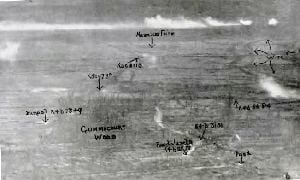
The photograph on the right is a view looking at the German Front line, Gommecourt Wood and Salient with the smoke of the British Barrage, East of Nameless Farm. (The strong front German line on the fringe of the wood and the belts of wire, west of the barrage are clearly seen). This is the view the 18th Battalion would have to assault on the 1st July 1916.
Douglas was killed by a shell penetrating a dug out and bursting inside, killing Captain D.S. Phorson, near Hebuterne. He is buried at the Military Cemetery of Sailly-au-Bois.
His Commanding Officer later wrote:- ‘Your son was a 2nd Lieutenant when I joined the battalion about four and a half months ago, he had the opportunity of commanding his company temporarily just before I joined. I found that he commanded his company efficiently and well in the trenches, so promoted him to be Captain straight away from 2nd Lieutenant. I found that the officers had a high opinion of his sound sense, and an equally high opinion of the sympathetic side of his character, and I know that he was universally liked in his company. On the night of the 16th he was sitting with his two subaltern officers in the dug-out which was his company’s headquarters. We had been giving the enemy a bad time with a certain artillery programme, we had made our dispositions for the safety of the men in the case if the enemy’s retaliation should be severe, and Captain Phorson had personally arranged for his own company that, without sacrificing protective measures in any way, the men might be as much under cover as possible. While sitting in his company headquarters, the enemy began some desultory shelling. This shelling grew in intensity, and Captain Phorson said to his two officers that they were to move with him to a deeper dug-out. I believe he had actually begun to get out of his chair, when they could hear a shell, which experience told them was coming somewhere near. Captain Phorson said ‘Wait for this’ and as he sat down again, the big shell hit the dug-out where the roof joined the wall, killing him and another officer (Lieutenant Busby) and wounding the third officer (Lieutenant Lean). He had no pain, as death was instantaneous. I am sure, from my knowledge of him, that he would wish for no better ending than dying at his post as he did. He had had very many narrow escapes in his time, for he was a seasoned soldier, and he took all his chances with the equanimity and coolness which, you know better than I, was one of his characteristics. I represent the whole battalion when expressing my deepest sympathy with you and the loss which the battalion has suffered in losing a valuable Company Commander’.
He was unmarried. His will dated 20th August 1917, left effects of £165 2s 10d to Peter Phorson, shipbuilder.
His younger brother Lieutenant Ronald Phorson was in the Royal Flying Corps, and in May 1919 he was one of the organisers for a Public Reception and Entertainment to all men of the Locally Raised Units.
Sunderland Echo Thursday 14/05/1919.
Douglas is listed in the University of Edinburgh Roll of Honour 1914-1919. His name does not appear on the Dick Veterinary War Memorial.
Source: De Ruvigny Roll of Honour
Douglas Stuart Phorson is remembered at Roker on R50.02, at Sunderland in S140.048 part 9, page 188 and in the D.L.I. Book of Remembrance page 330.