Every Name a Story
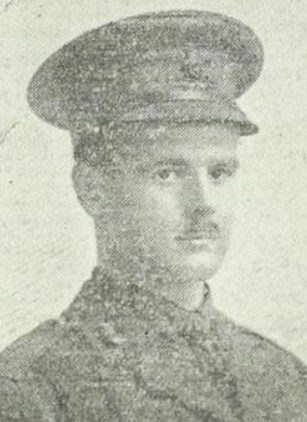
Charles Lancelot Chapman
Every Name a Story
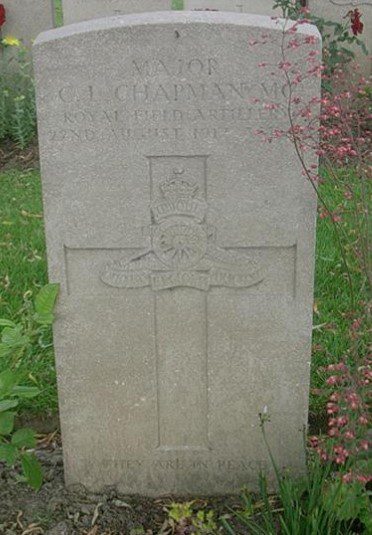
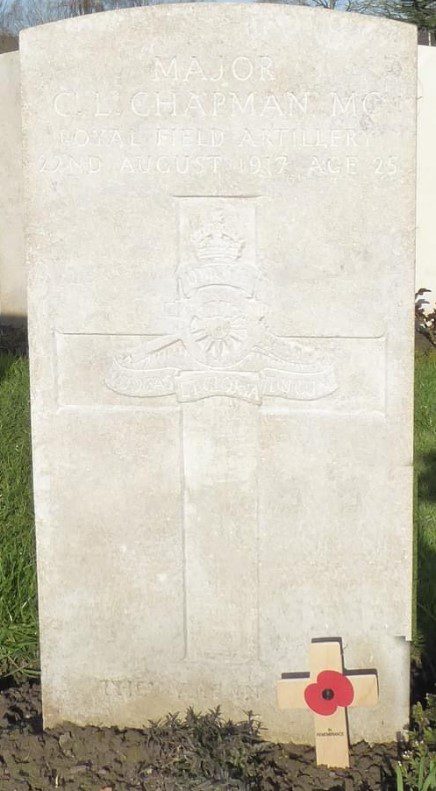
In Lijssenthoek Military Cemetery, Belgium is the Commonwealth War Grave of Acting Major, Charles Lancelot Chapman, who served in ‘D’ Battery. 173rd Brigade, Royal Field Artillery, who died 27/08/1917.
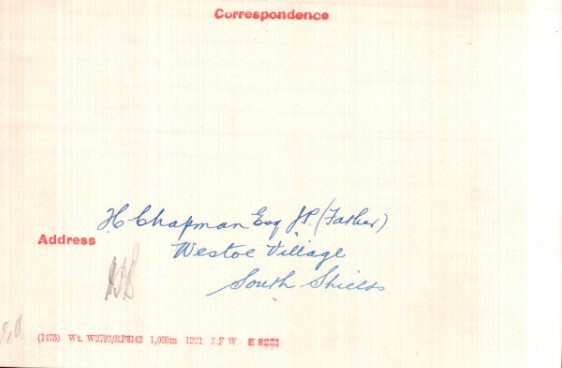
Charles Lancelot Chapman was born the youngest son of eleven children on the 1st August 1892, at ‘Seacroft’, Westoe Village, South Shields, to Henry Chapman, (a Chartered Accountant), born 1851, died 5th February 1936, and Dora (nee Gibson), Chapman, born 1856, died 17th May 1938, she was the eldest daughter of a George Gibson, born 1825, died 30th January 1865, and his wife Marion Gibson, (born 29th August 1862), died 1940. Henry and Dora were married on the 8th August 1876 at St Peters Church in Harton, Henry moving from his parents’ residence at Challoner Terrace, Westoe to 34 Winchester Street.
The other children were:-
- Ethel, born 3rd May 1877, died 10th December 1938.
- Henry, ‘Hal’ born 21st August 1878, died 29th January 1926.
- Robert Chapman, born 3rd March 1880, at 6 Wood Terrace, died 31st July 1968.
- George Gibson, born 3rd May 1882, died 31st December 1954, in Canada.
- Laurence Alfred, born 18th March 1886, died 3rd February 1943.
- Frederick Ernest Chapman, born 11th July 1887, died 8th May 1938.
- Alan Edward, born 1884, died 1898.
- Marion Dorothy Chapman, born 10th September 1890, died 10th August 1918.
- Dora Elizabeth, ‘Bessie’ born 20th December 1884, died 26th July 1935, she married Wallace Moir Annand, [they had one child Richard Wallace Annand, ‘Dickie’].
- Hilda born 1881, died 6th July 1929, [she married Sidney Howard Smith, (born 3rd February 1872), on the 18th October 1905, and in 1911 they were residing at ‘Beech’ Cottage, Rodborough, near Stroud, Gloucestershire, with one child Elizabeth Howard Smith born 15th August 1906, baptised 10th February, she died 12th November 1975].
Henry Chapman had built ‘Seacroft’ on the eastern edge of Westoe Village in 1887. It was a mansion with over twenty rooms. He also received a commission in 1884 as a Lieutenant in the Volunteer Forces.
Charles Lancelot Chapman was educated privately then at the South Shields High School, from the 6th June 1901, he left on the 30th July 1909. He passed his preliminary Institute of Chartered Accountants exams on the 7th, 8th and 9th December 1909. He was articled to his father’s accountancy business, Henry Chapman Son & Co at Barrington Street.
He was a keen Rugby player and joined the Westoe Rugby Club from 1907 to 1913. All of his brothers were educated at the South Shields High School. In 1897/98, his brothers Henry ‘Hal’ and George Chapman were in the South Shields High School Rugby Team. Charles had made ninety-one appearances, fifty for the first XV and forty-one for the Second XV.
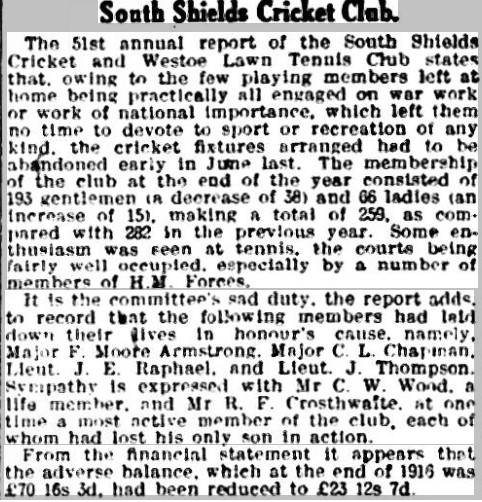
Charles also was a tennis player and was elected as the Honorary secretary in 1914 of the South Shields Cricket and Westoe Lawn Tennis Club. There are many reports of his prowess in the local newspapers. He was also a vice Captain of the Westoe Rugby football club.
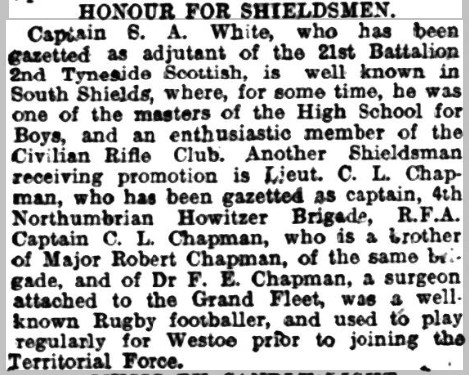
On the 25th November 1911, Charles was commissioned as a 2nd Lieutenant in the 4th Northumbrian (County of Durham) Howitzer Brigade of the Royal Field Artillery. His unit was based at the Drill Hall In Bolingbroke Street, South Shields and Hebburn. His promotion to a Lieutenant was dated 29th July 1913. On the 7th March 1914, Charles came fourth in the South Shields Rifle Association competition for small bore in the Officers event with a score of 50. This was located at the Bolingbroke Drill Hall where there was a miniature Firing Range in place.
Charles returned home on the 4th July 1914 from the 15 day Annual camp at Redesdale Camp, the first week was spent at Hareshaw Moor near Bellingham, the Brigade then marched twelve miles of mountainous country between Hareshaw and Bellingham.
On the 3rd of August 1914 Charles had to leave the Westoe annual Lawn tennis tournament and report to his unit at Bolingbroke Street. On August 5th he and his unit 4th Durham Battery, commanded by his elder brother Major Robert Chapman marched off to Hebburn. By the 15th September they were located at Newcastle upon Tyne at the Town Moor. In November Charles was promoted to a Temporary Captain. Charles was five feet nine inches tall and weighed 12 stone.
His unit was now part of the 50th (Northumbrian) Division entrained from Central Station and on the 19th April 1915 embarked on to the SS Anglo-Canadian, ship number 114766, from Southampton with their obsolete 5 inch BL Howitzers. He was in ‘D’ Battery.
The 50th were located at Caestre on the 23rd April 1915. The 4th Northumbrian Howitzer Brigade were ordered forward to an area called ‘Hellfire Corner’ just off the Menin Road. They were located about 3000 yds from Ypres and just North of the Menin Road. The Germans attacked Frezenberg on the 7th May 1915.
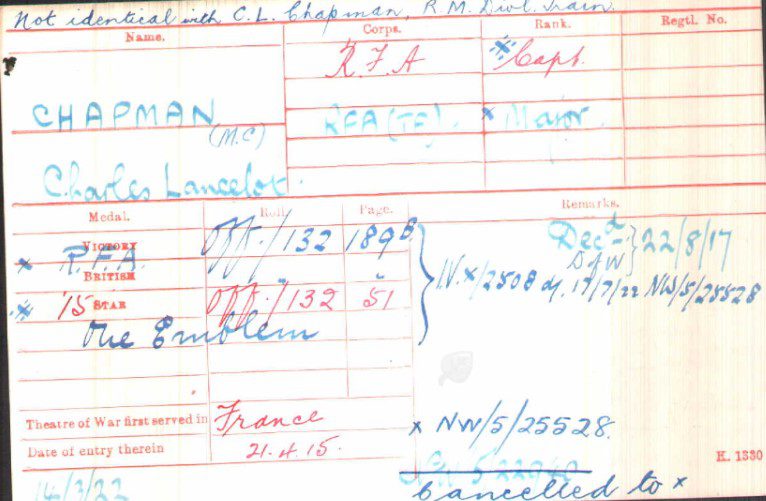
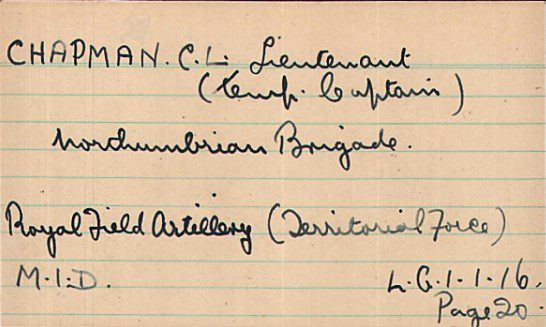
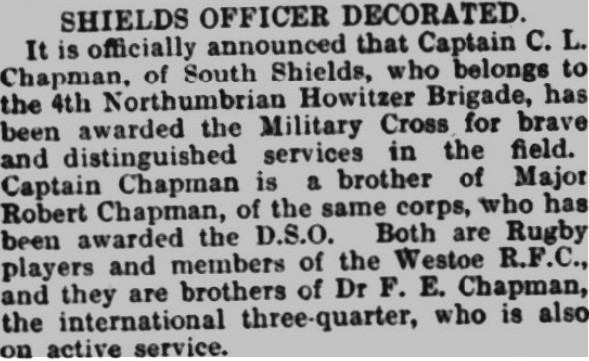
Charles had become the Forward Observation Officer for his unit. On the 16th June 1915, the 4th Battery was supporting the 3rd Division attack on Bellewaarde Ridge, ‘Captain C.L. Chapman was recommended for the D.S.O., for his excellent work. He was also mentioned in Sir Johns French’s despatch. He received the Military Cross in the New Year’s Honours List for 1916. Charles decided to have a career in the Army. He applied for a permanent commission in the Army. His application was dated 30th October 1914. Charles was refused, despite very high recommendations and references from highly influential figures.
On the 14th May 1916, Charles received orders to return to the UK. On the 1st June he was promoted to a Captain and after officers training, he joined the 529 (Howitzer) Battery. He embarked from Southampton and arrived two days later on the 4th October at Le Havre. Charles was now posted to the 36th (Ulster) Division in ‘D’ Battery of the 173 Brigade Royal Field Artillery. They were involved in the Battle of Messines Ridge which commenced on the 31st May 1917.
173 Brigade, raised in the areas of East and West Ham and Croydon in late May and early June 1915, these units, also known as 153, 154 (Howitzer), 172 and 173 Brigades of the Royal Field Artillery, eventually came under orders of the newly-arrived 36th (Ulster) Division. That formation had been raised in Ireland in 1914 without any field artillery of its own, and it had originally been intended to provide it with four brigades of the Territorial Force.
The new brigades initially moved to Bordon Camp but suffered greatly from a lack of even the most basic equipment. When on 31st August 1915 the artillery moved to Lewes in Sussex, where it finally came under orders of the division, “To be frank, there was some dismay when it was discovered how elementary was its training. A year was the estimate by some regular officers of the time needed to make it fit for service.” (Quote from the Divisional History by Cyril Falls).
The delayed state of training meant that in October 1915 the artillery remained in England when the rest of the division went to France. It eventually re-joined it there in late November and early December 1915.
Source: The Long Long Trail.
Charles was then sent on leave from the 21st June to the 1st July 1917. Meanwhile, his earlier application for a commission was now favourably recommended by the Field Marshal Commander in Chief of the British armies, Sir Douglas Haig, with his green fountain pen.
With seniority back to the 4th February 1916 he was accepted into the regular Army with a permanent commission. He was appointed Acting Major on the 8th March 1917.
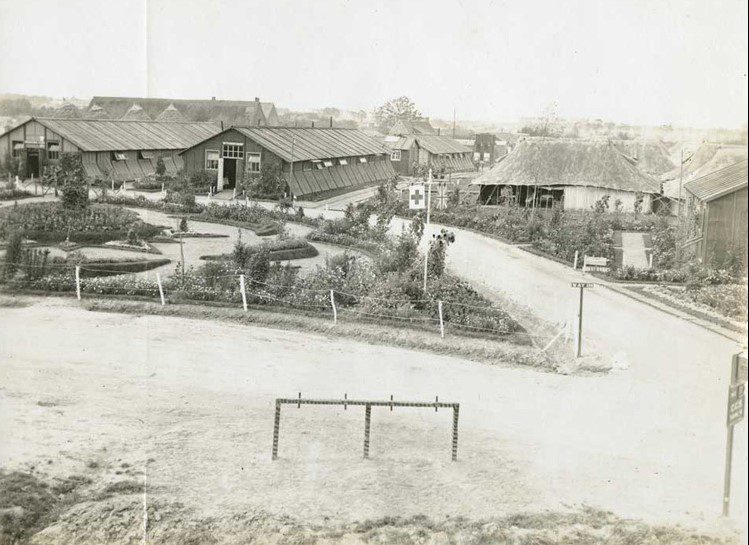
Charles was involved in the Battle of Langemarck which started on the 16th August. The counter battery work by both sides were intense and very heavy, there was no shelter for the crews or the guns. The attack was a failure and the 36th Division received very heavy casualties. On the 19th August, Captain Charles Lancelot was severely wounded by shrapnel from German Artillery firing from commanding positions, in the thigh, right arm, chest and left leg, whilst in his dugout. He was taken to the 2nd Canadian Casualty Clearing Station at Remy Sidings. In the 1917 campaign alone, 30,000 casualties were brought from the nearby front lines to be treated at the Clearing Station.
Charles Lancelot Chapman died of his wounds on the 22nd August 1917 at 9pm at the 2nd Canadian Casualty Clearing Station.
There was a very moving letter sent to his parents on the 4th September 1917 from his comrades at the 4th Durham Battery which was signed by all those that remained.
Research: James Hoy Archive; James Pasby; The British Newspaper Archive ;Mike Todd; The Long Long Trail;
There is an excellent book on the Chapman family titled A Tyneside Heritage by Peter S. Chapman. The History Press 2021. ISBN 978 075099626 6.
Charles Lancelot Chapman is remembered at South Shields on S86.027 and in S86.086, page 3, as well as in S86.104 and at Westoe in W101.05 also in Newcastle Parish notes.
First Name: Charles Lancelot
Last Name: Chapman
Which War: First World War 1914-18
Died: 22/08/1917
Age: 25
Rank: Acting Major
Regiment: Royal Field Artillery
Served in: Army
Unit/Ship: 'D' Battery 173rd Brigade
Decorations: Military Cross, Mentioned in Despatches
Links to Source Material
Shields Daily News Saturday 17/04/1915
Shields Daily News Tuesday 26/02/1918
Shields Daily News Monday 17/01/1916
Shields Daily News Thursday 18/05/1916
Football Gazette 17/09/1910
Shields Daily Gazette Tuesday 04/01/1916
Shields Daily Gazette Monday 27/08/1917