Every Name a Story
Henry Hassan
Every Name a Story
On the Tower Hill Naval Memorial, London is the name of Master Henry Hassan serving on SS Belgian Prince with the Mercantile Marine who died 31/07/1917.
Henry ‘Harry’ Hassan was born on the 8th June 1872 at Main Street, Bangor, Down, Ireland, to Alexander (born 1838, died 1st October 1919), and Eliza ‘Lizzie’ [nee Harrison] Hassan, (born 1856), who were married on the 11th September 1871 at the First Bangor Presbyterian Church.
Henry was the eldest of eight children,
John born 14th March 1874, died 1944, emigrated to the USA, was a bricklayer,
Jane born 14th March 1876, died 25th July 1959 at 25 Park Avenue, Bangor, who married James Wightman, on the 12th July 1901, born 1866 died 1945, [he attested on the 12th August 1915 into the Army Service Corps at the age of 44, service number T5/9056 and was discharged with a 30% disablement pension in 1919], they had 7 children,
Alexander ‘Sandy’ born 21st March 1878, married Mary Ann ‘Minnie’ Mulligan, [born on the 27th October 1881, at Plymouth, died 24th January 1957 at Newcastle upon Tyne], on the 5th November 1912, and they had two children, residing at 67 Richard Street, Newcastle upon Tyne, [Alexander served in the Royal Navy from the 15th February 1895 for 12 years, until the 23rd October 1909. In 1911, he was residing at 1 Brunswick Road, Bangor. Then a second period in the Royal Navy Reserve from the 3rd August 1914 to the 3rd April 1919 during WW1, Alexander gave a false date of birth to join as a Boy Sailor 2nd Class], he died on the 9th April 1959 at the Newcastle General Hospital, he was residing then at 41 Isabella Street, Newcastle upon Tyne, in 1939 he had been living at 73 Richard Street with his wife and one child, [one of their children Sheila Hassan born 25th May 1924, married William Davison, (born 26th September 1918, died 10th February 1987), on the 9th August 1952, they had 3 children in which the son Lance-Corporal, Colin Davison, a Royal Marine, born 9th October 1960, died at Blue Beach, San Carlos Bay, Falklands Islands, on the 27th May 1982, he resided at 27 Garth Vine, Killingworth].
Lena born 8th September 1881, died 13th October 1903 in a Lunatic Asylum in Belfast,
Hugh born 9th December 1885, left Liverpool on the 4th July 1906, onboard the SS Oceanic, ship Number 63332, arriving at New York on the 12th July 1906 with just 15 dollars. His trade was quoted as a Bricklayer and he was going to reside with his eldest brother John Hassan at the Fulty Hotel, Mount Vernon, Ohio,
William born 27th March 1889, served in the Royal Irish Rifles after enlisting at Newtownards with the service number 6/10451 into the 2nd Battalion, he was killed on the 9th August 1915,
and James born 30th January 1892, he enlisted into the Royal Navy on the 12th December 1914, James was Mentioned in Dispatches, and was transferred in to the Machine Gun Corp, M.G.C., was finally discharged in 1919, on the 24th April 1926, he embarked at Belfast on board the Montcalm, ship number 140349, arriving at Montreal, Quebec, Canada on the 1st May 1926, also travelling with him was John Hassan, his eldest brother a bricklayer, James was a Motor mechanic by trade. James’s wife Sarah nee Savage born 1897 died 19th May 1956 at Bangor, was suppose to follow at a later date. They were married on the 29th September 1921, and had four children. James died on the 23rd June 1969 at Bangor, Ireland. Hugh, William and James were all born at Brunswick Road.
The family had resided at Main Street then after 1881 moved to 1 Brunswick Road, Bangor. They resided there until 1911 where by now only James, a cycle mechanic, William working at a golf course and Alexander jnr, both general labourers, were still living at this address, in addition their Aunt Leona Johnston aged 80 was also residing with them. Alexander senior Hassan worked as a Jobbing Mason and in August 1916, he suffered a near fatal accident in his own garden by stepping on a wasps nest. His life was put in danger due to the great number of stings received. Alexander eventually recovered.
Henry Hassan married Elizabeth Robinson Donnan, on the 3rd January 1893 at the Ballymacarrett, St Patrick’s Church of Ireland. Elizabeth was born 1866 and was the daughter of a John Donnan born 1835 and his wife Eliza Jane McGreavy. Henry achieved his certificates as second and first mate in Belfast on the 13th September 1897, and the 5th May 1900 respectively. He then passed his Masters certificate (No. 032301) in 1904 in South Shields. As a mate, the ships he was appointed to were, the Persian Prince, ship number 96128, the Merchant Prince, ship number 105229, the Norse Prince, ship number 125433, the Indian Prince, ship number 129755 and the Roman Prince ship number 133549. Henry was on the St Louis leaving Liverpool bound for the United States at Ellis Island, New York in 1916 and again on the Orduna Ship Number 135539, to the same destination. Henry worked for the Princes Line company, Furness Whithy and Co. The family initially resided at 3 Park Road Hebburn, they then moved after 1911 to 9 Clervan (Clervaux), Terrace, Jarrow.
Henry Hassan was master of the S.S. Belgian Prince. ship number 111307, [The ship was built as the Mohawk in Sunderland by Sir James Laing & Sons Ltd. in 1901 for the Megnatic Steamship Company of Bristol, she was sold twice and finally ended up with the Furness Withy Company (she had been bought by the Prince Line Ltd. in 1912 but in 1916 the line was bought by Furness). In 1915 she was renamed Belgian Prince].
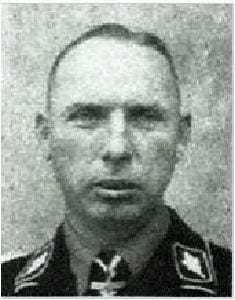
During a voyage from Liverpool to Newport Mews, Virginia, with a cargo of Blue Tray, the SS Belgian Prince was torpedoed by an U Boat U-55, commanded by Kapitanleutnant Wilhelm Werner at 19:50 when they were about 175 miles from Tory Island, Ireland, on the port side between the engine room and the no 5 hold. The engines soon were disabled along with the dynamo, this kept the ship from sending a distress signal. The ship took on a list and the crew abandoned her in three lifeboats. During this time the U-55 surfaced and began to shell the ship with the intention of disabling the wireless, Kapitanleutnant Wilhelm Werner, the commanding officer of the U-55 of course had no way of knowing the wireless could not be used, so this action is understandable.
For an unknown reason the U-55 moved around to the starboard side and fired her machine gun at the ship. Werner then approached the three lifeboats which held the entire forty-two man crew. They were all ordered to get out of the boats and taken on board the casing of the U-55. The Master, Harry Hassan was taken below while the men on deck were searched. They were asked if they had any weapons and handled quite roughly by the German crew, according to the survivors.
The crew of the U-55, under orders from Werner, took the lifebelts from most of the survivors and threw them overboard. They then got into the lifeboats, took what they wanted and tossed the rest into the sea, removed the corks and further damaged them with axes to be sure they would sink. One small boat was kept intact and boarded by five of the Germans who took her to the damaged drifting hulk. According to Chief Engineer Thomas A. Bowman, one of the three survivors; ‘When they boarded her they signalled to the submarine with a flash lamp, and then the submarine cast the damaged lifeboats adrift and steamed away from the ship for about two miles, after which he stopped.’
If the crew were taken aboard the U-55 to be returned to Germany as Prisoners of War getting the men on board and destroying the lifeboats would be understandable, a U-boat captain did not want to leave any evidence floating in the water that would indicate that a ship had been sunk lest his boat be discovered, and drifting lifeboats were the best evidence. However at this time the Belgian Prince had not sunk and Werner even had some of his own men on the ship. The U-55 crew then went below and closed the hatch and the boat got underway on the surface. Werner sailed about two miles then submerged the U-55 with the forty-one survivors still on the casing of the boat.
Chief Engineer Bowman stated; ‘About 10 p.m. the submarine dived and threw everybody in the water without any means of saving themselves, as the majority of them had had their lifebelts taken off them.’ Having taken their lifebelts and destroyed their lifeboats he now decided to just drown the entire crew, a clear act of cruelty and outright wilful murder, and this was not the first time he had done this. There were three survivors.
Able Seaman George Silenski swam back to the Belgium Prince and re-boarded her, he was on board when the U-boat came alongside of the ship the early the next morning. He said several Germans boarded the stricken ship and looted her, lucky for him the Germans did not see him and he jumped off the ship and got into a small boat which was nearby.
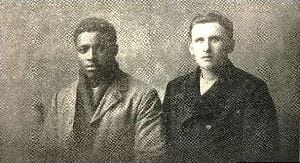
The third survivor was an American negro, 2nd Cook William Snell of Jacksonville Florida, he survived by hiding his lifebelt under his clothes. After the U-55 went under he also headed for the only place he could, the Belgian Prince. He got within a mile when he saw the Belgian Prince explode and sink. Silenski stated the U-boat fired two shots from her deck gun and the Belgian Prince sank stern first at about 07:00am on the 1st August 1917. Thirty-nine crewmen died in the North Atlantic, courtesy of Wilhelm Werner and the crew of the U-55, but what happened to the ship’s master? It is unclear if Harry Hassan was brought back on deck or kept as a Prisoner of War, but he ‘was never seen or heard from again by his family.’ Bringing the total lives lost to forty.
The KTB (Kriegstagebuch, in English War Diary) of U-55 mentions little of the event;
‘July 31: Unterwasserangriff. Heckschu, G-Torpedo. Scheneidewinkel 80, 600 m, Treffer Mitte. Englischer bewaffneter Viermastendampfer, 4800ts, in Ballast auslaufend. Vor Bewacher getaucht.’ (Attack submerged. stern tube, G-torpedo. Edge angle 80, 600 m, hit at center. Armed British four masted steamer, 4,800 tons, leaking out of ballast tanks. Dive in front of escort ship.)
‘Aug. 1: Dampfer mit Sprengpatrone versenkt; vor Foxglove bis 9 h vm getaucht.’
(Steamer sunk with scuttling charges, dive at 9 a.m. in front of Foxglove).
Werner makes no mention of the name of the ship, or the fate of the crew. He also makes no mention of taking the captain prisoner, a clearly evasive entry in the log of his boat.
[The U-55 was commanded by Oberleutnant zur See Wilhelm Werner but was promoted to Kapitanleutnant on the 24th April 1916. He was born on the 6th June 1888, at Apola. He was charged with War Crimes after the war, for sinking without warning the Clearfield, ship number 125451, Artist, ship number 128007, Trevone, ship number 128648, Torrington, ship number 119969, Toro ship number 118833 and attacking the hospital ships Rewa ship number 121332 and the Guildford Castle ship number132611. In the course of time this was reduced to a single charge of sinking the SS Torrington, and murdering the whole crew except the captain who was taken prisoner. He never appeared at the Leipzig trials, he fled Germany to work on a coffee plantation in Brazil. After some years he returned to Germany and even became a National Socialist member of the Reichstag. He eventually joined the SS and rose to the rank of SS Brigadefuhrer serving on the Reichsfuhrer, SS Heinrich Himmler’s personal staff. He died 14th May 1945].
The Shields Gazette at the time had the Headlines of:-
Cold Blooded Murder
Admiralty and the Drowning of the Crew of a Tyne Steamer
The Secretary of the Admiralty yesterday made he following announcement:- As already reported unofficially an the Press, the British steamship Belgian Prince was torpedoed by a German submarine on July 31st. The crew abandoned the ship in two boats, and were ordered on the upper deck of the submarine. Under his direction the boats were then smashed with axes and the crew of the Belgian Prince deprived of their lifebelts.
The master [Harry Hassan] was taken below and the hatch closed. The submarine submerged without warning with 43 men standing on her deck. This was the entire crew of the Belgian Prince with the exception of three. All these were drowned. The three survivors had contrived to retain their lifebelts without the knowledge of the enemy. They were picked up after having been in the water for 11 hours.
The details of this atrocious outrage are supported by the separate affidavits of the three survivors. The cold-blooded murder of these men equals, if it does not transcend, the worst crimes which our enemies have committed against humanity.
Local Victims
Cyril Joseph Hoey 17, the only son of Mr and Mrs S. Hoey, master and matron of Morpeth Workhouse, was one of the victims of the Belgian Prince. He was serving his apprenticeship on the vessel. Another of the victims from the crew of the Belgian Prince was an Apprentice Ralph Henderson Robinson age aged 18, whose widowed mother lives in Chester le Street. He was an only child. He had been away from for less than a fortnight when he was drowned, and had been at home as a consequence of having been torpedoed previously. A month ago he gave an exhibition of high diving at a local swimming gala, and won one of the prizes.
The three survivors [George Silenski, Thomas A. Bowman and William Snell], were taken to the Sailors’ Rest in Londonderry, where they were tended to by the maritime charity now known as the Sailors’ Society. George Silenski was saved by fellow crew member Richard Thornton who gave his life for George Silenski.
You can read the 3 survivors accounts here on the images section. At 8:00 a.m., the sloop Gladiolus that had rushed up was able to take the three surviving sailors on board and rescue them.
There is no evidence to support the theory that Hassan was taken to a Prisoner of War Camp. There is a list issued by the Board of Trade on the 31st May 1918 of Merchant Seaman/Fishermen detained as Prisoners of War in Germany, however this was not supported by the Red Cross after extensive enquiries.
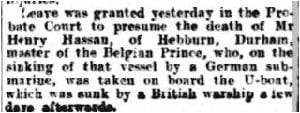
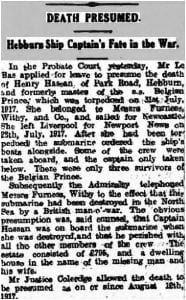
Mr La Bas who made the application said that Mr Hassan who lived at 3 Park Road, Hebburn in County Durham was Master of the steamship Belgian Prince, which belonged to Messrs Furness, Withy and Co Ltd. The Belgian Prince sailed from Liverpool on 28 July 28 1917 bound for Newport News. On 3 August information was received by the London office of Messrs Furness Withy & Co from the Admiralty, through the War Risks Association, that the steamer Belgian Prince was sunk by torpedo in the Atlantic. There were three survivors and they had made declarations which were placed before the Court.
Counsel said he was only permitted by the Admiralty to read parts of the declarations. The facts he was allowed to state were that the ship was torpedoed by a submarine; that the submarine ordered the boats alongside, took certain of the crew on board, and took also the Master on board. The Master (Mr Hassan) was taken below. Subsequently information was received from the Admiralty that that submarine had been destroyed by a British warship in the North Sea on its way home on 12 August 1917. [This is not true, as the submarine involved surrendered at the end of the War, it was not destroyed. The Admiralty were confusing another U Boat with the same event U-44]. The obvious presumption was that the Master, if alive at all at that date, was still on board the submarine and that when the submarine was sunk all in it perished. Nothing had been heard of Mr Hassan since. The estate consisted of 794 [sic] and there was also a dwelling-house which was vested in him and his wife as joint tenants.
Mr Justice Coleridge granted leave to presume the death of Mr Hassan on or since 12 August 1917. The date of death recorded on the CWGC Debt of Honour is the 31st July 1917 the date on which the SS Belgian Prince sank.
Elizabeth his wife now a widow, returned to Ireland before 1924, and died in Belfast on the 21st June 1936, and is buried in Dundonald Cemetery, Belfast.
Henry Hassan is remembered at Hebburn on H93.45, in our List of Ships’ Crews and at Cork in Ireland.
First Name: Henry
Last Name: Hassan
Which War: First World War 1914-18
Died: 31/07/1917
Rank: Master
Served in: Merchant Navy
Unit/Ship: S.S. Belgian Prince
Links to Source Material