
Every Name a Story
Thomas Minks
Every Name a Story
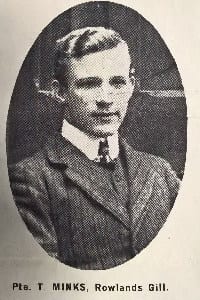
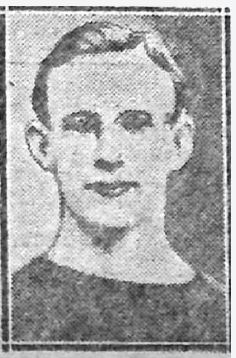
In St. Patrick Churchyard and Hookergate Cemetery is the Commonwealth War Grave of 18/328 Private Thomas Minks serving with the 18th (service) Battalion Durham Light Infantry, who died 17/12/1914.
Thomas Minks was born at 9 Allendale Cottages, between Medomsley and High Westwood, Durham, on the 21st December 1888, baptised at Medomsley on the 6th February 1889, the second eldest son of seven children to a Robert Minks, born Iveston, 1853, died 19th November 1904 and his wife Elizabeth nee Foreman, Minks, born May 1889, baptised 20th June 1889, died 27th August 1925. They were married in 1889.
The other children were: –
- William Bailey Minks, born 16th February 1879. He was a deputy overman at the Victoria Garsfield Colliery, employed by the Priestman Colliery Company. He was married in 1904 to an Isabella Houston.
In 1921, he was residing at Melbourne House, Rowlands Gill, By 1939, he was widowed and was residing at 20 Nell Terrace, Highfield, Blaydon and was a Permanent Way Labourer. Died 21st January 1943. Buried Blackhill Cemetery. He was a Freemason in the Tynedale Lodge at Lemington on Tyne, he was initiated on the 1st October 1914. - Alice Hannah Minks, born 16th April 1892, died 1964. She was educated at the Westwood Mixed Council Infants school then High Westwood school from the 1st September 1998 to the 21st September 1906. In 1908, she took part in the 6th Annual athletic sports of the Consett Technical Institute and Secondary Day school at Aynsley Terrace. She came forth in the three legged race, her sister Martha was first in the 80 yards for girls, Alice was fourth in the 80 yards girls over 14 and a half, Fifth in the Obstacle race for girls. She became a student teacher then a certified teacher. Alice attended Hereford Training College. 1st August 1920. was the date she registered with the Teachers Registration Council. Her previous experience was assistant mistress from 1911 to 1912 at the C.E. School Ebchester, then 1914 to 1922, Westwood Council Mixed School, Hamsterley Colliery, Newcastle upon Tyne [sic] She married a Henry Moore, born 7th June 1890, also a teacher, in 1922. In 1921, she was residing at Melbourne House, Rowlands Gill. By 1939, they were residing at 20 The Avenue, Consett, now with two children, John B. Moore, born 26th April 1923 and Kenneth H. born 1st September 1925. Henry Moore was an ARP in the Civil Defence..
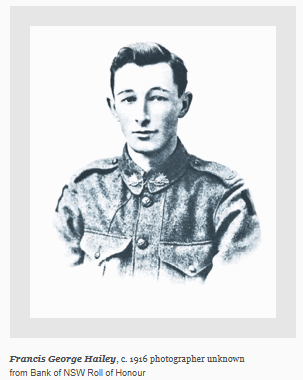
- Martha Amelia Minks, born 9th September 1893, died 31st August 1970. She was educated at the Westwood Council Mixed Infants School from the 1st September 1899 to the 20th September 1907, also at the Darlington Holy Trinity School. She was employed as a Telephonist at the Post Office at Newcastle upon Tyne, passing her open competition entrance examination in the Civil Service from the 5th February 1914. In September 1915, she received a 1st Class first aid certificate at the Primitive Methodist church, Victoria Garsfield, for members of the St John Ambulance Brigade. She was a member of the Ambulance and Nursing Division of Victoria Garsfield and Rowlands Gill. She married an Australian, Sergeant George Francis Hailey on the 24th September 1919. at St Johns’ Brixton, Lambeth, London. They emigrated to Australia. [Francis George Hailey was born on the 23rd September, 1895, at Carcoar, New South Wales, the son of Mr. Frank and Mrs. Catherine Hailey. He was educated at the Cowra Public School, and entered the employ of the Bank at Barmedman, New South Wales, in October, 1913. In December, 1914, he was transferred to Junee. Francis George Hailey enlisted in the A.I.F. on 25th April, 1916, and reached France in the following September as a member of the 53rd Battalion. He was engaged in the battles of the Somme from December and was transferred to the Bullecourt sector in May, 1917. He was also at Ypres in September, 1917, and did his share in the capture of Polygon Wood. After that action he was transferred to the Wytschaete sector; thence back to the Somme in March, 1918, and was at Villers-Bretonneux, where he was gassed on 17th April. He was invalided to England and eventually returned to Australia, having been promoted to sergeant on 13th August, 1919. He died on the 27th December 1950].
- Mavis Minks, born 20th June 1896, died 1973. Educated at the Westwood County Mixed School from the 1st September 1902, she left on the 11th September 1908. She was employed by the North Eastern railway as a cashier clerk at Newcastle upon Tyne. In 1921, she was residing at Melbourne House, Rowlands Gill, Winlaton, Co. Durham.
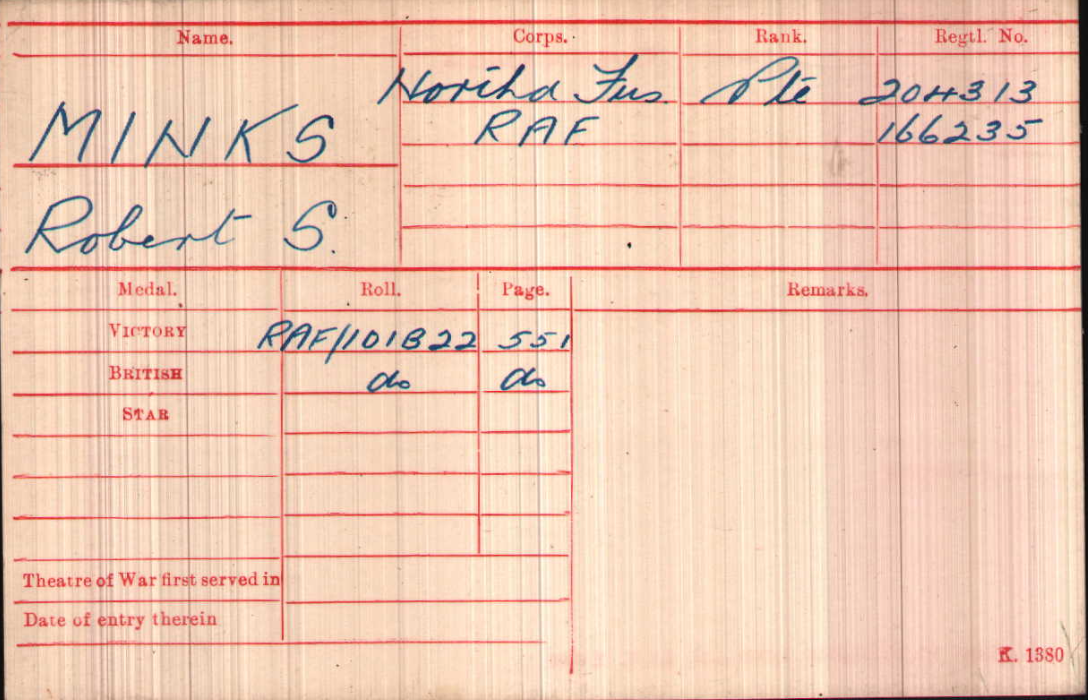
- Robert Sydney Minks, born 29th April 1898, died 26th March 1968 at York. He resided at 43 Beech Grove, York. In 1921, he was employed by the North Eastern Railway as a Goods Clerk at Consett. Robert Sydney was in the 4th T.F. Battalion Northumberland Fusiliers in WW1, Service number 204313, from the 22nd November 1916. He transferred to the Royal Air Force on the 1st April 1918, given a new number 166235. Robert was a clerk in the RAF. 5 Feet five and a half inches. Also promoted to a Corporal on the 8th January 1919. He was promoted again to Staff Sergeant on the 27th September 1919, then a Clerk class 1 on the 19th October 1919. On the 23rd November 1919, Robert is discharged from the RAF. He married an Florence L Ord, born 16th November 1902, died 1995, in 1927 at Gateshead. They had two children, Sydney Bryan Minks, born 27th December 1928, died 1998 and Bernard Dale Minks, born 20th May 1931, died 2nd April 2011.
- Mary Jane ‘Jeannie’ Minks, born 1890. She was employed by the North Eastern Railway as as correspondence clerk in 1921.
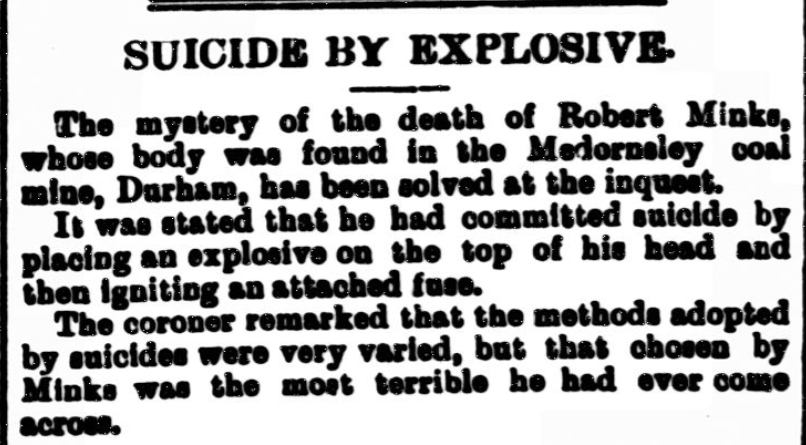
Robert the father was a deputy at Derwent Pit Colliery at Medomsley. In 1891, now married was residing at 9 Allendale Cottages, before moving to 15 Allendale Cottages by 1901. By 1901, the family had moved to 15 Allendale Cottages. Robert and his wife Elizabeth resided at 14 Fines Cottages, Medomsley after 1901. The father committed suicide on the 19th November 1904. This was decided by an inquest jury a few weeks later when his body was discovered in a remote part of the mine. His body when found, had a hole in the Skull, was in the south second west, where there had been a large fall.
The son William Minks gave evidence of identification. His father went to work at 10 o’clock at the Derwent Colliery on the 20th November. He had seen the remains at the ambulance house at the colliery that morning, and recognised them of his father by his clothes, face and teeth. The Dr William Allan perceived that a considerable portion of the scalp at the top of his head was missing, and the edges of the surrounding scalp were pulpy and decomposed. It was concluded that a strong explosive applied to the head would reproduce the injury as described. Cause of death laceration of the Brain. [Robert Minks about a fortnight before had enquired about fuses and charges and detonators]. The Coroner in summing up, The evidence pointed to a case of Suicide, and that the man had devised a way of destroying himself in a remote part of the pit where his body was not likely to be found. The only way he could have done this under the circumstances was by placing a detonator on the top of his head and setting the fuse alight.
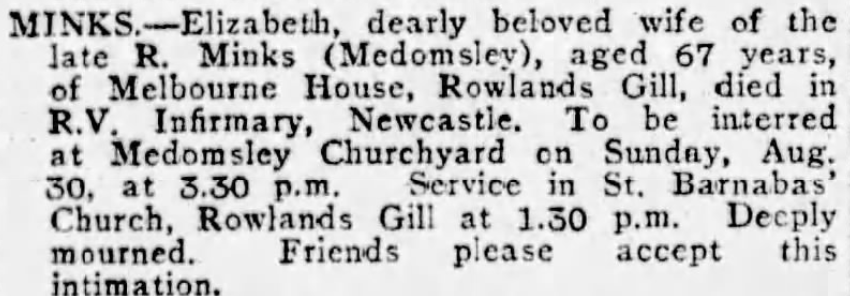
His wife Elizabeth was the eldest daughter of a William and Eva Foreman. She became invalided in later life. She received a pension of 5s [Shillings] a week. She passed away on the 27th August 1925 at the Royal Victoria Infirmary.
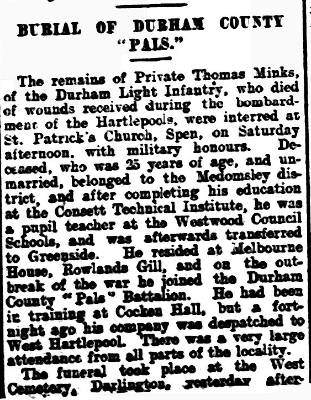
Thomas was educated at the Darlington Holy Trinity School infants then Westwood Council Mixed School, from the 16th September 1895, and then at the Consett Pupil Teacher training centre. Whilst training he was a Pupil Teacher at Westwood School. He then attended Bede College in Durham to train as a Teacher from September 1907 to July 1909. Thomas was also a member of the Rowlands Gill Tennis club, and a Private Leslie David Turner who also died in the Bombardment at Hartlepool was also a member.
In 1911, Elizabeth Minks was a newsagent at Rowlands Gill. Thomas was an Assistant schoolmaster, his sister Alice, was now a student teacher. The rest of the family were assisting their mother in running the newsagents shop. By 1914, Thomas had become a certified teacher and was employed at the Highfield Council School near Rowlands Gill, then he was moved to Greenside, working for Durham Education Committee.
His Short Service Attestation form, [3 years service], completed upon his entering the regular army on the 21st September 1914, aged 25, height 5 feet 6 inches, 131 lbs, grey eyes with light brown hair, Church of England, notes that he already had two years of service in the 1/8th Battalion, Durham Light Infantry in ‘G’ Company, Territorial Force. He was then transferred from this unit to the 18th Battalion, the Durham Pals, Durham Light Infantry. His address at this time was Melbourne House, Rowlands Gill, Winlaton, Co Durham. On September 24th, recruits began to assemble rapidly at Cocken Hall, the Durham City and District Contingent marching from the Race-course. They were soon joined by contingents from South Shields, Sunderland, Hartlepool and Darlington. Owing to the rapid increase in numbers additional accommodation had soon to be found, ‘B’ Company moved to billets in West Rainton and ‘A’ Company shortly after to Newton Hall. By early October the Battalion was raised to its full establishment, and in the beginning of 1915 it was increased to six companies, about 1300 strong.
During the first six weeks the training had consisted largely of route-marching. Meanwhile two companies of men, [who had been trained in Musketry],were despatched to Hartlepool on November 16th 1914 to take up Coast Defence Duty. These two companies were commanded by Major F.T. Tristam and the men were selected who had fired a course on an open range. This detachment entrained at Leamside and proceeded to Hartlepool. On arrival at Hartlepool, they were billeted at Hart Road. Later one company moved to old Hartlepool. The work chiefly composes of providing guards at various tactical points and places of importance, also improvement of the existing trenches.
On December 15th Colonel P. H. Hammond, who was in command of the Tyne and Tees Defences, received information from the War Office of the possibility of a raid by enemy warships on the East Coast on the following day at about 8.30am. The trenches were manned as usual and the rest of the detachment stood to. Wednesday, 16th December, there was a mist which allowed the German ships to come in close before being detected, also firing out to sea in a clever ruse to give the impression they were British ships retiring.
The previous evening four battle cruisers, Seydlitz, Moltke, Von der Tann and Derrflinger’; one heavy cruiser, Blucher, four light cruisers and two flotillas of destroyers had left their base, heading out into the North Sea. The intention was to bombard Hartlepool and Scarborough, both were by now fortified towns and considered legitimate targets.
Facing this massive force armed with a total of twenty 11 inch and twelve 8.2 inch guns were the three six inch guns of the Heugh Battery and a flotilla comprising of two scout cruisers, four destroyers and a [HMS C9] submarine based in the port. That morning the four destroyers HMS Doon, HMS Waveney, HMS Test and HMS Moy a division of the 9th DF, were already at sea but without the scout cruisers HMS Patrol [under the command of Captain Bruce] and HMS Forward which were still in port, [some reports say they were getting ready to sail]. At 8.00am the four destroyers sighted the German ships but their puny 12 pounder armament meant they were hopelessly outgunned and the German warships easily chased them off, but not before HMS Doon fired a torpedo which unfortunately missed.
No-one in the town heard anything. The Seydiltz, Moltke and Blucher continued to steam towards the nearest target and the rest headed for Scarborough.
The telephone conversation at this time was recorded.
At 8.00am, War Signal of the Port telephones that the three warships are approaching at great speed. The officer is at once called to the telephone and rings up the Petty Officer.
‘What ships are they?’ he asks. The Petty Officer answers back-“I believe they are own ships, as they are flying the White Ensign!”
“What class are they?” asks the officer. “I believe the Indomitable class,” replies the Petty Officer. Immediately after this little colloquy, firing is heard out at sea. The destroyers are assailing and are being assailed. “What are they firing at?” asks the officer. “I presume at the enemy,” says the Petty Officer. “Are you sure they are not firing at our own destroyers, which put to sea two hours ago?” is the next question, and “I can’t see what they are firing at,” is the reply.
At 8.10 a.m. as the inhabitants were readying themselves for the days work, the first shell was fired. They were aiming at the shore batteries and the Lighthouse. The shell cut all the lines of communications between the batteries throwing them into confusion.
By 8.25 a.m. most of the ships had come as close as four thousand yards and had begun to pour their fire into the gun emplacements and the docks. Some of the armour piercing shells had delayed action fuses and a number bounced off the batteries into the town.
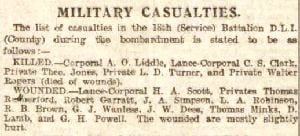
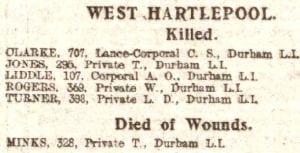
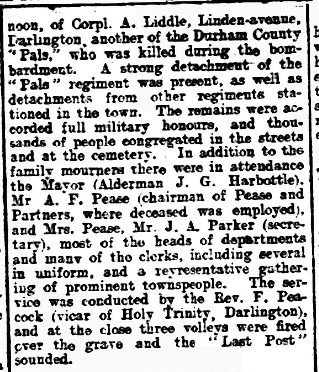
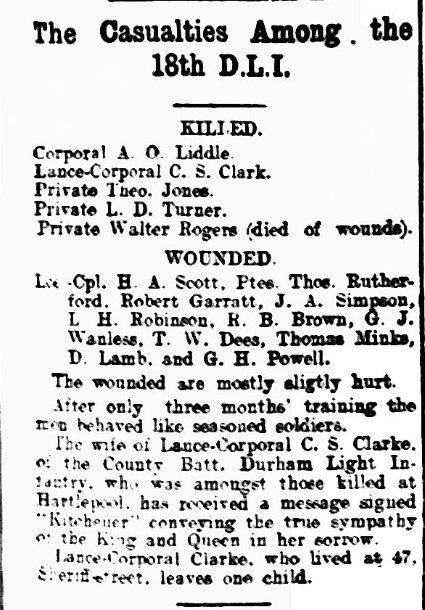
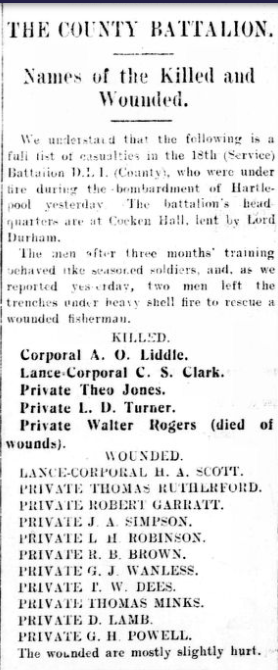
The first shots landed close to the Heugh Battery, killing Private Theophilus Jones (aged 29) of the 18th Battalion D.L.I. Three other soldiers were fatally wounded at the same time. [Private Leslie David Turner was one of them]. Theo became known as the first soldier to be killed on English soil during the First World War. The first shell landed on the right hand corner of the battery, killing the sentry, and three of the infantry guard. Two more soldiers were killed running to pick up their comrades who had fallen, by the next shell. This also hit the telephone line between the two batteries, so the Commander had to try to relay orders by megaphone. This proved impossible because of the noise, so a man was sent to stand between the command post and the battery to relay orders by word of mouth.
The Lighthouse Battery gun managed to hit the Blucher, killing nine sailors and causing damage to the ship and two of her 6-inch guns. Following this, Blucher placed herself in such a position that the batteries were unable to fire on her because the lighthouse blocked their line of fire.
Three British coastal defence craft -two light cruisers, HMS Patrol, HMS Forward and a HMS C9 submarine, were moored in the Victoria Dock at the time of the attack. The submarine was hit as it came out of the harbour, which then blocked the way for the cruisers behind it. This left them unable to help during the following attack.
Both batteries fought back bravely but were hampered by misfiring guns and dud ammunition. Fortunately the Germans were using standard anti ship ammunition with time delay fuses which bounced off the gun aprons to explode behind the batteries otherwise casualties among the gunners would have been far higher. Lighthouse Battery did particularly well as one shot seems to have temporarily disabled the Blucher almost forcing her to run aground.
The Germans spent nearly an hour relentlessly bombarding Hartlepool pouring 1,150 shells into the town, for the terrified people it must have seemed that the carnage would never stop. At 8.52am the German squadron fired its last shell and as quickly as it had appeared, it withdrew into the mists of the North Sea. They left 102 people dead including nine soldiers, seven sailors, 15 children and 467 wounded. Seven churches, ten public buildings, five hotels and more than 300 houses were damaged. But the Germans did not escape completely unscathed, the Heugh battery had fired 123 rounds mainly at the Blucher smashing her fore-bridge, damaging some of her guns and killing nine.
For their bravery the Gun Captains at the Heugh were awarded the first ever pair of Military Medals and the Lighthouse Gun Sergeant, Sergeant T. Douthwaite won the Distinguished Conduct Medal. Controversially the commander, Lieutenant Colonel L. Robson also won a number of awards but his subordinates who actually fought the action went unrewarded, thanks to their German ancestry.
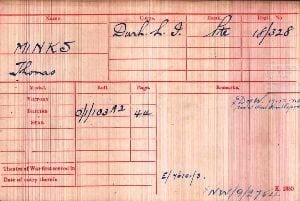
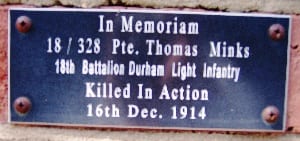
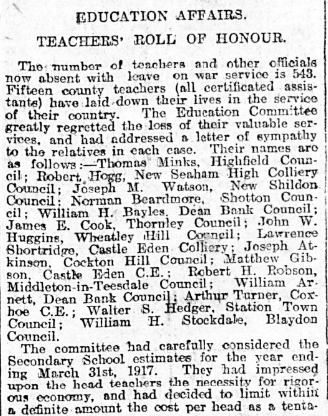
Thomas Minks died of wounds received from the bombardment of Hartlepool on the 17th December 1914. He was the first Durham County Council employee to die in World War 1. He only completed 88 days in service and was awarded the British War Medal. This was not claimed by his mother until 16th January 1923. Because his military service was so short he did not qualify for a War Gratuity.
Adam Smith, head teacher at Highfield School made two entries in the School log;
28/9/1914: Mr. Minks left today to join the “service” tomorrow, “Bede College” Corps.
23/12/1914. Mr. T. Minks CA was killed at Hartlepool on Wednesday 16th December.”
“CA” stands for “Certificated Assistant”.
His brother Robert Sydney Minks, had moved to Springfield, Guildford Road, Woking, by 1919. He eventually moved to York and resided at 43 Beech Grove.
Sources: British Newspaper Archive; Western Front Association; Heugh Gun Battery; Hartlepool Local Library; Naval Net; National Archives; IWM; De Ruvigney Roll of Honour Vol 3, page 195.
Thomas Minks is remembered at Consett on C101.13, at Durham on D47.017, D47.052, D47.126, D47.127 and D47.141, at Hartlepool on H115.21 and H115.74 with the incorrect date of death, at High Spen on H106.02 and H106.03, at Medomsley on M36.05, at West Hartlepool in W111.77, on our Lists of Teachers who fell in 1914-18 and in Teachers who served in 1914-18 and in the D.L.I. Book of Remembrance page 334.
First Name: Thomas
Last Name: Minks
Service Number: 18/328
Which War: First World War 1914-18
Died: 17/12/1914
Age: 25
Rank: Private
Regiment: Durham Light Infantry
Served in: Army
Unit/Ship: 18th (Service) Battalion
Links to Source Material
If you know more about this person, please send the details to NEWMP.
