Every Name a Story
Thomas Mark Smith
Every Name a Story
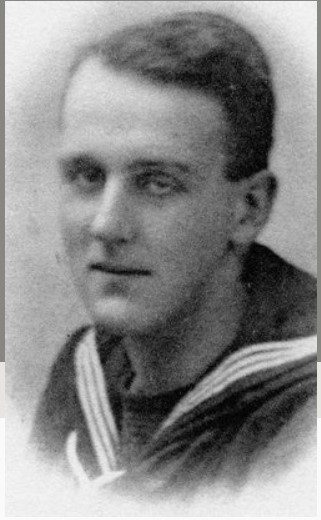
On the Helles Memorial Turkey (including Gallipoli) is the name of LZ/1018 Leading Seaman Thomas Mark Smith, serving with ‘D’ Company, Hawke Battalion, Royal Naval Division who died 20/06/1915.
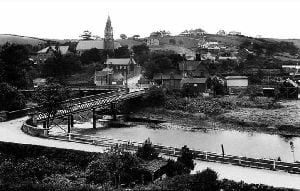
Thomas Mark Smith was born on the 25th February 1892, at Greatham, Durham, the eldest boy of three children to John William Smith, born Whitby, 1864, died 1906, who was a Master Mariner in the Merchant Marine, and his wife Isabella nee Mark, born 1863, a Pupil Teacher in 1881. They were married in 1888. One of the children had died. The other child was
John Forest Smith, ‘Forrest’ born 13th October 1893, died 3rd August 1973. (John Forest Smith received his medical education at St Thomas’s Hospital, qualifying with the Conjoint in 1916. After house appointments at St Thomas’s, he was awarded the John and Temple research fellowship in 1922. He took the MRCP in 1925, was appointed to the staff of St Thomas’s in 1928, and elected a Fellow of the College in 1931).
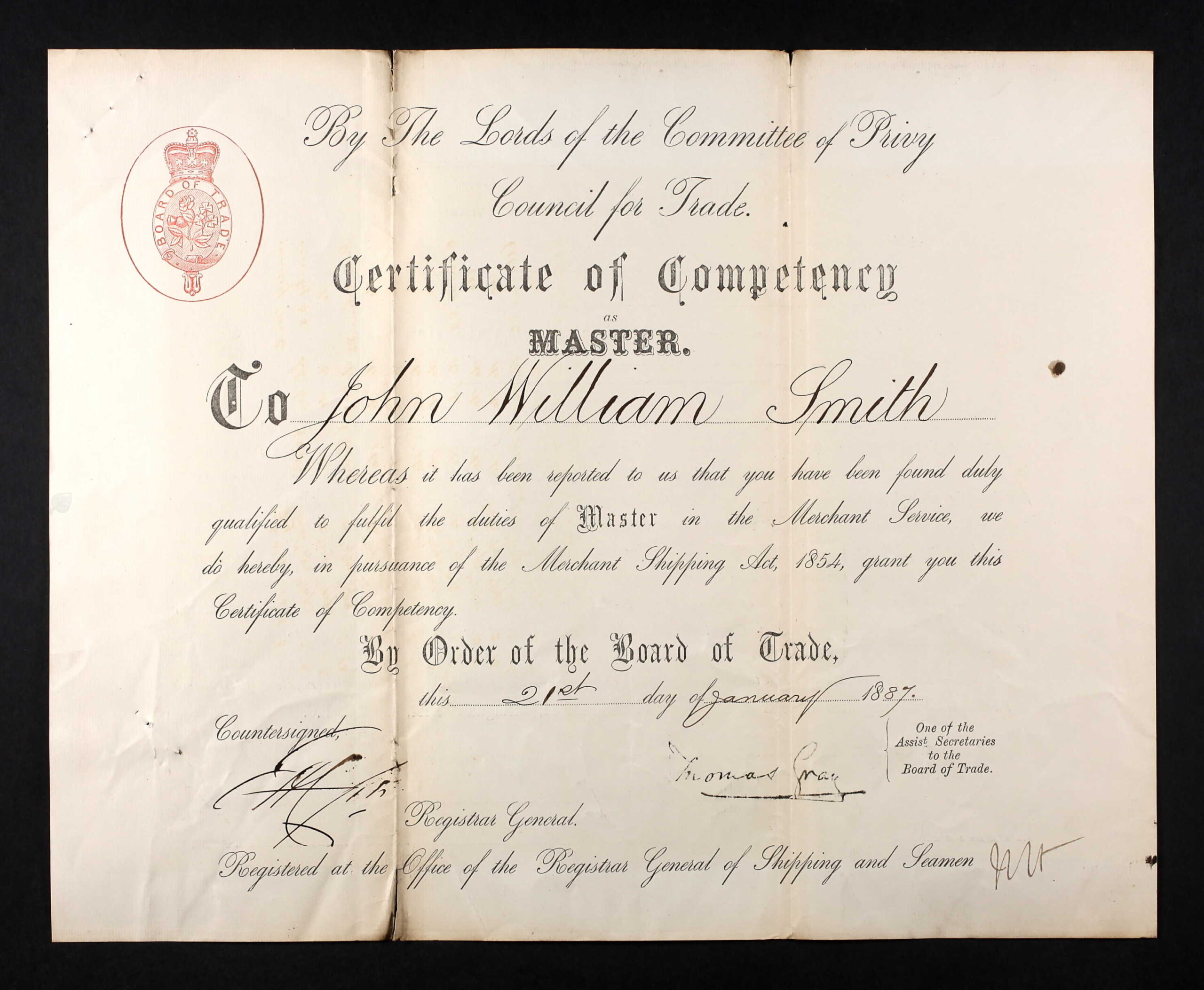
John William Smith, was the son of Ralph Smith, born Whitby, 1834, died 1914, and his wife Jane nee Boulby Smith, (who were married in 1860), were farmers and in 1881 were residing at the Bells Hotel, Baxtergate, Whitby. They had nine children. John William Smith passed his Master’s Certificate at Arbroath on the 21st January 1887.
Their residence address in 1901 was Greatham House, Chubb Hill, Ruswarp, Yorkshire.
By 1911, Thomas was residing at Front Street, Greatham, Stockton on Tees, Durham, with George Fox, aged 52, (a Elementary school teacher), his wife Annie Margaret age 51, their daughter Frances Margaret age 17. Also at the same address was Thomas’s mother Isabella Smith, age 46 now a widow, who was sister-in-law to George Fox, also Thomas’s brother John Forest Smith then aged 17. Thomas Mark Smith was educated at West Hartlepool Technical School. Residing at 129 Thornton Street, during the academic year 1912-13.
Thomas was employed as a Marine Engineer Apprentice then a Draughtsman by Messrs. William Gray and Co Ltd at West Hartlepool. He also was one of the first Undergraduates to enrol at the Imperial College at London to study for a marine engineering degree. His brother was then a medical student at St Thomas Hospital, London, who served in the R.A.M.C., in WW1 was captured but escaped. He died in 1973.
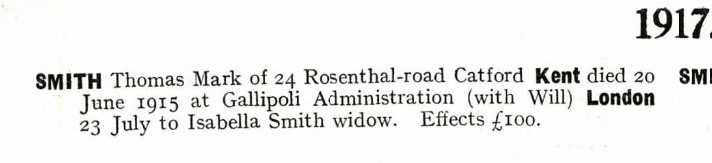
When Thomas enlisted, the family had moved to 24 Rosenthal Road, Catford. Thomas’s father had died in December 1906.
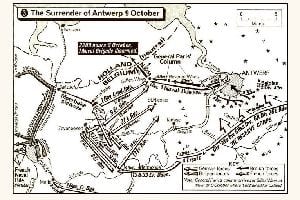
Thomas enlisted in a Public Schools Battalion, on the 8th January 1915, as his name is on the Nominal Roll of the Public Schools Battalion. He was an able bodied seaman on the 6th April then a Leading seaman on the following Day. On the 3rd of May, he is at Blandford, [where the Royal Naval Division did its training], and from there was transferred to the Hawke Battalion ‘D’ Company. [In October 1914, a large number of men of Hawke Battalion were either captured by the Germans or crossed into Holland and were Interned for the Duration of the War, as they retreated from Antwerp]. Thomas was 5 feet ten inches tall, Fair complexion, Dark Brown hair with Hazel eyes.
A new Hawke Battalion was raised, ‘D’ Company was formed by volunteers from the ‘Public Schools Battalion.’ They remained in England when the Royal Naval Division sailed for the Dardanelles, finally re-joining the Royal Naval Division at Cape Helles on the 30th May 1915. The Hawke Battalion saw action at Gallipoli, from 30th May 1915 to January 1916. MEF (Mudros & Imbros) January – May 1916.
In May 1916, Hawke Battalion joined the BEF as part of 189th Brigade, 63rd (RN) Division seeing action in France and Belgium until May 1919.
Thomas’s service record card reads as follows:- 8th January 1915. On the Nominal Roll of the Public School Battalion.
3rd May 1915. Hawke Battalion D Co [Company] Blandford. (Checked for disc)
3rd July 1915. Hawke Battalion, Missing 20/6/1915. RND List 180.
9th August 1915. NOK advise letter retd, marked Dead. Cabled Alex [Alexandria] R O 66 for confirmation.
23rd September 1915. MFC 17879 recvd. Nothing further reported. NOK inf [informed] 24.9.15.
20th July 1915. Recd D.O. No 3 dtd ?.7.15,-Missing (Dnelles) 20.06.1915.
28th September 1915. Enquired through F.O.
26th January 1916. Circular enquiry for further news sent to NOK.
31st January 1916. Recd, reply from NOK, saying he was last seen by A.B. Francis Glen, Tyneside Z/258, who left him alone in the trench looking after his dying officer, Sub-Lieut Tremayne.
27th February 1917. Service cert sent to C.P. Depot for entry of service at Depot and for transmission to S.C.O. Blandford.
29th March 1916. RND Missing Circular, No 1, recd from O/C 3rd Reserve Battn. gives Killed on June 20th during an attack on the sap while operation with the machine gun.
29th March 1916 Wrote to O/C 3rd Res Battn, for full signed report.
19th June 1916. Recd reply through F.O. No news.
20th June 1916. NOK Informed.
3rd July 1917 NOK informed death accepted by Board/Authy assumed killed in action 20th June 1915 AFB 209c rendered 3.7.16.
5th July 1916. RND List no 648.
10th July 1916. R.N.D. DD List no 60.
16th July 1916 Recd BEF Hawke DO 73-13.7.1916-Reported Missing, Dardanelles. Death accepted for Official purposes 20.6.15. Authority:- AFB 2090C from C in C Records, R.N.D. London.
7th August 1916. AFB 209c returned from Base R.O.
22nd August 1916. A.F. 209C Passed to A.G. 9 Reg Page No 19.
17th July 1916. AFB/103 Received and Filed.
13th March 1917, D.C. no 1944 sent to NOK
13th July 1917. Duplicate D.C. sent to N.O.K.
24th February 1919. W.G [WAR GRAVE] form passed to A.G. 9B, Paid
26th August 1921, S.C passed to A.G.14 for disposal.
On the day in question that Thomas died there were at least 18 other casualties from the Hawke Battalion.
HELLES – Following the Third Battle of Krithia on the 4th June, Major General Sir Archibald Paris commanding the RND had decided to push forward a more advanced firing line into No Man’s Land. It was realised that they could get forward some 100 yards reasonably easily but that in the centre of the RND line there was an advanced Turkish trench which if captured would allow an even greater advance.
The Hawke Battalion was ordered to attack on the night of the 19th June. Lieutenant Douglas Jerrold left an outline of the fighting when the attack started at 00.30 on 19 June.
A dark, moonless night, and particularly quiet. The Turkish rapid fire was by now far less active, as our machine gunners learnt to keep the Turks below their parapets. Punctually at 12.30am Morgan led out his platoons from the saphead, and giving the word himself led the attack. From that moment the fortunes of this miniature battle alternated with bewildering speed. Advancing with more enthusiasm than method, and adopting the old fashioned and probably mistaken habit of cheering as they advanced, the assaulting line was seen to reach the trench; then there was a burst of firing from the enemy and five minutes’ pause, broken only by a confused shouting of orders. by officers separated from their men; then a swift and inexplicable retreat. Morgan himself had reached the neighbourhood of the trench with some of his men and had there been killed. That much was certain, but the rest was confusion. Each man had found himself alone, as indeed happens to men facing death at night in the open for the first time; someone had ordered a concentration on the right; another had directed his fellows to the right; a third had heard his officer call a halt; nor had countenanced a retirement, yet the chances of war had resulted in nothing less. The attack had failed, and Sub Lieutenant Little and two men, who were the only party who had actually reached the trench unwounded, were obliged, seeing themselves isolated, to retreat themselves. But the attack had not begun. Such, at any rate, was the view of Lieutenant Horsfield, Morgan’s second-in-command, who had been left out of the first assault; and a new attack was immediately planned and immediately executed. This time there was no mistake, and the trench was taken at 2.30am, Horsfield, Rush, Little, and Tremayne (Machine Gun officer), with the survivors of the first assault, reaching their objective with little loss. Now in the two hours of darkness that still remained the work of consolidation had to be completed. For a time there was peace. The Turkish garrison of the trench had fled, and silence reigned while their victorious successors filled sandbags and attempted to prepare a defensible position.
The account is then taken up by Sub Lieutenant Rush.
The trench, however, proved to be barely 4 feet deep, and was untraversed for almost its entire length, besides having scarcely any parapet or parados. It was apparent, moreover, that its position alone rendered it almost untenable. Attempts to consolidate were made by reversing the parapet, and by blocking the trench about 100 yards towards the left. Here the `machine gun was mounted and got into action, though it soon jammed. Sub- Lieutenant Tremayne was here shot through the head whilst firing over the parapet. The garrison continued to maintain a steady fire until very heavy casualties, and the fact that there the enemy offered no very clearly defined target, made active defence difficult.
Lieutenant Douglas Jerrold continues:
An hour before dawn the struggle entered on a new phase. Rifle and machine gun fire was concentrated on the position from the Turkish trenches which dominated it, and the enemy advanced to the counter-attack. Partly by fire from the captured position, mainly owing to the vigilance of the Nelson Battalion in Nelson Avenue, this was beaten off, but our losses in the trench were becoming serious, and ammunition was running out. Moreover, as it grew lighter our communications had become insecure. In the half light before dawn volunteers from D Company (among whom Able Seaman Chalkley was conspicuous) took out ammunition and rifles to the now small and exhausted garrison, and came back, for the most part, safely, (though six men of this fine company: L. W. Young, S. G. Brown, J. S. Menhinnick, L. H. Salaman, E. W. Langland, and H. W. Stoessiger were killed), it was already clear that the position would be held with difficulty. The garrison was dangerously reduced. Lieutenant Horsfield, wounded in the first assault, had been wounded again, this time mortally. Sub-Lieutenant *Tremayne, the battalion machine gun officer, had been killed. Of the original assaulting party, not more than twenty were unwounded. Sub Lieutenant Rush made his way back to Colonel Wilson, watching the situation anxiously from the saphead, and gave him a detailed account. Whatever the issue might be, it was clear to Colonel Wilson that ‘A’ Company must be relieved, and Lieutenant Cotter’s 10th Platoon (‘C’ Company) was ordered up. Before this platoon had reached the front line, however, the Adjutant, who was in charge at the saphead of the digging parties and other arrangements, got a message from the garrison that another officer was wanted.
The Hawke Battalion Adjutant was Lieutenant R. H. Sheldon and he takes up the story:-
Being on the spot, I went over and found the trench, which was only about 3 feet deep, an absolute shambles. Soon after, Cotter arrived with his platoon, and as dawn was breaking, and there was about 20 yards of open ground to get over, I ordered the ‘A’ Company men to crawl back one by one; the Turks spotted this and turned a machine gun on to them, and it was then that Little was killed. In the trench there was no field of fire, but we kept the Turks back with bombs. When these were exhausted, the Turks crawled up and bombed us; this was at about 8am, and as we were badly enfiladed it could only have been a question of time before we would have been all wiped out. I then gave orders to withdraw one by one. Poor Horsfield was lying badly wounded in the trench, but managed, the Lord knows how, to crawl as far as the commencement of the communication trench, where Cotter and l found him and got him back to the front line; he died the next day. Of Cotter’s platoon, which had held the trench for not more than half an hour, more than half had become casualties.
By 08.30 on the morning of 19 June this disastrous little operation came to an end. The Hawke Battalion had lost 29 men killed and 75 wounded.
SOURCE: D. Jerrold, The Hawke Battalion: Some Personal Records of Four Years, 1914-1918, (London, Ernest Benn Ltd, 1925), pages 67-70.
On Sunday 20th June the total casualties for the Hawke battalion were as follows :- BARCLAY, Thomas, Leading Seaman, RNVR, Clyde Z 1214
BIRCH, Edward, Petty Officer, RNVR, KP 147
CHARLTON, James, Able Seaman, RNVR, Tyneside Z 1284
HOLBROOK, Samuel, Able Seaman, RNVR, Tyneside Z 878
HUNTER, James T, Able Seaman, RNVR, Tyneside Z 915
JORDAN, Robert P, Able Seaman, RNVR, Tyneside Z 1621
KELWICK, Ernest C, Able Seaman, RNVR, KW 422
KENNEDY, Thomas, Able Seaman, RNVR, Tyneside Z 1469, DOW.
MILNE, James, Petty Officer, RNVR, Clyde Z 1124
PORTEOUS, Thomas, Able Seaman, RNVR, Tyneside Z 951
REAY, Robert R, Able Seaman, RNVR, Tyneside Z 1448
REDPATH, Frederick W, Able Seaman, RNVR, Tyneside Z 1207
SMITH, Thomas M, Leading Seaman, RNVR, London Z 1018
STOESSIGER, Herbert N, Able Seaman, RNVR, ZP 1045
TAIT, William, Able Seaman, RNVR, Tyneside Z 1259
WHITEHEAD, Charles, Able Seaman, RNVR, KW 345
WRIGHT, Albert, Able Seaman, RNVR, Tyneside Z 996
YOUNG, Leslie H C M, Able Seaman, RNVR, London Z 701.
On Saturday 19th June the casualties for the Hawke Battalion were as follows:- ATKINSON, Jones, Able Seaman, RNVR, KW 416
BROWN, Stanley G, Able Seaman, RNVR, London Z/719
CRONE, William L, Petty Officer, RNVR, Tyneside Z 168
DEWS, Joseph W, Able Seaman, RNVR, KW 364
HORSFIELD, John N, Ty/Lieutenant, RNVR, DOW
LANGLANDS, Edward W, Able Seaman, RNVR, Tyneside Z 2605
LITTLE, Howard W, Ty/Sub Lieutenant, RNVR
MAIN, George C, Able Seaman, RNVR, Clyde Z 1113
MILLER, George W, Able Seaman, RNVR, Clyde Z 1128, DOW
MORGAN, William W, Ty/Lieutenant, RNVR
PROCTER, George, Able Seaman, RNVR, Tyneside Z 1210
SALAMAN, Lewis H, Able Seaman, RNVR, London Z 1180
SWITZER, Henry, Able Seaman, RNVR, Clyde Z 1134
TREMAYNE, John A, Ty/Sub Lieutenant, RNVR
WEBSTER, William S, Able Seaman, RNVR, Tyneside Z 1214
WILKINSON, William, Able Seaman, RNVR, Tyneside Z 1004.
* JOHN A. E. TREMAYNE was a Sub-Lieutenant in the Royal Naval Volunteer Reserve, who died on the 19th June 1915, age 26. [The service card mentions a NCO, saying he [Thomas Smith] was last seen by A.B. Francis Glen, Tyneside Z/258, who left him alone in the trench looking after his dying officer, Sub-Lieut Tremayne.]
W. Bro. Revd. David T. Youngson, PPAG Chaplain, Northumberland gives the following:
The information given below in respect of some of the brethren is the best possible conclusions from Lodge records, Grand Lodge records, Commonwealth War Graves Commission and data in respect of merchant ship losses during the First World War
764 Harbour of Refuge
Year of Warrant 1856
Masonic Hall Seaham Harbour
London Z/1018 Leading Seaman SMITH Thomas Mark
Royal Naval Volunteer Reserve
Hawk Battalion R.N. Division
A Draughtsman he was Initiated on the 11th November 1913; Passed 10th February 1914 there is no record of him being Raised. He died at Gallipoli on the 20th June 1915 aged 23 and is Remembered on the Helles Memorial, Gallipoli, Turkey, Panels 8 to 15.
Editors Note
There were five CWGC casualties listed with the initials
T.M. The entry above is the only one with Mark as a second name and the Masonic records correspond with CWGC records. The Lodge Minutes record that he was reported missing at Gallipoli. Presumed dead
Mr. Euan Macauslan has submitted the following:
My great uncle was Thomas Mark Smith. I still have his Masonic glass wear.
Thomas Mark Smith, his brother (John Forest Smith) and his mother moved to London in around 1912-1913, from West Hartlepool.
His brother saw service with the RAMC in France as a medical officer and was captured. After escaping and returning to the UK he became a surgeon Lt in the Royal navy and went on to see action in Russia during 1918/19. He died in 1973. (Forest Smith became interested in diseases of children at an early stage in his career. He was a pupil of C.R. Box, who was responsible for the first outpatients clinic for children at St Thomas’s Hospital. After the first world war, when paediatrics became a full time specialty in the London teaching hospitals, St Thomas’s appointed R.C. Jewesbury as physician to the children’s department, and Forest Smith was appointed children’s house physician in 1920. He succeeded R.C. Jewesbury when the latter retired in 1938. In association with his colleagues Professor Hugh Maclean, Dr. H. Gardinar-Hill and others, he wrote papers on pituitary obesity in adolescence; a clinical and metabolic study in obesity; carbohydrate tolerance in myxodema, and factors of significance in adolescent goitre. In collaboration with Donald Paterson, he published Modern Methods of Feeding in Infancy and Childhood, which ran into nine editions and then continued as ‘Paterson and Newns’. Forest Smith was the last of C.R. Box’s students to serve on the active staff of St Thomas’s and completed 30 years as a consultant physician, 20 of which were spent in charge of the children’s department. He served on the board of governors of the hospital, and after his retirement in 1958 he was reappointed to the board for a further period.
Forest Smith MRCS LRCP(1916) MRCP(1925) FRCP(1931), was president of the British Paediatric Association at the time of his retirement from active service, and he continued to be a member of its council with an undiminished interest in its activities. For over 20 years he also served as physician to the Grosvenor Hospital for Women, and served on the maternity services committee formed to keep under review this section of the National Health Service.
His devotion to his hospital was only equalled by his work for the medical school, which he served through the second world war and after as clinical dean and sub-dean until 1956. He was chairman of the library committee from 1946-1955. He was also a lecturer to the medical school for many years and continued to serve on the school council after his retirement.
Forest Smith served as a Censor for the College in 1948 and 1949, and as Senior Censor in 1950. He was also an examiner from 1935-1939. In 1954 he gave the Croonian Lecture on Nutrition and Child Health.
From 1953-1960 he represented the College on the Committee of Management of the Conjoint Board. He also examined for Birmingham University.
‘Forest’, as he was affectionately known, was an amusing raconteur with an endless supply of good stories. He had a strong personality, and combined all the virtues of a good clinician with an excellent memory for cases and literature. His hobby was the keeping of tropical fish, which gave him great pleasure in a busy life. (He was married in 1934 or 1935 to Emily nee Broxholme or Edith Copeman and had one daughter).
In 1939 John Forest Smith was residing at 152,156 St Annes “Moreshead Hotel” Richmond Hill, Richmond Upon Thames where he was a Consulting Physician.
Source: Royal College of Physicians.
Thomas Mark Smith is remembered at Greatham on G52.01 G52.02 and G52.04 and in the Masonic Roll of Honour.
First Name: Thomas Mark
Last Name: Smith
Service Number: LZ/1018
Which War: First World War 1914-18
Died: 20/06/1915
Age: 23
Rank: Leading Seaman
Regiment: Royal Naval Volunteer Reserve
Served in: Navy
Unit/Ship: Hawke Battalion Royal Naval Division
Links to Source Material