Every Name a Story
Richard Clarkson
Every Name a Story
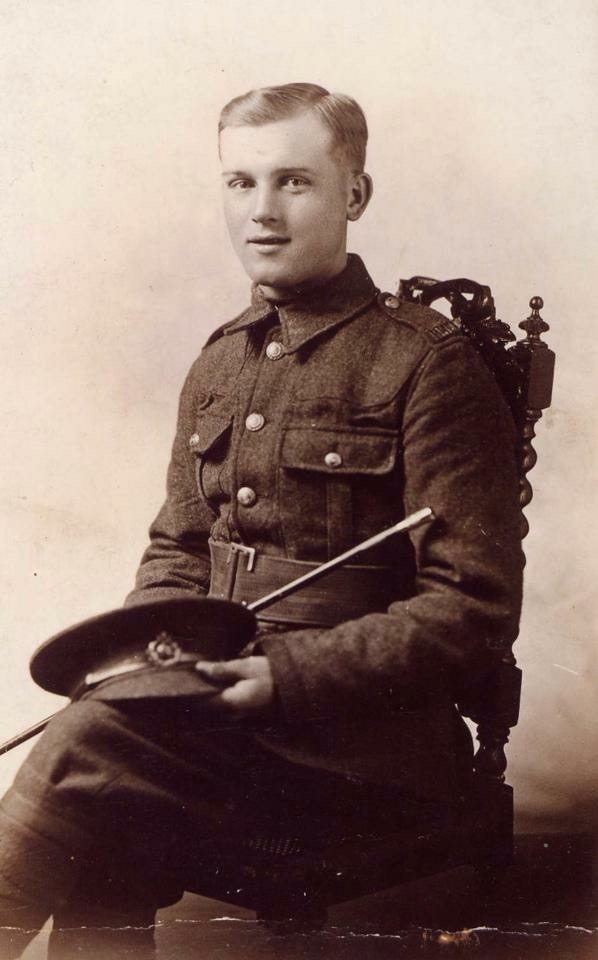
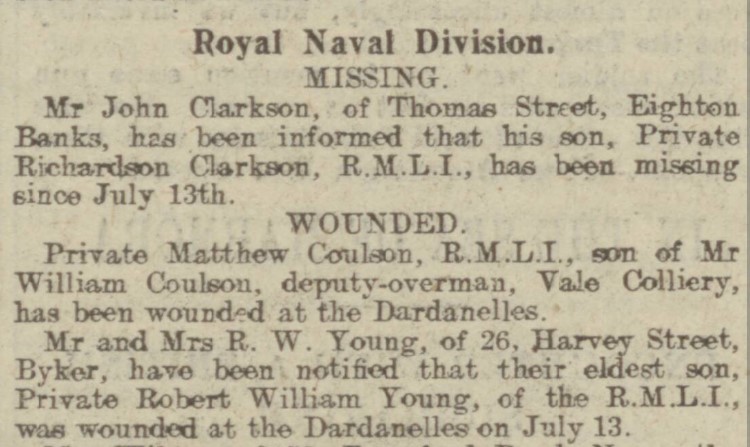
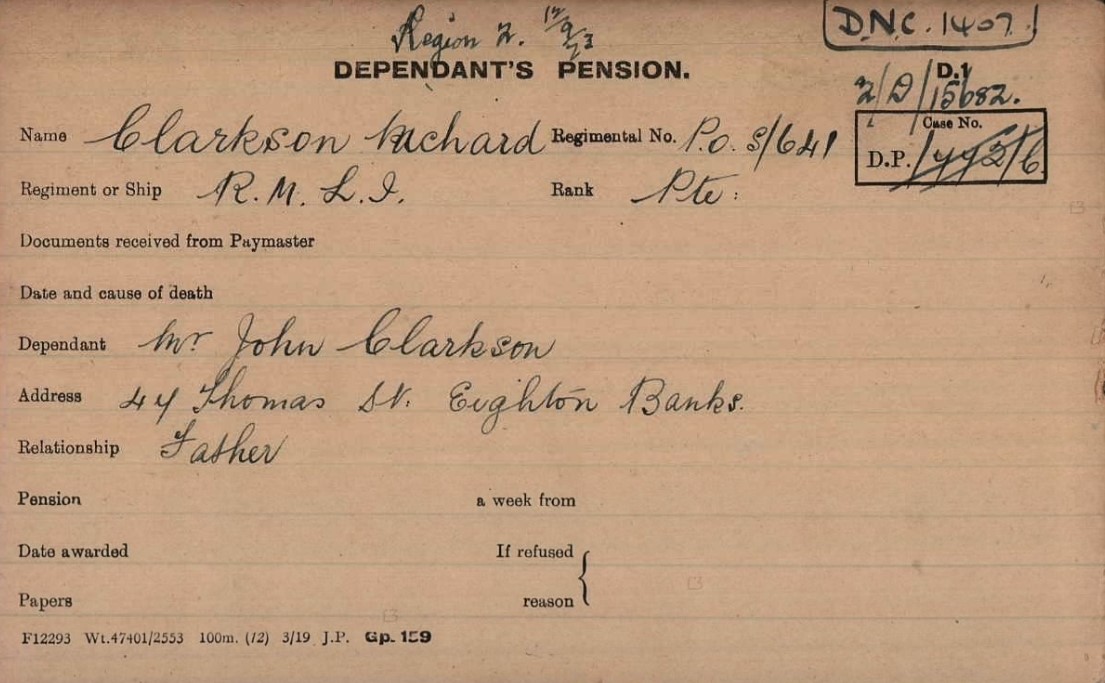
On the Portsmouth Naval Memorial is the name of PO/641(S) Private Richard Clarkson, serving with the Royal Marine Light Infantry, Portsmouth Battalion, Royal Naval Division who died 15/07/1915.
Richard Clarkson was born at Albion Street, Windy Nook on the 6th September 1894, the fifth eldest of eight children to John Clarkson, born 5th April 1859, and his wife Elizabeth nee Slater, Clarkson, born 1869 at Byers Green. They were married in 1885.
The other children were:-
- Joseph Clarkson, born 25th January 1888, he married Annie C. [born 10th December 1890], and in 1939 they were residing at 6 Chapel Row, Chester le Street, Co Durham, with three children, John, Mary, (married a Bamford), and James.
- John Laverick Clarkson, born 6th September 1889, in 1939, he was residing at 22 Chambers Crescent, Eighton Banks, a builder’s labourer, already widowed, died 1973.
- Madgeline Clarkson, born 1892,
- Mary Ann Clarkson, born 1896,
- Robert Clement Clarkson, born 19th July 1899, in 1939 he was married, residing with his brother,
- Thomas Witherington Clarkson, born 5th May 1904, at 7 Armitage Gardens, Eighton Banks.
- Elizabeth Laverick Clarkson, born 1907.
In 1891, John Clarkson and his wife Elizabeth were residing at 65 Cooper Street, Gateshead where Joseph and John were born, by 1901 the family were now at Albion Street, Windy Nook. The father, and five of his sons, Joseph, Richard, John, Robert and Thomas all worked in the mines, the father and four of his sons worked for John Bowes and Company at Springwell Colliery, the youngest son Thomas worked at the Vale Pit at Eighton Banks.
By 1911, all the family were residing at Jubilee Avenue, before finally residing at 47, Thomas Street, Eighton Banks, Wrekenton, Durham. There were only 4 members of the family remaining at this address in 1921.
As soon as war was declared, orders were issued for the formation of a Royal Marine Brigade, for service in the newly formed Royal Naval Division (RND). 1st Royal Naval Brigade, 1st Battalion ‘Drake’, 2nd Battalion ‘Hawke’, 3rd Battalion ‘Benbow’, 4th Battalion ‘Collingwood’. 2nd Royal Naval Brigade. 5th Battalion ‘Nelson’ 6th Battalion ‘Howe’ 7th Battalion ‘Hood’, 8th Battalion ‘Anson’. 3rd Royal Naval Brigade (Marines), 9th Battalion ‘Portsmouth’, 10th Battalion ‘Plymouth’, 11th Battalion ‘Chatham’ and 12th Battalion ‘Deal’.
The new Royal Marine Brigade (consisting of 3 RMLI Battalions and an RMA Battalion) served briefly at Ostend from the 26th August 1914 to the 1st September 1914, then returned to England. The RMA Battalion was withdrawn and a 4th RMLI Battalion. (Deal Battalion) replaced them.
Approximately 2500 ‘Kitchener’s men’ were transferred from the Army to the RNVR. They all came from North Country Regiments (the Durham Light Infantry, Northumberland Fusiliers, Sherwood Foresters, York & Lancs. and KOYLI), the greater proportion from the Durham/Tyneside area. The RNVR had acquired its core of hard men, almost all Miners or Labourers. The majority served in the Royal Naval Division with great distinction.
The Royal Marine Brigade (now of 4 RMLI Battalions) landed at Dunkirk on the 19th September 1914 and was severely engaged in the “Defence of Antwerp” in October 1914. Over 300 Marines of the Portsmouth Battalion (and nearly 3 entire RNVR Battalions of the RND) were taken prisoner or crossed into Holland and were interned during their retreat. The Royal Marine Brigade returned to England via Ostend on the 11th October 1914. All Marines serving in the RM Brigade at this time were long-servicemen, with the exception the Royal Marine Artillery Battalion, who took 60 of their new short-service recruits to Dunkirk as Motor Drivers. In early September 1914, for the first time in 250 years of Royal Marine history, short service recruitment began. The RMLI Divisions Plymouth (Ply), Portsmouth (Po) and Chatham (Ch), all opened enlistment for three years/duration of war.
Richard Clarkson enlisted for a short service attestation on the 13th October 1914 at York, he was 5 feet five inches, fresh complexion, blue eyes with light brown hair residing at 47 Thomas Street, Eighton Banks. He was a Private with the official number PO.641 (S), in the Royal Marine Light Infantry.
He trained until the 3rd December 1914, then on the 4th December 1914, he was posted to the 3rd Royal Marine Battalion at Browndown. His character was [V]ery [G]ood and his ability [Sat]isfactory. During this period before leaving for abroad, the Battalion spent its time training at Portsmouth, Fareham, a three day route march through the New Forest to Lyndhurst and Ringwood, finally ending up at Okeford Fitzpaine.
During the last week of January the Battalions were ordered to concentrate at Blandford, but there was no accommodation in the camp, so they were billeted at Okeford Fitzpaine, near Shillingstone and neighbouring villages.
On the 6th February 1915, ‘Plymouth’ and ‘Chatham’ Battalions entrain at at Shillingstone near Blandford, and move to Devonport. They are temporarily known as the “Royal Marine Special Service Force”. ‘Portsmouth’ and ‘Deal’ Battalions remain at Blandford. About 6pm Plymouth Battalion and the headquarters of the Royal Marine Brigade sail on the “Braemar Castle“, ship number 108381, Chatham Battalion sails on the “Cawdor Castle“, ship number 114823.
On the 26th February, the Portsmouth Battalion left Okeford Fitzpaine, Dorset, marched down to Shillingstone station by 5.00pm. They eventually left at 6.30pm for the port of Avonmouth arriving at 11.30 pm. They left the UK on the 27th February 1915. The battalion was allocated the Mess Deck just under the 1st Class saloon. The Battalion were vaccinated on the 3rd March and arrived off Gibraltar on the 5th March. 8th March the island of Gozo was spotted then Malta. They berthed at 2pm, but were not allowed to go ashore. Officers were. Left Malta on the 9th March.
On the 11th March, ‘Portsmouth’ Battalion arrived at Mudros Bay, Lemnos from England on the “Gloucester Castle“, ship number 132592, at about noon, and ‘Deal’ Battalion arrived on the “Alnwick Castle“, ship number 114784.
12th March, Royal Marine Brigade reorganised and “Royal Marine Special Service Force” ceases to exist. Brigade comes under orders of Royal Naval Division. ‘Deal’ Battalion is placed under orders of 1st Royal Naval Brigade.
In early March the Battalion was going to be sent to the Rufigi River in East Africa and were embarked onto the “Gloucester Castle” at Portsmouth. This operation was cancelled and they were diverted to the Dardanelles instead. On the 19th March, the transports made a demonstration off Gaba Tepe, but returned to Lemnos. On the 24th March the Battalion sailed to Alexandria to re-organise, arriving at Port Said on the 26th and 27th. Went in to camp until the 7th April. The Battalion returned to Mudros on the 11th and 12th April. From the 17th April till the 24th April the battalion is at Trebuki Bay, Skyros training in landing operations.
On the 28th April 1915 he disembarked at Anzac Cove, the ‘Portsmouth’ Battalion the first to land at 5pm from the “Gloucester Castle” and the “Cawdor Castle” ordered to move and anchor off Gaba Tepe. ‘Chatham’ and ‘Portsmouth’ Battalions ordered to disembark and come under orders of 1st Australian Division on arrival. On completion of disembarkation at 8pm, Brigade ordered to take over No 2 Section of defences held by Australian and New Zealand forces. This was the western edge of Lone Pine plateau.
Portsmouth Battalion on the right and Chatham Battalion on the left on top of a ridge. ‘C’ ‘A’ ‘B’ and ‘D’ companies in line left to right. McLaurin’s Hill and the North part of Lone Pine Plateau were the sectors they were holding. It was in this sector where the first Victoria Cross was gained by the Royal Marines in WW1. Lance-Corporal Walter Richard Parker, of the Portsmouth Battalion. He was a short service recruit.
On the 12th May, the battalion was relieved and they embarked onto the “Cawdor Castle” and were transferred to the Helles sector.
Richard was severely wounded in the ‘Action of the Achi Baba Nullah’, the offensive started on the 12th July 1915, one of the hottest days of the year. The Turkish Trenches on the right, along the Kereves Dere Ridge, had been taken by the French troops, so enfilade fire was lessened. On the 13th July the RND Battalions were to attack at 4.30 pm but they were late. The objective were 3 Turkish Trenches and the RND were to capture the third undefined trench line. Portsmouth were to attack the sector track E11 to 2a. Chatham Battalion was to attack the line T-S to the track at E11. Portsmouth Battalion advanced in two lines, the first from Parsons Road and the second from Trotman Road, found that their objective the third Turkish line unrecognisable, and advanced past it. Many advanced past E12 until they were all killed. The remaining fell back, but dug in on a line in advance of the Turkish Third line, which proved to be a narrow ditch 18 inches deep.
Casualties were 4 officers killed, 7 wounded, 32 N.C.O.s and men killed, 140 wounded and 54 missing afterwards.
An eye witness commented “Only those who actually witnessed it can imagine the unbelievable confusion of the battle, the sickness of the troops, intensified a hundredfold by local conditions and the tenacity of the Turkish resistance… As night came on the conditions were-nigh unendurable. Some of the worst scenes ever experienced on the battlefields of France and Mesopotamia were crowded into this narrow front of half a mile, over which fighting had been continuous for nearly 48 hours, where many hundreds of men lay dead and dying, where a burning sun had turned the bodies of the slain to a premature corruption, where there was no resting place free from physical contamination, where the air, the surface of the ground, and the soil beneath the surface were alike, poisonous, foetid, corrupt.”
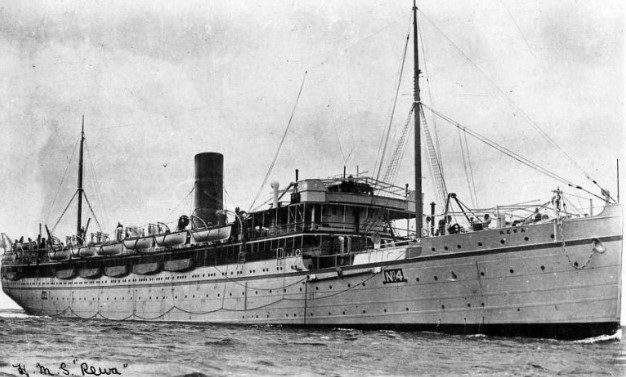
The ‘Nelson’ and the ‘Portsmouth’ Battalions took heavy casualties, and Richard was wounded by a shotgun wound to his arm and his abdomen on the 13th July, he was taken to the Hospital Ship HMHS ‘Rewa‘, ship number 121332, but dies on the 15th July 1915 of his wounds and is buried at sea.
In 1939 the father John Clarkson now widowed and retired was residing at 7 Armitage Gardens, Eighton Banks, with two of his sons.
Acknowledgments: John Taylor and Ann Norman; Geoff Clarkson; The Royal Naval Division; Long Long Trail; National Archives/British Newspaper Archive;WO95/4291, war diary of the Royal Marine Brigade; Britain’s Sea Soldiers by General Sir. H. E. Blumberg..
Richard Clarkson is remembered at Eighton Banks on E50.01 and E50.02.
First Name: Richard
Last Name: Clarkson
Service Number: PO/641(S)
Which War: First World War 1914-18
Died: 15/07/1915
Age: 20
Rank: Private
Regiment: Royal Marine Light Infantry
Served in: Navy
Unit/Ship: Portsmouth Battalion
Gallipoli diary Volume I.
Gallipoli diary Volume II.
Gallipoli by John Masefield.
Maps of the Dardanelles.
Links to Source Material