Every Name a Story
Leslie Dobson Turner
Every Name a Story
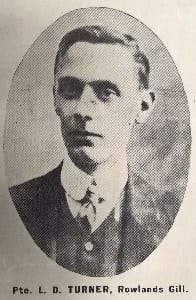
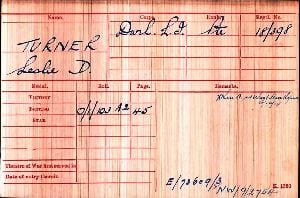
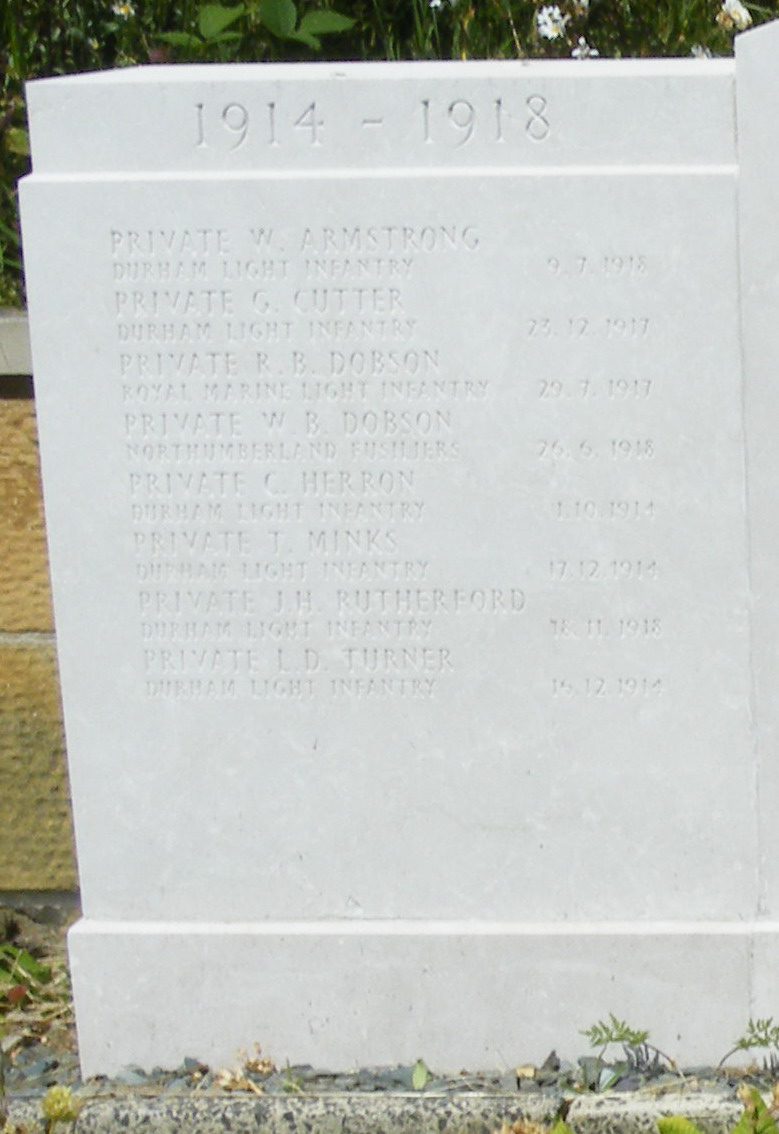
In St. Patrick’s Churchyard and Hookergate Cemetery is the Commonwealth War Grave of 18/398 Private Leslie David Turner serving with the 18th Battalion Durham Light Infantry who died 16/12/1914.
The son of William H. and Mary Frances Turner, of “Dalmeny,” 10, Rectory Drive, Gosforth, Newcastle upon Tyne.
In Gosforth St Nicholas Churchyard is a family headstone which reads:-
In loving memory of Harry N TURNER Captain RWF second son of W H & Mary Frances TURNER of Dalmeny Gosforth who died 13th April 1923 aged 31 years
Also Leslie D TURNER their eldest son who gave his life for God King and Country 16th December 1914 aged 24 years
Leslie Dobson Turner was born in 1891 the son of William Henry and Mary Frances Turner. He was a member of the Rowlands Gill Tennis Club and the Whickham Hockey club also was a well-known county player.
In 1911 the family were living at Dalmeny House, Rowlands Gill. Father William aged 50 was a Railway Accounts Clerk, Mary Frances was 41 years, Leslie aged 20 was a Railway Storekeeper Clerk, and was employed at the North Easter Railway superintendents office at Newcastle upon Tyne since leaving school. Harry Norman aged 18 was a Railway Accounts Clerk, Roland 13, Herbert 10 and Winifred 7 were at School.
On September 24th, recruits began to assemble rapidly at Cocken Hall, the Durham City and District Contingent marching from the Race-course. They were soon joined by contingents from South Shields, Sunderland, Hartlepool and Darlington. Owing to the rapid increase in numbers additional accommodation had soon to be found, ‘B’ Company moved to billets in West Rainton and ‘A’ Company shortly after to Newton Hall. By early October the Battalion was raised to its full establishment, and in the beginning of 1915 it was increased to six companies, about 1300 strong.
During the first six weeks the training had consisted largely of route-marching. Meanwhile two companies of men were despatched to Hartlepool on November 16th 1914 to take up Coast Defence Duty. These two companies were commanded by Major F.T. Tristam and the men were selected who had fired a course on an open range. This detachment entrained at Leamside and proceeded to Hartlepool. On arrival at Hartlepool, they were billeted at Hart Road. Later one company moved to old Hartlepool. The work chiefly composes of providing guards at various tactical points and places of importance, also improvement of the existing trenches.
On December 15th Colonel P. H. Hammond, who was in command of the Tyne and Tees Defences, received information from the War Office of the possibility of a raid by enemy warships on the East Coast on the following day at about 8.30am. The trenches were manned as usual and the rest of the detachment stood to.
Wednesday, 16th December, there was a mist which allowed the German ships to come in close before being detected, also firing out to sea in a clever ruse to give the impression they were British ships retiring.
The previous evening four battle cruisers, Seydlitz, Moltke, Von der Tann and Derrflinger’; one heavy cruiser, Blucher, four light cruisers and two flotillas of destroyers had left their base, heading out into the North Sea. The intention was to bombard Hartlepool and Scarborough, both were by now fortified towns and considered legitimate targets.
Facing this massive force armed with a total of twenty 11 inch and twelve 8.2 inch guns were the three six inch guns of the Heugh Battery and a flotilla comprising of two scout cruisers, four destroyers and a [HMS C9] submarine based in the port. That morning the four destroyers HMS Doon, HMS Waveney, HMS Test and HMS Moy a division of the 9th DF, were already at sea but without the scout cruisers HMS Patrol [under the command of Captain Bruce] and HMS Forward which were still in port, [some reports say they were getting ready to sail]. At 8.00am the four destroyers sighted the German ships but their puny 12 pounder armament meant they were hopelessly outgunned and the German warships easily chased them off, but not before HMS Doon fired a torpedo which unfortunately missed.
No-one in the town heard anything. The Seydiltz, Moltke and Blucher continued to steam towards the nearest target and the rest headed for Scarborough.
The telephone conversation at this time is recorded.
At 8.00am, War Signal of the Port telephones that the three warships are approaching at great speed. The officer is at once called to the telephone and rings up the Petty Officer.
‘What ships are they?’ he asks. The Petty Officer answers back-“I believe they are own ships, as they are flying the White Ensign!”
“What class are they?” asks the officer. “I believe the Indomitable class,” replies the Petty Officer. Immediately after this little colloquy, firing is heard out at sea. The destroyers are assailing and are being assailed. “What are they firing at?” asks the officer. “I presume at the enemy,” says the Petty Officer. “Are you sure they are not firing at our own destroyers, which put to sea two hours ago?” is the next question, and “I can’t see what they are firing at,” is the reply.
At 8.10 a.m. as the inhabitants were readying themselves for the days work, the first shell was fired. They were aiming at the shore batteries and the Lighthouse. The shell cut all the lines of communications between the batteries throwing them into confusion.
By 8.25 a.m. most of the ships had come as close as four thousand yards and had begun to pour their fire into the gun emplacements and the docks. Some of the armour piercing shells had delayed action fuses and a number bounced off the batteries into the town.
The first shots landed close to the Heugh Battery, killing Private Theophilus Jones, of the 18th Battalion D.L.I. Three other soldiers were fatally wounded at the same time, including Leslie David Turner. Theo became known as the first soldier to be killed on English soil during the First World War. The first shell landed on the right hand corner of the battery, killing the sentry, and three of the infantry guard. Two more soldiers were killed running to pick up their comrades who had fallen, by the next shell. This also hit the telephone line between the two batteries, so the Commander had to try to relay orders by megaphone. This proved impossible because of the noise, so a man was sent to stand between the command post and the battery to relay orders by word of mouth.
The Lighthouse Battery gun managed to hit the Blucher, killing nine sailors and causing damage to the ship and two of her 6-inch guns. Following this, Blucher placed herself in such a position that the batteries were unable to fire on her because the lighthouse blocked their line of fire.
Three British coastal defence craft -two light cruisers, HMS Patrol, HMS Forward and a HMS C9 submarine, were moored in the Victoria Dock at the time of the attack. The submarine was hit as it came out of the harbour, which then blocked the way for the cruisers behind it. This left them unable to help during the following attack.
Both batteries fought back bravely but were hampered by misfiring guns and dud ammunition. Fortunately the Germans were using standard anti ship ammunition with time delay fuses which bounced off the gun aprons to explode behind the batteries otherwise casualties among the gunners would have been far higher. Lighthouse Battery did particularly well as one shot seems to have temporarily disabled the Blucher almost forcing her to run aground.
The Germans spent nearly an hour relentlessly bombarding Hartlepool pouring 1,150 shells into the town, for the terrified people it must have seemed that the carnage would never stop. At 8.52am the German squadron fired its last shell and as quickly as it had appeared, it withdrew into the mists of the North Sea. They left 102 people dead including nine soldiers, seven sailors, 15 children and 467 wounded. Seven churches, ten public buildings, five hotels and more than 300 houses were damaged. But the Germans did not escape completely unscathed, the Heugh battery had fired 123 rounds mainly at the Blucher smashing her fore-bridge, damaging some of her guns and killing nine.
For their bravery the Gun Captains at the Heugh were awarded the first ever pair of Military Medals and the Lighthouse Gun Sergeant, Sergeant T. Douthwaite won the Distinguished Conduct Medal. Controversially the commander, Lieutenant Colonel L. Robson also won a number of awards but his subordinates who actually fought the action went unrewarded thanks to their German ancestry.
The Consett Guardian 25/12/1914 reports:-
Turner – Killed in the bombardment of Hartlepool, aged 24 years, Leslie D. Turner, eldest son of Wm. N. and Mary F. Turner, of Rowlands Gill.
Following the War the Turner family moved to Dalmeny, 10 Rectory Drive, Gosforth. Later his mother paid for a Hospital Bed at the Fleming Children’s hospital in memory of her two sons Leslie and Harry who gave their lives in the Great War 1914-1918.
Only CWGC give Leslie’s second name as David all other records state Dobson.
Harry Norman Turner died April 11th 1923 from pneumonia after a bout of malaria (contracted during his service).
Leslie Dobson Turner is remembered at Hartlepool on H115.74, at High Spen on H106.03, at Newcastle on NUT032, at Rowlands Gill on R45.01, in the D.L.I. Book of Remembrance page 333 and on the North Eastern Railway War Memorial at York.
First Name: Leslie Dobson
Last Name: Turner
Service Number: 18/398
Which War: First World War 1914-18
Died: 16/12/1914
Age: 24
Rank: Private
Regiment: Durham Light Infantry
Served in: Army
Unit/Ship: 18th Battalion
Links to Source Material