On Portsmouth Naval Memorial is the name of PO/X 115677 Marine Frederick Davison Hopkins, serving on H.M.L.C.S. (L) 256 with the Royal Marines who died 01/11/1944.
Frederick Davison Hopkins was born in 1923, the son of Frederick William Hopkins, born 11th December 1899, baptised 16th January 1900, and Mary E. N. Hopkins, born 5th June 1903, died 1967, of Felling, Co. Durham, the youngest son of possibly two children. The other child was Tom Hopkins, born 14th August 1925, in 1939 they were residing at 8 Greenlane Gardens, Felling Gateshead.
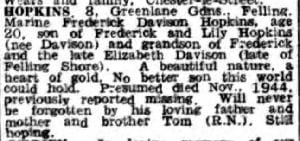
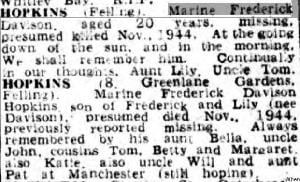
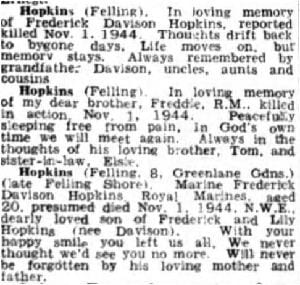
His death was reported in Heslop’s Local Advertiser 16/11/1946:
Hopkins – Felling. Frederick D., killed in action Nov. 1, 1944. Royal Marines.
The edition of 15/11/1947 carried the same wording.
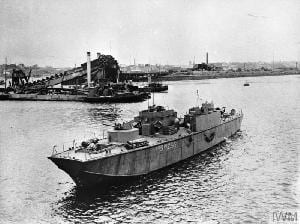
LCS (L) 256 was part of the Inshore Support Squadron Eastern Flank which protected the Eastern flank of the Normandy beachhead Anchorage commonly known as the “Trout Line”.
LCS(L) No.252, 256, 258, “Landing craft support (Large) (MkII) (total 3, 112t each) lost in Operation Infatuate, Walcheren Landings, Holland, 1st November 1944.
LCS(L)256 built John Sadd, Maldon 1943. 1943 sunk 1/11/1944.
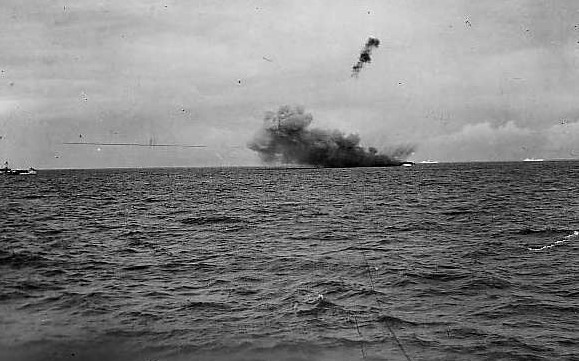
This Division (LCS(L) 252, 256 and 258) were in the Southern Group and accompanying LCG(M) 102 towards the shore when 252 was hit by a salvo from the Zoutelande Battery (W13), set on fire, blew up and sank. 256 was also hit and set on fire. 258 drew alongside to rescue survivors, was hit and set on fire too. The order to abandon ship was given and shortly afterwards both craft blew up and sank.
Operation Infatuate
The force sailed from Ostend at 03:15 hours and by 09:30 hours they were off the objective. The ships bombarded the German defences with everything at their disposal including the 15-inch (380 mm) guns of HMS Warspite, Erebus and Roberts, the Landing Craft (Gun)s, the rockets of LCT(R)s. The first German fire at 8:09 was followed by the other batteries. Most of the German fire was concentrated on the support landing craft rather than those carrying the troops. Several landing craft were hit including a rocket LCT which received a direct hit. The RAF was able to provide a squadron (No. 183 Squadron) of explosive rocket-firing Typhoon fighter-bombers just at the point the LCTs were due to land.
Part of the naval Support Squadron of 27 small craft, under Commanders Sellar and Leefe, closed to engage the eleven still-operational German shore-based batteries, on the direction of Captain A.F. Pugsley, R.N., DSO, the naval commander of the amphibious landings. This they did with conspicuous gallantry, but with very heavy casualties.
By 12.30pm, nine of the Support Squadron’s craft had been sunk, eleven put out of action, and a high percentage of their crews killed or wounded.
Ultimately the Support Squadron was recalled as so many of the craft had been damaged or destroyed, but their aim, of drawing the fire of the defending batteries from the landing craft making the primary assault, had succeeded.
Royal Marine Commandos landing at Walcheren using DUKW’s, LVT, LCT’s and Buffalo amphibians on the 1st November 1944.
In a tribute to the bravery of the Support Squadron, General Laycock, Chief of Combined Operations, wrote to Captain A.F. Pugsley with the following words:
“I understand that the success of the landings and the comparatively light casualties sustained by No. 4 Special Service Brigade at Walcheren was due largely to the heroic efforts of the Naval Support Craft who, at great cost to themselves, effectively silenced the coastal defences. I should like to express the appreciation of all ranks, Special Service Group, and particularly that of General Sturges and Brigadier Leicester and all ranks of No. 4 Special Service Brigade for the self-sacrifice shown by all naval personnel during the landings, which had such splendid results.”
Source : Operation Infatuate Official despatches.
Frederick Davison Hopkins is remembered as D. Hopkinson R.M. at Felling on F32.10, at Gateshead in G39.135 page 47 and in our List of Ships’ Crews.