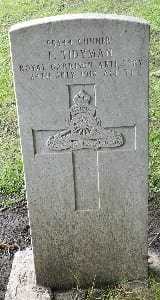
In Holy Trinity Churchyard, Murton, is the Commonwealth War Grave of:-
55344 Gunner
F. Tidyman
Royal Garrison Artillery
24th July 1918 Age 34
Frederick Tidyman was born in Murton, 1st December 1883, the youngest boy of ten children to Christopher Tidyman, born 1842, died 1913, and his wife Jane nee Soppit, born 1st October 1845, died 1916. They were married on the 12th May 1863 at St Peter’s at Monkwearmouth, Sunderland.
The other children were:-
- Elizabeth Jane Tidyman, born 1866, died 1928.
- Joseph Tidyman, born 1896, died 1938.
- Charles Tidyman, born 1871, died 12th December 1882.
- Mary Isabella Tidyman, born 4th October 1873, died 1940.
- Robert Tidyman, born 1876.
- Anthony Tidyman, born 1878.
- John Thomas Tidyman, born 1879.
- Charles William Tidyman, born 1883, died 1960.
- Annie Tidyman, born 1896.
In 1891, the family were residing at 28 Church Street, East Murton, Murton Colliery, Co Durham.
Frederick Tidyman was married on the 2nd September 1905 to Ursula Wood, (born 11th March 1885, died 1966), at St Andrew’s church, Dalton le Dale. (In 1939, she was residing at 47 Coronation Road, Hillingdon, Hayes and Harlington, Middlesex). They had six children,
Florence May Tidyman, born 8th August 1906, died 1925,
Ursula Tidyman, born 28th May 1908,
Robert Tidyman, born 9th February 1910, (in 1939 he was already married to Bella, born 15th May 1914, and was residing at 11 Phelps Way, Hillingdon, Hayes and Harlington, Middlesex, he was a Radius Service Engineer),
Margaret Jane Tidyman, born 31st May 1912, died 1927,
Alice Tidyman, born 21st July 1914
and Freda, born January 1919.
They resided at 4 Coronation Street, East Murton in 1911. Frederick worked at the Murton Colliery as a Hewer.
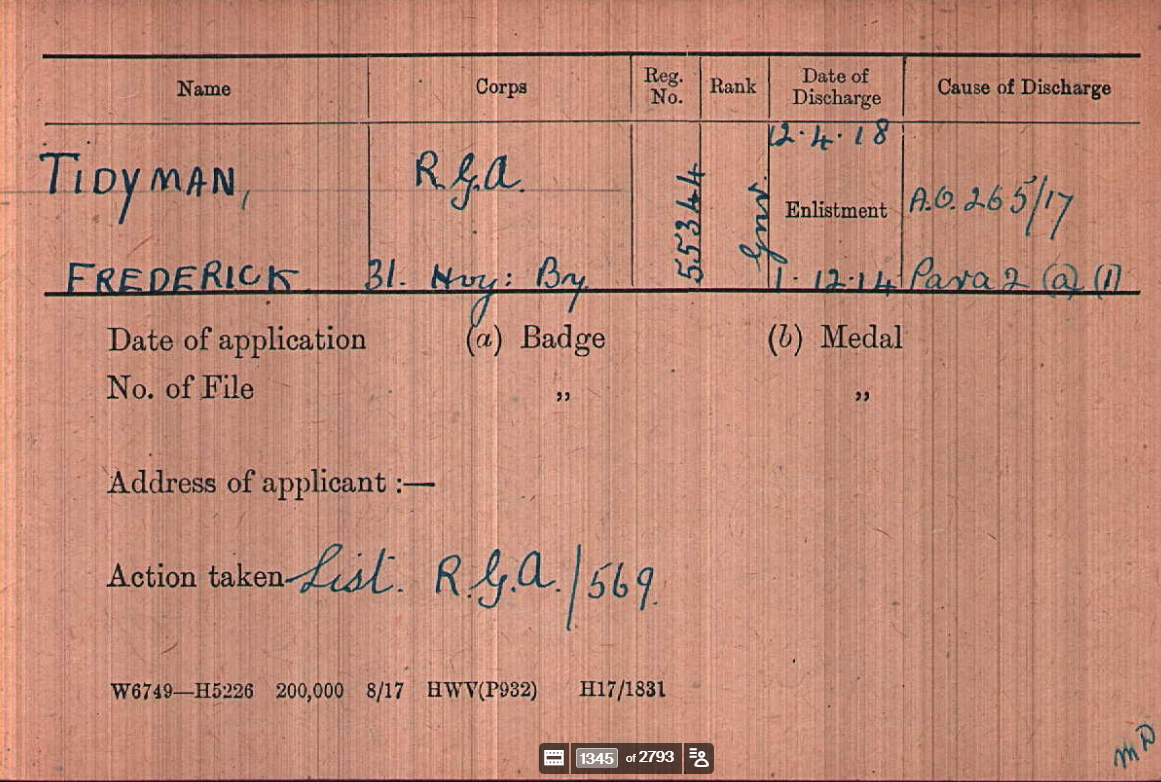
Frederick enlisted on the 1st December 1914 at Sunderland, he was 5 feet eight inches, 140lbs. fresh complexion, blue eyes and brown hair. He was posted into the Royal Garrison Artillery, with the service number 55344, rank was a Gunner. He was residing at 18, Green Street, Murton, Co Durham. Frederick was posted to no 1 Depot at Newhaven on the 2nd December 1914. On the 25th January 1915 he was posted to the 25th Heavy Battery.
Heavy Batteries RGA were equipped with heavy guns, sending large calibre high explosive shells in fairly flat trajectory fire. The usual armaments were 60 pounder (5 inch) guns, although some had obsolescent 5 inch howitzers. As British artillery tactics developed, the Heavy Batteries were most often employed in destroying or neutralising the enemy artillery, as well as putting destructive fire down on strongpoints, dumps, store, roads and railways behind enemy lines.
25th June 1915, Frederick was at the No 2 Depot (Heavy and Siege), at Fort Brockhurst, Gosport. He was sent overseas to Rouen on the 1st July 1915. On the 7th September 1915, he was attached to the 66th Battery, North Midland. On the 8th November 1915 he was posted to the 31st Heavy Howitzer Battery. On the 15th January 1916, Frederick was admitted to Hospital and returned to his unit 5 days later. On the 18th February 1916, he was admitted to the 62nd Field Ambulance, but returned to duty on the 21st February 1916. He was on leave from the 26th November to the 8th December. On the 1st December he was awarded 2nd Class Proficiency pay 3d a day.
On the 25th August 1917, Frederick was admitted to the 58th Scottish General Hospital with contusions on his back and buttocks, a start of a cough from the beginning of 1916, which was gradually getting worse, was identified with a cold.
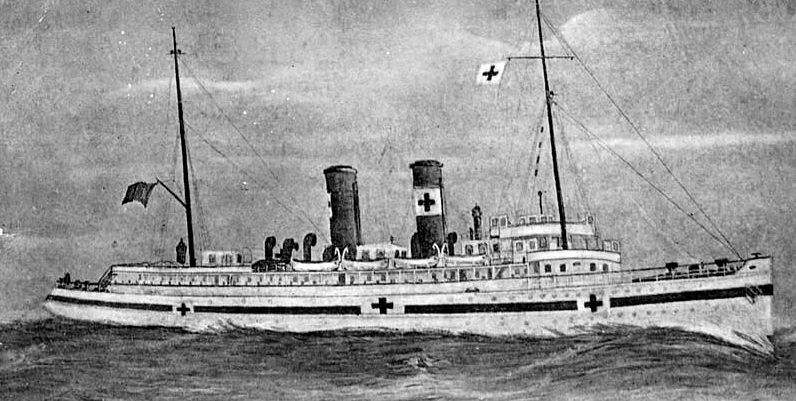
On the 1st September 1917, Frederick was invalided back in the UK. He was on the Hospital Ship Princess Elizabeth, {no ship number as the ship was Belgium owned, but hired by the British Government]. On the 2nd September, Frederick was at Warrington in the Lord Derby Military War Hospital. He was diagnosed with Tubercule of the Lungs. On the 25th March 1918, he underwent a full medical examination, and as a result he was awarded the Silver War Badge number 346682, and was discharged under Kings Regulations Para 392 (xvi) Para 2 (a) 1. Permanently unfit for further War service, Home service and Light Duties, on the 12th April 1918. He was recommended for sanitorium treatment.
Frederick Tidyman died on the 24th July 1918 at Blackfell sanitorium fronm War Related Sickness Tuberculosis.
He received a pension of 27s 6d a week. His character was described as Good, a sober and tidy hard working man.
Footnote: In 1920, Ursula received his medals, however, the Medals were sent to the wrong soldier, she received William Tidyman’s Medals, who had the same service number 55344, but had the wrong initial.
In 1921, Ursula had moved to 18, Green Street, East Murton, Durham, with the six children. By 1939, she had moved to 47 Coronation Road, Hillingdon, Hayes and Harlington, Middlesex. Still a widow. She died in 1966.
Frederick Tidyman is remembered at Murton on M47.01, M47.02, M47.06 and M47.09.