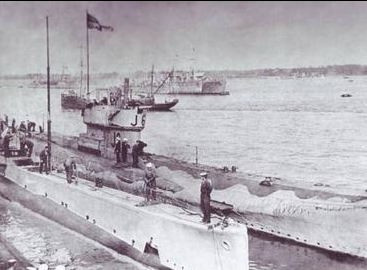
On Chatham Naval Memorial is the name of M/12905 Engine Room Artificer Third Class Ernest William Armstrong, serving on H.M. Submarine ‘J6’ with the Royal Navy, who died 15/10/1918.
Ernest William Armstrong was born on the 11th November 1893 at Gateshead, baptised 13eth December 1893, third eldest of 8 children to Robert Henry Armstrong, born York, 1854, died 1919, and his wife Elizabeth Armstrong, born Pembroke, 1854. They were married in 1875.
The other children were:
- Maud Armstrong, born 1887.
- Elizabeth Armstrong, born 1892.
- Edith A. Armstrong, born 1876.
- Winifred Mabel Armstrong, born 1885, died 1950, married in 1902 a William G Baker. They had two children..
- Frederick Charles. Armstrong, born 1878. In 1921 he was residing at 37, Second Street, Gateshead, Co Durham. He was a Loco Engine fitter for the Northern Railway Company, he was at the Greenslade Shed at Gateshead.
2 other children died.
Ernest William Armstrong was an apprentice Engine fitter working for the North Eastern Railway at Gateshead. The family changed its address quite frequently. In 1881 33, Gibson Street, Gateshead, Co Durham, In 1891 they family was residing at 45, Cramer Terrace, Gateshead, Durham. In 1911 the family had moved to 127 Marion Street, Gateshead, Co Durham.
The father was a Loco Engine Fitter at Gateshead. Ernest joined up on the 1st April 1915 for Hostilities Naval service only. He was 5 feet six inches, fresh complexion, Official number M/12905. Chatham based. brown hair, blue eyes. He started his training at a land based establishment Pembroke II. Chatham barracks. This was an accounting base. He was a stoker. After 11 days he was sent to Yarmouth. Here he became an Engine Room Artificer Class IV, then III,
Ernest married Ellen Armstrong.
Ernest was posted to the ship HMS Titania from the 13th May, then posted to the submarine ‘J6′ from the 12th June.
The Rev. David Youngson has submitted the following:
Ernest William ARMSTRONG
M/12905 Engine Room Artificer 3rd Class
Royal Navy HM Submarine J6
He was the son of William Armstrong of Gateshead on Tyne. A Fitter and Turner, he was Initiated into 48 Industry Lodge in the Masonic Hall at Gateshead. on the 29th May 1917 but there is no record of any further Advancement. The Year of Warrant of the Lodge was 1735 but has now been surrendered.
He was the husband of Ellen Armstrong of 24 Henderson Road Sunderland. He died on the 15th October 1918 aged 24 and is remembered on the Chatham Naval Memorial 29.
Editors Note. Three versions of the same incident.
The submarine ‘J6‘ was sunk by the British Q ship Cymric. ship number 106898.The Cymric was a merchant ship taken over by the Admiralty, converted into a camouflaged gun boat and armed. She acted as a decoy ship under a neutral flag to lure German U boats into range. H.M. Submarine ‘J6′ was lying on the surface outside Blyth, Northumberland and the Q ship Cymric was also in the area having previously encountered two British submarines on that day. At 16.00 hours, a third submarine was spotted. The Cymric went into action believing it to be a German U Boat. Despite a recognition signal being hoisted by ‘J6′ the attack continued. ‘J6′ went into a fog bank but was again attacked as she began to submerge. It was only after survivors were picked up that the mistake was discovered.
Cymric sank a submarine in what is now called ‘friendly fire’. On the 15th October 1918, HMS ‘J6′, a J-class submarine, was on the surface outside her base, Blyth, when she was spotted by Cymric which mistook her ‘J6‘ marking for ‘U6’. Cymric opened fire, ‘J6′ tried to signal, but the signalman was killed. ‘J6′ fled into a fog bank, but Cymric located ‘J6′ again, and sank her, with the loss of 14 lives. An order under the Official Secrets Act prohibited mention of this incident until 1969.
On the 15th October 1918 ‘J6′ was on patrol off the Northumberland coast when she was spotted by the Q-ship Cymric. The captain of the Cymric, Lieutenant F Peterson RNR, mistook the identity lettering on the conning tower of ‘J6′ for U6. Assuming U6 to indicate a German U-boat, Peterson raised the White ensign and opened fire on ‘J6′. ‘J6′ tried to signal, but the signalman was killed. ‘J6′ fled into a fog bank, but Cymric located ‘J6′ again and sank her. After a number of direct hits, ‘J6′ sank. It was only after the survivors were seen in the water that Peterson and the crew of Cymric realised their mistake and recovered the survivors. Of the crew of ‘J6′, 15 were lost; a subsequent court of enquiry found that no action would be taken against Peterson.
Sources: British Newspaper Archive
Ernest William Armstrong is remembered on the North Eastern Railway War Memorial (York) and on our List of Ships’ crews.