Every Name a Story
Charles Allan Bruhn
Every Name a Story
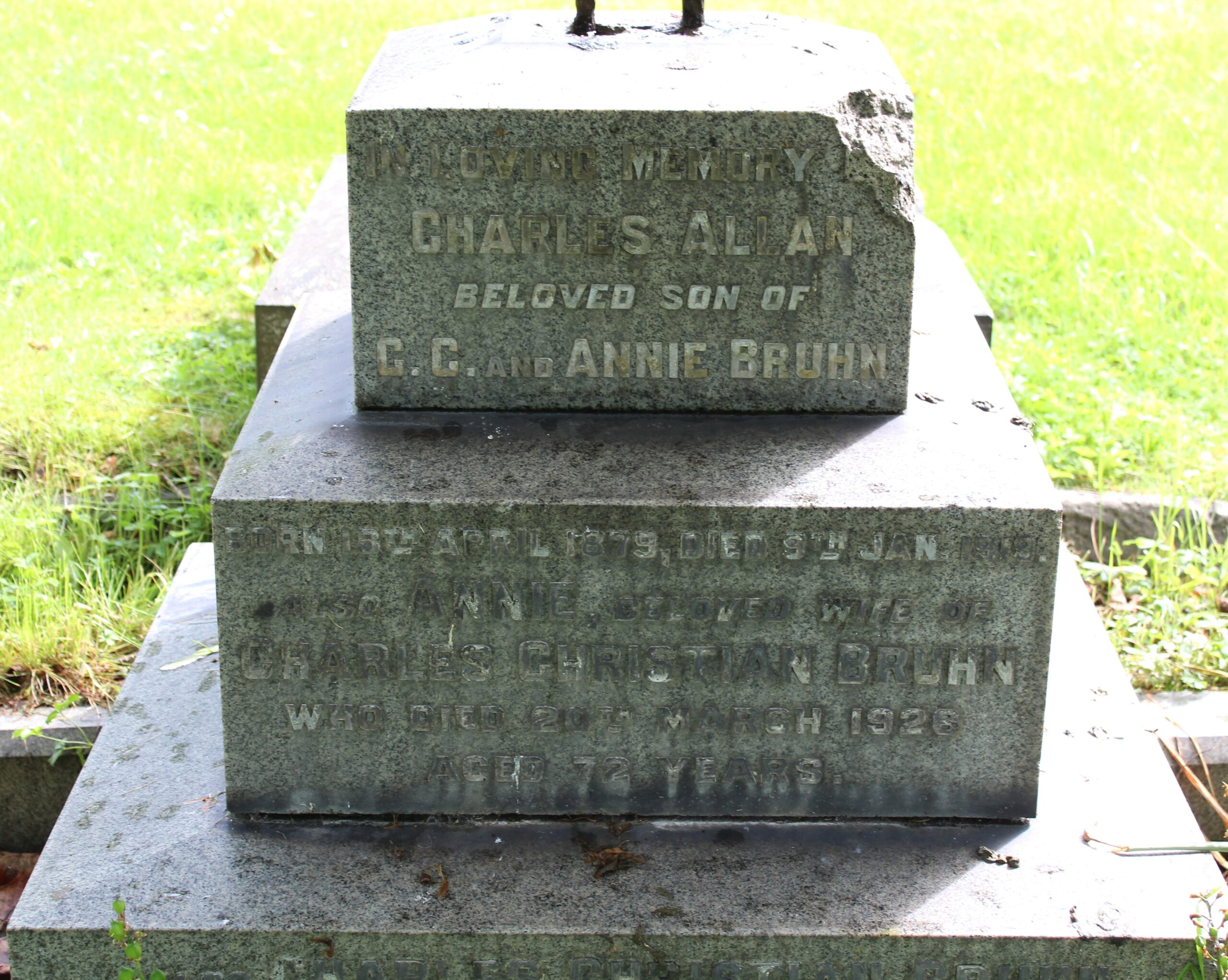
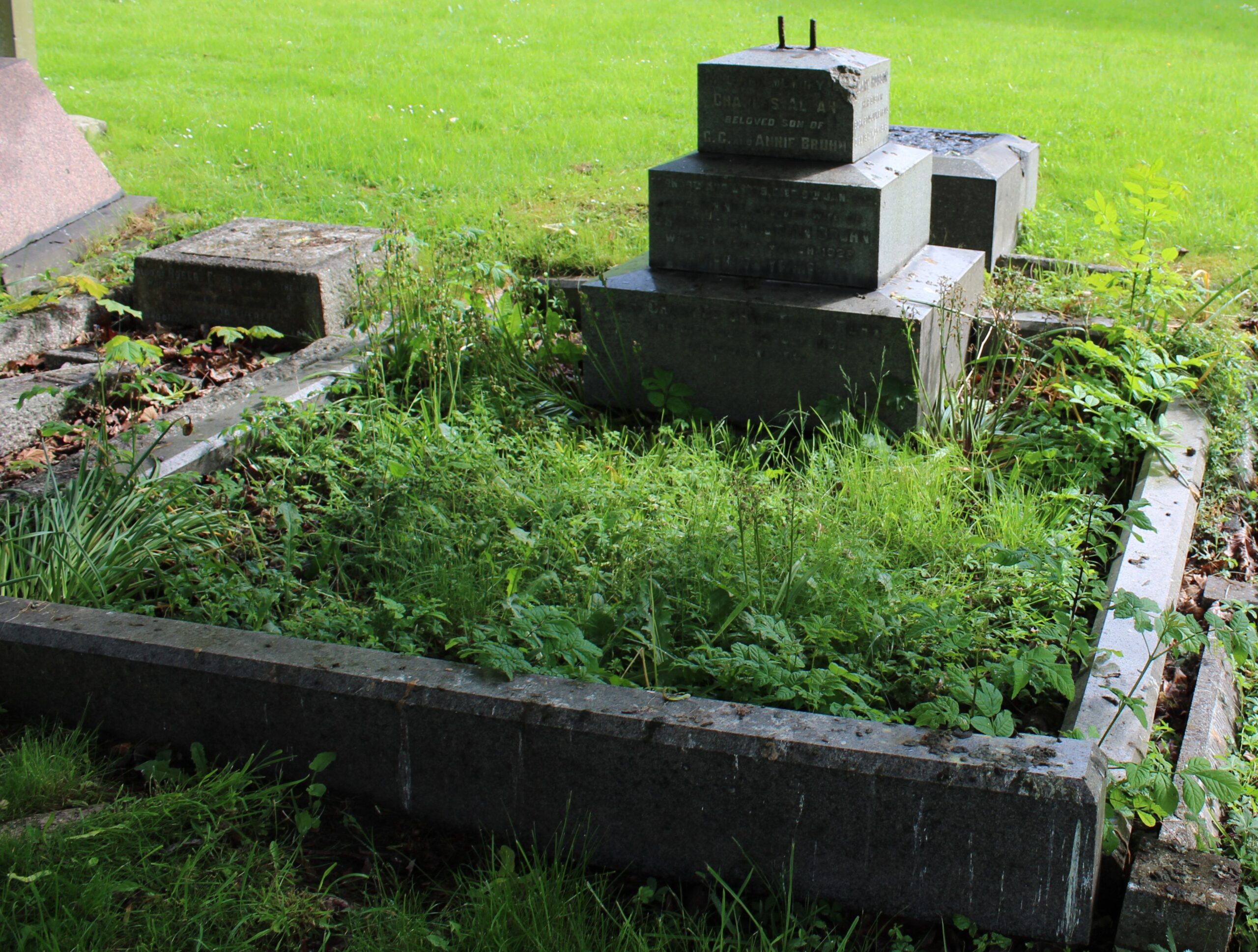
In South Shields (Harton) Cemetery is the Commonwealth War Grave, with a private headstone, of Pilot Charles Allan Bruhn serving with the Lighthouse and Pilotage Authorities on S.S. Northumbria who died 09/01/1919.
The headstone reads:
In loving memory of
Charles Allan
beloved son of
C.C. and Annie Bruhn
born 18th April 1879, died 9th Jan. 1919.
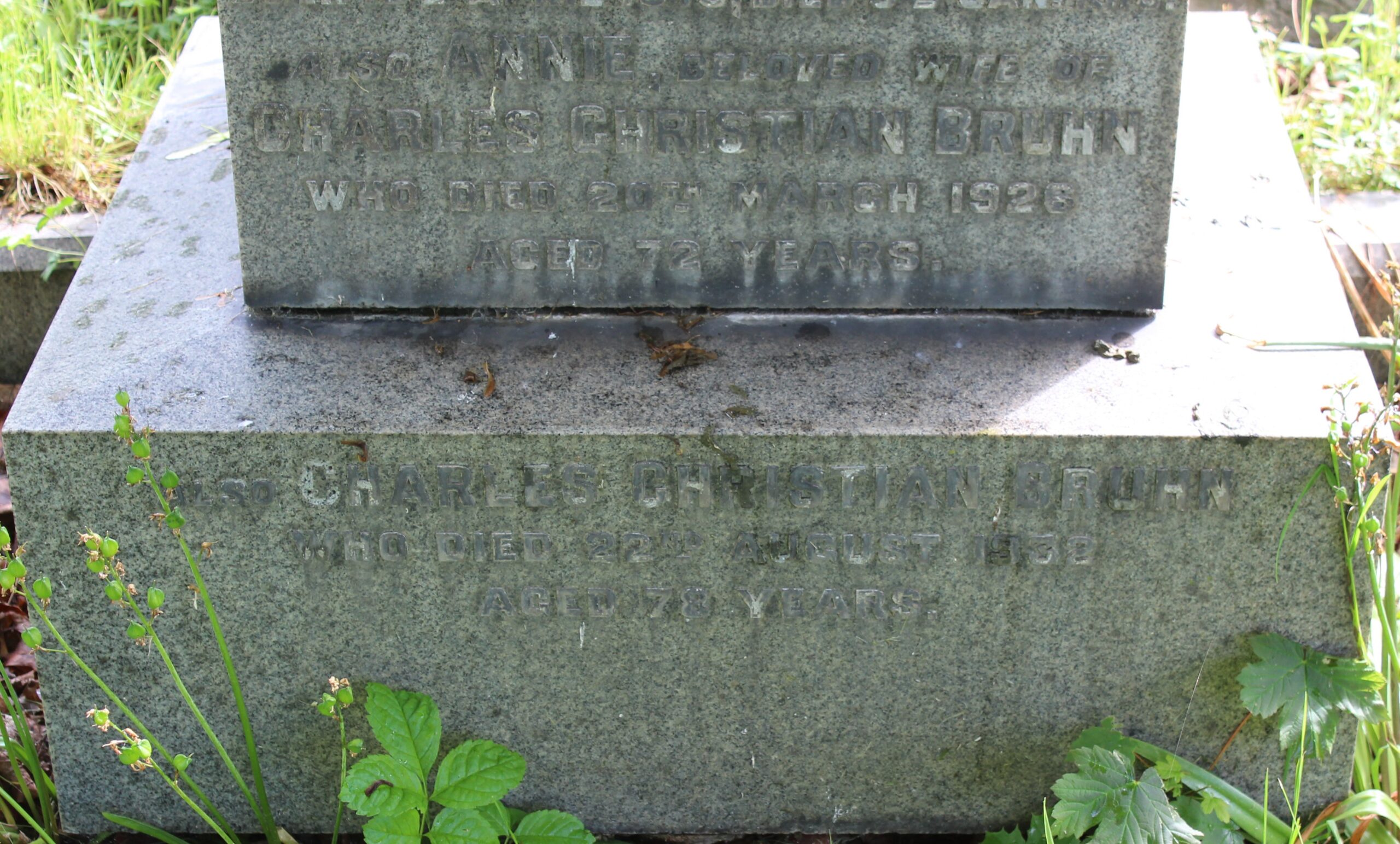
Also Annie, beloved wife of
Charles Christian Bruhn
who died 20th March 1926
aged 72 years.
Charles Christian Bruhn
who died 22nd August 1932
aged 78 years.
The son of Charles Christian Bruhn and Annie Bruhn, of 5 Village Terrace, Westoe, South Shields and the husband of Kate Bruhn, of Rodney House, 4 Endsleigh Street, Victoria, London.
Charles Allan Bruhn was born the oldest son of two boys on the 18th April 1879, and baptised 1st June 1879, at St Thomas Church, Westoe, South Shields, to father Carl [Charles] Christian Bruhn, born 1854, died 22nd August 1932, and his wife Ann nee Robson, born 1854, died 20th March 1926. They were married on the 10th June 1878 at St Hilda’s Church, South Shields
The other child was: –
- Harold Charles Bruhn, born 1881.
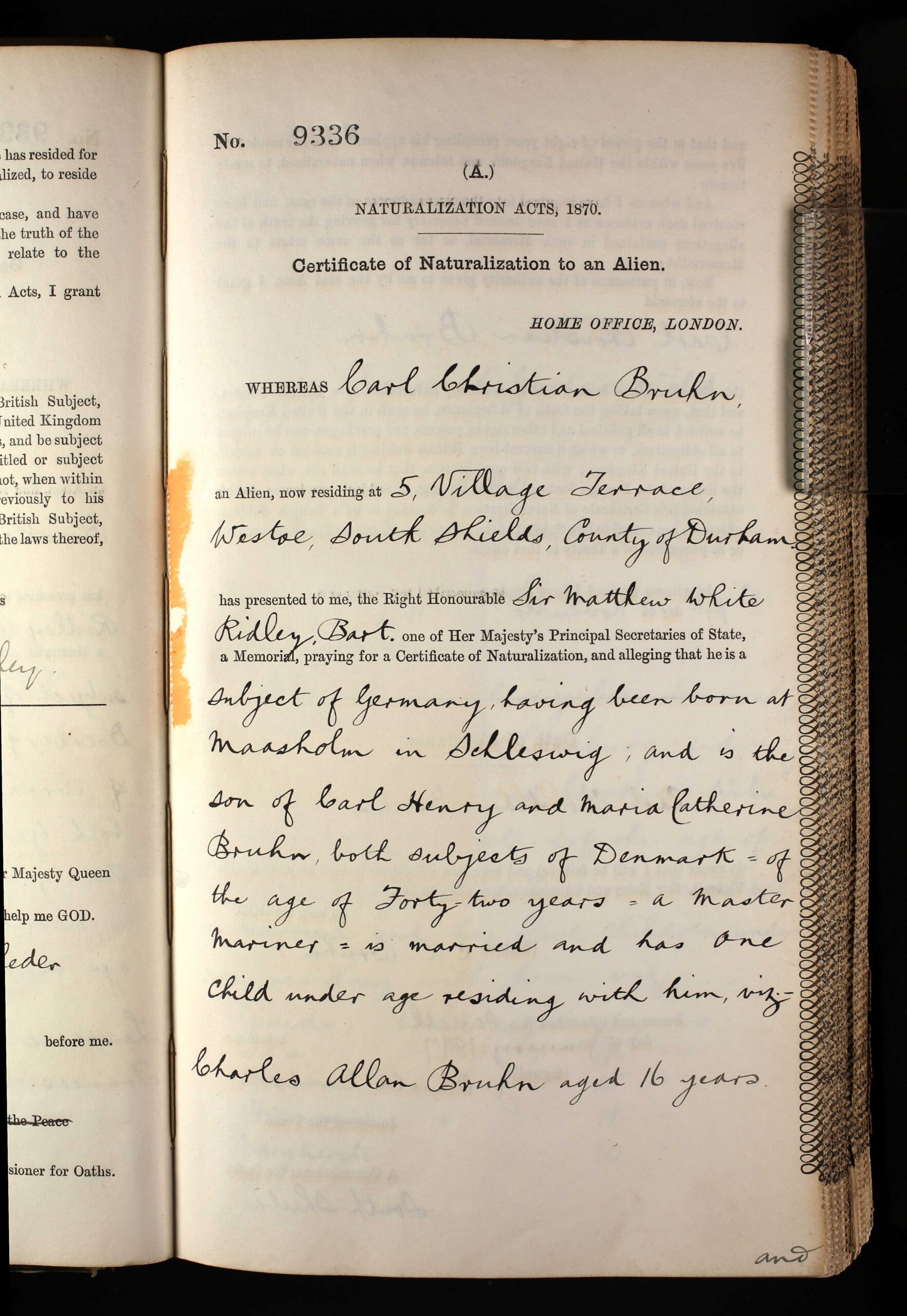
Carl Cristian Bruhn obtained his naturalisation certificate when he was residing at 5 Village Terrace, Westoe, South Shields, a subject of Germany, born at Maasholm in Schleswig, the son of Carl Henry and Maria Catherine Bruhn, both subjects of Denmark, aged forty-two. Carl Christian Bruhn was a Master Mariner, and his son Charles Allan Bruhn, aged 16, was residing with him.
In 1881, Charles Allan Bruhn was residing with his parents, Charles Christian and Annie Bruhn, at 63 Hedley Street, South Shields, and his father was a Mariner Chief Mate, but was out of work.
On the 13th September 1894, Charles age 15 was apprenticed to William Runciman until 1898 based at Newcastle upon Tyne.
On 5th June 1899, Charles Allan Bruhn obtained his Second Mate certificate for foreign-going steamships
In 1901, ALNWICK GUARDIAN AND COUNTY ADVERTISER SAT 12THJULY 1919 was boarding with Catherine Wilkinson, born 1847, her brother, Thomas Wilkinson, born 1851, and another boarder, Aaron Wilson, born 1846, at 20 Winterbottom Street, South Shields, and Charles was a Mariner. [In 1901, Kate Cleghorn was residing at the Workhouse at Pitsmoor, Sheffield, Yorkshire, and was a Nurse there]. Charles married Kate nee Cleghorn, Bruhn, [born 26th September 1879, died 30th April 1962, at 26 Bedford Place, W.C.1], on the 3rd August 1906 at St Barnabas Church , Bethnal Green, Tower Hamlets, London.
W. Bro. Revd. David T. Youngson, PPAG Chaplain, Northumberland offers the following: The information given below in respect of some of the brethren is the best possible conclusions from Lodge records, Grand Lodge records, Commonwealth War Graves Commission and data in respect of merchant ship losses during the First World War
1970 Hadrian Lodge
Year of Warrant 1882
Freemasons Hall South Shields
2418 Hedworth Lodge
Year of Warrant 1891
Freemasons Hall Ingram Street South Shields
Charles Alan BRUHN
(Commonwealth War Graves list him as Allan)
Mercantile Marine
Sea Pilot S.S. Northumbria
A Master Mariner, he was Initiated into Hadrian Lodge No 1970, South Shields, Province of Durham on the 7th April 1914; Passed in Hedworth Lodge No 2418, South Shields, Province of Durham on the 27th August 1914 and Raised on the 21st November 1914, becoming a Joining Member of Lodge of Friendship No 100, Great Yarmouth, Province of Norfolk on 10th May 1917.
He died 9th January 1919, aged 40, and was the husband of Kate Bruhn of Rodney House, 4 Endsleigh Street, Victoria, London. He is buried in South Shields (Harton) Cemetery, Grave Reference D.672.
The S.S. Northumbria (4215grt), shipnumber 120652 built in 1906 by the Northumberland Shipbuilding Company Limited, Howdon on Tyne for Westminster Shipping Company Limited (Sir John Jackson), London. She was the second ship of this name to be lost during World War One. She struck a mine off Middlesbrough. What is believed to be the only lifeboat that got clear of the vessel was washed ashore at Newton by the Sea on the Northumberland Coast with two survivors and twelve dead, some of whom are buried in the nearby Embleton Churchyard. It has been suggested that the boat had no row locks hence it drifted so far. The ship operated as a defensively armed merchant vessel.
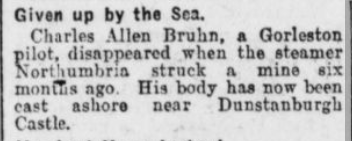
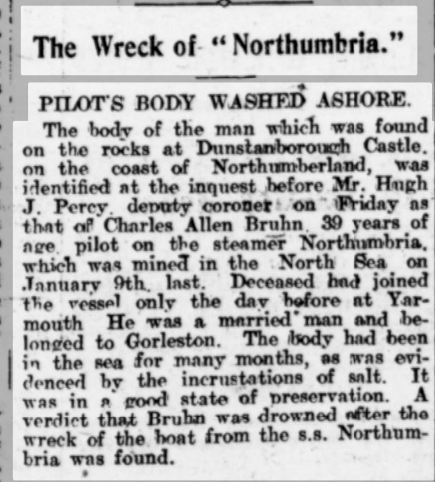
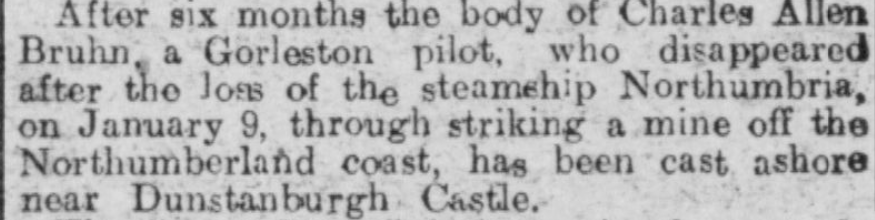
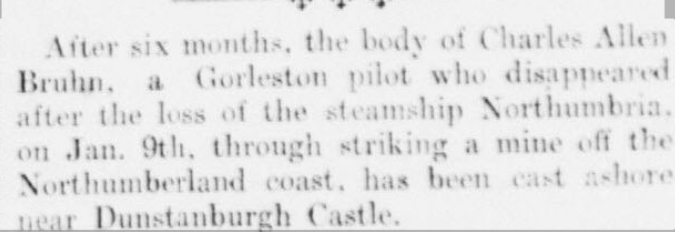
Charles Allan Bruhn body was washed up and recovered, from 6 months ago from the rocks at Dunstanborough Castle and was identified by the deputy coroner Mr. Hugh J. Perry at an inquest on the 11th July. The body was in a good state of preservation as evidenced by the incrustations of salt. He had only joined the ship the day before it was mined.
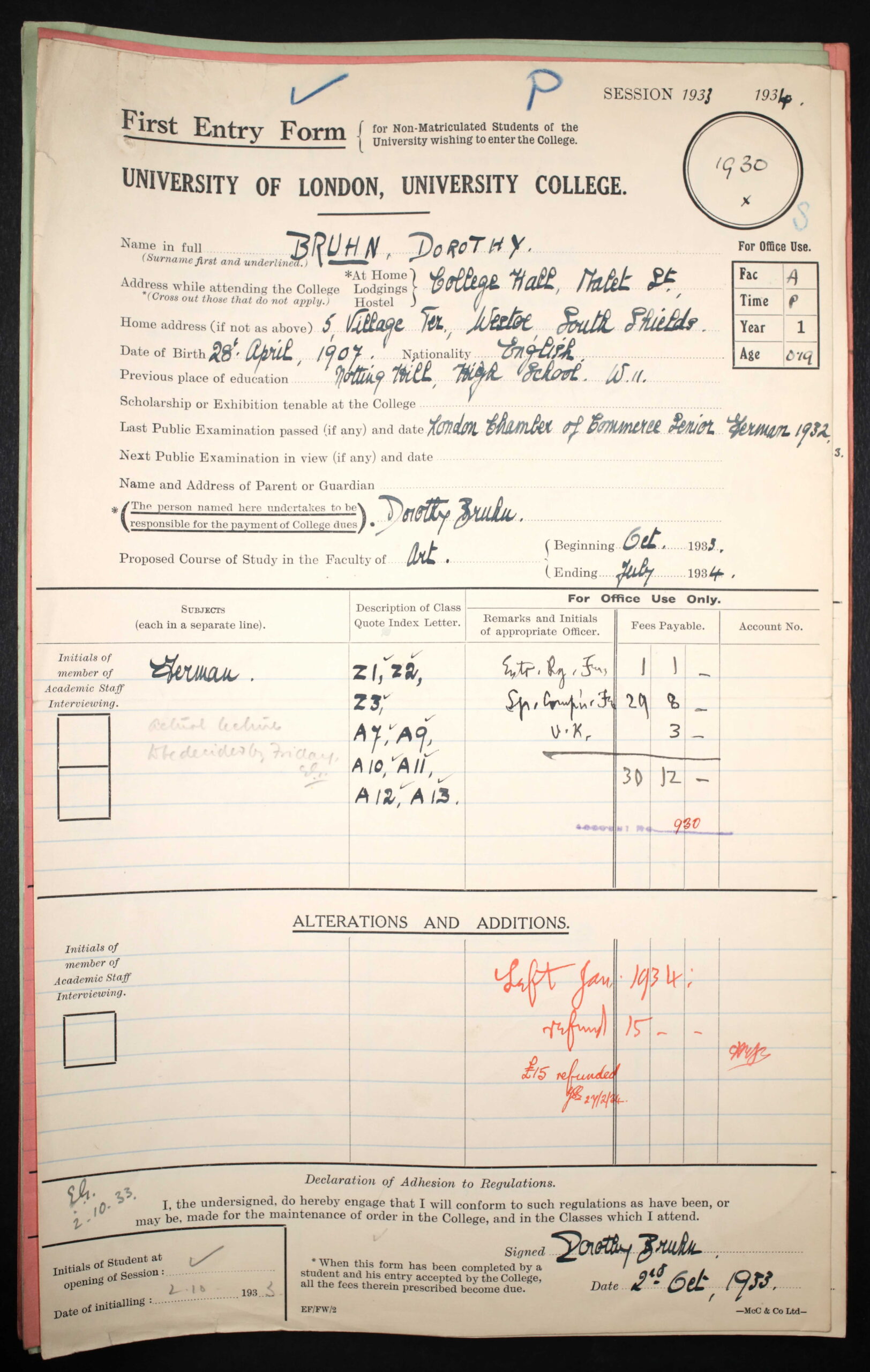
In 1921, widowed Kate Bruhn was residing, with hers and Charles’ two daughters, at 2 Great Woodstock street, Marylebone, London and she was a Sick Nurse. Dorothy Bruhn, born 28th April 1907, she attended the University of London in 1933-34, studying art and German. In 1939, she was residing at 28 Alexandra Drive, Liverpool and was a Secretary. Dorothy Bruhn died, aged 94, in 2001, in Waveney, Suffolk and Marjorie Chloe Bruhn, born 23rd July 1914, baptised 24th August 1919, at St Marys Church, Low Harrogate, Yorkshire. She married William Leonard Clough in 1934, at South Shields, [he was the son of an Albert John and Hannah Clough, husband of Marjorie Chloe Clough of Westcliff-on-Sea, Essex], they had a son, Peter Leonard Clough, born 24th December 1934, who later married an Anne Margaret Grace. Marjorie Clough, by 1939, was divorced and residing at the Savoy Hotel, Westcliffe Parade, Southend on Sea. Her mother Kate Bruhn was also residing with her. Marjorie later married Mr Rutherford in 1952. Marjorie Rutherford married Donald J B Stewart, in Southend on Sea, Essex. Marjorie Chloe Stewart died, aged 83, in 1997, in Horsham, West Sussex.
William Leonard Clough was a Flight Sergeant in the Royal Air Force Volunteer Reserve, official number 923190, in Bomber Command as an Observer, with 115 Squadron based at Mildenhall, Suffolk. He was shot down by a Focke Wulfe 190 into the Ijsselmeer during a raid on the Dortmund-Ems canal near Lingen. Two the crew survived and were captured.
[The fighter pilot hunched in the confines of the cockpit of his aircraft was tense, keen eyed and alert. The long range radar had been monitoring the bomber for some time now the local controller wasvectoring him into the vicinity of the enemy aircraft. He cursed the fleeting clouds through which he was flying. He could easily miss his prey in this white mist. At that precise moment the bomber broke through the thin cloud veil in which it had been hiding. The eyes of the fighter pilot locked on to it. The wallowing, bulky intruder was ahead and slightly above him. The gunners seemed unaware of his presence. His hand instinctively pushed the throttle forward and the huge radial engine surged into full power as he climbed into the attack. Now the bomber was close and moving across his line of flight. His pulse was racing, the adrenalin pumping… steady… steady…allow for deflection … the RAF roundels on the portly beam of the Wellington bomber grew large in his sight. He pressed the firing button. His cannon shells crashed into the cabin of the enemy aircraft. Pushing forward on the stick he broke away below pulling his Focke-Wulf 190 fighter into a wide arc out of range of the gunners. Sweeping round for a second attack he throttled back. It was unnecessary. The Wellington trailing fire and smoke was steadily descending. He watched it crash into the sea reported to his controller and set course for base.
Inside the bomber the crew members were dismayed to find the thin cloud cover had completely vanished. A startled exclamation over the intercom was the only warning they had of the impending attack. As the cannon shells tore through the fuselage Flight Sergeant Parker, the Canadian wireless operator, was hit and died immediately. Flames from the ruptured wing gasoline tanks spread rapidly, fanned by the slipstream. The pilot, Squadron Leader Parsons, shouted over the intercom that he would try to ditch the bomber. The front gunner, Sergeant Gilmour, came into the cockpit from his turret and saw the observer, Flight Sergeant Clough, with the cabin fire extinguisher in his hand vainly trying to subdue the raging furnace. The aircraft hit the sea and only two survivors emerged, the gunners, both Canadians, Sergeants Gilmour and Stansell. That was how Len Clough died.
I first met William Leonard Clough at No 8 ITW, Newquay, Cornwall, in November 1940. We were both in “D” Flight where we endured the rigours of basic square bashing and the pressures of Navigational Theory. We moved on to Canada to become part of No.6 Air Observer’s Course at Port Albert in April 1941 and experienced our first thrills of flying in Avro Ansons. After the wartime austerity of Britain Canada was paradise. We bought an old 1930 Essex automobile from a garage in Goderich in which we explored as much of Ontario as was possible in our periodic long weekend leaves. On termination of the course we were posted to the Bombing and Gunnery School at Picton. Here we were taught how to drop practice bombs with a reasonable degree of accuracy and the use of the Vickers Gas Operated machine gun in air firing. The aircraft we flew in were Fairey Battles. Not so sedate and much more exciting kites than Avro Ansons. The great day arrived on 29th September 1941 when we were awarded the coveted observer’s brevet and our sergeant’s “stripes”. By some freak of posting we were still together, two members of the original ITW “D” Flight.
Back in Britain our next posting in November 1941 was to 20 OTU, Lossiemouth, Scotland, for operational training. The real war was getting closer. The ultimate move to an operational Squadron in the south was nigh. Soon we would be dicing with flak, night fighters and the remorseless North Sea. The chance of an identical Squadron posting vanished when Len entered hospital for a minor operation. I was sent down to 115 Squadron at Marham in Norfolk and within two months was a Prisoner of War in Stalag VIIIB, Germany. A letter received from home gave me a veiled hint that Len had followed in my footsteps and when a new batch of fliers arrived at Stalag VIIIB in October 1942, two Canadian gunners from 115 Squadron, in answer to my query, informed me that Len Clough had been their observer. From them I learned the story.
On Monday, 28th September 1942, three Wellington aircraft from 115 Squadron were detailed for a “cloud cover” daylight bombing attack on Lingen on the Dortmund Canal. A Wellington bomber was no match for a German fighter. It was essential that there was sufficient cloud to hide in. This type of attack was primarily intended to disrupt German industry by driving the workers into air raid shelters. All aircraft captains had strict orders to return to base if the cloud cover broke up. As the aircraft made their way east the cover thinned out rapidly to a scattering of isolated clouds. Sergeant Crimmin in Wellington BJ695 KO V decided to turn back. Squadron Leader Sandes in Wellington BK272 KO T made a similar decision. Squadron Leader Parsons in Wellington Z1663 KO J decided to press home the attack. Approximately eight kilometres south west of Urk, over the Zuider Zee, his attack failed…
My career in the RAF was virtually identical with that of Len Clough until the 28th September 1942 when he joined the ranks of all those whom we remember on this very special day].
Source: WayBack Machine: Written by Don Bruce – Observer 115 Squadron -POW Stalag VIIIB © Don Bruce 1996, 2001, 2007. Please respect the copyright.
115 Squadron’s Vickers Wellington III (#Z1663) aircraft, with an aircrew of five, took off at night from RAF Mildenhall for an air operation over the Dortmund-Ems Kanal near Lingen in Germany. Z1663 was shot down by a German night-fighter, resulting in its crashing and taking the lives of three members of the crew. The two airmen who survived the crash were captured and imprisoned in a German Stalag VIIIB PoW camp.
The airmen who perished in this incident were- RAFVR Flight Sergeant William Leonard Clough, RCAF Flight Sergeant John Austin Parker and RAF Squadron Leader Robert James Sealer Parsons.
Sources: The British Newspaper Archive: The Western Front Association; The James Hoy Archive; Simon Glancey; The National Archives; Jennifer Stephenson; Merchant Navy Archives; Way back Machine: Don Bruce:
Charles Allan Bruhn is remembered at South Shields on S86.027, and in S86.086, page 2, in the Masonic Roll of Honour 1914-18 (London), in the Masonic Roll of Honour 1914-18 Rev. Youngson Part 2 and Part 3 and in our List of Ships’ Crews.
First Name: Charles Allan
Last Name: Bruhn
Which War: First World War 1914-18
Died: 09/01/1919
Age: 40
Rank: Sea Pilot
Regiment: Lighthouse and Pilotage Authorities
Served in: Navy
Unit/Ship: S.S. Northumbria
Links to Source Material