Every Name a Story
Bertha Massey Gleghorn
Every Name a Story
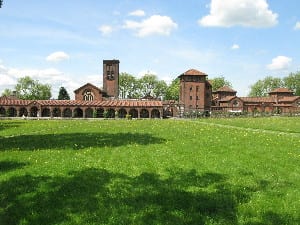
In the Garden of Remembrance at Golders Green Crematorium, Hoop Lane, London NW11, is the grave of PC 128, Woman Police Constable Bertha Massey Gleghorn, serving with ‘C’ Division, Metropolitan Police, who died 19/06/1944.
Bertha Massey Lawson was born at ‘Glebe Cottage’ on the 9th October 1910, at Stockport, Norton, Salop, Shropshire. She was the daughter of unmarried mother Sarah Ann Lawson, (born 16th September 1888}, who was the second eldest daughter of William Lawson, (born 1849, Shrewsbury, christened 7th January 1850, at St Chads), a house painter, and his wife Emma, (nee Williams), born 1856, Woodcote, Shropshire. They were married in 1881 in the 2nd quarter of the year. They had nine children but two died. Sarah born 1888, Arthur, born December, 1890, Wilfrid Frank, born 1897, Maggie, born 1894, John, born 1893, Lilian, born 1988, and Walter born 1882.
In 1891, Sarah Anne Lawson was residing at Stockton, with her parents, and her mother’s father John Williams then aged 79.
William Lawson’s, Sarah’s father, was also called William, born 1815, at Warrington, Lancashire. He married Emilia, born 1821, and they had four children John, born 1841, Elizabeth, born 1847, Martha, born 1857 and William born 1850.
In 1911, Bertha, then aged five months, was entered on the census as a grand daughter. Sarah Ann’s brother Wilfrid Frank Lawson (born on the 18th August 1897, was residing at this address along with his parents and of course with Bertha.
Bertha’s mother Sarah Ann married George Gleghorn, (born 19th August 1880), a Police Constable, on the 3rd August, 1915 at Darlington register office. His first wife Mary died in January 1915 and they had two children Irene aged 9 and George aged 6, George was living at 7 Hollyhurst Road, Darlington, this may be the address Sarah was employed by George prior to marrying him.
Bertha received an elementary education before working as a housekeeper, she had been working as a housekeeper for two elderly spinster sisters in west London. Residing at 54 Holland Park Avenue, Kensington.
Bertha Gleghorn had joined the London Metropolitan Police force on the 8th January 1940, a single woman aged 30, who was 5 feet 7 inches tall
Bertha was posted to A (Whitehall) Division as Probationer No. 128-423. On 7th October 1940 Bertha was transferred to B (Chelsea) Division, and on the 29th September 1941 to C (St. James’s) Division, which included Tottenham Court Road Police Station (CT) Section. Her duties would mainly have included dealing with women and children. It is most likely she was following the example of her step-father, George who at 59 had retired from being a policeman himself in Durham.
George retired from the police force in 1934 to run the Darlington Conservative Club, his son George also became a policeman.
“Darlington Club and Institute is a long-established club which has survived many changes. Officially opened on November 6th 1901, it was set up by a small group of local railwaymen – perhaps not surprisingly given Darlington’s strong historical links with the railways. It soon became CIU affiliated. The group first met in ‘Frareys’ cocoa rooms, Tub Well Road in Darlington on March 1st 1901. They were able to appoint a president, treasurer, secretary and committee.”
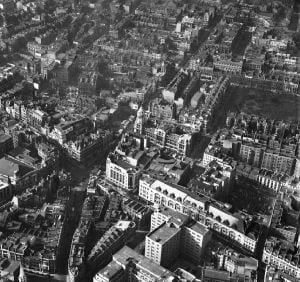
In July 1940 the old police station at 58 Tottenham Court Road and 19 Whitfield Street had been closed for re-building and all business transferred to 16-17 Rathbone Street, W1, a former Section House (single officer accommodation) it was re-designated Tottenham Court Road Police Station and Bertha would initially have worked out of these premises. On the 10th December 1942, the temporary police station at Rathbone Street closed and all business was moved to the new station at 56, Tottenham Court Road.
One of her beats adjoined West End Central (CD) Section at Oxford Circus and on the morning of Monday the 19th June 1944 a WPC on early turn patrol from ‘CD’ saw Bertha patrolling her beat in that area. Bertha’s colleague returned to West End Central for refreshments, while presumably Bertha did likewise.
In 1939, Bertha’s mother and her step father were residing at 10 Salutation Road, Darlington, Durham, George [died 1960], was also an Air Raid Warden, Sarah died in 1971.
Women police had been established in London two decades earlier but many in the force opposed their recruitment. In the early part of WW2 women’s duties were still restricted but gradually expanded to cover the whole range of law enforcement. Women Police dealt with refugees, evacuees, and enemy aliens. They took their turn on duty at air raids. She received a Commissioner’s Commendation on August 28th 1942 for the detection of offences against the betting, gaming and licensing acts.
On the morning of the 19th June 1944, she suffered fatal injuries when the back of Tottenham Court Road police station was struck by a V1 Flying Bomb. It was located just North of Oxford Street. The blast caused a wall of brickwork to collapse trapping her under the rubble.
The blast also destroyed 2 police cars. She was taken to Middlesex Hospital but died later that day.
“Bertha’s colleague taking refreshments at West End Central heard a big bang and knew it was near. Woman Police Inspector Butcher, who was visiting the women police in the West End, heard the V-1 and saw, as the motor cut out, it check and fall. Bertha was just leaving Tottenham Court Road to go back on her beat when it landed at the rear of the station damaging the building, destroying two police motor vehicles in the garage and bringing down a wall which buried WPC Gleghorn. Inspector Violet Butcher was on the scene within minutes but could do little but hold Bertha’s hand until she was freed from the rubble and taken to the Middlesex Hospital nearby, where she died later that day. Four other officers were injured”
The cause of death registered on Wednesday the 21st June, given on Bertha’s death certificate was due to war operations. She was described as a ‘woman police officer’ and daughter of George Gleghorn, ‘police pensioner’.
The Bomb Census report written the day of the incident included the following statement of the damage notes : “V1 fell on old brick and timber properties at rear of Tottenham Court Road Police Station. Damage extensive and severe but impossible to assess at time of investigation. Street filled with debris and rescue work in progress. Casualties feared heavy many trapped”.
Source: NA HO 198/180, 1944.
The situation report at 6.00pm on June 20th, the following day, reported an many concurring incidents around London. For Whitfield Street, the situation report claimed 21 had been killed, 70 seriously injured, 146 slightly injured, and about 8 people still missing at that time.
For Bertha Massey Gleghorn, then just 33, was Britain’s first woman police officer to die in the line of duty.
She paid the ultimate price for refusing to leave her post at Tottenham Court Road police station as the capital came under fire at the height of the Second World War.
At the time of her death she was earning 64 shillings a week and the female contingent in the Met consisted of 128 uniform and eight CID officers.
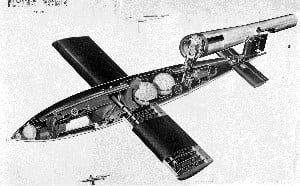
“The Germans created a special unit to handle the flying bombs the 155th Flak regiment commanded by Colonel Wachtel. The V1 officially for the Germans the FZG-76 was also known as the ‘doodle bug’, ‘buzz-bomb’ and ‘cherry stone’. It was 25 feet long and had a wing span of 16 feet. Loaded with fuel, it weighed 2 tons and it had a warhead of 2,000 lbs of explosives. The most common way of launching the V1 was by ramp. It could also be launched by a modified Heinkel III. Originally, the V1 had a maximum range of 150 miles but this was improved to 250 miles to allow for it to be launched from Holland. About 10,500 were launched at Britain from June 1944 on, 8,800 by ramp and the rest by plane. The first one was on June 13th 1944.”
Bertha Gleghorn was cremated at Golders Green Crematorium, on the 23rd June 1944 and her ashes dispersed in the Crematorium gardens. No memorial was erected but an entry was made in the crematorium’s Book of Remembrance, her epitaph reads:
Gleghorn, Bertha Massey
Born 9th October 1910
Died 19th June 1944
In Loving Remembrance
At rest in God’s garden.
In 2014, Assistant Commissioner Cressida Dick unveiled a plaque honouring WPC Bertha Gleghorn at a ceremony in Charing Cross police station on Friday. Westminster Borough Commander, Chief Superintendent Paul Rickett opened the service by honouring WPC Gleghorn and other fallen officers across the Met. A service led by Senior Chaplain Jonathan Osborne followed.
Chief Supt Rickett, said: WPC Bertha Gleghorn demonstrated tremendous courage, dedication and professionalism in her role as a police constable until her tragic death, while on duty, keeping the people of London safe. We must always remember those brave officers who have tragically lost their lives.
We will always be indebted to them for their service, paying public tributes to their ultimate sacrifice and offering support to loved ones and colleagues they have left behind. We should not, and will not, forget them.
AC Dick, of Specialist Crime and Operations, said: I was really pleased to be able to meet Bertha’s family and to unveil the plaque. The story of her life and how she came to die in service, killed by the V1 bomb, is extremely moving. Many thanks to everyone who has helped to research her history and to all at Westminster who worked so hard to arrange the memorial event. It is great to think that her photograph and the plaque will remain at Charing Cross as an appropriate memorial.
Many thanks to Keith Foster who did the initial research. Keith Foster, Researcher, National Police Officers Roll of Honour Research Project founded 1995.
John Kenealy has sent in the following:
My name is John Kenealy, I retired from the Metropolitan Police Service In October 2017. My Mother’s maiden name was Lorna Gleghorn, my Great Grandfather was George Gleghorn, who was Bertha’s Step Father. Do you believe in fate?
I joined the MPS because Policing was in my genes. I was a skilled Telecommunications Engineer, yet aged 35 I became a Police Officer. Although I lived in rural Essex it was the Met or nothing. I passed through Hendon recruit training and was posted to Vine Street, C Division. Like Bertha, I became a Soho beat Officer. I knew nothing of her, however, but the Memorial plaque in the Station Office at Vine Street really intrigued me. Gleghorn is NOT a common name. PC128C as she was. The original 1944 copy of Police notices was still in the Station Archive and through that I discovered part of her story.
My MPS journey began with the Admiral Duncan and ended in Westminster with a Terrorist who killed my colleague PC Keith Palmer. When my Father passed away, George Gleghorn’s Grandmother Clock given to him on his retirement from Durham Constabulary was in their home. I still have the plaque from it commemorating his Service. Its but a small part of Bertha’s story. Should anyone want it however, I am happy enough to pass it on. My Mother was raised as a child by her Grandparents in Darlington and she simply adored my Great Grandfather, that much I know.
Some things in life are just meant to be.
Eleanor Dexter August 13th 2020 sent these details about Violet Butcher.
VIOLET BUTCHER Metropolitan Police officer MP98
Violet was born on November 8th 1882. Her father was Colonel Henry Townsend Butcher dob 1857 – 1915. He was a colonel in the Royal Artillery. Violet’s mother was Annie Susan Dalrymple Hay 1857 – 1934. Both parents were born in Peshawar Punjab, India during British rule there and both died in Malta. Violet had three sisters called Einna, May and Beryl. Violet never married. Her uncle was Sir Harley Hugh Dalrymple-Hay who was a notable engineer working on the underground railways in and around London, England. He was awarded the Telford Medal in gold by the Institution of Civil Engineers for his paper on the Waterloo and City Railway. He was born October 6th, 1861 in Bengal, India. He worked on the Bakerloo line, the Hampstead tube and the Piccadilly line and was consulting engineer to the London Post Office railway which was completed in 1928. After World War 1 he was involved in an extensive programme of station reconstruction on the London Underground system, including the replacement of many lifts with escalators.
I (Eleanor Dexter nee Heighway) was born in 1957 and my parents were then living in London. My father was a clergyman called Francis Heighway. Violet was a parishioner at St Mary-le-Park church, London. At the time she lived at 87A Albert Bridge Road, Battersea SW11. This would have been after her retirement around 1944 from the Metropolitan police. During the 1950’s there was, apparently, a rent scam going on in London led by a man called Rachman who was involved in the exploitation and intimidation of tenants by unscrupulous landlords. My father had something to do with an organisation that put pressure on the powers that be, to investigate this. Violet’s basement flat was obviously one of those properties and as she was one of his parishioners, this is how she came to know my family.
My father moved to another parish in Bermondsey which had a huge vicarage. The top floor had a self contained flat and Violet came to live with us. From that time she became a much loved member of our family and when my father moved us to other parishes, she accompanied us. We moved to Hertford, Stockton and Sabden, near Clitheroe, Lancashire where she died in her 80’s around 1967. I only knew her for the first ten years of my life but I remember her as a very independent lady, always smartly dressed with her white hair in a neat bun and a cameo brooch in her blouse. She always insisted on taking her meals in her rooms but would come down for special occasions with the family such as birthdays or Christmas. When I was a bit older, eight years or nine perhaps, she would invite me into her rooms and I would sit on a stool next to her Victorian bureau. She would give me a juice, a biscuit and relate stories from her Victorian childhood, her time in India and of course some of her experiences in the Metropolitan police. I was fascinated.
I recently found her name mentioned in an article on the North East War Memorial site about another Metropolitan police woman PC Gleghorn. Violet was mentioned as Inspector Violet Butcher who ran to her aid when a V1 bomb fell on the Tottenham Court police station on June 19th, 1944. PC Bertha Gleghorn (PC 128) was Britain’s first woman police officer to die in the line of duty. It states in the article that Inspector Violet Butcher who was nearby, ran to her aid but could only hold her hand as she was trapped under a wall until help came. I am unsure of the dates Violet was with the Metropolitan police but my brother tells me she served for approximately 30 years and retired in 1944.
Eleanor Dexter August 13th, 2020
Bertha Massey Gleghorn is remembered at Darlington in D40.035, also remembered at the Police Roll of Honour Trust site.
First Name: Bertha Massey
Last Name: Gleghorn
Which War: Second World War 1939-45
Died: 19/06/1944
Rank: Police Woman
Served in: Civilian War Dead 1939-45