Every Name a Story
Arthur John Joyce
Every Name a Story
In Wandsworth (Earlsfield) Cemetery is the Commonwealth War Grave of 9932 Serjeant Arthur John Joyce serving with the Royal Flying Corps who died 13/03/1918.
The husband of Mrs. Joyce, of Keildon Road, Clapham Common, London.
Arthur was born in 1890 the son of Edward Henry and Ann Maria Joyce. In 1911 the Arthur was 21 and a Railway Gateman.
On September 4th 1913 he married Florence Ada Martin and the couple had two children – Muriel Florence born August 28th 1916 and Denis Arthur born January 26th 1918
Arthur enlisted into the Royal Flying Corps on October 13th 1915 at that point he was Motor Driver and living at 87 Grandison Road Clapham Common. He was promoted to Corporal October 1st 1916, became a 1st Class Pilot August 14th 1917 and promoted again to sergeant on the same day.
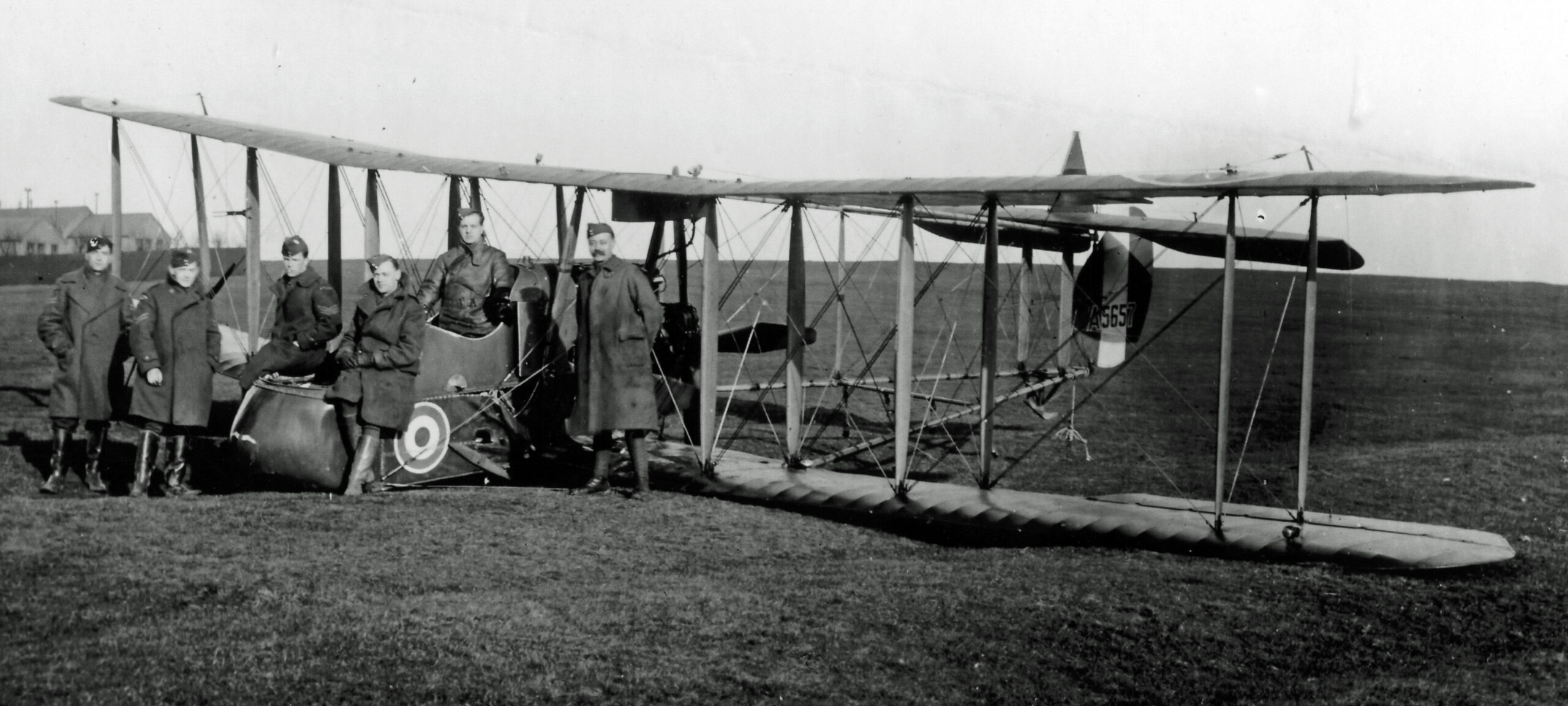
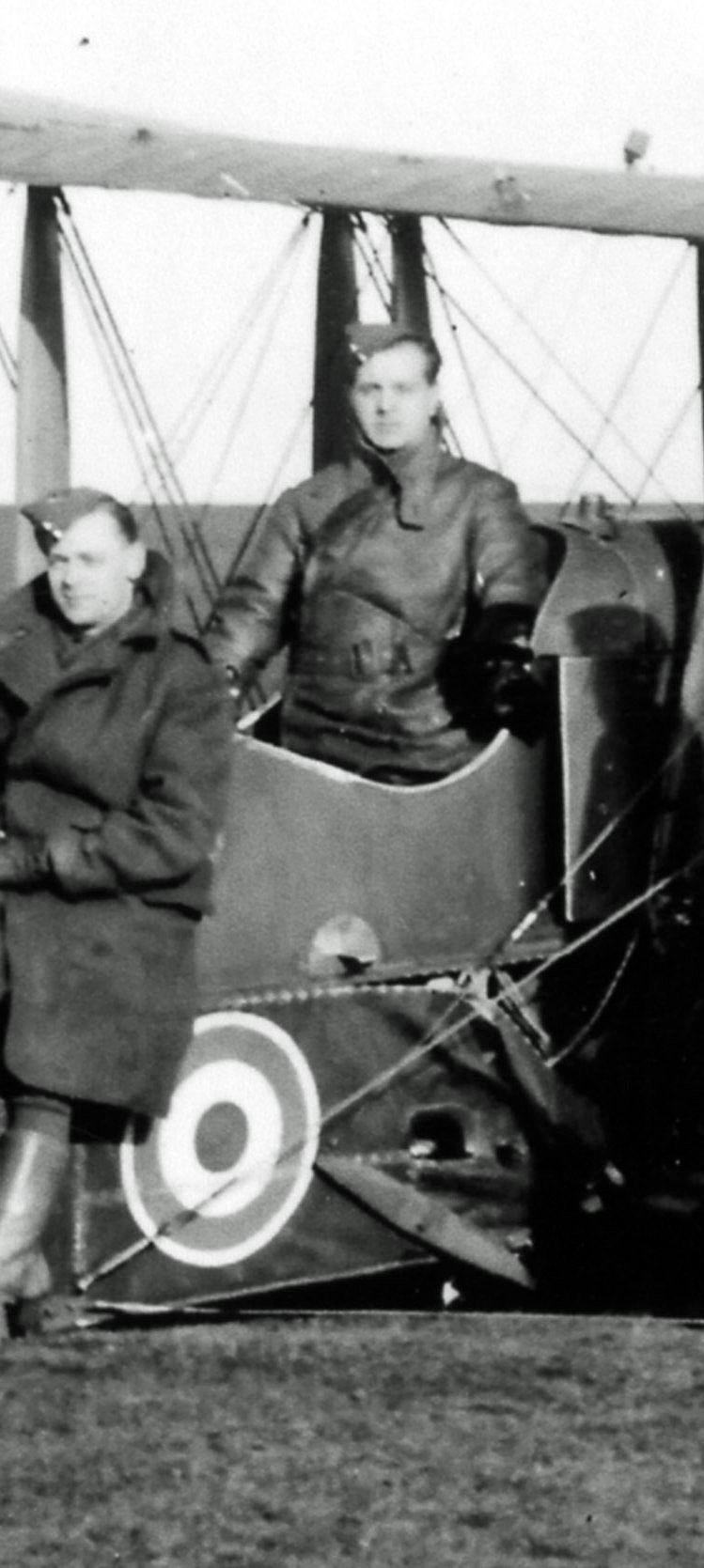
A black and white photograph shows Sgt. Pilot Joyce standing in the cockpit of an FE26, made by Royal Aircraft Factory, which he had just crashed, seemingly unscathed. The FE2B carried a 120 hp Beardmore engine, which powered the propeller which was situated to the rear of the plane. The gunner sat at the front with the pilot in the cockpit behind him.
The Newcastle Journal 16/03/1918 reports:-
AEROPLANE FATALITY NEAR ANNFIELD PLAIN.
An inquest was held by Mr John Graham (coroner), at Annfield Plain, yesterday, on Sergeant Arthur John Joyce, R.F.C., who met his death through his machine crashing to the ground.
Corpl. Wm. Wallace Douglas. R.F.C., identified the body- He said that Joyce, who belonged to London, had had nine months’ experience flying, and was a very capable airman.
In turning to avoid some houses he tilted or banked the machine, which side-slipped and came to earth. Death had evidently been instantaneous.
The Coroner said no blame could attach to anyone. The deceased was quite able to manage his machine, which was apparently in perfect order.
A verdict of Accidental death was returned.
The Consett Guardian 22/03/1918 reports:-
Sad fatality to an Airman
near Annfield Plain
Death not due to burning
Several Misconceptions Cleared up
The terrible tragedy that occurred in our midst on Wednesday night of last week, during the time that an air raid was taking place at Hartlepool, caused the utmost sorrow in the district and many bemoan the sad fate of the intrepid young fellow who lost his life in such a tragic manner whilst out on active service. As is usual in such cases, the most wild and unlikely stories were in circulation but these ridiculous rumours and misconceptions were satisfactorily cleared up at the inquiry held in the Old Committee Rooms of the Annfield Plain Cooperative Society on Friday afternoon.
It was the general belief that the airman died in awful agony as the result of burns but this theory was entirely disproved from the evidence adduced death having apparently taken place before the burning flames of the aeroplane could do their deadly work. The accident was bad enough and sad enough in all conscience, but is some little consolation to know that the unfortunate airman did not suffer the terrible agony of death from burning petrol that burst into flames as the biplane touched the ground. It is the unanimous opinion of those best qualified to judge that the shock, together with a blow from the radiator of the engine caused instantaneous death before the flams touched the unfortunate fellow.
The engine of the ill-fated biplane had been brought to the Store yard on one of the lorries of the Cooperative Society, and was examined by Mr Coroner Graham and the jurymen, the necessary explanations being forthcoming from three members of the RFC who attended viz 2nd Lieut. Grime, Corpl WW Douglas and Corp. Banks. Mr R Clarke was appointed foreman of the Jury and during the course of the inquiry showed that he possessed an excellent practical knowledge of flying machines. Inspector Robson of Stanley was also present.
The first witness was Corpl. William Wallace Douglas RFC, who identified the body, and said that Joyce was a Sergeant Pilot in the RFC and was 27 years of age. Deceased belonged to London and has had about nine month’s experience of flying. He left the aerodrome on the night of the accident about 9.5pm in a FE2B Machine. The pilot’s seat was at the rear, in front of the radiator. The observer sat in front of the pilot. It was a two seater machine but Joyce was alone, the observer’s seat being filled with bags of sand for the purpose of balancing. There were about 160lbs of sand. Deceased was about 12st 6lb, 5 feet 8 ½ ins in height and was a well-built man.
The object of Joyce leaving alone was that he might get to a higher altitude, as he was on active service. He was quite capable of managing the aeroplane and was fully equipped with all that he requires, including map and compass. He had flown the same machine several times without accident and as a matter of fact had flown the machine the same afternoon of the day that he was killed, being up for about 45 minutes and nothing happened. When he left the aerodrome at 9.5 there had been an alarm and an air raid was in progress; therefore, he was on duty. At the time he left the deceased was in perfectly good health. Witness had seen the remains of the aeroplane and also the deceased.
The Coroner: What in your opinion was the deceased doing at the time?
Witness thought that at the time of the accident deceased was trying to find a landing place. At the spot where Joyce was it was between 900 and 1000 feet higher than their aerodrome, where a thick ground fog came in on the night of the accident and it might have extended 100 feet from the ground thus rendering it difficult for deceased to find his way home. Having seen the place of the occurrence the witness noticed that there were houses on the north side of the road and a grass field on the opposite side. The grass field would be a suitable place for landing and he thought Joyce had tried to land there. In circling towards the end of the houses his right wing had approached rather too near the house-end and to avoid a collision he had tilted the machine or banked by depressing the left wing and raising the right. This would cause a side-slip and instead of rising the aeroplane would probably come to ground being at the time flying so low. Then on the aeroplane alighting it would be in a tilted position and the nose would strike the ground. He thought that the deceased was killed by the machine coming in contact with the ground and that he received a blow from the radiator causing instant death. The burning petrol would do the rest.
The Foreman: I suppose he was carrying an aneroid?
Witness: Yes
The Foreman: You are convinced that he was trying to alight?
Witness: Yes
Mr Armstrong as juryman: Do you think he was in distress?
Witness: No
The Foreman: Did the fog extend to the sea?
Witness: Yes
Edward Henry Carr, a coalminer, of 14 Loud Terrace, Annfield Plain said that on the previous Wednesday night, he was standing at the back door of the terrace where he lived, when he saw an aeroplane coming from the direction of the Loud Farm. He saw what he took to be lights on the machine. The aeroplane went in the direction of South Pontop and circled round. Then he saw what he thought were blue lights dropped from it. The machine came over by Greencroft and he saw what appeared to be a spark and the lights were all put on and the engine shut off as though the airman wanted to land. He was flying very low between 20 to 30 feet and witness’ s idea was that he probably saw the houses close to him, which caused him to turn sharply and nose dive and he crashed into the fence by the side of the road close to where witness was standing. The aeroplane at once burst into flames. He went over towards the machine but could see nothing of the pilot. The aeroplane had turned over. Whilst the machine was on fire there was an explosion of petrol.
The Foreman: Was he flying square on to the terrace when you saw him?
Witness: Yes As soon as he saw the houses he tried to turn and side slipped, crashing to the ground.
In reply to further questions witness said the bursting out of flames and the landing of the machine were simultaneous. The aeroplane took fire as soon as ever it touched the ground. It was not on fire in the air.
PC Bunning who is stationed at Greencroft said that on the night in question about 10.30 he was on duty at South Pontop, when he saw an aeroplane flying very low. The airman was dropping flare lights and seemed to be seeking a place to come down. Eventually witness saw him alight and went to the place. Deceased was found underneath the machine. His feet and hands were terribly burnt but not his face. They were not able to get any water for the fire owing to a breakage in the mains at Castleside. With the assistance of Sergt. Sutheran the body was lifted out of the ditch.
PC Curtis stationed at Catchgate, said that on the night in question he saw an aeroplane circling round South Pontop and then go in the direction of Loud Hill. The machine appeared to be turning over and then made a sharp nose dive into the ditch by the side of the road. PC Bunning and himself ran to the place from where they were standing at the bottom of the bank. The machine was then in flames and a number of explosions occurred. Eventually the fire burnt itself out. Witness corroborated PC Bunning’s evidence as to finding the body.
The Coroner: You had no sand or water and were helpless. You could not put the fire out.
William Chambers Watson, an engineer employed by the South Derwent Coal Co. and living at Annfield Plain, said that on the previous Wednesday night he was in his kitchen when he heard the sound of an aeroplane in the vicinity. What drew his attention was the peculiar sound of the engine. He went out and saw the machine, which appeared to be on fire.
The Coroner: After having heard the evidence so you still think so?
Witness: I thought so
The Coroner: Corpl. Douglas has explained the lights on the aeroplane which might have caused you to think it was on fire.
Witness agreed that it was quite possible that he had been mistaken. The machine took a sharp turn to the north and appeared as he then thought, to be on fire at the rear but now he thought it was merely the lights of the flares to show the airman his whereabouts. Opposite Loud Terrace the machine crashed to the ground and burst into flames. Witness had had 12 years’ experience of motors. In his opinion the pilot had engine trouble owing to the unusual noise that it was making.
The Coroner Do you still think so? We are given to understand that it was not due to engine trouble.
Witness said it was only a matter of opinion and he was not sure about it. He might have been wrong.
Sergt. Sutheran, of Annfield Plain, stated that on the night referred to he was on duty in West Road Annfield Plain, when his attention was directed to the sound of an aeroplane. He saw flare lights dropping from the machine which appeared to be flying low. The machine seemed to be on fire.
Coroner: That seems to be a mistake
Witness said that there were lights coming from the rear every now and again.
The Foreman and Corpl. Douglas said that was due to the exhaust.
Witness said that he immediately went to the scene of the accident. The machine fell close to the highway. He found the dead body of the pilot. The lower parts of the body, hands and feet were burned to the bone.
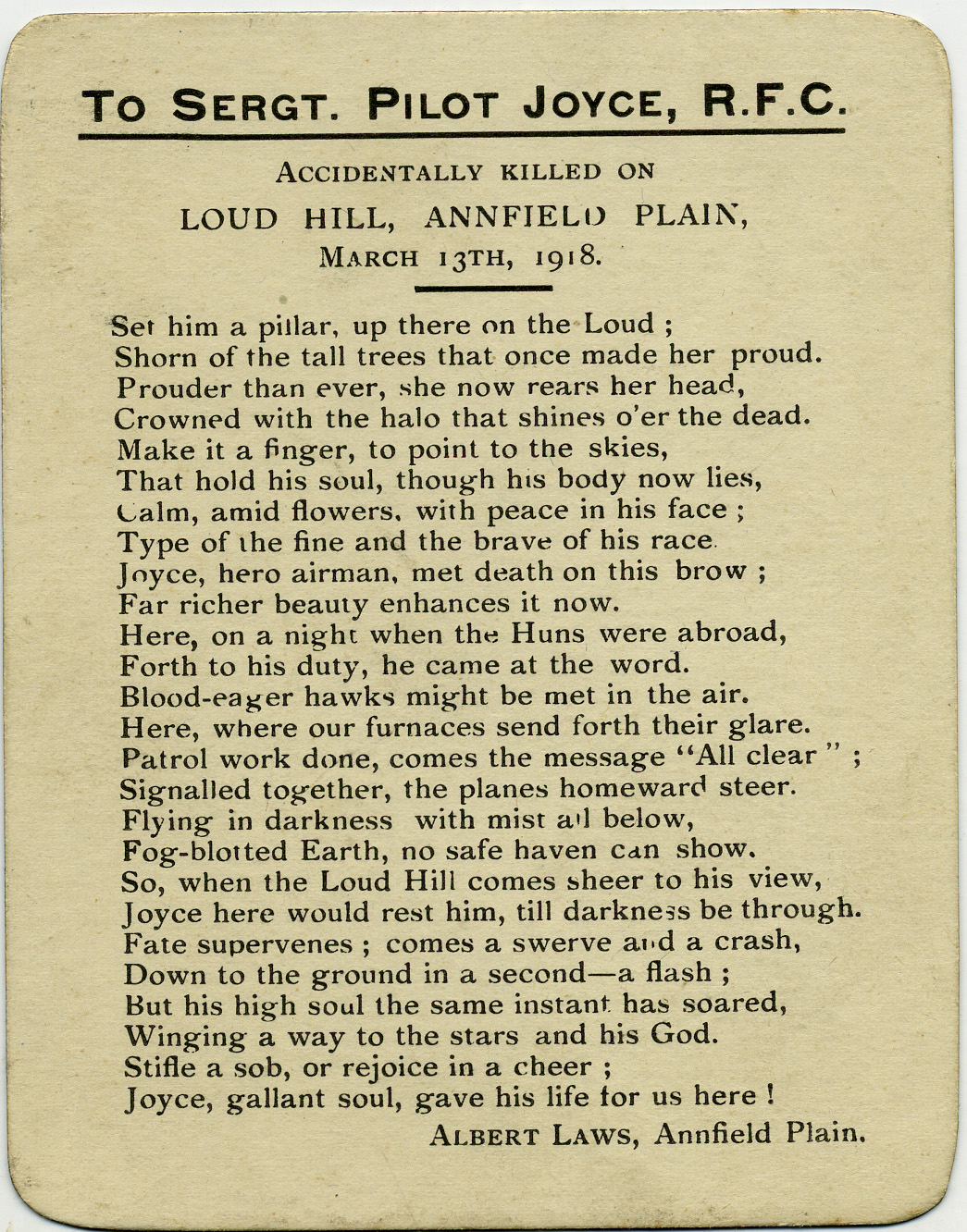
Albert Laws of Fair View Annfield Plain said that at 10.30 on the 13th inst. He was drawn by the sound of the engines of the aeroplane to the back of his house and saw the machine pass over the South Pontop Colliery, where a blue light was dropped. The aeroplane flew towards Greencroft and soon returned after dropping more blue lights. Flying low over the field in front of Fair View Terrace the airman dropped another flare which would disclose to him the nearness of the houses forming Loud Terrace. He swerved to the left, uphill to avoid these houses and at his turning the plane went vertical and the machine dropped to the ground. The instant it crashed to earth it burst into flames and in common with many people witness ran towards the spot at the south side of the Loud Hill Road where the wrecked aeroplane lay in the ditch. There were many small reports and presently there was a burst of flame as the petrol tank exploded. The police and some civilians made attempt to see whether the airman was on the machine but this was impossible for a few minutes till the flames left the outer parts of the machine. He saw the police and other men discover and release the body from the wrecked aeroplane and noticed the lights of another aeroplane hovering to the south.
The Coroner said that was all the evidence he had to put before them. There is nothing more, Inspector?
Inspector Robson mentioned that the deceased’s map was found on top of the engine, and he had evidently being studying the map. He thought that the injuries to the man’s head would kill him instantly.
The Coroner said that they wanted to make that clear. The accident was bad enough but it would have been much worse for the relatives if it had been proved that the poor man had been burnt alive. He though that anybody who had seen the remains of the unfortunate man might have been excused for thinking that he had suffered an excruciating death. His face was not really injured. He thought that they had all taken the pains that they could in order to get at the whole facts of the case. It was desirable that they should all know as far as possible all the details. It had been established with perfect clearness that the machine had been in good order, and that every requisite necessary was put on board. Although it was built for two it was perfectly safe for one, the man being capable and able to manage it. The first witness had spoken of the deceased’s ability and then they had that he held the rank of sergeant. There they had the machine equipped with a capable pilot who was out doing service for their protection, and all round about there was great alarm owing to a raid on the coast. So that in the discharge of his duty and that duty nearly completed he was killed. His work had been accomplished. Although there was a ground fog on that particular night up where he was it would be clearer. Then he came down, found that there was ground fog below and according to the inspector was probably using his map in order to make out his locality. He saw what he thought was a field upon which he could safely alight. It might be that the difference in level between his own aerodrome and that where he was rather misled him if he could not see where the land was. If he were only 20 to 30 feet up, as said his instrument might show 1000 feet and he would think all was clear and not find out until he came down that he was among the houses. Then the difficulty of getting clear of the houses had been thoroughly well explained and that was the cause of the accident. No blame was attached to anyone. It simply came to this – it was a deplorable accident –most deplorable- and one that they all felt keenly about.
Tribute to the Flying Corps
First of all (continued the Coroner) they had a great admiration for the particular branch of the service to which the deceased belonged. He thought that the service rendered by the RFC had eclipsed all that had been done in the past. Before the war flying had been simply due to private enterprise. It was marvellous the state of perfection that had been reached in such a comparatively short period.
It was almost beyond the grasp of those who had no technical knowledge. Then look at the pluck of the pilots. They could not but feel acutely when accidents of that kind happened. Had the deceased been burnt alive it would have added to their sorrow, but it was bad enough as it was. No blame could be attributed to anyone. It was a terrible accident and they could only express their deepest sympathy with the relatives and deceased’s comrades.
The Foreman said that deceased died from risks inseparable to the service.
The Jury returned a verdict that the deceased was accidently killed on active service by his aeroplane crashing to earth when attempting to land, his reason for so doing being that a heavy ground fog prevented him from finding his way back to his aerodrome.
A subscription set going by Mr Robert Clarke, foreman of the jury and others realised a handsome that was expended in a floral cross provided by Mr V Shanley. The cross was of fine Proportions and great beauty, being of lilies of the valley set against a beautifully decorated background of flowers and foliage. Ai bore the inscription “From a few Annfield Plain people in honour of the brave airman who gave his life in their defence.” Another lovely wreath was subscribed and brought by the Annfield Plain Soldiers and Sailors Welcome Home organisation in toked of sympathy and admiration.
The Consett Guardian 29/03/1918 reports:-
The Late Pilot Sergt. Joyce RFC
It will be of great human interest to the thousands of people who knew of the heroic death of Pilot Sergt. Joyce who at the age of 27, was killed on patrol duty in connection with the Zeppelin raid on Wednesday March 13th, to learn that the handsome and genial airman was a married man, and had spent seven years of ideal happiness with his young children and was blest with two young children. The baby was christened on March 24th.
The young airman in pre-war days was a thriving taxi-driver owning his own car. He was recently bereaved of a brother killed in France and himself leaving four young children.
Airman Joyce was given a full military funeral which had a tremendous attendance. Respect in his home neighbourhood of Clapham Common and honour for the heroic nature of his death, drew a vast concourse of military and sympathising public to the ceremony at Wandsworth Cemetery. A gun carriage with the Union Jack as drapery carried the body.
In addition to the flowers mentioned in our last week’s report was a wreathed grouping of flowers to use up the balance of cash oversubscribed for the cross of arum lilies and the chaste effect was made up of narcissi, pink carnations, pink tulips. Lilies of the valley and violets. Other four brothers of Arthur Joyce are also serving in the army –truly a patriotic family
Fred Wade in his History of Annfield Plain stated Coroner Graham wrote his notes with a quill pen and that at the end of the inquest gave all the witnesses a new half-crown. He also added that although Mrs Joyce did not attend the unveiling of the memorial in May 1919 she came and stayed with her two sons (sic) at the home of Mr Albert Laws (One of the witnesses)
Arthur’s brother Ernest serving with the Royal Field Artillery had died October 5th 1917.
Florence married John G Tomes in 1932 and died in 1981.
Their son Denis Arthur Joyce was killed in 1940. His name was added to the Memorial at Annfield Plain in 1959.
Arthur John Joyce is remembered at Annfield Plain on A38.06.
First Name: Arthur John
Last Name: Joyce
Service Number: 9932
Which War: First World War 1914-18
Died: 13/03/1918
Age: 27
Rank: Serjeant
Regiment: Royal Flying Corps
Served in: Air Force
Links to Source Material