Memorial
Cenotaph 1914-18 1939-45 Roadside
Gateshead
Memorial Name: Cenotaph 1914-18 1939-45 Roadside (G39.001)
NEWMP Ref No.: G39.001
Parish: Gateshead
At the Junction of Durham Road and Prince Consort Road, Deckham, Gateshead. NE8 4LN NZ 25762 61773
a. 1914-18
b. 1939-45
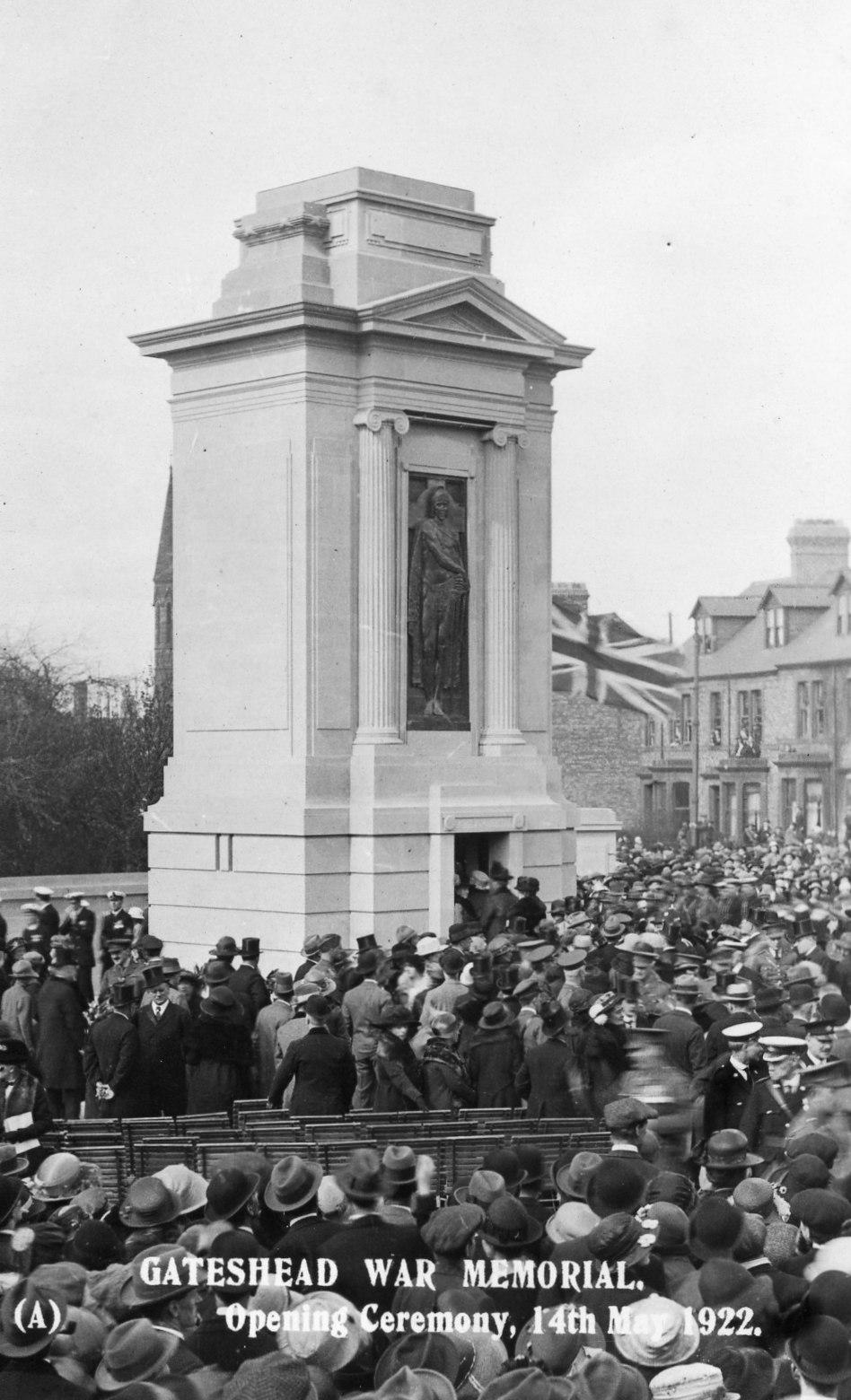
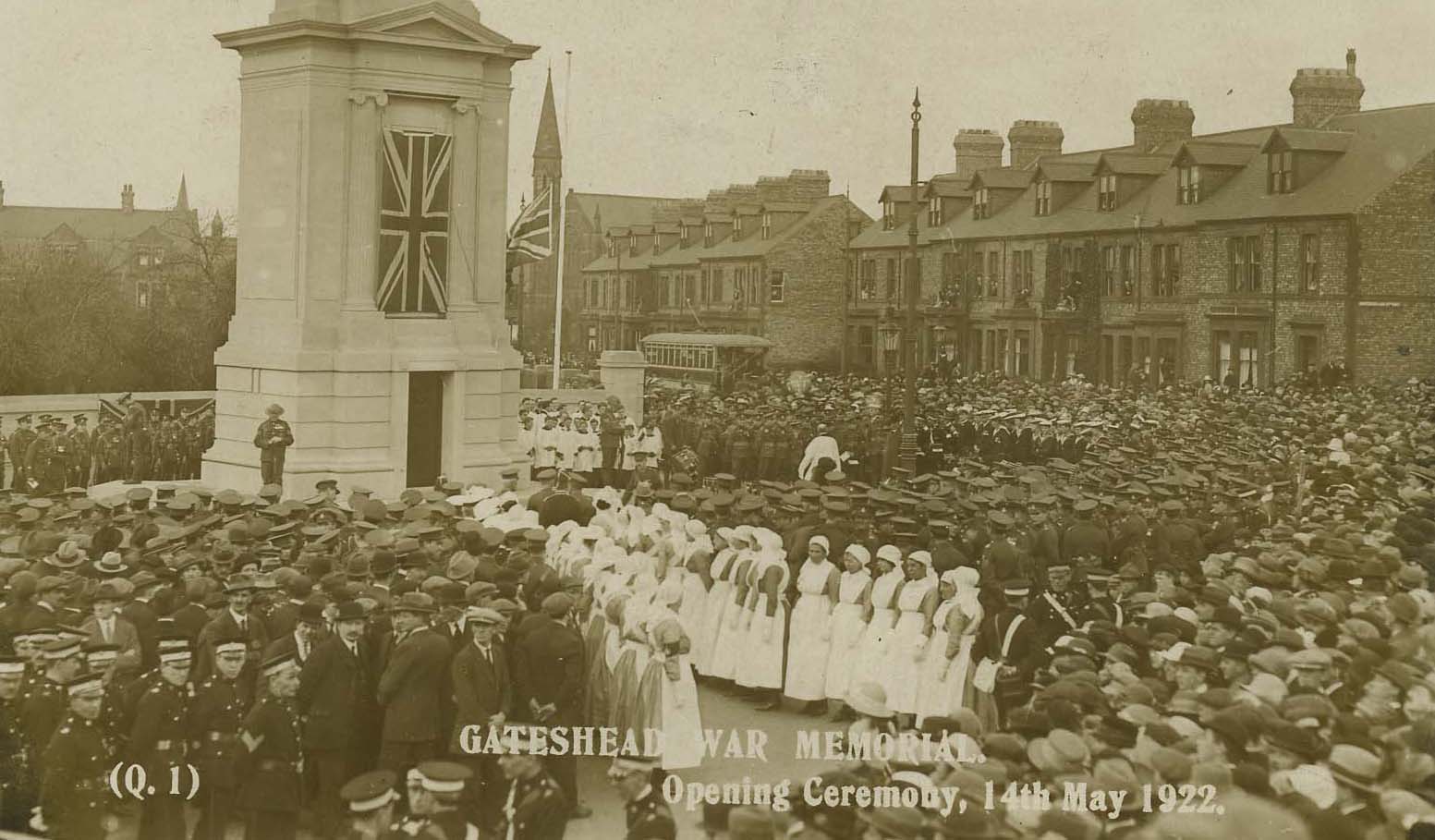
a. Unveiled May 14th 1922 by Major-General Sir Percy S. Wilkinson, K.C.M.G., C.B.
b. Inscription added 1983.
Heworth Burn Blue stone from the quarry of Messrs. Tate, Brown & Co.
War Memorial Committee, Chairman Ald. William Clough, J.P., Hon.Treasurer Mr. F. Winter; Hon.Secretaries Major E.G. Crouch and George Gill.
£5,283 13s 11d.
Public meeting was held on 11th March 1920.
Nearly £900 was promised at the meeting, and following an appeal to the public, £5,500 was raised, £232 by house to house collection and by 20,000 schoolchildren.
There was a surplus which was donated to the Children’s Hospital.
Present Condition: Good
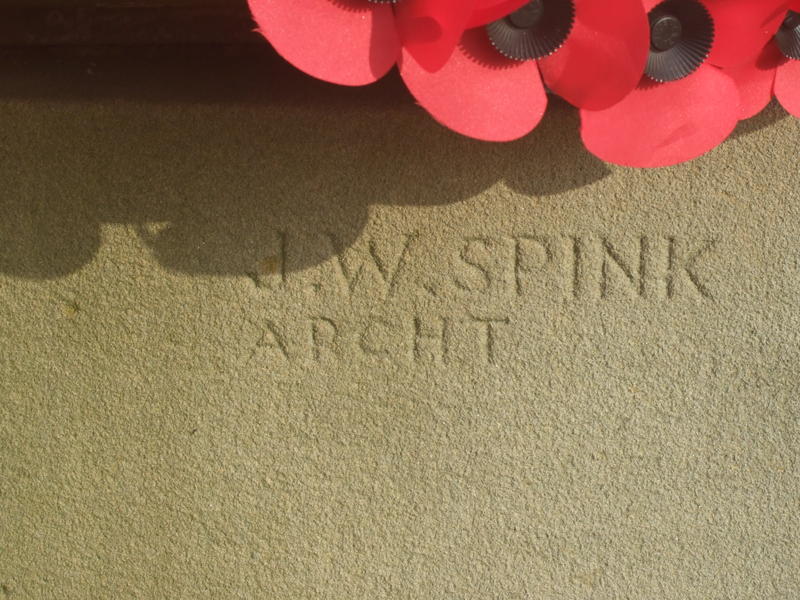
The cenotaph was designed by Mr. John Spink of Kingston on Thames;
erected by Messrs. Alex Pringle of Gateshead & Newcastle;
The carving was done by Mr. J.W. Oglebury of Newcastle.
The bronze panel was designed Richard R. Goulden; modelled and cast at the Foundry of Mr. A.B. Burton of Thames Ditton, Surrey;
The bronze door was made by Messrs. Pringle of High Street, Gateshead.
The Electric Light Supply Co. laid in the electric cable, and Messrs. Embleton and Barker carried out the wiring, both free of charge.
Ownership and Maintenance: Gateshead Council
a.
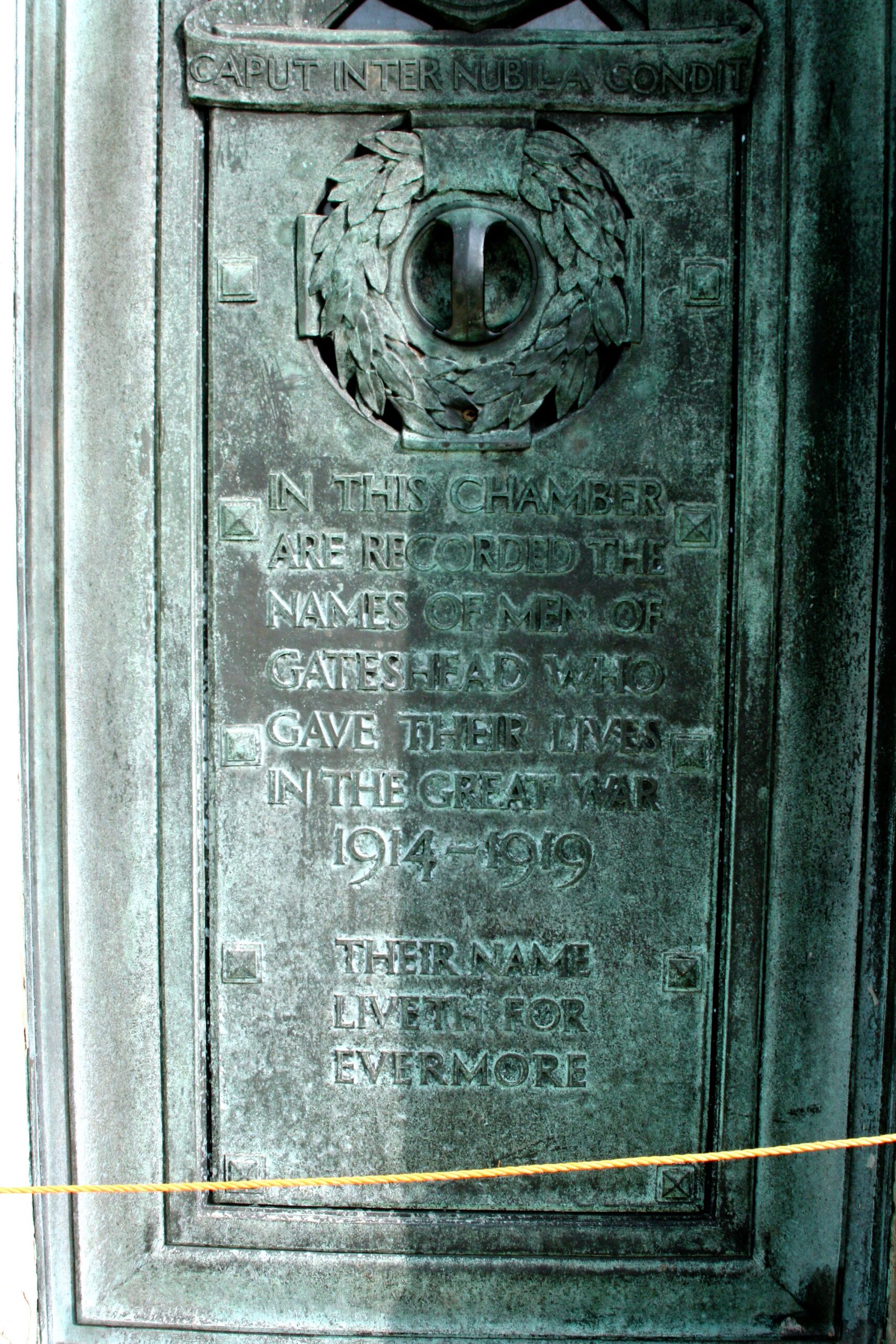
On Cenotaph :
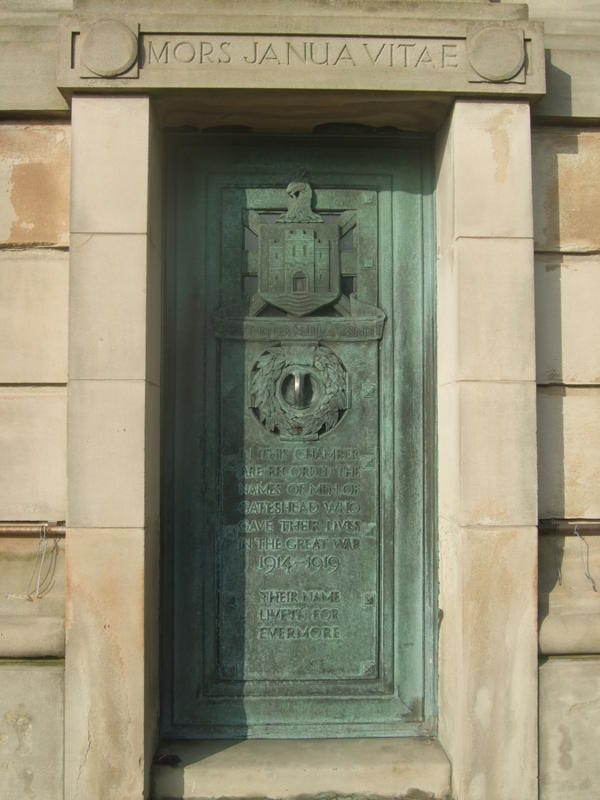
In this chamber are recorded the names of the men of Gateshead who gave their lives in the Great War 1914-1919. Their Name Liveth For Evermore.
On wall behind Cenotaph:
1914-1919
To the Glory of God and to the immortal Memory
of the men of Gateshead who fell in the Great War. This memorial is erected by their grateful fellow-townsmen.
b.
Above doorway to Chamber:
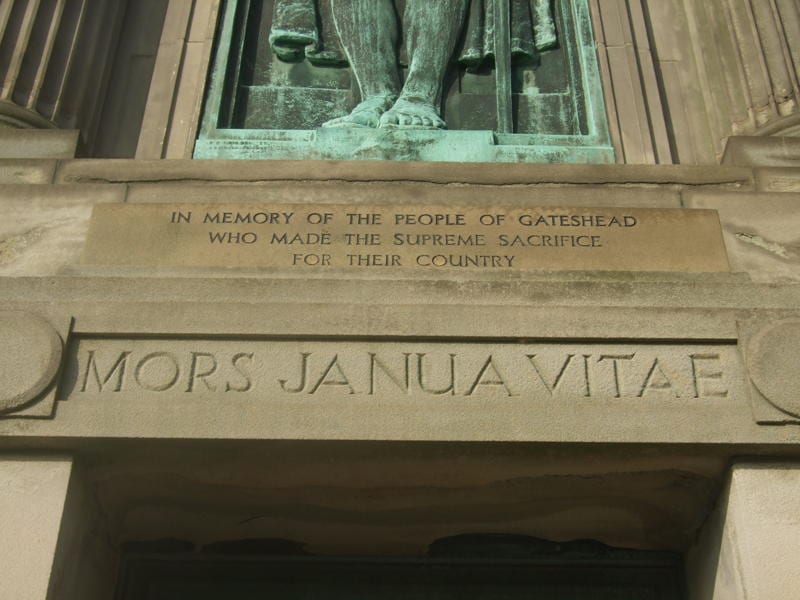
In memory of the people of Gateshead who made the Supreme Sacrifice for their Country.
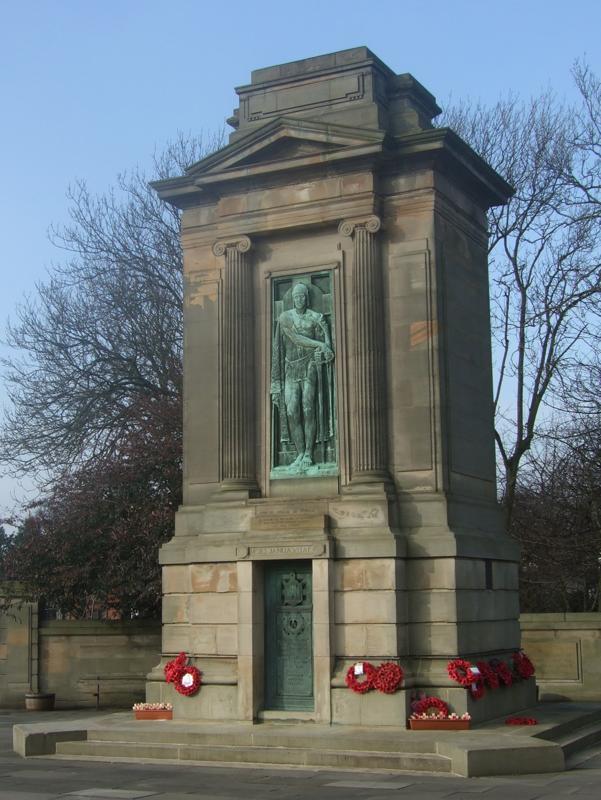
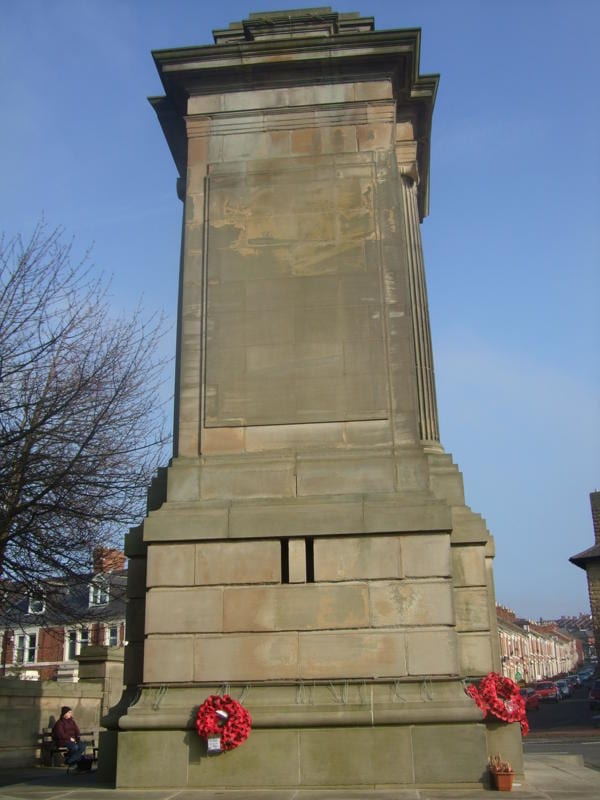
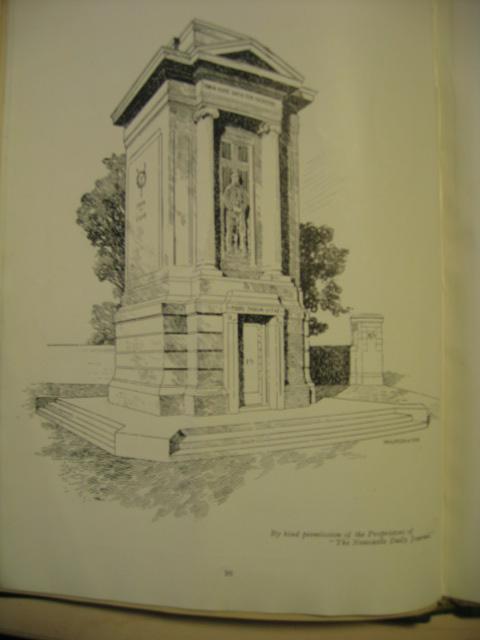
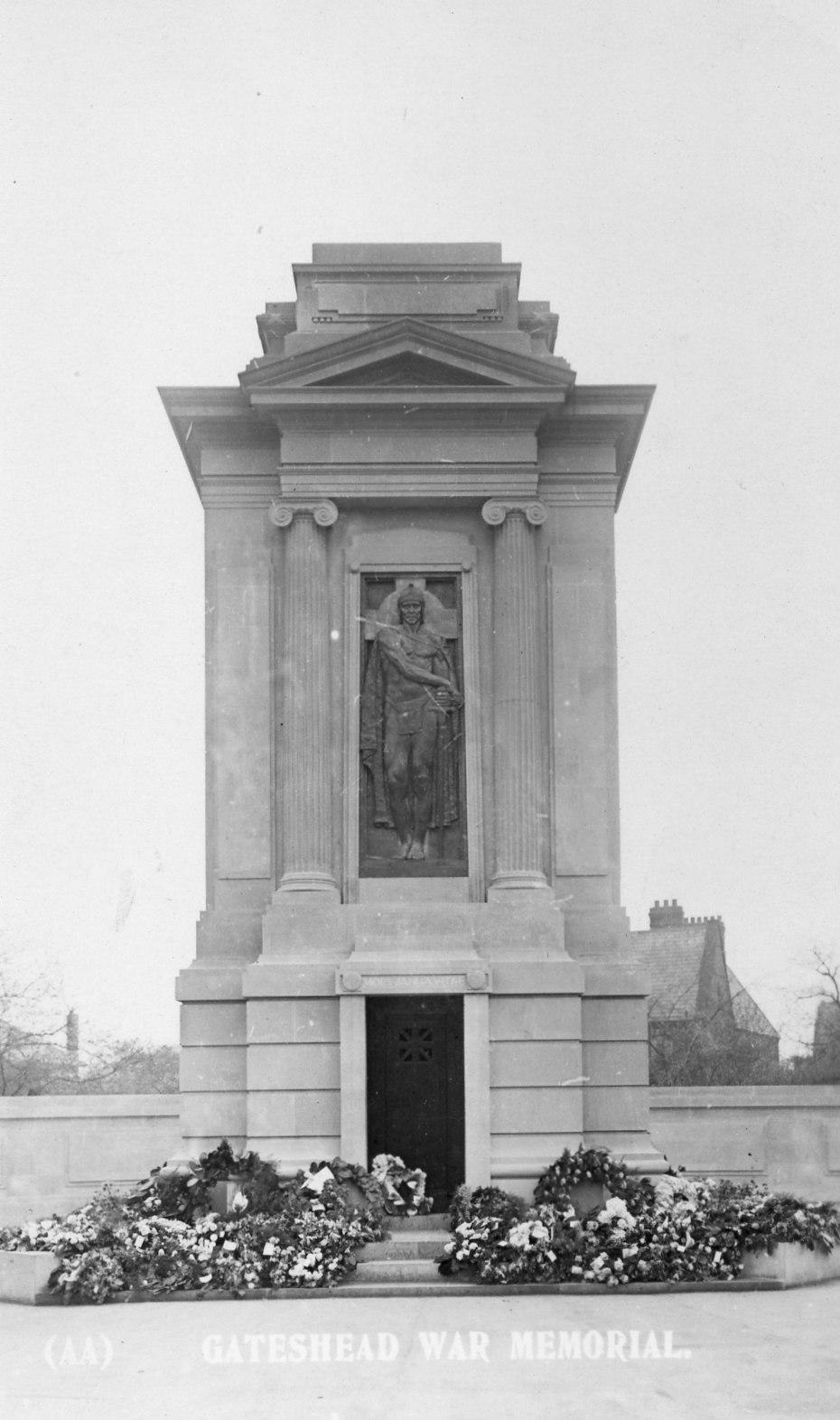
Cenotaph of Classic design.
It measures 16 feet long by 13 feet wide (4.87m x 3.96m) at the base, and 33 feet 7 inches high from the pavement level (10.23m).
It is raised on a rectangular platform 26 feet long by 23 feet wide (7.92m x 7.01m), three steps above the ground line.
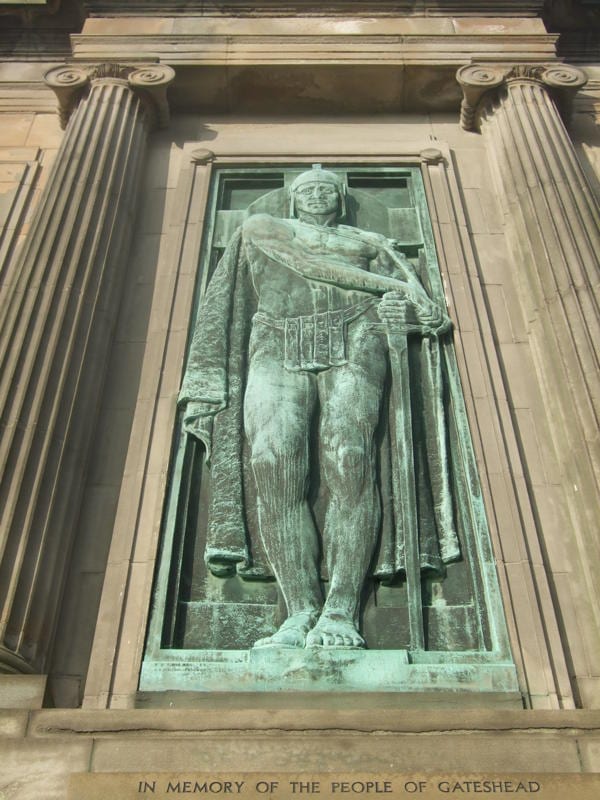
Above the base of the Cenotaph, on the principal front and flanked by Grecian Ionic pilasters, is a bronze panel in low relief, 3 feet 6 inches wide by 10 feet high, (1.06m x 3.04m).
It bears a figure of a Warrior in half relief, 9 feet (2.74m) high, depicting our “Manhood” in an attitude of “Defence”, strong, motionless and unconquerable, lightly resting upon the unsheathed sword so lately raised “In Defence of Right” and gaining as his reward for the greatest of all self-sacrifice – the Cross – in front of which he stands.
In the front of the Cenotaph, below the warrior, is the Room of Remembrance.
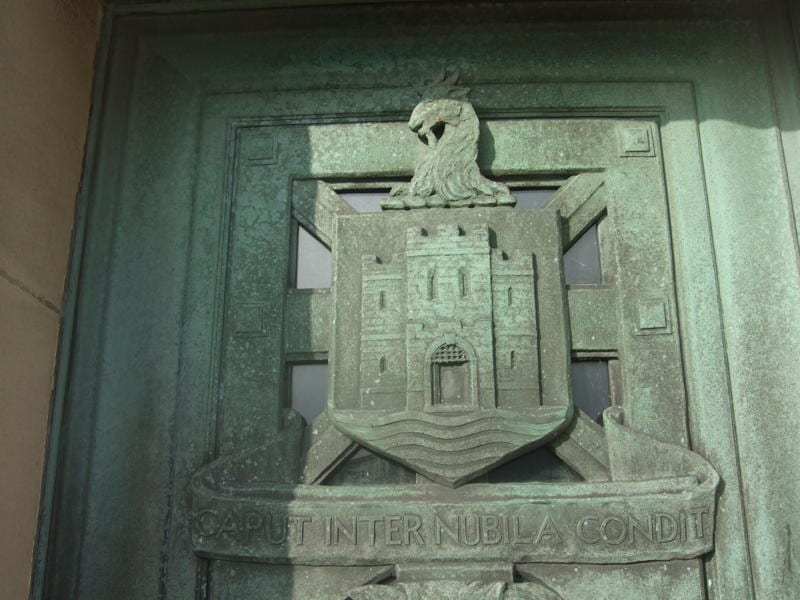
The entrance is through a teak door, above which are the words “Mors Janua Vitae” (Death is the Door to Life).
The Room of Remembrance, measures 11 feet by 8 feet, (3.35m x 2.43m) with vaulted ceiling 8 feet high (2.43m). In the centre stands a stone lectern, around the top of which is carved the inscription “Their Bodies Are Buried In Peace But Their Name Liveth For Evermore”. The Book of Remembrance [was] on this lectern. Immediately above, suspended from the ceiling is an ever burning Lamp. [No longer kept burning].
Around the back of the Cenotaph is a curved stone wall, flanked by massive piers, and upon the centre panel of which runs the Dedication Inscription.
The teak door was later replaced by a bronze door.
None
1. One proposal for the memorial was an extension and endowment to the Gateshead Children’s Hospital at a cost of £10,000; another was for the enlargement of the out-patients’ dept. of the hospital; a third was for the creation of a hostel “for the use of the soldiers and sailors who had to tramp from town to town in search of employment”; a “Red Triangle Club” was also proposed.
2. The Roll of Honour Book G39.004 originally housed in the monument was later transferred to the Public Library for safe-keeping.
3. There was a delay in getting coke for the casting of the bronze caused by a coal stoppage.
4. There was a proposal to have all the men who returned photographed for inclusion in the pedestal roll of honour. Only two thirds of them visited the photographer for the purpose.
5. An artistic metal wreath was made to be placed on the wreath by Mr. Louis Van Bokle, a Belgian resident in Gateshead. He worked for Mr. Morrison, a Gateshead sculptor.
6. After the unveiling there was a proposal to adhere to the architect’s original proposal to have a bronze door rather than the teak one. The cenotaph had cost £5,284; the amount raised was £5,457, leaving a surplus of £359. The approximate costs of altering the gate to bronze would be £300. Following this change, any further surplus would go to the Children’s Hospital.
7. The site for the memorial contained a caretaker’s cottage attached to the Secondary School. It was suggested that the cottage be removed to allow for an uninterrupted view of the memorial. This would allow for a new cottage for the caretaker and road improvements. This was rejected by the Town Council by 11 votes to 7.
8. “Thanks to a one-man campaign by Gateshead Councillor Pat Conaty a tribute to the fallen in the Second World War is at last to be added to the town’s cenotaph. There will also be a tribute to all the dead in wars since then without being specific” (Evening Chronicle 28/02/1983). (Cllr. Conaty was a member of the South Tyneside War Pensions Committee).
9. The Memorial was cleaned and renovated in 2018, just finishing on the 10th November 2018.
10. At the unveiling ceremony in 1922, the Cenotaph was officially handed over to the Mayor of Gateshead.
Photos of Unveiling programme and line drawing: James Pasby;
Photos: Kevin Milburn;
old postcards: Tony Harding; John Grainger
Evening Chronicle
28/02/1983 reports proposal to add names from 1939-45
Gateshead Post
12/05/1972 carries report of unveiling with photograph; also article with brief details of those who were decorated.
Illustrated Chronicle
13/02/1920 page 10 reports proposal to extend Children’s Hospital as a war memorial;
13/07/1920 reports fund raising;
30/11/1921 reports proposed unveiling;
14/03/1921 gives progress report;
14/09/1921 reports lack of coke;
22/02/1922 reports progress in obtaining photographs;
16/03/1922 reports progress with unveiling ceremony and fund-raising;
03/05/1922 reports Mr. van Bokle’s metal wreath;
03/05/1922 also gives comprehensive details of the unveiling ceremony;
10/05/1922 ditto; 11/05/1922 ditto;
15/05/1922 reports unveiling with photos;
14/07/1922 reports bronze gates proposal;
10/11/1923 has photo of new bronze door.
Newcastle Daily Chronicle
20/03/1919 reports meeting to identify how the dead should be commemorated;
09/01/1920 carries letter Major Crouch supporting the idea of a cenotaph;
12/02/1920 carries suggestion of Children’s Hospital extension;
12/03/1920 reports acceptance of cenotaph and lists subscribers;
29/03/1920 reports War Memorial Committee and list of subscribers;
09/07/1920 reports proposed house-to-house collection;
31/07/1920 reports results of house-to-house collection;
10/08/1920 reports progress;
11/08/1921 carries a letter from the Mayor asked for £500 more;
23/09/1021 reports launch of a 10,000 shilling fund;
28/09/1921 reports fund raising progress;
03/10/1921 reports that the Duke of York would be unable to unveil the memorial next May;
04/10/1921 reports fund raising ball;
06/10/1921 reports shilling fund progress;
18/10/1921 reports proposal to remove the cottage beside the memorial site;
20/10/1921, 02/05/1922, 11/05/1922 report funding progress;
10/05/1922, 11/05/1922 report arrangements for unveiling ceremony;
15/05/1922 reports unveiling.
Newcastle Daily Journal
08/01/1920 reports proposal for cenotaph;
13/02/1920 reports proposal should be extension to Children’s Hospital;
12/03/1920 reports setting up of Committee of 20 men; agreement on Cenotaph;
03/04/1920 reports site agreed estimated £5,000.
Newcastle Weekly Chronicle
13/03/1920 reports decision;
22/10/1921 reports suggested removal of cottage;
18/03/1922 reports proposed unveiling; 06/05/1922 carries photo of Mr. Bokle with the wreath he made;
13/05/1922 reports proposed unveiling;
20/05/1922 reports unveiling.
Northern Echo
16/03/1922 reports funds raised;
10/5/1922 reports proposed unveiling;
15/05/1922 reports unveiling with photos.
North Mail
08/01/1920 reports proposal to have a memorial;
12/03/1920 reports proposal have a cenotaph like the one in London.
Shields Daily News
02/12/1921 reports costs and proposed opening date.
Gateshead Archive
File containing posters, traffic poster, newspaper cuttings, invitations, etc. compiled in May 1933. Ref C609290160
Imperial War Museum has photographs in Mr. Saggers’ Collection
A Guide to the Public Monuments and Sculpture of Tyne and Wear (Ayris, Jubb, Palmer, Usherwood, Specialist Conservation Team Publication, 1996)
Durham County Record Office
Souvenir programme of unveiling. Ref: D/DLI 13/2/107
The Glorious Dead. Figurative Sculpture of British First World War Memorials. Geoff Archer, Frontier Publishing; 2009. ISBN 978 1 872914 38 1
Source of quotation
“Their name liveth for evermore” Apocrypha, Ecclesiasticus 55
Additional Research Documents
G39.001 Unveiling Programme 1922
Ralph W. Gould;
Ethel and Neville Armstrong;
Whickham & District LHS;
Mrs. N. Smith;
Imperial War Museum;
James Pasby;
Tony Harding;
Dorothy Hall;
Alan Vickers;
Kevin Milburn
If you are researching this memorial please contact 2014@newmp.org.uk


If you know more about this memorial, please send the details to NEWMP.
War Memorial Indexes
Over The Tees Index
This is a work in progress. Interested in helping, contact 2014@newmp.org.uk