
Memorial
Book of Remembrance 1914-18 Presbyterian
Jesmond
Memorial Name: Book of Remembrance 1914-18 Presbyterian (J1.16)
NEWMP Ref No.: J1.16
Parish: Jesmond
John Knox Presbyterian, Burdon Terrace / Tankerville Terrace
This is now Jesmond United Reformed Church
1914-18
Published 1923
Paper
Roll of Honour
The following served in the Great War.
Book of Remembrance containing photos and a brief life of the fallen on a double page for each, one page containing his history, and the facing page a photograph.
25 names, photos and life histories of the fallen, and 81 names of those who served.
See transcript.
1. “A Memorial Volume, with portraits of these men, was published by Mr. J.R. Hall in 1923. He presented to the church the vellum copy of the volume which is now kept on the table in front of the War Memorial.”
Photos: Tony Harding
Jesmond Presbyterian Church 1888-1938 A Jubilee Memorial
Additional Research Documents
J1.16 Photos of All Pages
Tony Harding;
James Pasby
If you are researching this memorial please contact 2014@newmp.org.uk
JESMOND United Reformed Church
Roll of Honour
The following Served in the Great War.
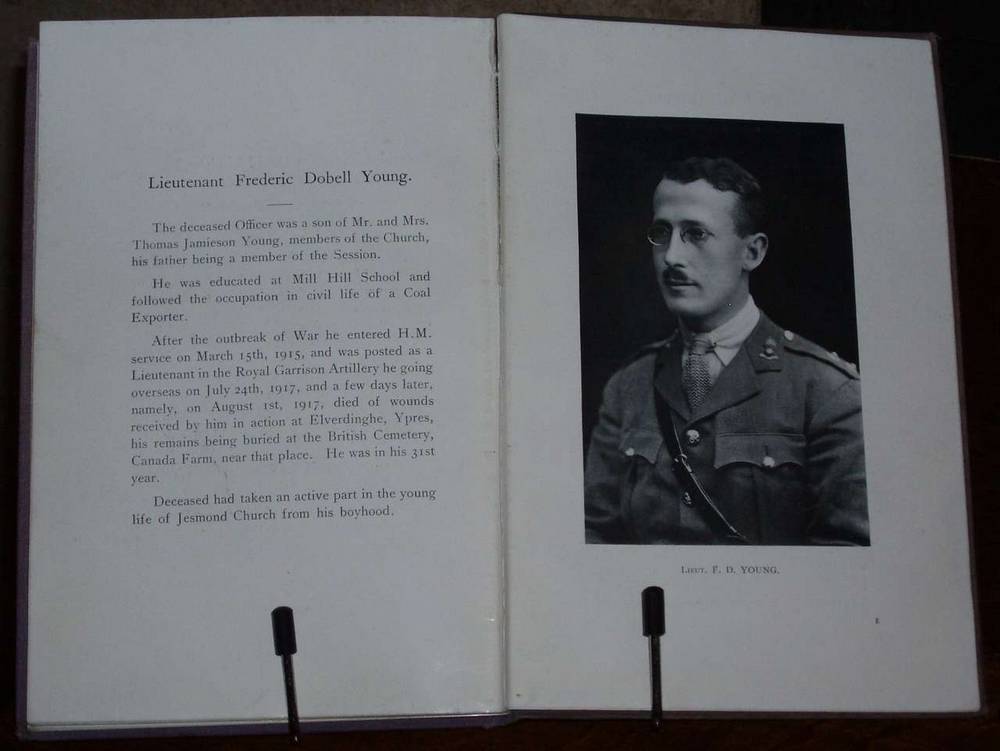
Lieutenant Frederic Dobell Young.
The deceased Officer was a son of Mr. and Mrs.
Thomas Jamieson Young, members of the Church,
his father being a member of the Session
He was educated at Mill Hill School and
followed the occupation in civil life of a Coal
Exporter.
After the outbreak of War he entered H.M.
service on March 15th, 1915, and was posted as a
Lieutenant in the Royal Garrison Artillery he going
overseas on July 24th, 1917, died of wounds
received by him in action at Elverdinghe, Ypres,
his remains being buried at the British Cemetery,
Canada Farm, near that place. He was in his 31st
year. Deceased had taken an active part in the young
life of Jesmond Church from his boyhood.
———————————————–
Corporal James Ballantyne
At the outbreak of War in August, 1914, Mr.
Ballantyne, a son of Mr. and Mrs. James Ballan-
tyne, members of the Church, was a draper
employed in Newcastle. On the call for volun-
teers from the staff of his firm he enlisted in the
16th Northumberland Fusiliers (1st Commercials).
After a period of training, and having attained the
rank of Corporal, he went overseas in November,
1915.
His Battalion took part in the attack at
Thiepval at the opening of the Battle of the
Somme on 1st July, 1916, on which date he was
reported missing. His superior officer, in writing
home, stated he had been seen after he had gone
over the “Top” coming from the Dressing
Station suffering from wounds, but after that he
had not been traced, and also expressed “much
regret at the loss of such a capable and hard
working N.C.O. who, by his coolness under fire,
won the respect of all his men.”
His place of burial is unknown.
At the date of his death Corporal Ballantyne
was 22 years of age.
———————————————–
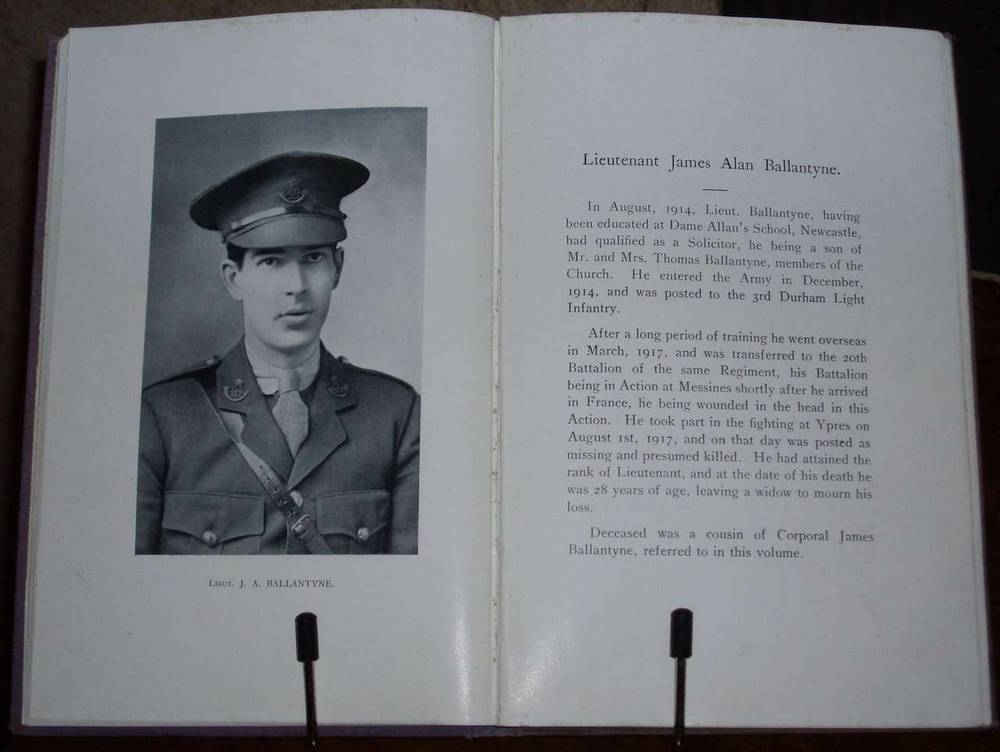
Lieutenant James Alan Ballantyne
In August, 1914, Lieut. Ballantyne, having
been educated at Dame Allan’s School, Newcastle,
had qualified as a Solicitor, he being a son of
Mr. and Mrs. Thomas Ballantyne, members of the
Church. He entered the Army in December,
1914, and was posted to the 3rd Durham Light
Infantry.
After a long period of training he went overseas
in March, 1917, and was transferred to the 20th
Battalion of the same Regiment, his Battalion
being in action at Messines shortly after he arrived
in France, he being wounded in the head in this
Action. He took part in the fighting at Ypres on
August 1st, 1917, and on that day was posted as
missing and presumed killed. He had attained the
rank of Lieutenant, and at the date of his death he
was 28 years of age, leaving a window to mourn his
loss.
Deceased was a cousin of Corporal James
Ballantyne referred to in this volume.
———————————————–
Second-Lieutenant James Ashton Black
The above officer was the son of Mr. and Mrs.
James Black, members of the Church. He was
educated at Newcastle Modern School, and at the
outbreak of War was a Clerk in a Shipbroker and
Coal Exporter’s office on the Quayside, Newcastle.
He was one of the first to volunteer in Newcastle
for active service, he joining the 1st Commercials
(16th Northumberland Fusiliers) as a Private in
August, 1914. He went to France in November,
1915, and with his Battalion took part in the first
battle of the Somme, commencing 1st July, 1916,
he being slightly wounded in the course of the
fighting. He subsequently was gazetted as a
Second-Lieutenant and posted to the 3rd Durham
Light Infantry but attached to the 2nd Durham
Light Infantry with which Battalion he served in
France taking part in two engagements the last
being on 21st March, 1918, on which date he was
reported missing after fighting in the Cambrai
district. Conflicting reports were received by his
parents concerning him – one report stating he was
badly wounded, taken prisoner, and died the next
day, being buried at Beauhill, near Prouville, and
another report stating that he was killed by enemy
shell fire. After his death his Commanding Officer
wrote home in high terms of his bravery and
absolute reliability. Age 22.
———————————————–
Chief-Engineer George Cockburn
The above was a son of the late Mr. and Mrs.
Cockburn, who had been members of the Church
since its opening in Burdon Terrace.
He was educated at Dame Allan’s School and
Rutherford College, Newcastle, and at the out-
break of War was Chief-Engineer of a merchant
vessel. At the time of his death he was Chief-
Engineer of H.M. Transport “Willintonia” he
being drowned when this vessel, on 25th August,
1918, was sunk by enemy Submarine in the
Mediterranean whilst carrying coal to the Fleet.
The Captain of the Transport reported he had lost
his life in courageously attempting to save some of
his shipmates. The Admiralty issued a Certificate
testifying to his zeal and devotion to duty. He
was specially mentioned in the London Gazette on
15th February, 1919.
At the date of his death he was 40 years of age.
———————————————–
Lieutenant John Hammond Edgar
Deceased was born at Belfast and graduated
with High Honours at Campbell College and
Queen’s College in that City, and also at the
University of London, he holding the following
Degrees: B.A., M.A., LL.B., and in the course
of his College career won many prizes and a
valuable Scholarship.
He was called to the Irish Bar in 1904 and the
following year was called to the English Bar. He
joined the N.E. circuit and settled at Newcastle,
regularly attending the services of the Church.
He entered the Army shortly after the out-
break of War, being gazetted as a Lieutenant and
posted to the 9th Durham Light Infantry. He
went overseas in May, 1915, with his Battalion
which formed part of the 50th (Northumbrian)
Division this Division being in a heavy Action
within a few days of its arrival in France. He was
slightly wounded in a Bomb explosion and also
gassed on another occasion. He met his death on
24th February, 1916, within a few hours of his
return to the Front from leave, being wounded in
the head by shrapnel, and was buried in a Military
Cemetery near Villebeke.
Deceased was well known and highly esteemed
in legal circles in Newcastle, and was rapidly
building up an excellent practice.
At the date of his death he was aged 35.
———————————————–
John Halifax Feggetter, M.C.
The above Officer was the son of Mr. and Mrs.
William Feggetter, members of the Church (his
father being a member of the Session). He was born
in 1895 and was educated at Rutherford College,
matriculated from there (being second in the list)
and entered Armstrong College in 1914, entering
the Honours Schools of English and Latin in 1915,
and had before him a University career of great
promise. After the outbreak of War he entered
Durham University O.T.C. and at Christmas,
1915, was gazetted as a Second-Lieutenant in the
15th Northumberland Fusiliers, being subsequently
transferred to the 13th Northumberland Fusiliers,
with which Battalion he went overseas in June,
1916. With his Battalion he took part in the
Battle of the Somme which commenced on July
1st, 1916. During the continued fighting he was
wounded at Mametz Wood about the middle of
July and was invalided home: he again returning
to his Battalion in France in December, 1916, as
Signalling Officer. In April, 1917, his work was
so excellent, and his courage and gallantry so in-
spiring, particularly at the capture of Crousilles,
that he was recommended for the Military Cross,
which decoration was subsequently bestowed upon
him. On 4th October, 1917, at the Battle of
Broodseinde, Flanders, he was killed he at that
time being Intelligence Officer of his Battalion, his
Colonel being also killed in the same battle, which,
whilst a victory for the Allies, was a heavy cost
to the Battalion. He was buried where he fell, but
the precise place is not known. A brother Officer
writing home, after referring to his capabilities and
courage, said “It is a glorious end to a magnificent
life, and in the sight of God life is not measured
by length, but by worth.”
Prior to entering the Army deceased was a
Teacher in and Treasurer of the Church Sunday
School.
———————————————–
Capt. Percy Gordon Graham
At the time of his death deceased was 27 years
of age, and the son of Mr. and Mrs. J.C. Graham,
the former being Session Clerk of the Church.
Deceased was educated at Rutherford Collage,
Newcastle, and after training was qualified by
examination as an Architect. He was one of the
best known and loved men in Athletic circles in
Newcastle area, his achievements consisting of
winning the Swimming Championship of the City
for seven years in succession when, unbeaten, he
retired, also in winning several other Champion-
ships and many medals and prizes for the same
branch of sport.
Immediately on the outbreak of War in August,
1914, he entered the 16th Service Battalion of the
Northumberland Fusiliers as a private, but his
ability and bearing soon singled him out for com-
missioned rank. He went overseas on 20th
November, 1915, was frequently engaged in the
front line, where he was wounded. Finally he took
part with his Battalion in the opening of the offen-
sive on the Somme on 1st July, 1916, being
killed on that day by Machine Gun fire whilst lead-
ing “B” Company of the Battalion in the attack.
Before entering the Army he was a popular
officer in the Boys’ Brigade and a successful teacher
of boys in the Sunday School.
———————————————–
Second-Lieutenant Percy G. Hall
The deceased was a son of Mr. and Mrs. J.R. Hall, his
father being an Elder of the Church. His mother died in 1912.
He was educated at Newcastle Grammar School, and on leaving
school in 1909 went a voyage with the Cadet School Ship “Port
Jackson” to Australia. He, on his return home, finally decided
upon a sea life and subsequently served his apprenticeship in deep
sea sailing ships, chiefly in the Colonial and Pacific trades.
In August, 1914, he was on a voyage to Australia and his
vessel narrowly escaped destruction in the South Atlantic by one of
the German commerce raiders. He returned to England in the
early part of 1915 and was offered a commission in the 4th
Battalion Tyneside Scottish, which he accepted. During training
with his Battalion he was selected and served a course at the
Staff College, Camberley, ultimately proceeding to France with
the Tyneside Scottish Brigade in January, 1916, and taking part
in Trench raids and fighting during the opening months of that
year.
Prior to the opening of the Battle of the Somme, the Tyneside
Scottish Brigade lay in the front line trenches at La Boiselle and
it was found late on June 29th, 1916, that as the whole of the
German wire had not been destroyed by Artillery fire, engineering
operations were necessary to destroy this wire and a covering party
from the Tyneside Scottish was required for the protection of the
Engineers. Volunteers were called for, Lieut. Hall immediately
offered, was accepted and joined by about 20 men of his platoon.
After entering “No Man’s Land” at midnight to carry out the
plans which he had made he was killed by an enemy sniper. His
Sergeant who then took charge of the party was awarded the
D.C.M. His remains are buried in the Cemetery near La Boiselle
where lie the remains of many of his comrades who were killed
the following day. His age was 23.
From subsequent letters received by the father of deceased it
appears from Brigade Orders for the opening of the Battle of
the Somme on 1st July, 1916, that the 4th Battalion Tyneside
Scottish was to lead the Allied line into action at La Boiselle.
From the 4th Battalion Orders the 11th Platoon under the com-
mand of the deceased Officer was to lead the Battalion for, as his
Commanding Officer stated “he knew that nothing but a rifle
bullet would stop Lieut. Hall and his men would follow him
anywhere.”
Lieut. W.B. Tytler and Second-Lieut. J.H. Tytler
were cousins of Second-Lieut. Hall.
———————————————–
Second-Lieutenant Fred Herries
The deceased Officer was the son of Mr. and
Mrs. A.H. Herries, members of the Church, and
at the date of his death was aged 23. He was
educated at Allan’s Endowed School in Newcastle
upon Tyne, and followed the business of a
Stationer and Bookseller, being well known in
Newcastle athletic circles as a fine all-round athlete,
winning many medals and cups.
In January, 1916, he entered the Army being
gazetted as Second-Lieutenant of the Border Regi-
ment but attached to the 10th Durham Light
Infantry with which Battalion he went overseas in
October, 1917. The Battalion took parting the
fighting at Passchendaele Ridge shortly after its
arrival in France. He was badly wounded in the
fighting on 18th December, 1917, and died the
following day at Poperinghe, his remains being
buried at Nine Elms Cemetery at that place.
His O.C. writing home after his decease, stated he was
the officer he was best pleased with, showing
remarkable courage and initiative, he on one
occasion having a single combat with three
Germans, and on another occasion on a Red Cross
signal from the German Trenches he entered the
enemy trenches to bring back to our own line a
wounded British soldier.
———————————————–
Signalman William Robert Lowe, R.N.V.R.
Deceased was the son of the late Mr. John
Wardlaw Lowe, and of Mrs. Lowe, members of the
Church. He was educated at Allan’s Endowed
School, Newcastle, and in civil life was a fully
qualified Chartered Accountant. He entered
H.M. Service on 1st March, 1916, being enrolled
in the Tyneside Division of the Royal Naval
Volunteer Reserve. After a course of training he
was posted, in December, 1916, as Signalman, to
H.M.S. “Thalia” (yacht “Verona”) he being
lost with this vessel when she was destroyed two
months later by a mine explosion in the North Sea
on the 24th February, 1917.
He was aged 31 at the time of his death.
———————————————–
Lieutenant William McIntosh
The deceased officer was the son of the late Mr.
G.I. McIntosh and Mrs. McIntosh, members of
the Church, the former having been a member of
Session. Lieut. McIntosh at the date of his death
was aged 28.
He was educated at Newcastle Grammar School
and also at Woodhouse Grove School. He entered
on a business career and was in the office of a firm
of Steamship Owners in Newcastle. When War
broke out he was one of the first to enlist as a
Private in the Commercial Battalion (16th North-
umberland Fusiliers) in September, 1914, and after
training was gazetted as a Lieutenant in the 4th
Tyneside Scottish (23rd Northumberland Fusiliers)
with which Battalion he went overseas in January,
1916. After seeing active service in various
parts of the fighting line, the Tyneside Scottish
Brigade was ordered to take the position in our
front line trenches opposite La Boiselle and to lead
the Army at that part of the Allied line into the
Battle of the Somme on 1st July, 1916. Lieut.
McIntosh took part with his Battalion in the open-
ing of this Battle and was most seriously wounded
when leading his platoon in the attack. The
wounds proving fatal, he died in hospital at
Rouen on 5th July, 1916, and was buried at St.
Severs Cemetery, Rouen.
———————————————–
Lieutenant William Black Noble
The above Officer was a son of Sir William J.
Noble, Bart., and of Lady Noble, of West Denton
Hall, members of the Church, and at the date of
his death was in his 24th year. He was educated
at Charterhouse School, and in civil life was a
Steamship Owner and a Fellow of the Institute of
Ship Brokers
At the outbreak of War he was
already a trained Territorial Officer he having in
1908 joined the 6th Northumberland Fusiliers, and
with that Battalion went to France in April, 1915.
The 50th Division, of which his Battalion was a
unit, was immediately in action after its arrival,
Lieutenant Noble taking part in the attack at St.
Julien and being killed on April 26th whilst
seeking a refuge for his men. He was buried near
Wieltje Road.
———————————————–
Lieutenant John Pittendrigh R.N.R.
The deceased Officer at the time of his death
was 29 years of age. He was a son of Mr. and
Mrs. William Pittendrigh, members of the Church,
and in civil life was an officer in the Mercantile
Marine. At the outbreak of War he was studying
for his Master’s certificate and when volunteers
were called for he immediately offered himself for
service in the Royal Navy, as accepted, and after
passing tests in gunnery was appointed to H.M.S.
“Sarnia” and with that vessel took part in the
operations at the Dardanelles. He was beach
Officer at the evacuation of Suvla Bay. Subse-
quently he saw service as Lieut. on H.M.S. Drake
from May, 1916, to April, 1917, and in August of
that year he was appointed Senior Gunnery-
Lieutenant on H.M.S. “Hussar”. In October,
1918, an epidemic of influenza to which Lieut.
Pittendrigh was a victim, broke out on board the
vessel, he dying on 28th October, 1918, and was
buried in the British portion of the Camp Santo,
Genoa.
———————————————–
Captain Harold Price, M.C.
Deceased was born in British Columbia, his
parents being Mr. and Mrs. W.S. Price of Van-
couver, members of St. Andrew’s Presbyterian
Church in that City. He, after passing through
Public and High Schools in Vancouver, studied at
the local branch of McGill University in Science
and Art. In civil life he was a British Columbia
Land Surveyor, which qualification he obtained on
attaining his majority. Immediately on the outbreak
of War he entered the 22nd Royal Fusiliers as a
private and after training was gazetted as a Captain
in the 3rd Tyneside Irish, he being also gazetted as
Adjutant of that Battalion, but which position he
subsequently resigned. His work in connection
with the Tyneside Irish brought him in close touch
with Jesmond Presbyterian Church, and he made a
point of attending the services with regularity.
With his Brigade and Battalion he went to France
early in January, 1916, and his valuable work and
courage brought him distinction he being twice
mentioned in Dispatches and awarded the Military
Cross. Subsequently on the night of 25th-26th
June, 1916, he was killed at La Boiselle he having
been out with some of his men attacking a
point in the German lines, and on his return with
his men found one missing, and going back to the
enemy lines to search for his comrade was killed.
———————————————–
Capt. Ralph Broomfield Pritchard, D.S.O., M.C.
The above deceased Officer was a son of Mr. and Mrs.
Henry P. Pritchard, members of the Church, and
at the date of his death was aged 25.
He was educated at the Royal Grammar School,
Newcastle, and subsequently was on the staff of the
Newcastle upon Tyne Insurance Committee.
On the outbreak of War he immediately enlisted
as a Private in the 1st Commercial Battalion, 16th
Northumberland Fusiliers, and after training with
that Battalion for some months was promoted to
commissioned rank and gazetted as Sec.-Lieut. of
the 4th Tyneside Irish (27th Northumberland
Fusiliers) in May, 1915, rising to the rank of Lieut.
in October of the same year. He went with his
Battalion to France in the early part of January,
1916, and was promoted to the rank of Captain a
month later. His Battalion took part in minor
engagements, chiefly trench attacks, prior to the
Battle of the Somme, and in the opening of that
Battle on 1st July, 1916, he was wounded. On
resuming service he was posted to the 12/13th
Northumberland Fusiliers attached to the 2nd
Lincolnshire Regiment and then with that regi-
ment at the end of 1916 and early 1917 he was
mentioned in Dispatches for certain fine work which
enabled his Battalion, through the work of the
Advance Guard of which he was in charge, to
achieve certain objects. He was awarded the
Military Cross and subsequently the Distinguished
Service Order. He was promoted Acting-Major
in October, 1917, which rank, however, he relinquished
on disbandment of his Battalion in March,
1918. In the fighting on 16th April, 1918, Capt.
Pritchard was badly wounded, and as the result
died on 26th April, 1918, and was buried in
Mendingham British Cemetery, Proven. His
name was subsequently again mentioned in
Dispatches on 27th December, 1918.
———————————————–
Second-Lieut. William Alwyn Pritchard
The deceased Officer was the younger brother
of Capt. R.B. Pritchard, D.S.O., M.C., being
at the date of his death aged 24. He was also
educated at the Royal Grammar School, and joined
the staff of one of the large Fire Insurance Com-
panies, carrying on business in Newcastle. He
entered H.M. service in January, 1916, enlisting as
a Private in the 3rd Northumberland Fusiliers,
with which Battalion he took part at the battle of
the Somme in July, 1916, and was wounded, he
returning overseas after recovery in December,
1916. He subsequently attained commissioned
rank in November, 1917, and was posted to the 3rd
Durham Light Infantry but attached to the 1st
Wiltshire Regiment. He was heavily engaged in
the fighting at Mount Kemmel in March and April,
1918, and after the German counter-attack on that
place on 26th April, was reported missing and has
not since been heard of.
———————————————–
Second-Lieut. Hugh Price Rose.
The deceased was the only child of Mr. and
Mrs. Alexander Morrison Rose, members of the
Church, Mr. Rose being a member of Session.
He was educated at Sherborne School, and with
the intention of ultimately going to Oxford he
passed “Responsions” and the Entrance Exam-
ination for Oriel College, but owing to the War he
entered the Royal Military College, Sandhurst in
January, 1916, passing out of the College in
August of the same year. But for the War he
would have returned to Oxford to complete his
course. He entered H.M. Service as a Second-
Lieutenant of the 2nd Battalion of the Seaforth
Highlanders on 14th August, 1916, and two
months later joined the fighting forces in France.
He took part in the Battle of Arras on 11th April,
1917, with his Battalion, and was killed that day.
His remains are buried at Brown’s Copse
Cemetery, Fampoux. From information subse-
quently received it appeared that Lieut. Rose
with three Companies of the Battalion were ordered
to attack the Rouex Chemical Works from
Fampoux but in traversing open ground the force
was met by deadly machine Gun fire, resulting in
serious loss to the attacking force, every officer
being a casualty. Reference may be made to an
extract from a letter to Mr. and Mrs. Rose from
Rev. E.S. Woods. Chaplain to the R.M. College,
Sandhurst, well known as the Author of “Knights
in Armour”. Amongst other things he stated
“He if anyone deserved the name of ‘Christian
Gentleman’ using each word in the fullest sense,
and he had great influence for good in his
Company.” Deceased was 20 years of age.
———————————————–
Corporal William George Simon
The deceased at the date of his death was
25 years of age, and was the son of the late G.H.
Simon, Solicitor, and Mrs. Simon. He was
educated at home (Mold, North Wales) and Mold
County School, and at the outbreak of War was
engaged as an Insurance Clerk in Newcastle. He,
with many others, answered the call for service
entering the 1st Commercial Battalion (16th North-
umberland Fusiliers) at the end of August, 1914,
as a Corporal.
With his Battalion he went overseas in October,
1915, remaining in the battle area, taking part in
various fighting until the beginning of the Somme
Offensive on 1st July, 1916, when he was killed.
He was connected with, and attended the
Church, through his uncle, Mr. D.G. Owen, who
was one of the managers of the Church. Deceased
was one of three brothers who joined H.M. Forces.
———————————————–
Corporal Lindsay Nelson Stephens
The above deceased was the son of Mr. and
Mrs. Richard Stephens, members of the Church.
He was educated at the Royal Grammar School,
Newcastle, and was engaged in shipping when
War broke out. On the call for volunteers in
September, 1914, he immediately threw up his
civil occupation and enlisted as a Private in the
9th Battalion Northumberland Fusiliers, finally
going to France in June, 1915, he having become
a Corporal in the same Battalion. After seeing a
good deal of service of the front line, he was,
whilst engaged wiring before trenches, killed
by machine Gun fire on the 6th May, 1916,
near Armentieres, and was buried at the Cemetery
Bon Jean, near that place. The Adjutant
of the 9th Battalion writing home to his father
expressed his very high appreciation of the
extraordinary fine work done by deceased, and his
sterling worth, disposition and character, and
adding that his C.O. had decided to recommend
him for a commission, for no one in the Battalion
deserved to get on more than he. Aged 21.
———————————————–
Second-Lieutenant J.H. Tytler
The deceased officer was a Master of Arts and
Minister of the Church of Scotland, being at the
outbreak of War an assistant Minister at St.
Columba’s Church, Elgin.
He was the son of Mr. J.M. Tytler and Newton
More, Invernesshire, his mother having died some
years ago. Educated at Kingussie Grammar School he
matriculated at Edinburgh University.
On the formation of the Tyneside Scottish he
was appointed officiating Clergyman being attached
to the 4th Battalion of that Brigade during its
training at Gosforth. Subsequently he decided to
take combatant rank and after a course of training
in the O.T.C. (Durham University) was gazetted
as Second-Lieut., 9th Durham Light Infantry, and
went overseas on May 29th, 1916. He took part
in several engagements with that Unit and finally
on September 15th, 1916, was fatally wounded at
High Wood in the Battle of the Somme.
The deceased who was 27 years of age was a
brother of Lieut. W.B. Tytler.
During the period he acted as Officiating
Clergyman of the 3rd Tyneside Scottish and
training with the O.T.C. he regularly attended the
services in the Church.
———————————————–
Lieutenant William Boyd Tytler
Deceased was a brother of Lieut. J.H. Tytler,
and at the date of his death was 22 years of age.
Like his brother he was educated at Kingussie
Grammar School, and intending to enter the
Teaching profession, was at the outbreak of War
a student at Moray House Training College,
Edinburgh.
In 1912 he entered as a private in the 6th Royal
Scots (Training College Unit) and at the end of
1914 applied for and was granted a commission as
a Second-Lieut. in the 4th Battalion of the Tyne-
side Scottish, he subsequently rising to the rank of
Lieutenant.
He went overseas with the Tyneside Scottish in
the early part of 1916, and after taking part in
trench fighting was engaged with his Battalion in
the opening of the Battle of the Somme at La
Boiselle on 1st July, 1916.
From information subsequently received it
appears that Lieut. Tytler, though suffering
from repeated wounds, was the only officer of
his Battalion (the others being killed or out
of action) to reach the German third line trenches,
he though dying continuing to hold the position
and cheering the survivors of his men, one of whom
later in the day attempted to carry him on his back
to the British lines, but was unable to do so.
His precise place of burial is unknown.
———————————————–
Lieutenant Robert Alexander Wilson
The deceased Officer was the son of Mr. R.A.
Wilson, one of the Elders of the Church, and the
late Mrs. Wilson, and at the date of his death was
in his 37th year,
He was educated at Dr. Ehrlich’s School, New-
castle, and also at Trinity College, Harrogate.
At the outbreak of War he was the representative
in New Zealand for an Edinburgh firm, and
immediately returned home for the purpose of
enlisting. He joined the London Scottish as a
Private in March, 1915, and went overseas with
his Battalion in June, 1916. On the 23rd August,
1916, he was wounded in the trenches and was
invalided home, meantime he had been gazetted as
a Second-Lieutenant in the 15th Battalion of the
D.L.I., and after joining that Battalion took part
with it in the Battle of Arras in April, 1917. He
advanced to the rank of Lieutenant in the same
Battalion and on the 2nd May, 1917, was engaged
in the fighting at the Hindenberg Line near Arras,
he being killed on that day at La Fontaine, where
his remains were buried.
———————————————–
Mr. Robert Phillips Wood
The deceased was the son of Mrs. Eleanor
Wood, one of the members of the Church, and was
in his 28th year at the date of his death. He was
educated at Felton, Northumberland, where he
was born, and in civil life followed the occupation
of a gardener.
He entered H.M. Service on April 27th, 1917,
and was lost with H.M.S. “Lovaine” on 20th
January, 1918.
———————————————–
Second-Lieutenant David Lindsay Young
The above was a son of Mr. and Mrs. Lindsay
S. Young, members of the Church, Mr. Lindsay S.
Young being one of the Elders.
The deceased Officer was educated at Mill Hill
School and in civil life followed the occupation of
an Accountant. At the time of his death he was
aged 24. He was gazetted as a Second-Lieutenant
in the 4th Northumberland Fusiliers on 23rd June,
1915, and joined the Battalion in France on
November 5th, 1916. He took part in several
engagements at Arras, Wancourt, Passchendaele
Ridge, and Houthulst Forest, and was unfortun-
ately killed at the latter place before dawn on 26th
October, 1917, whilst taking part in an attack on
enemy positions.
Before he entered the Army he was a teacher
in the Church Sunday School.
Deceased was a cousin of Lieutenant Frederick
Dobell Young referred to in this volume.
NamesJ1.16
War Memorial Indexes

County Durham Index

Newcastle Index

Northumberland Index

Over The Tees Index
This is a work in progress. Interested in helping, contact 2014@newmp.org.uk
