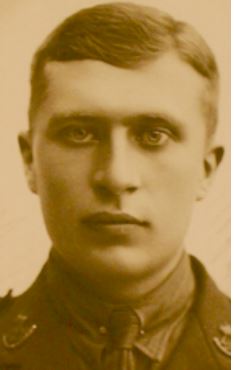
In Railway Dugouts Burial Ground (Transport Farm), Belgium is the Commonwealth War Grave of Lieutenant Rollo Edward Atkinson, serving with the 1/9th Battalion Durham Light Infantry, who died 20/02/1916.
Lieutenant R.E. Atkinson was the Battalion Bombing officer when he got killed near Ypres. He was shot by a German Sniper in the right lung whilst leading a bombing party up a sap.
Read his remarkable story attached below. (The article of 39 pages takes some time to download!)
The Newcastle Daily Chronicle 24/02/1916 reported his death, giving his initials wrongly as “R.P.”
Death of Lieut. R.P. Atkinson, of Hexham.
Information has been received of the death in action of Lieutenant Rollo P. Atkinson, of 1st/9th Durham Light Infantry.
Lieut. Atkinson was the second son of Mr. T.H. Atkinson, Eilan’s Gate, Hexham (of the firm of Atkinson and Sons Ltd., Newcastle), and was educated at Sedbergh School and at Cambridge, where he took his B.A. and LLB degrees. He was also a famous athlete at college, and was a Cambridge Blue. When war broke out he joined the 9th D.L.I., and went to the front in April. He was slightly wounded a few weeks ago, and after he recovered he had leave for eight days, when he returned home. Lieut. Atkinson went back to duty on Sunday, February 13 and was killed on the 20th.
The Sporting Chronicle 24/02/1916 reports:-
R. E. ATKINSON KILLED.
The Man Who Outpaced Norman Taber.
News has been received at Hexham that Lieutenant Rollo E. Atkinson, the famous Cambridge University athletic Blue, has been killed in the fighting in France. An old Bossall boy, he first of all at Fenner’s went in for long-distance running. but in the three miles race against Oxford he was just a little bit outclassed. Alec Nelson, however, decided to try him at a shorter distance, and in 1914 be was carefully prepared for the half mile, and on March 9 he won the Cambridge race, doing 1.58, and suggesting that he would give the Oxonians a good race when he met them on March 27 at Queen’s Club. In the interval he improved greatly, and a quiet confidence was reposed in his ability. Atkinson’s race with Norman Taber, the American Rhodes scholar, who last year set up the new world’s record of 4.12 3-5, will never be forgotten by those who saw it.
That Taber was a fine runner everybody knew; he had proved that in the United States, and in addition his races at Oxford suggested he was speedier than Atkinson; but when it came to the real test in that run-in past the pavilion towards the finishing post at the entrance gate corner Atkinson showed the real grit which was in him. He simply piled on speed which surprised the Yankee, whom he beat in 1.56 2-5 amidst great excitement. That success helped in large measure to win a memorable match for the Cantabs.
In the A.A.A. championships of that year Atkinson also competed, but he met a better half-miler than Taber in the New York man Homer Baker. A. G. Hill and Atkinson tried their best, but they were both beaten by Baker, who did 1.54 2 5 and beat them by three yards and two yards respectively. The time was just a bit too fast for the Cantab.
Lieutenant Atkinson had a goodly stock of athletic prizes, and some of them he had gained in the land of the enemy; he was successful for one place at Buda Pesth. He was the son of Mr. T. H. Atkinson, and much sympathy will be extended in Northumberland to his relatives. This Cantab was a rare runner.
Jonathan Bland-Hawthorn writes: “He was my first cousin three times removed and I know a great deal about him. Here’s one of my long documents, an amazing man”.
Rollo Edward Atkinson is remembered at Hexham on H51.03 H51.26, H51.46, and H51.51, in the 9th Battalion Book of Remembrance page 4 and in the D.L.I. Book of Remembrance, page 32.