Every Name a Story
Algernon George Parsons
Every Name a Story
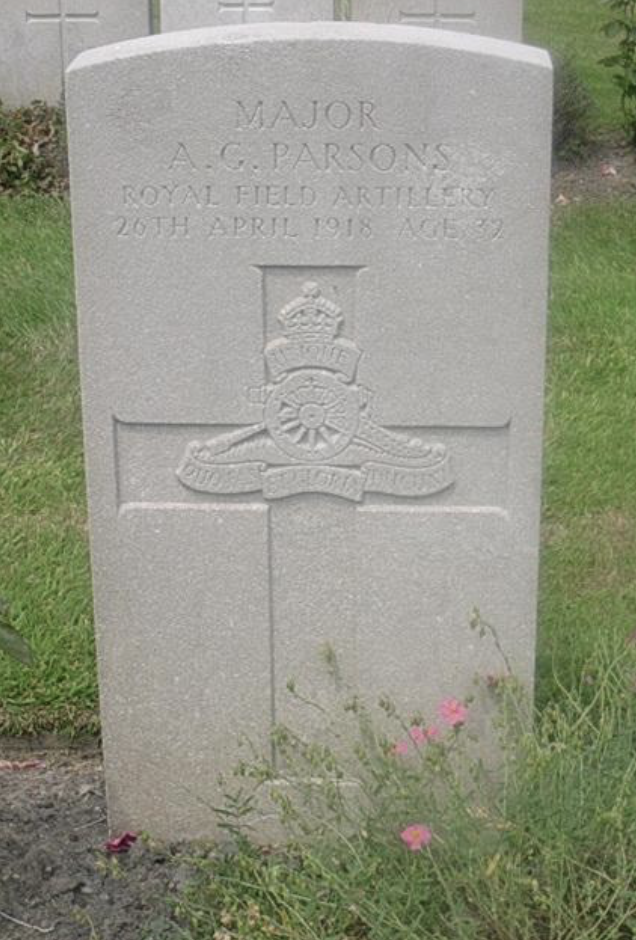
In Lijssenthoek Military Cemetery, Belgium is the Commonwealth War Grave of Major Algernon George Parsons, serving with the “C” Battery 149th Brigade Royal Field Artillery who died 26/04/1918.
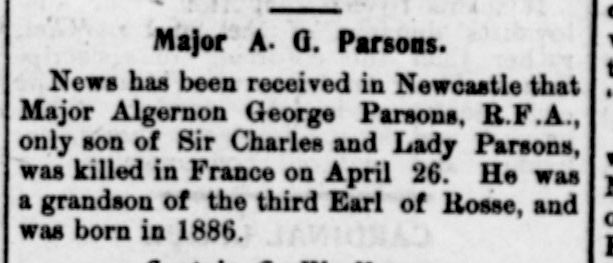
He was the son of The Hon. Sir Charles and Lady Parsons, of I, Upper Brook Street, London. He was born in Northumberland.
The following appeared in the North East Coast Institution of Engineers and Shipbuilders Transactions Volume 34, 1917-1918, page 384.
Obituary: Algernon George Parsons
Algernon George Parsons, Major, R.F.A., born in 1886, was killed in action on the 26th April, 1918. He was the only son of the Hon. Sir Charles Parsons and the Hon. Lady Parsons. Educated at Eton and Woolwich, Major Parsons received his first commission in 1906, and after serving three years retired to enter the engineering profession. He was a Director of Messrs. C.A. Parsons & Co., Ltd.
At the outbreak of war he re-joined the R.F.A., and went to the front in November, 1914. In 1916 he was attached to the experimental department of the R.F.C., where he made several useful mechanical improvements. In November, 1917, Major Parsons was severely wounded in the fighting near Cambrai. He returned to the command of his battery early in March, 1918.
Major Parsons was elected a Member of the Institution in December, 1912.
Acknowledgements: Tony Harding
Pauline Priano has submitted the following:-
Algernon George Parsons was the only son of Charles Algernon Parsons and Katherine Bethell.
His father Charles Algernon Parsons was the son of William Parsons Earl of Rosse, a title he inherited after his father’s death, October 31st 1867. Charles was born in the City of London, Greater London, June 13th 1854. As Earl Rosse, Charles Algernon Parsons was married, January 10th 1883 to Katherine Bethell. Born in 1859 at Rise Hall, East Riding Yorkshire the home of her great uncle Richard Bethell Esquire, a leading landowner in Yorkshire with over 13,000 acres, she was the daughter of William Froggatt Bethell and Elizabeth Beckett Denison, who inherited Rise Hall and the bulk of Richard Bethell’s estate after his death, December 25th 1864.
Charles Algernon Parsons was an engineer, in 1864 he invented the turbine which was successfully applied to the “Turbinia” in 1887 which revolutionised marine propulsion. He had joined the Armstrong engineering works in Newcastle upon Tyne in 1877 although he and his wife Katherine also occupied 10, Connaught Place, Bayswater, City of Westminster, London, birthplace of their only daughter Rachael Mary, January 25th 1885, baptised February 24th 1885 at St. Paul, Wilton Place, London.
After a brief period in the Roman town of Corbridge, their only son Algernon George Parsons, affectionately known as Tommy, was born October 19th 1886 at Elvaston Hall, Ryton, historically in County Durham.
In 1887 Charles Algernon Parsons was a partner in Clarke Chapman, Parsons & Company Limited, in Gateshead, historically in County Durham. He left in 1889 taking with him 12 employees and established his own business, Heaton Works, Newcastle upon Tyne, for the manufacture of turbines, dynamos and other electrical items. He held the position of Chairman of C.A. Parsons & Company and was a director on the boards of several other electrical supply and engineering companies.
In the census of 1891 Rachael Mary (6) and Algernon George (4) are listed as visitors in the home of their aunts Maria and Lucy Birkell, who lived on their own means at The Hall, Newton Kyme cum Toulston, North Yorkshire, while their mother was a visitor at Womersley Hall, Yorkshire, Charles Algernon Parsons may have been looking after his affairs abroad.
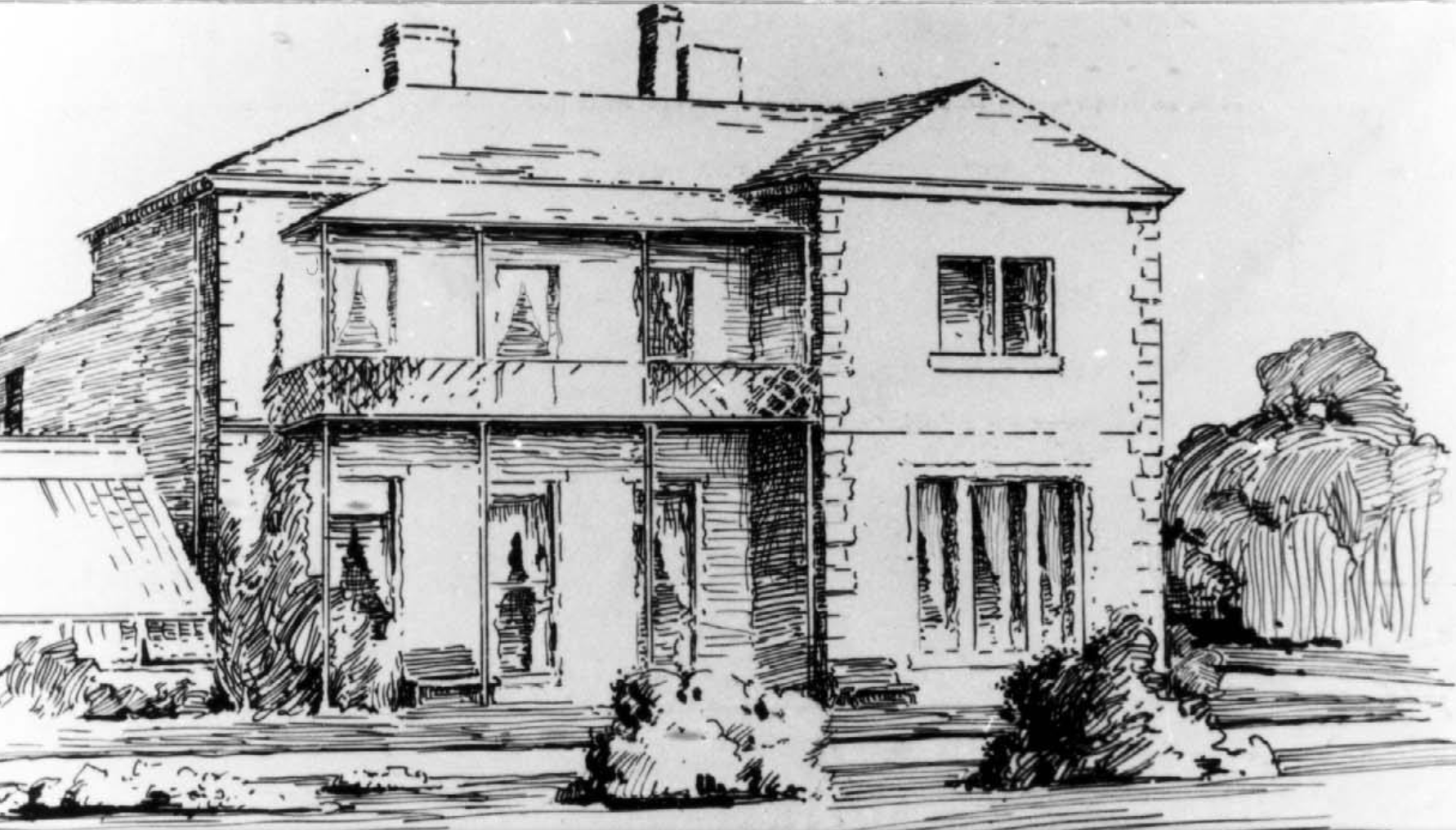
After the demolition of Elvaston Hall in 1900 the Parsons moved into Holeyn Hall, Wylam, Northumberland. In 1901 Algernon (14) was a boarder at Eton, Buckinghamshire, his sister Rachel Mary (16) had attended Newcastle High, Wycombe Abbey, Clarence House between May 1899 and April 1900 and was now a pupil at Roedean School, Rottingdean, Sussex. She went on to study Mechanical Sciences at Newnham College, University of Cambridge, one of the first three woman to do so. Their parents had taken into their home, nephew and electrical engineer, Geoffrey L. Parsons, in attendance were a cook, a parlour maid, 2 house maids, a lady’s maid, a kitchen maid, a scullery maid and a gardener.
By 1911 Rachel Mary had concluded her studies and was again living at home. Adding to the numerous honours and titles bestowed upon him over the years, Charles Algernon Parsons was knighted in 1911. Although Charles and Katherine remained owners of Holeyn Hall they bought a larger estate of Ray at Kirkwhelpington consisting of over 10,000 acres where they built a house for themselves. It was a useful place to live as the Wannie Line had a train stop at Ray Demesne connecting Morpeth to Reedsmouth, a valuable link to the main line Edinburgh to London.
Once concluded his studies Algernon George Parsons received his first commission in 1906, and after serving 3 years he retired and took a position in the family firm of Messrs C.A. Parsons & Co. Ltd., as a director.
February 28th 1914, described as 5 feet 10 and a half inches tall, fair hair, blue eyes and fair complexion, Algernon departed from the port of Liverpool aboard the S.S. “Lucitania” disembarking in New York his final destination was Chicago, Illinois. He made a return journey from Montreal, Quebec, Canada, aboard the S.S. “Teutoric” of the White Star Dominion Line, disembarking at Liverpool, July 4th 1914.
Within one calendar month, August 4th 1914, Britain had declared a state of war existed with Germany. Algernon left the family estate at Ray Demesne and enlisted for the duration of the war, assigned as Temporary Lieutenant, September 13th 1914, to 1A Reserve Brigade, Royal Field Artillery. The brigade consisted of 1, 2 and 3 Reserve Batteries at Fenham Barracks, Barrack Road, Newcastle upon Tyne.
Having risen to the rank of Captain he departed with the British Expeditionary Force to France, November 13th 1914. Captain Parsons served with several batteries and was promoted to the rank of Major in November 1917. Severely wounded during the Battle of Cambrai which raged from November 20th-December 6th 1917 when he was recovered and returned to the front he was placed in command of “C” Company, 149th Brigade, Royal Field Artillery.
The 149th Brigade R.F.A. served as Divisional artillery with the 30th Division. They participated during the Battles of the Somme where the 30th Division captured Montaban. They saw action during the retreat to the Hindenburg Line as of February 1917, the Arras Offensive, April 9th-May 16th in France before moving north to Belgium where they participated during the 3rd Battle of Ypres at the Battle of Pilkem Ridge, July 31st-August 2nd 1917.
When the Germans attacked once again on the Somme front March 21st 1918 they returned to France in action on the Somme then moved north once again to Belgium participating during the Battles of the Lys, a phase of the 4th Battle of Ypres, April 7th-29th 1918.
Major Algernon George Parsons Royal Field Artillery was killed during the actions on the Lys, April 26th 1918, and interred at Lijssenthoek Military Cemetery, West Vlaanderen, near Ypres, Belgium, grave XXXVIII. C. 4. Major Parsons was 32 years of age and single.
The Honourable Sir Charles Algernon Parsons received all monies due to his late son from the Army and his awards of the British War Medal and Victory Medal. His mother The Honourable Lady Katherine Parsons applied for the 1914 Star on behalf of her late son, September 17th 1918. The Will of Major Algernon George Parsons resident of Ray, Northumberland, assigned effects in the sum of £11,418 and 11 pence to The Hon. Sir Charles A,. Parsons K.C.B., December 24th 1918.
Sir Charles Algernon Parsons died February 11th 1931 at sea in his cabin, after a brief illness (neuritis), during a transatlantic cruise with his wife. His death was registered in Kingston, Jamaica and his body was repatriated to Ray, Northumberland.
After a service attended by his family, he was laid to rest within St. Bartholomew’s churchyard, Kirkwhelpington, Northumberland. Memorial services were held at Westminster Abbey in London, March 3rd 1931, at St. John’s College, Cambridge from whence he graduated in mathematics in 1877 and St. Nicholas Cathedral, Newcastle upon Tyne.
His widow Lady Katherine Parsons nee Bethel was assigned his effects in the sum of £810,395 8 shillings 9 pence May 2nd 1931. Upon her death, October 16th 1933 the sum of £108,160 3 shillings 1 pence was assigned January 3rd 1934 to Barclays Bank Limited, her daughter Rachael May Parsons and Tom Brown, land agent.
During the war years Rachel Mary Parsons had taken her brother’s place as director at the Heaton Works. She oversaw the recruitment and training of women who replaced the men who had enlisted in the forces. She was a campaigner for women’s rights and equal access to technical schools and colleges.
Rachael Mary Parsons did not continue in her role as a director at Heaton Works after her brother’s death but continued to promote the place of women in the workplace, in particular in engineering. In 1940 although she maintained a London residence she acquired the property of Little Court consisting of 25 acres of land in Sunningdale, Berkshire. Her interest in horses prompted her to build up a stud farm on the 2600 acre Branches Park estate near Newmarket, Suffolk.
Rachael Mary Parsons was found dead at her property in Newmarket, July 2nd 1956. Stableman Dennis James Pratt, a former employee, was acquitted of murder but found guilty of manslaughter on the grounds of provocation.
July 6th 1965 her funeral was held at St. Mary’s church, Newmarket, officiated by her cousin, Canon R.E. Parsons and attended by her cousin Michael Parsons, 6th Earl of Rosse. Rachael Mary Parsons was laid to rest within Newmarket Cemetery.
With no surviving heirs this branch of the Parsons family ceased to exist.
In God’s safe keeping. Rest In Peace.
Acknowledgements; Colin Cresswell
Algernon George Parsons is remembered at Heaton on H91.01, at Jesmond on J1.08, at Kirkwhelpington on K16.01, K16.03, K16.05 and K16.06, at Newcastle on NUT260, at Wallsend on W7.49, at Wylam on W73.01 and W73.02, in the North East Coast Institution of Engineers and Shipbuilders Transactions 1914-18 and North East Coast Institution of Engineers and Shipbuilders Transactions Vol. 35 1918-19.
First Name: Algernon George
Last Name: Parsons
Which War: First World War 1914-18
Died: 26/04/1918
Age: 32
Rank: Major
Regiment: Royal Field Artillery
Served in: Army
Unit/Ship: "C" Battery 149th Brigade
Links to Source Material