Every Name a Story
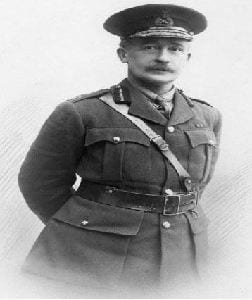
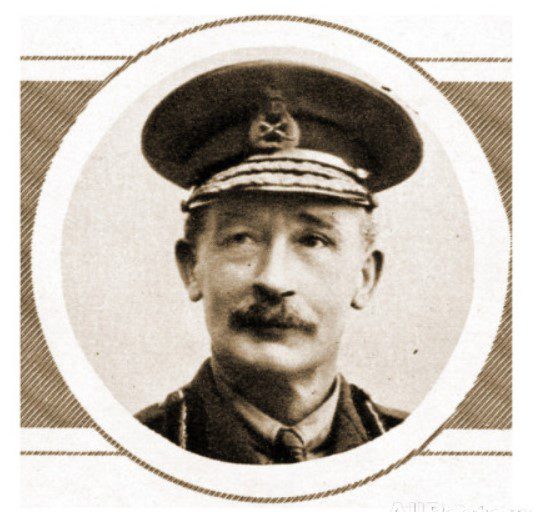
James Foster Riddell
Every Name a Story
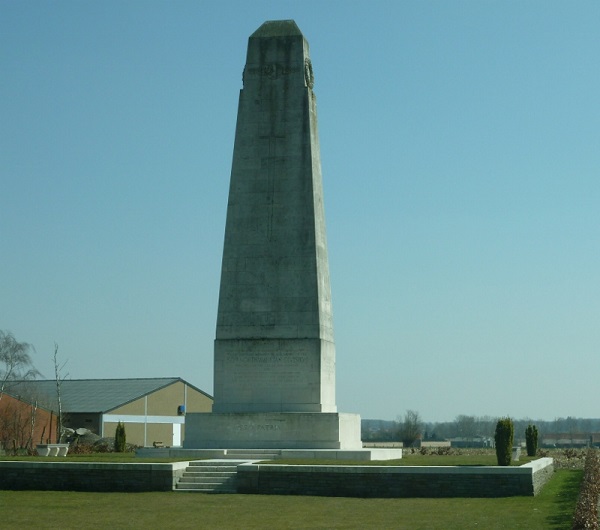
On the Tyne Cot Cemetery, Belgium is the Commonwealth war Grave of Brigadier-General James Foster Riddell, Commanding 149th (1st/1st Northumberland) Infantry Brigade, late 2nd/5th Northumberland Fusiliers, who died 26/04/1915.
The son of John Riddell, of the family of Riddell, formerly of Riddell in Roxburghshire and the husband of Margaret G. Riddell (daughter of the late Sir Henry Scott), of Hyde, Churt, Farnham, Surrey.
James Foster Riddell was the only son of the late John Riddell [5th in descent from the Rev. Archibald Riddell, 3rd son of Sir Walter Riddell, 2nd Bart. of Riddell, co. Roxburgh], and his first wife, Jane, daughter of William Peppercorn; born 17th October 1861. He was educated at Wellington and Sandhurst, gazetted 2nd Lieutenant 1st July, 1881, Captain 18th November. 1889, Major 10th January. 1900, Lieut-Colonel. 15th August. 1904, Colonel. 15th August. 1907, substantive Colonel. 10th February. 1909, Brigadier commanding Northumberland Infantry Brigade, 3rd July 1911, and Brigadier-General 5th August. 1914.
He served in the Hazara Campaign of 1888 (mentioned in despatches, medal with clasp); in the South African War, 1899-1900 and 1902, including the operations in Cape Colony, south of the Orange River, 1899-1900, and in the Orange Free State Jan. to May, 1902 (Queen’s medal with three clasps), and with the Expeditionary Force in France, 21-26th April, 1915.
During the South African War he raised the 3rd Battalion Northumberland Fusiliers (which he afterwards commanded). The battalion was disbanded after the war, and he was given the command of the 2nd Battalion with whom he finished his term of command in the regiment, having served with it for about 30 years. His next command was in 1911 when he was made Brigade Commander of the Northumberland Infantry Brigade.
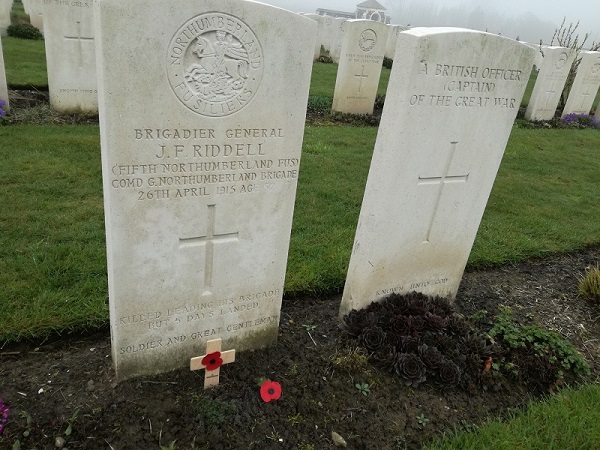
His Commonwealth War Grave headstone reads:
Brigadier General
J.F. Riddell
(Fifth Northumberland Fus.)
Comd. G. Northumberland Brigade
26th April 1915 age
Killed leading his brigade
but 5 days landed.
Soldier and great gentleman.
He married at St Mary Abbotts, Kensington, 17th April, 1912, Margaret Christabel (Lesbury House, Lesbury, Northumberland), daughter of the late Sir Henry Hall Scott, well known in Northumberland and of Eilanreach co. Inverness.
On the outbreak of war in 1914 he was one of the first colonels to be gazetted Brigadier-General. Throughout the winter of 1914-15, Gen. Riddell guarded the important part of the north-east coast behind which lay the vast military resources of Newcastle upon Tyne, and he further prepared his Brigade for service abroad. On the night of 20-21st April he crossed with his Brigade to France, and on the 26th April – not a week later – was killed in the Second Battle of Ypres. It had been intended, as are, of course, all large units at first to quarter the Northumberland Brigade at a base in France. Billets were actually taken, but on the 22nd the Germans delivered their first gas attack and the Brigade was rushed up in all haste to help to fill the great gap torn in our line. By Sunday, after a forced night march without food or rest, except the men’s emergency rations, the Brigade was in touch with the enemy. All that day and the night before, Gen. Riddell was moving about among his men where the fire was hottest, inspiring the men with his extraordinary cheerfulness and absolute coolness.
Men and officers alike speak of his example of absolute fearlessness. Next day, April 26th, orders were received at Brigade Headquarters that the Brigade was to attack and retake at all costs the village of St. Julien – a frontal attack over open ground swept by fire of all kinds. At about three o’clock, Gen. Riddell decided he must go forward into the firing line. His Brigade Major did all that he could to stop him, as in that officer’s words, There was a very murderous fire going on over the ground he had to cross. But he was much too brave a man to be deterred by anything I said.
He reached his men, and wearing the marks of his rank exposed to every sniper, he stepped out before them, a stick in his hand. An eye-witness wrote: It was only a question of time. The bullet entered the cap close to the fatally conspicuous gilt flap, and Gen. Riddell fell, killed apparently instantaneously.
Field-Marshall Sir John French afterwards addressed the Brigade (depleted within a week from leaving England of more than half its officers and men), and speaking of Gen. Riddell, said: He fell at the head of his Brigade while leading you to attack the village of St. Julien. I deeply deplore the loss of one of the most gallant officers that ever lived, and one of the best leaders.
Morpeth Herald 07/05/1915 carries an obituary:
Brigadier-General J.F. RIDDELL killed in action
News was received at Lesbury House, near Alnwick, on Thursday last, that Brigadier-General J.F. Riddell, commanding the Northumberland Territorial Infantry Brigade, had been killed in action in France.
Brigadier-General Riddell was married to a daughter of the late Sir Henry H. Scott, Hipsburn, and resided at Lesbury House. Brigadier Riddell succeeded Colonel W.E. Sturges in command of the Northumberland Infantry Brigade, consisting of the 4th, 5th, 6th and 7th Battalions Northumberland Fusiliers, in May, 1911, and he left the district for the Front just recently.
General Riddell, who was well known in North Northumberland, had a long service with the Fighting Fifth. He joined the regiment in 1880, and served in the Hazara Expedition, 1888, for which he received the medal and clasp; and also in the South African War, from 1900 to 1902. He held the Queens Medal and three clasps for the latter campaign.
A keen soldier and strict disciplinarian, he worked hard to advance the efficiency of the Territorials whom he has commanded for the past four years, and of whom he was in charge when he met his death. For some time he was in command of the 3rd Battalion of the Northumberland Fusiliers, which was disbanded several years ago, and whose colours now hang in St Nicholas Cathedral, Newcastle.
Much sympathy will be felt with Mrs. Riddell in the great loss she has sustained by the death of her husband. Mrs. Riddell has taken a close sympathetic interest in the Territorial Brigade, and has done much to secure comforts for its members on active service.
An old brother officer, who had known Gen. Riddell all his life wrote in the “Regimental Gazette”: Throughout his life he was a master soldier, no finer company officer ever lived or one who understood his men better . . . no truer hearted or more loyal comrade ever breathed. Always a fine horseman and a very bold one, he was well known in the Cattistock country and in all the hunting fields of the Northumberland he knew and loved so well.
De Ruvigny’s Roll of Honour
David Thompson has submitted the following:-
James Foster Riddell was born 17 October 1861, the only son of the late John Riddell (5th in descent from the Rev. Archibald Riddell, 3rd son of Sir Walter Riddell, 2nd Baronet of Riddell, Roxboroughshire, Scotland) and his first wife, Jane, daughter of William Peppercorn.
He was educated at Wellington and Royal Military Academy Sandhurst.
He married at St. Mary Abbots, Kensington, 12th April 1912, Margaret Christabel (of Lesbury House, Lesbury, Northumberland), daughter of the late Sir Henry Scott (well-known in Northumberland, and of Eilanreach, Invernesshire).
He was first commissioned as an Officer in the Northumberland Fusiliers in 1881 and served in campaigns in Africa between 1888 and 1902.
When the First World War broke out in August 1914, Riddell was appointed to command what became the 149th Infantry Brigade, which was made up of the Territorial Force battalions of the Northumberland Fusiliers, including many local men in the 7th Battalion based at Alnwick. Initially the Brigade was tasked with guarding the North-East coast but after the Regular Army suffered heavy losses in the opening battles of the war Territorial Force units were sent to war. The Northumberland Brigade went in mid-April 1915 and was put in reserve near Ypres.
On the 22nd April 1915, the German’s unleashed poison gas for the first time in war and terrified French troops ran away rather than be choked, leaving a significant gap in the Allied lines and the threat of a German breakthrough and the loss of Ypres. The Northumberland Brigade was rushed to the front in commandeered London buses and, on the 26th April, it was ordered to counter-attack alongside the Lahore Indian Division, from the village of St Julien, north of Ypres.
As the Northumberland Fusiliers pushed forward, they were exposed to very heavy machine gun and artillery fire. Although this prevented them from pushing the Germans back it helped to re-establish the line.
The cost was high, with over 2,000 casualties, including many local men. Brigadier General Riddell was one, hit in the head as he conferred with his officers in front-line trenches. He is buried with 11,871 British and Commonwealth soldiers at Tyne Cot Commonwealth War Graves Commission Cemetery. He was 52 years old and had been on the Western Front only a week.
The Newcastle Journal 30/04/1915 reports:-
Brigadier-Gen. J. F. Riddell Reported To Have Been Killed In Action.
A telegraph message was received at Lesbury House, near Alnwick, yesterday, that Brigadier- General J. F. Riddell, commanding the Northumberland Territorial Infantry Brigade, had been killed in action in France. Brigadier-General Riddell was married to daughter of the late Sir Henry Scott, Hipsburn, and resided at Lesbury House. Brigadier J. F. Riddell succeeded Colonel W. E. Sturges in command of the Northumberland Infantry Brigade, consisting of the 4th, 5th, 6th, and 7th Battalion Northumberland Fusiliers, in May, 1911, and he left, this district for the Front at the beginning of last week. He was probably killed, therefore, in the first engagement into which the brigade entered. General Riddell, who was well known in North Northumberland, had a long service with the “Fighting Fifth.” joined the regiment in 1880, and served in the Expedition, 1888, for which he received the medal and clasp; and also in the South African War, from 1900 to 1902. held the Queen’s medal and three clasps for the latter campaign. A keen soldier and strict disciplinarian, he worked hard to advance the efficiency of the Territorials whom he has commanded for the past four years, and of whom he was in charge when he met his death. For some time he was command of the 3rd Battalion of the Northumberland Fusiliers, which was disbanded several years ago, and whose colours now hang in St, Nicholas’ Cathedral, Newcastle. Much sympathy will be felt with Mrs Riddell in the great loss she has sustained by the death her husband. Mrs Riddell has taken a close sympathetic interest in the Territorial Brigade, and has done much to secure comforts for its members on active service.
The Hartlepool Northern Daily Mail 04/05/1915 reports:-
Pinned To The Ground By Intense Fire: How Brigadier General Riddell Died
Lieut.-Col. G. B. B. Spain, commanding the first line 6th Battalion Northumberland Fusiliers, writing from somewhere in Belgium under date April 2Sth, to Lieut Col, Kayll, commanding second line 6th Battalion, with reference to the operations in which this battalion, along with the rest of the Northumberland Brigade (i.e., 4th, 5th, and 7th), were engaged on the 27th April, speaking of a certain phase says: “Up the rise we began to meet machine guns, bullets in streams, rifle bullets from every angle, and then the high explosive coal boxes or ‘Jack Johnsons.’ The corps still pushed forward, losing terribly, but behaving way that has been admired all who saw the fight. The 7th N.F-joined us, and, with great dash, surged up to the outskirts of the village, where the ground is covered with dead Germans weeks old Here we were pinned to the ground absolutely by the intense fire.” Alter description of the terrible time through which the Brigade then passed, Colonel Spain refers to the death of the Brigadier, saying: “Brigadier-General Riddell came up the road past me and I explained the situation to him. He then ran forward, leaving me, and saying, ‘Well done the 6th. Push forward, men!’ and instantly fell, shot through the head.” There is one further item with reference to the same occasion, in Colonel Spain’s letter which it is permissible to publish, and of which the Northumberlands may be proud. He says: “General Hull, commanding the 1st Canadian Division, published the following order to his command next day: “Headquarters, 1st Canadian Division. “The Divisional Commander wishes to congratulate the Northumberland Infantry Brigade on the excellent manner in which they carried out the attack on ——–.”
James Foster Riddell is remembered at Alnmouth on A10.12, Alnwick on A11.38 and in A11.43, in A11.56, page 60, at Lesbury on L9.01, at Warkworth on W16.01 and W16.03 and at Newcastle on NUT071 and on NUT260.
First Name: James Foster
Last Name: Riddell
Which War: First World War 1914-18
Died: 26/04/1915
Age: 52
Rank: Brigadier-General
Regiment: Northumberland Infantry Brigade
Served in: Army
Unit/Ship: General Staff Commanding 149th (1st/1st Northumberland) Infantry Brigade
Links to Source Material