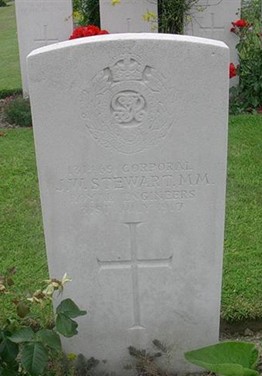
In New Irish Farm Cemetery, Belgium is the Commonwealth War Grave of 131469 Corporal John William Stewart, M.M., serving with the 234th Field Company Royal Engineers who died 31/07/1917.
John William Stewart was the son of Charles and Jane (nee Milne) Stewart who had married in Cardiff in 1882. It is thought that Charles was a seaman. The 1891 Census shows Jane as head of the family, living at 18 Tilery Road, Stockton on Tees, next door to her mother, with four children, Charles (b.1884), Elizabeth (b.1886), John William (b.1887) and Florence (b.1890).
By 1901 John William was an errand boy, and eight years later on 17th April 1909 he married local girl Emma Buckle. They had two children Leslie (b.1909) and Raymond (b.1911), and lived at 30 Samuel Street, New Town, Stockton on Tees. John William worked as a plumber.
Kevin Richardson has provided the following information:
In Middlesbrough on 9th August 1915 John William became Sapper 131469 when he enlisted with the 234th Field Company Royal Engineers, part of the 39th Division.
The Royal Engineers carried out a number of different roles for the Army both in the field and along the lines of communication. The various tasks were organised into different types of units which were attached to Divisions or to larger formations, the main ones were the Field Companies and the Signals Companies and these companies often saw action and took part in the fighting, all Other Ranks were armed as rifle carrying infantrymen.
The Field Companies provided engineering assistance in terms of construction of roads, defences, bridges, the provision of water supplies as well as the demolition of obstacles and bridges. They relied heavily on horses for transport and had riding horses, draught horses and pack horses.
On 8th March 1916 Sapper Stewart landed in France, and before moving to the Somme area in August, the 39th Division took part in an attack around Richebourg l’Avoue, and it was around this time that the Sapper was promoted to Lance Corporal.
Whilst on the Somme the Division took part in the Battle of Ancre Heights in October, capturing the Schwaben Redoubt and helping in the capture of Regina Trench. The Battle of Ancre Heights was a preliminary engagement to Haig’s autumn offensive involving the proposed capture of the Thiepval Ridge which looked over the upper Ancre area. Central in the defensive positions were the Schwaben Redoubt, Stuff Redoubt and Regina Trench, which were all captured by the 21st October thereby giving the British forces control of the ridge.
The Official History offers the following description of weather conditions: “By the middle of October conditions on and behind the battle front line were so bad as to make mere existence a severe trial of body and spirit…The ground was so deep in mud that to move one 18-pounder [gun] 10 or 12 horses were often needed…The infantry sometimes wet to the skin and almost exhausted before zero hour were often condemned to struggle painfully forward through the mud under heavy fire against objectives vaguely defined and difficult to recognise.”
By 19th November 1916 with winter rain again enshrouding the battlefield, offensive operations were called off. After four and a half months of fighting on the Somme, British and Commonwealth forces were calculated to have lost 419,654 dead, wounded and missing.
On 6th January 1917 it was announced in the London Gazette that Corporal John William Stewart had been awarded the Military Medal.
The Third Battle of Ypres 31st July – 10th November 1917
January 1917 and the British were still recovering from the Battle of the Somme. In March, the Germans made a tactical withdrawal to the Hindenburg Line to better consolidate their defences. At the end of July, the Third Battle of Ypres commenced, what is now known as Passchendaele.
It was obvious to the Germans that an offensive was imminent and the attack at Messines Ridge on the 7th June 1917 was a further indication of the Allied intent. However, delays occurred and it was not until the 11th July that the air offensive began followed on the 18th July by a massive artillery bombardment then on the 31st July the attack itself commenced.
Nine Divisions of the British Fifth Army attacked north east from the Ypres Salient. Initially good progress was made but after strong counter attacks the advance stalled. Heavy rain fell on the first nights flooding the swampy ground whose drainage system had been totally destroyed by the 10 day bombardment. As a result, the whole operation was held up and the next significant attack did not take place until the 16th August.
John William Stewart was killed in action on 31st July 1917.
John William Stewart is remembered in Stockton on S138.12 and in S138.18 page 54.