Every Name a Story
Ralph William Hebdon
Every Name a Story
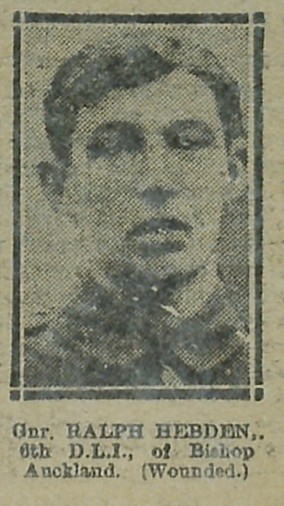
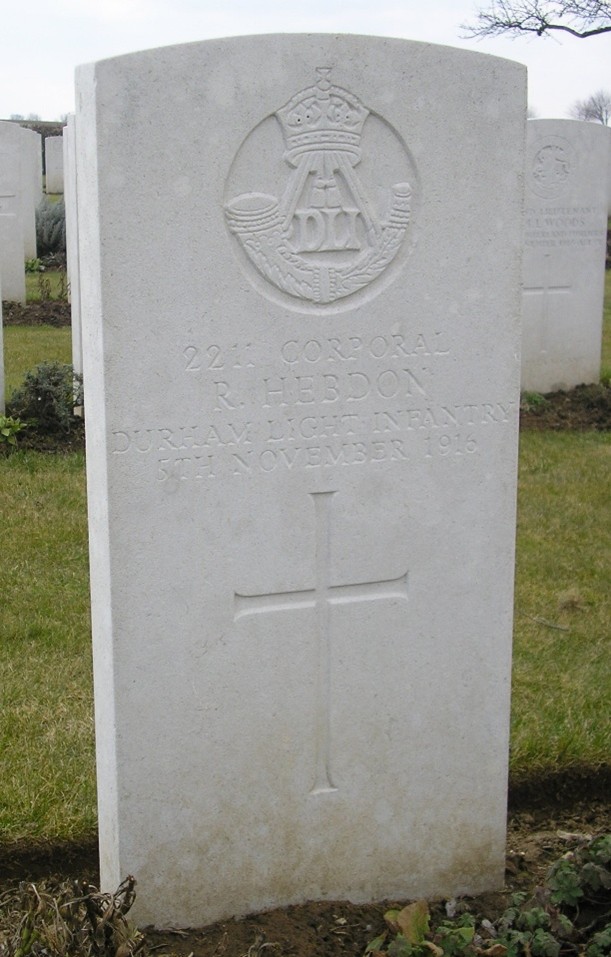
In Warlencourt British Cemetery, France is the Commonwealth War Grave of 2211 Corporal Ralph William Hebdon serving with the 1/6th Battalion Durham Light Infantry who died 05/11/1916.
Peter Wise and Brenda McMahon have submitted the following:-
Ralph was born at Ettersgill in 1891. At the age of only 4 months he was living with his widowed grandmother, a farmer, at Low Beck Head. The others in the household included daughter, Mary Ann and Leonard William (who was his father, although he is listed as single).
Towards the end of 1891 Leonard married Elizabeth Tarn.
The 1901 shows Ralph still living with grandmother, Elizabeth Bell. Ralph had a brother, Ernest William who was born in 1897.
In 1911 Ralph was living with aunt and uncle, Michael and Sarah Bewsher and two other relatives. All the men were miners, Ralph being a putter at Tindale Crescent.
In 1912 he married Sarah Annie Labron at St. Helen, Auckland. Together the couple had three daughters, Violet, Jane (known as Jenny) died aged 23 and Mary, died aged 2 years.
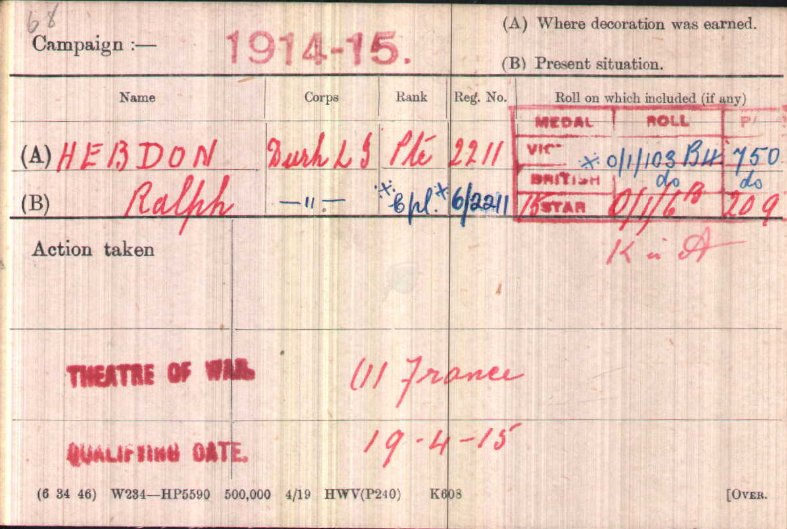
Ralph was sent to France on the 19th April 1915. About the 8th of May 1915 he was wounded. He was hit by a shell and crept two miles to the nearest hospital. In a letter to his mother Ralph describes his wounds as sore and painful but states he is looking forward to them healing a little so he can visit home. He tells her to keep a good smile. We are not downhearted yet.
Kevin Richardson has provided the following information:
The Battle of the Somme 1st July – 18th November 1916
The first day, 1st July, was preceded by a week long artillery bombardment of the German positions. Just prior to zero-hour, the storm of British shells increased and merged with huge mine explosions to herald the infantry attack. At 7.30am on a clear midsummer’s morning the British Infantry emerged from their trenches and advanced in extended lines at a slow steady pace over the grassy expanse of a No Man’s Land. They were met with a hail of machine gun fire and rifle fire from the surviving German defenders. Accurate German artillery barrages smashed into the infantry in No Man’s Land and the crowded assembly trenches – the British suffered enormous casualties totalling 57,470. The loss of great numbers of men from the same towns and villages had a profound impact on those at home.
The Battle of the Somme can be broken down into 12 offensive operations Albert (July), Bazantin Ridge (July), Delville Wood (July-September), Pozieres Ridge (July-September), Guillemont (July-September), Ginchy (September), Flers-Courcelette (September), Morval & Thiepval (September), Le Transloy (October), Ancre Heights (October-November) and Ancre (November).
Adverse weather conditions, the autumn rains and early winter sleet and snow turned the battlefield into morass of mud, such conditions helped bring to an end Allied offensive operations after four and a half months of slaughter. The fighting brought no significant breakthrough. Territorial gain was a strip of land approximately 20 miles wide by 6 miles deep. In terms of casualties, the cost was enormous – British and Commonwealth forces were calculated to have 419,654 casualties (dead, wounded and missing) of which some 131,000 were dead. French casualties amounted to 204,253. German casualties were estimated between 450,000 to 600,000. In the spring of 1917, the German forces fell back to their newly prepared defences, the Hindenburg Line, and there were no further significant engagements in the Somme sector until the Germans mounted their major offensive in March 1918.
The Butte de Warlencourt, 5th November 1916
As the Battle of the Somme was drawing to a conclusion with winter closing in, by the beginning of November few seriously thought that the British Army could break German resolve in 1916. The advance towards the Le Transloy ridge had left British positions overlooked by the Germans and an attempt was to be made to capture a feature known as the Butte de Warlencourt, an ancient burial mount from a prehistoric era, 50 feet high, it stood out from the man-made swamp that surrounded the battered mass of muddy white chalk. Cavan, GOC XIV Corps wrote to Rawlinson concerned that the assault was all but impossible however it is thought that Haig was under pressure from the French high command. The attack took place, 5 November 1916. Peter Hart records that 1/6DLI suffered 11 officers killed, wounded or missing and there were 34 other ranks dead, 114 wounded and 111 missing. He comments “For the people of County Durham, the fighting that raged over the Butte de Warlencourt in early November 1916 affected the lives of thousands who had never consciously heard of it.”
The Durhams Battalions in action
The 3 DLI Battalions took over the front line positions and the 1/5th Borders came up behind them as the reserve battalion. The 1/6th DLI was in the centre of the line, 1/8th DLI was to the right and 1/9th DLI, known as the “Gateshead Ghurkas” were to the left. Together they would attack the Butte on 5th November 1916 at zero hour 0910.
In the early hours of Sunday morning, the companies moved forward to man the front line trench. The weather was dreadful, heavy rain, a howling gale, it was bitterly cold and there were rumours that men had drowned in the mud. Owing to the boggy ground, progress was extremely slow. The trench was in a deplorable condition and the men had to march along the parados in full view of the enemy, to reach their allocated places.
As Zero Hour struck, all the available artillery laid down a barrage some 200 yards in front of the jumping off line. The Durhams went over the top with mud high above their knees, wading, slipping, stumbling and falling forward, laden with all their equipment – it was worse than they could ever have imagined. “They were met by terrific and annihilating fire and crumpled up like snow in summer”, reported one young Lance Corporal of 1st/6th DLI.
The Germans concentrated all their machine gun fire on a devastating onslaught on the hapless Durhams, and succeeded in isolating the British front line and cut off the assaulting troops from any reserves. The Durhams fought the battle on their own.
Eventually the survivors fell back across No Man’s Land with the hard pressing Germans soon threatening even the British front line. After hard fighting, the Germans were held back with the situation exactly as it had been before they started.
From the three DLI Battalions there are 10 officers and 264 other ranks with 5th November 1916 recorded as their date of death.
Corporal Ralph Hebdon was one of those killed in action 5th November 1916.
There are memorials dedicated to the 50th Northumbrian Division and the 1/6th DLI at Wieltje, Belgium, the Butte de Warlencourt in France, Durham Cathedral (D47.073), the Church of St. Mary and St. Cuthbert, Chester le Street (C105.18) and St. Andrew’s Church, South Church, Bishop Auckland (S144.03).
The following appeared in the Teesdale Mercury, November 1917.
In loving memory of Corp. Ralph Wm. Hebdon, 6th DLI of Tindale Crescent, Bishop Auckland, who fell in action in France on November 5th 1916, age 26 years.
We often sit and think of him
His name we often call
Yet there’s nothing left to answer
But his photo on the wall
It may be a soldier’s honour
At his country’s call to fall
But we cannot think of glory
Without the sorrow it caused us all
Ever remembered by his Aunt Lizzie, Uncle Leonard and cousin Ernest.
Sources: The British Newspaper Archive; The Western Front Association; Kevin Richardson; Peter Wise and Brenda McMahon;
Ralph William Hebdon is remembered at Barnard Castle on B135.02, B135.23 and B135.25, also at Durham in the D.L.I. Book of Remembrance, page 306.
First Name: Ralph William
Last Name: Hebdon
Service Number: 2211
Which War: First World War 1914-18
Died: 05/11/1916
Age: 26
Rank: Corporal
Regiment: Durham Light Infantry
Served in: Army
Unit/Ship: 1/6th Battalion
Links to Source Material