Every Name a Story
John Edward Martin
Every Name a Story
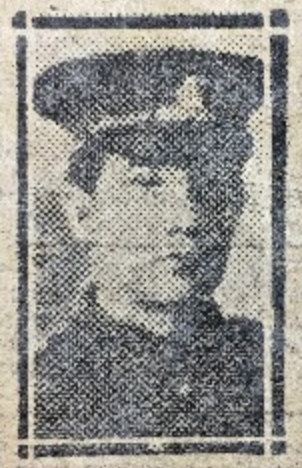
In Tilloy British Cemetery, Tilloy-Les-Mofflaines, France, is the Commonwealth War Grave of 21347 Gunner John Edward Martin, serving with ‘C’ Battery, 78th Brigade, Royal Field Artillery who died 19/04/1917.
The son of John and Ellen Martin, of 33, Harrass Bank, Birtley, Co. Durham.
John Edward Martin was born in Newcastle upon Tyne in 1884. His parents were John Martin, born January 1857, and Ellen (nee Pellican/Pelican), born London, March 1857, and they married in Newcastle upon Tyne in 1883. They indicate on the Census returns that they were both from Ireland; John was from Co. Cavan.
In 1891 the Martin family were living at 21 Brewis Street in Gateshead. John and Ellen had two children at this time, John Edward and James. They left Gateshead sometime between 1894 and 1897 and moved to reside in Birtley.
In 1901 John Edward Martin (now aged 17 years) was living at 6 Birtley Terrace with his parents and four surviving siblings; James (born 1886 Gateshead), Mary (born 1892 Gateshead), Margaret Ann (born 1894 Gateshead) and Thomas (born 1897 Chester le Street).
John Edward and his father were both employed as general labourers, and James was a coal worker below ground.
John Edward Martin married Emma Jane nee Pine, born 13th May 1885, in 1908. Emma Jane was born in South Hetton and prior to her marriage she was living at 5 Long Row, Bewicke Main, Lamesley with her parents Samuel and Christiana (nee Dixon) and siblings. Emma Jane was one of ten surviving children. [One of her brothers was a Henry Pine, born 1895, who served in WW1. Initially in the Royal Garrison Artillery but was transferred into the 8th Battalion Black Watch. He was 5 feet seven and three quarters inches, 143lb, Black Hair, Blue eyes. He resided at 14 George Street, Birtley and was a Miner. His service number was 15501, then when transferred into the Black Watch it became S 10455. He was discharged on the 28th September 1916 under Kings Regulations Para 392 (xvi), Medically unfit to be a soldier. He suffered from severe Bronchitis].
In 1911, John Edward Martin and his wife were boarding at 2 Harras Bank at Clover Houses in Birtley, in 3 rooms with the Dodds family. Head of the household is William Dodds (who worked at the brick works), his wife Ann and their three children William, Henry and Veronica. John Edward Martin was also employed in brick manufacture, and was working as a labourer for a Brick Manufacturer.
John Edward Martin and Emma had six children, Ellen, born 1908 died 1910, and twins Christina born 1910, died 1910 and Madeline born 1910, died 1911, Frances, born 12th October 1917, died 20th January 1918, Thomas, born 31st October 1912, and John Edward, born 17th January 1915.
In the 1911 Census John Edward’s parents were living in 3 rooms, Harras Bank in Birtley. There were also two boarders in the household, named as Thomas Price and Michael Power. The Census gives the information that John and Ellen have had six children, but sadly two infants did not survive; Joseph born 1889 Gateshead, died 1890, and also Thomas born 1897, died 1905 aged 8 years.
There are no surviving military papers for John Edward so the exact details of his service and any transfers are unknown. The documentation available however gives the information that he was an early volunteer and he enlisted in Newcastle. His name appears in the Chester le Street Chronicle 02/10/1914 in the lists of local men who had answered Kitchener’s call.
John Edward enlisted into the Royal Field Artillery, and after training he embarked for France on the 21st May 1915.
In 1899 the Royal Artillery was split into three sections, which were the Royal Field Artillery (RFA), the Royal Horse Artillery (RHA) and the Royal Garrison Artillery (RGA). The RFA was the largest and they provided howitzers and medium artillery near the front lines.
At the time of his death he was known to be serving with ‘C’ Battery, 78th Brigade, Royal Field Artillery. The 78th Brigade (LXXVIII) served under the command of the 17th (Northern) Division and remained with this Division for the duration of the war. The Division was formed in September 1914 as part of Kitcheners Second New Army, or K2. The early days were somewhat chaotic, due to lack of equipment and billets and very few trained officers.
In January 1915 the three six-gun batteries were reorganised to become four four-gun batteries and were consequently given the titles of ‘A’, ‘B’, ‘C’ and ‘D’ Batteries. When at the front the improved 18-pounder field guns had a range of 6,500 yards and were pulled (with crew) by a team of six horses, in pairs.
After initial training, the 17th (Northern) Division moved to Dorset then Winchester in May 1915. On the 5th July they were informed they had been selected for Home Defence but this order was cancelled and they proceeded to France, advance parties of the Division left on the 6th July and the main embarkation began leaving Southampton on 12th July concentrating near the area of St. Omer. However, John Edward had already embarked for France on The 21st May, and therefore presumably may not have initially been attached to the 17th (Northern) Division. The Division served on the Western Front for the remainder of the war. On arrival in July 1915 they worked on trench familiarisation before holding the front lines in the southern Ypres salient. In 1916 they were involved in fighting at the Bluff (south-east of Ypres on the Comines canal), and the Battle of Albert (the Division captured Fricourt) and the Battle of Delville Wood at the Somme.
John Edward was wounded in 1916, he was named in the Casualty Lists issued by the War Office on the 26th June 1916 (he would have been entitled to wear a wound stripe) and he also appears in the Newcastle Journal 26/06/1916 in the wounded list for the Royal Field Artillery: Northern Casualties.
The War Diary for the 78th Brigade places them at BAYENGHEM LEZ SENINGHEM in June 1916. The Brigade did not come into action until the 23rd, and on the 30th the War Diary reports; bombarded continuously night and day enemy lines and defences FRICOURT small retaliation.
There are however no reports of casualties for June in the Diary.
In 1917 the Division fought in the Arras Offensive, including the First and Second Battles of the Scarpe and the Capture of Roeux.
For the 18th April the War Diary reports they were at MONCHY. The batteries were still being heavily shelled during the day and night and their positions were becoming untenable at times and they had to be evacuated until the shelling ceased. At CAMBRAI ROAD the Batteries were under a continuous barrage, rendering the supply of ammunition difficult. Additionally, it is noted in the Diary that the enemy was suspected to have left an observer with buried cable in MONCHY or some other such suitable point of observation.
The following day on the 19th the weather was very bad, with visibility low (Ariel nil) and again the Batteries were heavily shelled. B/78 were moved to a new position despite being under heavy shellfire and had one man was wounded. C/78 had a direct hit on their gun and had 3 men killed and one wounded.
The Diary reports visibility remained low, and the enemy was still suspected of having observer in our lines.
John Edward Martin was killed when his gun received a direct hit on the 19th April 1917. Two other members of the team were also killed and the three men are buried in Tilloy British Cemetery. Next to John Edward lies Driver Peter McGuiggan, aged 26, the only son of Mary and the late Peter McGuiggan (of Felling) and stepson of Michael McCann, West Stanley. He was married to Ellen (nee Laffey) and the couple lived at 66 Fleming Street in Gateshead with their two sons. Next to Peter lies Gunner Albert Seymour Lloyd M.M., an apprentice in H.M. Dockyard, Pembroke Dock before the war. He was aged 23 and the son of Alderman W. G. Lloyd and Mrs. M. A. Lloyd of Britannia House, Corporation Terrace, Pembroke Dock.
John Edward’s father had May He Rest In Peace added to his headstone.
His wife Emma Jane passed away only months later on the 7th January 1918 from heart disease, she was buried in St Joseph church, Birtley on the 9th January 1918. Her father-in-law John Martin (of 33 Harras Bank) was in attendance, and placed his mark ‘X’ on the death certificate as the informant.
Newcastle Evening Chronicle January 1918
Martin Birtley, 34, Harras Bank, 7th inst., aged 32 years, Emma Jane, widow of the late John Edward Martin, and daughter of Mrs. Pine. Interment St. Josephs, Birtley, on Thursday; cortege leaves residence 2.40. All friends kindly invited. R.I.P
John Martin Snr. became Guardian to the children and he was named as such on the soldiers effects documentation. However more tragedy was to follow, with the death of Frances aged 3 months on the 20th January 1918.The pension award was made to John Martin Senior as the appointed guardian, and received 13s [shillings], a week.
John Edward’s brother also served, James Martin of 33 Harras Bank is listed in the absent voters list for Birtley; Service number 555092, 60th Labour Corps. His previous service number and unit were 26196 Northumberland Fusiliers.
In 1921, John Martin and Ellen were residing at 33 Clover Homes, Birtley, with three children, James born 1886, Thomas born 1912 and John Edward Martin, born 1915, the last two children were his grandsons. John Martin was out of work, and was employed by the Birtley Iron Company, James was a Masonic Labourer for Birtley Council and the last two were still at school.
Research: Jean Atkinson/James Pasby; The Western Front Association; The British Newspaper Archive; War Diary;
John Edward Martin is remembered at Birtley on B127.01 and B127.09.
First Name: John Edward
Last Name: Martin
Service Number: 21347
Which War: First World War 1914-18
Died: 19/04/1917
Age: 34
Rank: Gunner
Regiment: Royal Field Artillery
Served in: Army
Unit/Ship: 'C' Battery 78th Brigade
Links to Source Material