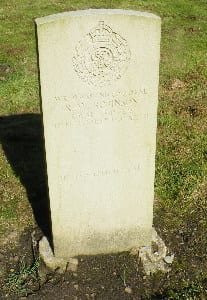
In St. John’s Churchyard is the Commonwealth War Grave of:-
WR/253258 2nd Corporal
R.W. Robinson
Royal Engineers
12th December 1918
He answered the call
Robert William was the son of Thomas and Mary Robinson. He was born at Rookhope.
Pauline Priano has submitted the following;
Robert William Robinson was one of 5 known children of whom only 4 reached adulthood.
His father Thomas Robinson was born at Eggleston, County Durham, October 2nd 1852, where he was baptised by his parents, farmer Joseph Robinson and his wife, grocer Mary Ann, May 14th 1853.
Thomas Robinson was married in the district of Teesdale in 1876 to Mary Cameron who was the daughter of John Cameron, gardener/gentleman born at Middleton and his wife Dorothy Hudson, native of Alston, historically in Cumberland. Mary was born at Middleton, Teesdale, County Durham, June 14th 1851.
Their first born child John Cameron Robinson was born at Middleton, December 18th 1876, Joseph Robinson, March 25th 1878 who sadly died, May 9th 1878, before the family moved to Stanhope, County Durham where Mary gave birth to a daughter Eleanor Ann, April 29th 1879. In 1881 they were living at Strait Cottage, Bolts Burn, Rookhope where Thomas was employed as a draper and grocer’s assistant.
Robert William Robinson was born at Rookhope, August 3rd 1887 as was Thomas Hudson Robinson. April 12th 1889. The joy of his birth was marred by the death of Mary Robinson nee Cameron ten days later, April 22nd 1889, presumably of post partum complications, she was 37 years of age.
Widower Thomas Robinson remained at Bolts Burn as a draper and grocer assisted by his son John Cameron (14), Eleanor Ann (11) attended school, Robert William and Thomas Hudson remained at home. The entire family was cared for by Thomas’ sister Margaret Robinson (31) whom he employed as a housekeeper until he remarried to a lady named Elizabeth.
Thomas Robinson, aged 44 years, died at Rookhope, August 25th 1897. John Cameron Robinson took responsibility for the family after his father’s demise and in 1901 was running his own draper and grocery business at Bolts Burn, Rookhope. Living in his household was his step mother Elizabeth (62) and his siblings Robert William (13) and Thomas Hudson (11), Eleanor Ann had left the family home in 1898 and was now living as Mrs. Robert Watson Ward at Hilton Terrace, Rookhope.
By 1911 Robert Watson Ward, who was employed a truck builder at Consett Iron Company Wagon Shops and Eleanor Ann were living in 5 rooms at Rookhope House, 11, The Avenue, Rookhope with their only child, 10-year old John Thomas Ward. They had taken into their home Robert’s sister Elizabeth Ward (32) and her 5-year old daughter, Elizabeth, also Robert William (23) employed as a grocer’s assistant at G. Powell’s Stores and Thomas Hudson (21) a labourer at Consett Iron Company Wagon Shops which built ore wagons.
As early as 1911 there were already rumblings of a possibility of war with Germany which was declared within hours of Germany, as part of a massive attack on France, invaded Belgium violating Belgian neutrality. After a request to Britain by the Belgians for help, London gave Berlin an ultimatum which expired August 4th 1914 at 11 p.m. London time. When this was ignored, King George V then declared war on Germany that same evening.
In answer to Kitchener’s call to arms and the order that all regiments raise new battalions men from all walks of life volunteered to serve their Country. Robert William Robinson was employed by the railway as a platform porter and still living at Rookhope House when he joined the Royal Engineers.
The corps of the Royal Engineers expanded rapidly during WW1 created by Commander Holland, who at the outbreak of war was Marine Superintendent of the London and North Western Railways. Officers and men were recruited with the formation of tunnelling companies, trench building, forestry, quarrying, gas warfare, aerial surveying. The waterways of France and Belgium provided the Allies with an important means of transport and it was decided that the Waterways Transport section would also be part of the Corps of Royal Engineers
Robert William Robinson enlisted at Whitehall, London, October 20th 1915, giving the name of his brother John Cameron Robinson as next-of-kin. He was attested the following day and assigned as Sapper 135518 Railway Operations Division Royal Engineers, October 21st 1915. January 7th 1916 Sapper Robinson was posted to the British Expeditionary Force bound for France where he served with a change of service number as WR/258253 with the Waterway and Railways Operating Division, Royal Engineers and had risen to the rank of 2nd Corporal by November 14th 1916.
2nd Corporal Robinson remained in France until he was repatriated to the United Kingdom, November 24th 1918 and admitted to the Nottinghamshire County War Hospital, Radcliffe on Trent, which from August 1918-October 1919 cared for shell shocked soldiers.
2nd Corporal WR/258253 Robert William Robinson Royal Engineers was diagnosed as suffering from acute mania. He died at the hospital, the cause listed as acute mania and exhaustion, at 2:15 a.m., Thursday, December 12th 1918. He was 31 years of age and single. Awards; British War Medal and Victory Medal.
At the request of his family and paid for by them, the Army organised that the body of Robert William be transported to his home. 2nd Cpl. R. W. Robinson Royal Engineers is at rest within Rookhope (St. John) Churchyard, Stanhope, County Durham, Row 2 from entrance path to the north, Grave 6 West of “Roddam” white marble head.
John Cameron Robinson commissioned at a cost of 4 shillings 11 pence an additional inscription to be added to his late brother’s military headstone, it reads, “HE ANSWERED THE CALL.”
Thomas Hudson Robinson also served during WW1 with the Royal Defence Corps.
All monies due to the late 2nd Corporal Robinson were divided between his surviving sibling, John Cameron Robinson received 10 pounds 1 shilling 3 pence, Thomas Hudson Robinson and Eleanor Ann Ward (nee Robinson), 10 pounds 1 shilling 2 pence each.
In God’s safe keeping. Rest In Peace.
2nd Corporal was a rank used by the Royal Engineers and Army Supply Corps until 1920 when the rank was abolished.
Robert William Robinson is remembered at Rookhope on R51.01, R51.02 and R51.03.