
Memorial
Plaque Campania 1917 Mission to Seamen
North Shields
Memorial Name: Plaque Campania 1917 Mission to Seamen (N34.75)
NEWMP Ref No.: N34.75
Parish: North Shields
In The Royal Patrol Service Institute which was opened on the same day.
Seamen’s Mission, Chapel. 53 Mill Dam, South Shields. NE33 1EF.
1914-18
a. Unveiled 20th June 1917 by the Bishop of Newcastle.
b. Re Dedicated and unveiled 13th April 1932 by Captain Guy P. Bowles of Tynemouth, Divisional Coastguard Superintendent.
Brass and Mahogany.
Mission to Seamen
Tyne Auxiliary Patrol
Present Condition: Excellent
Ownership and Maintenance: Seamans Mission Society
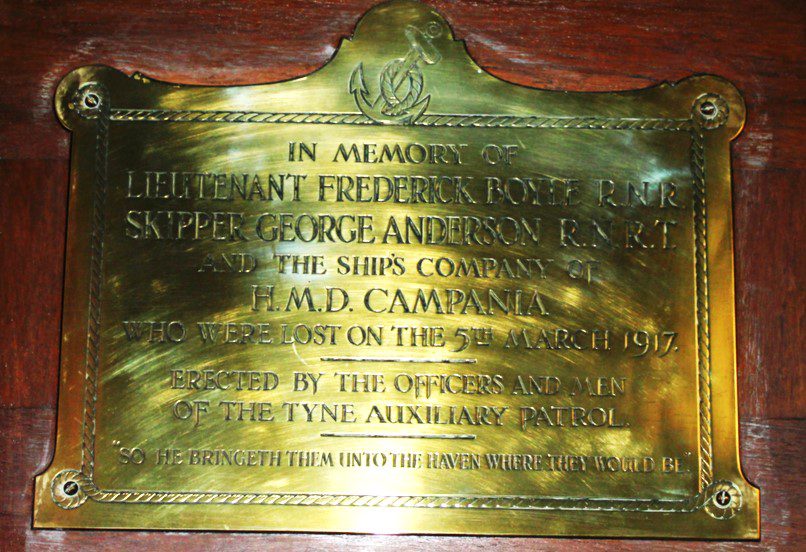
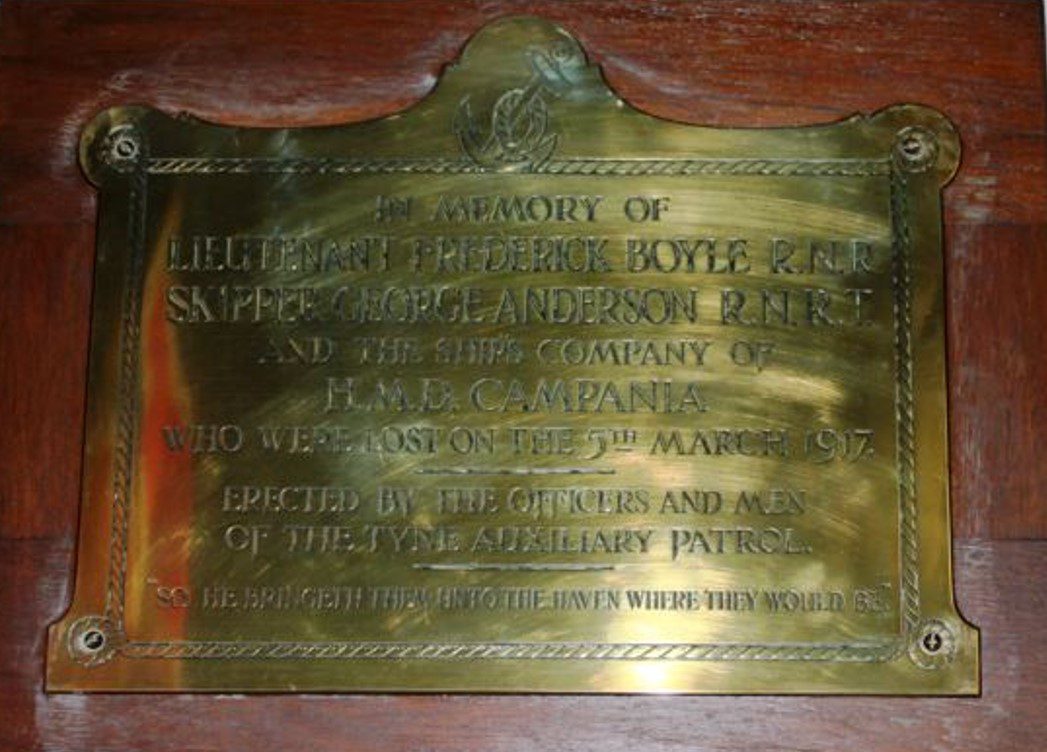
In Memory of
Lieutenant Frederick Boyle R.N.R.
Skipper George Anderson R.N., R.T.
and the ship’s company of
H.M.D. Campania
who were lost on the 5th March 1917
Erected by the Officers and Men
of the Tyne Auxiliary Patrol
“So he bringeth them unto the haven where they would be”.
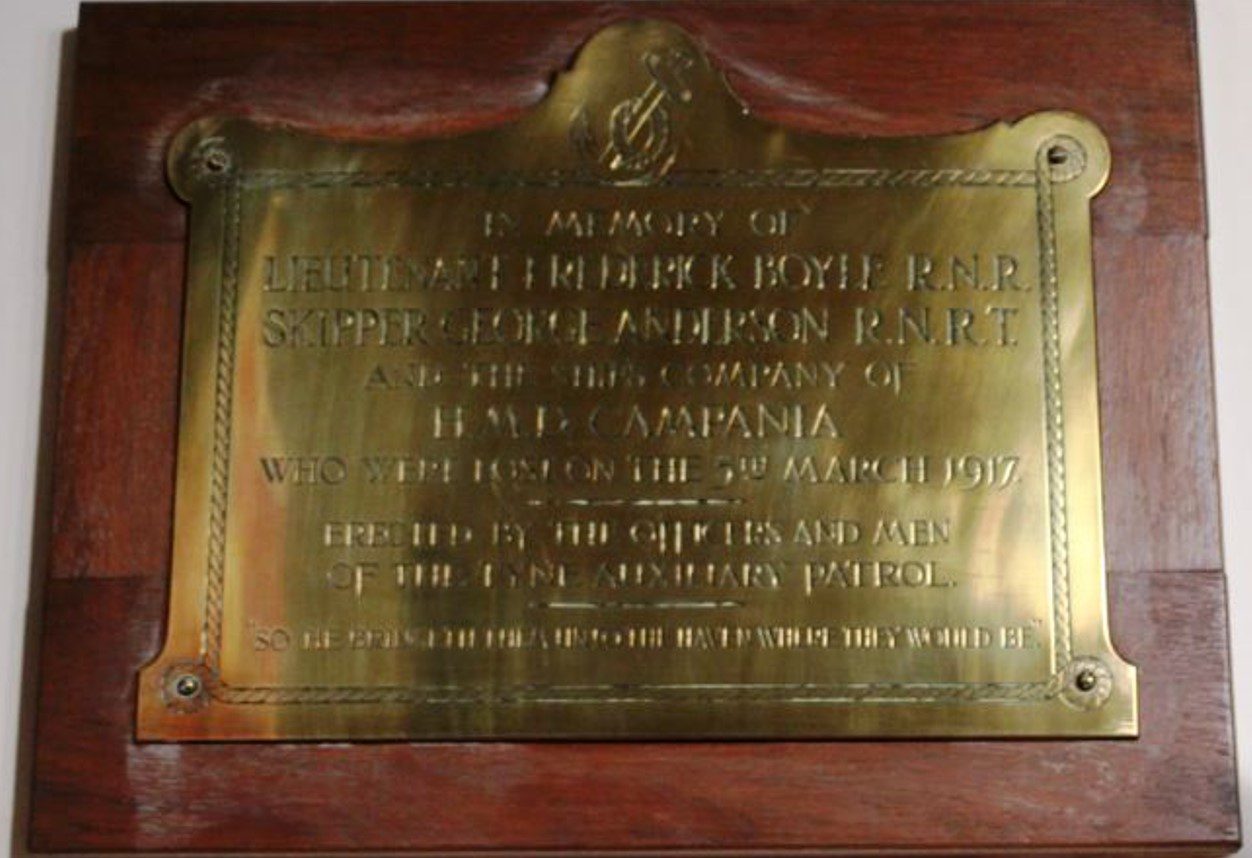
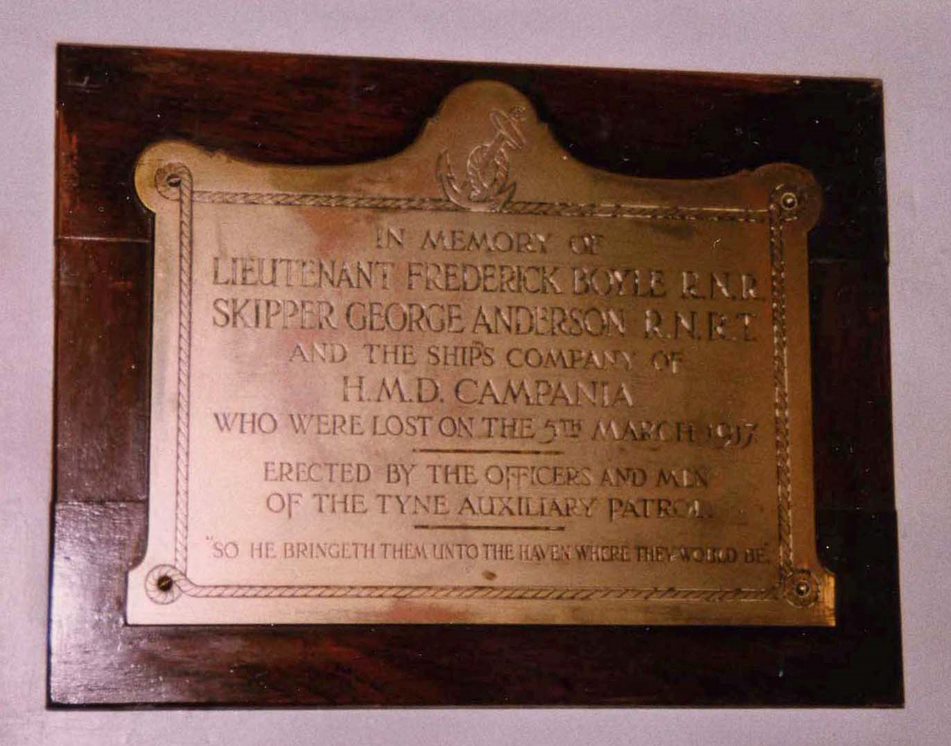
Brass Plaque on mahogany pattress.
The plaque is 11 inches (276mm) high x 12 inches (304mm) wide.
The pattress is 13 inches (326 mm) high x 16 inches (408mm) wide.
The plaque has rounded extended corners at the top and square ones at the bottom.
At centre top is a rounded top which contains an anchor.
There is a border of rope which encircles the screws in each corner and the anchor at the top.
Lettering is in Roman capitals throughout.
2 full names and ranks.
See transcript.
1. H.M.S. Campania was reconstructed by April 1915 as an aircraft (seaplane) carrier. She was finally sunk by collision in the Firth of Forth on 5th November 1918.
2. She was designated in 2001 under the Protection of Wrecks Act 1973 as a site of historical importance. Eleven aircraft are still entombed with her.
3 The Institute had been erected by the Mission to Seamen, Tyne Station, as a clubroom for mine-sweepers, consisting of a large general room for the use of officers, a coffee bar and a galley for cooking meals. Those using the institute could play billiards and other games. There was a general room seating about 200 people.
4. The plaque was moved to South Shields Seaman’s Mission when the Institute was closed and a new unveiling took place there, several other plaques were dedicated at this time relating to the South Shields mission. One to Miss Mary Anne Young, who bequeathed £5,000 to the Station; another records the renaming of the frigate Diamond to Joseph Straker, a benefactor; a third to Mrs. Mary Elizabeth Bavington, in whose memory a writing room in the mission had been equipped; another records that the mission’s first steam launch was called Mrs. Carrie Edwards.
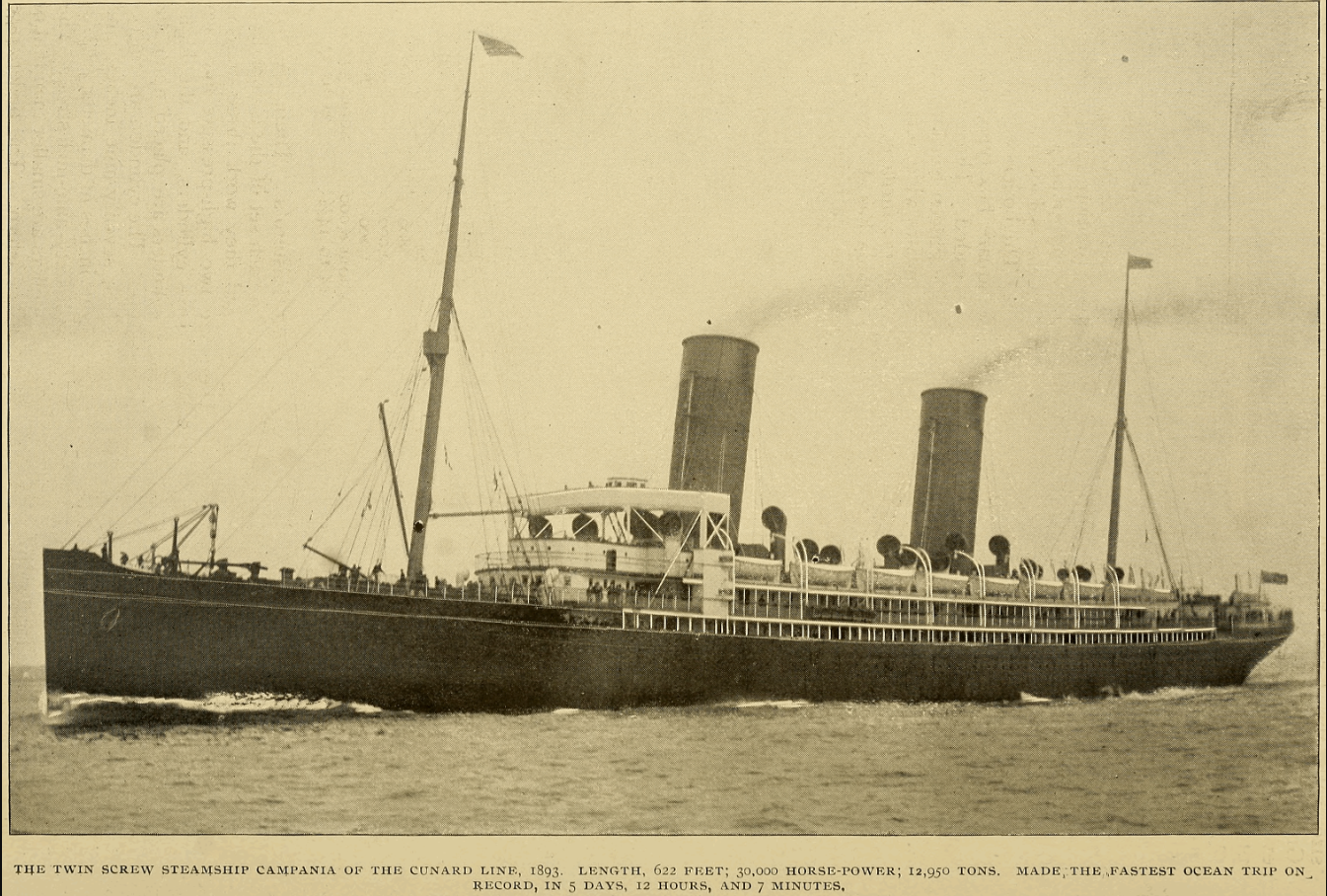
5. RMS Campania was a British ocean liner owned by the Cunard Line, built by Fairfield Shipbuilding and Engineering Company of Govan, Scotland, and launched on Thursday, 8th September 1892. Identical in dimensions and specifications to her sister ship RMS Lucania, Campania was the largest and fastest passenger liner afloat when she entered service in 1893. She crossed the Atlantic in less than six days, and on her second voyage in 1893, she won the prestigious Blue Riband, previously held by the Inman Liner SS City of Paris. The following year, Lucania won the Blue Riband and kept the title until 1898 Campania being the marginally slower of the two sisters. With the appearance of a third Cunard giant in 1914, RMS Aquitania, Campania was no longer required. Her last planned voyage for Cunard was her 250th, and commenced on the 25th April 1914. On her return to Liverpool, she was chartered to the Anchor Line to do voyages from Glasgow to New York. However, the First World War broke out and Aquitania, having completed only three voyages, was immediately commandeered by the Navy and converted into a fully armed merchant cruiser. Campania was therefore recalled to take her place but unfortunately, she was too old and managed only three voyages before being sold for scrap. Her last voyage as a passenger liner was on the 26th September 1914. However, Campania was to have a last-minute reprieve.
While Campania awaited demolition, the Admiralty stepped in at the last minute and bought her with a view of converting her to an armed merchant cruiser that could carry seaplanes. The original idea was to use float-planes which would be lowered into and retrieved from the water by a crane. The conversion was carried out at the Cammell Laird shipyard in Birkenhead. Her interior was completely gutted, and room made inside to store up to 14 aircraft. She was also equipped with eight 4.7″ (120-mm) guns. The conversion was completed in 1915, and trials took place under Captain Oliver Schwann of the Royal Navy, with Charles H. Lightoller (formerly second officer of RMS Titanic) as the first officer. Two weeks later she joined the fleet at Scapa Flow as HMS Campania, and subsequently began manoeuvres in the North Sea. Her job was to send aeroplanes ahead to scout for the German fleet.
After a short period, it was decided to add 160 ft (49 m) flight deck at the front of the ship, to enable aircraft to take off directly from the ship without being lowered into the water. Trials following this conversion indicated that the deck was too short, so it was extended to 220 ft (67 m). The alterations required the removal of the forward part of the superstructure, and the first funnel (which was replaced by two narrower funnels on each side). The aft deck was cleared and the aft mast removed, so that she could also serve as an Observation Balloon Ship. Campania now bore little resemblance to her original configuration.
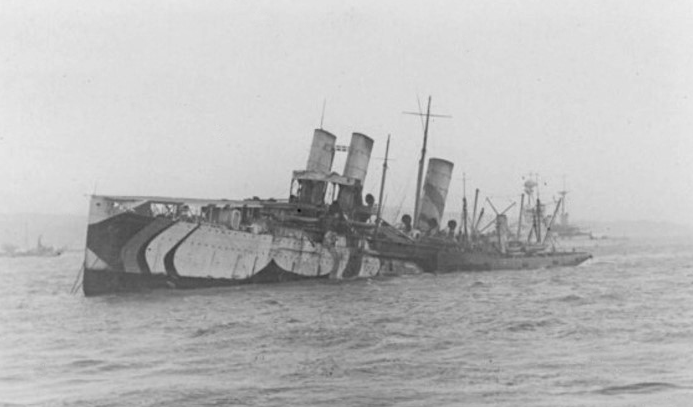
HMS Campania served with the Admiralty right up until the 5th November 1918—just six days before the armistice was signed, when she was involved in an accident in the Firth of Forth during high winds. Campania dragged her anchor in a sudden squall, and at 03:45 struck the bow of the battleship Royal Oak and then dragged along the side of the battle cruiser Glorious. She began to sink stern first. A few hours later an explosion—presumed to be a boiler—sent her to the bottom.
Because of the shallowness of the water, she was considered a danger to shipping and large charges were placed on the decks to demolish her. By 1921, the wreck had been reduced to a safe clearance depth. Further to this destruction it is reported that salvage of valuable metals took place on the wreck, possibly during the late 1940s and the 1960s. Despite this damage, the wreck site today is located at 56°02′N 03°13′W and is classified as being of historical importance, being designated under the Protection of Wrecks Act in 2000. This designation was revoked in 2013 when the site was re-designated as a Historic Marine Protected Area under the Marine (Scotland) Act 2010.
Photos: James Pasby
Newcastle Journal
21/06/1917 reports opening of institute and unveiling of memorial.
South Shields Gazette
14/04/1932 reports unveiling along with other plaques.
Photo of Campania sinking
IWM ref 1818.
The Monumental Brasses of County Durham William Lack, H. Martin Stuchfield and Philip Whittemore 2002 ISBN 095 4327101
British Vessels Lost at Sea 1914-1918 first published by HMSO in 1919 and republished by Patrick Stephens ISBN 085059 384 0
Source of quotation
“So he bringeth them . . .” Psalm 107 v 30 “So he bringeth them unto their desired haven”
Additional Research Documents
Dorothy Hall;
James Pasby
Fitzhugh Collection, Middleton in Teesdale;
Janet Brown;
IWM;
Michael Mulhern
If you are researching this memorial please contact 2014@newmp.org.uk
War Memorial Indexes

County Durham Index

Newcastle Index

Northumberland Index

Over The Tees Index
This is a work in progress. Interested in helping, contact 2014@newmp.org.uk
