
Memorial
War Record 1914-19 Durham School
Durham City
Memorial Name: War Record 1914-19 Durham School (D47.057)
NEWMP Ref No.: D47.057
Parish: Durham City
1914-18
1919
Printed by Robert Youll, Engraver, Printer etc, 28 Northumberland Street, Sunderland.
Old Dunelmians
in the
Navy
Army
and
Air Force
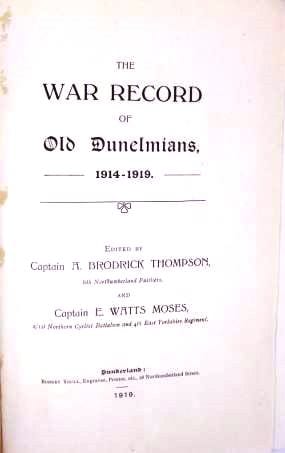
Book entitled “The War Record of Old Dunelmians 1914-1919”.
It contains a list of names, years at the school; rank; regiment; honours; whether wounded or killed and other information.
438 of those who served,
plus 25 who died and 71 who were killed in action.
See transcript.
1. As well as the Roll of Service, the book contains full-page biographies, and on the facing page full-page photographs, of each of the fallen.
2. The proceeds from the sale of the book were to be devoted to the Durham School War Memorial.
3. There has been an up to date reprint version of this publication.
4. The name A. N. Suggitt is incorrectly spelt, it should read Suggit. [See page 244].
Newcastle Daily Chronicle
20/12/1919 carries an appeal for names;
19/05/1920 reports publication of book and details of sale.
The War Record of Old Dunelmians 1914-1919. Eds. Captain Broderick Thompson, Captain E. Watts Moses, Sunderland, Robert Youll, 1919.
Additional Research Documents
Tony Harding;
Dorothy Hall;
James Pasby
If you are researching this memorial please contact 2014@newmp.org.uk
If you know more about this memorial, please send the details to NEWMP.
The
War Record
of
Old Dunelmians,
1914-1919.
Edited by
Captain A. Brodrick Thompson,
6th Northumberland Fusiliers,
and
Captain E. Watts Moses,
2/1st Northern Cyclist Battalion and 4th East Yorkshire Regiment.
Sunderland
Robert Youll, Engraver, Printer, etc., 28 Northumberland Street.
1919.
—————————————————————-
EDITORS’ FOREWORD.
It was originally intended that this book should take the form of a
permanent record of the lives of those Old Dunelmians who fell in the
service of their country during the War of 1914-1918. It was, however,
felt that the scope of the book should be extended to include
the School War List of Old Dunelmians serving in H.M. Forces, and it
is with that end in view that the Editors have undertaken its
compilation.
It is realised that there are probably omissions in the book,
especially in the “List of Old Dunelmians serving in the Army, Navy
and Air Force”, and the Editors will be glad to receive additions or
corrections for inclusion in any future edition.
The thanks of the Editors are due to all those who have so kindly
helped in the collection of material for the book, and especially to
those relatives of the fallen who have so willingly provided
photographs, letters, and details of interest, from which the
biographical portion of the book-has been compiled.
A.B.T.
F.W.M.
——————————————————————
Page vi
INTRODUCTION.
When war with Germany was declared in August 1914, the number of Old
Dunelmians serving in the Regular Forces was not large, although the
School was well represented in the Auxiliary Forces. Durham School is
not, and never has been, what is known as an “Army School”; rather
has it been the aim of the authorities to prepare boys for the
Universities and professions with a view to fitting them to practise
the arts of peace.
At the same time reference to the School Register reveals the fact
that in previous wars the School has always provided its quota to the
Forces of the Crown. Henry, Viscount Hardinge, who was one of Sir John
Moore’s right-hand men in the Peninsular, who served as a Brigadier-
General under Wellington in 1815, and who reached the top-most rung of
his profession when he was created a Field Marshal in 1S55, was an Old
Dunelmian; with him in the Peninsular there also served John Chipchase
and Roderick Impey Murchison, the latter of whom, disappointed at not
having the opportunity of seeing further active service, relinquished
the sword and made a name for himself in the world of science. Later,
in the Indian Mutiny, many Old Dunelmians played their part, either as
soldiers or civilians, as witness the names of George Jackson, Lachlan
Macqueen, John Losh, the
———————————————————
Page vii
Crasters, Frederick and Henry Forbes, H.C. Wilkinson, Sir William
Fairfax and Moyes Preston, to mention but a few. In later days,
whether in the Crimea, on the Indian frontiers, or in Africa, the
traditions of Durham were upheld by such men as Hubbach, W.T. Corrie,
Patrick Thorpe Dickson, Charles Macgregor, the Chaytors, Rivett-
Carnac, Charles Warddell, Sir James Trotter and Mitford Cust. In the
South African War Old Dunelmians fought and died, and many who had
served in that war came forward again in 1914.
As regards the Royal Navy, one does not expect to find the names of
many Old Dunelmians in the history of past wars, but in the Register
are recorded the names of two distinguished sailors in Admiral of the
Fleet Sir Thomas Maitland, G.C.B., and Admiral Sir Thomas Sabine
Pasley, K.C.B.
Such, then, was the heritage bequeathed to Dunelmians by those who had
gone before, and when war broke out in August 1914, Dunelmians were
not slow in coming forward, and it will be seen in the pages that
follow in this book that the traditions of former generations have
been worthily upheld.
On the mobilization of the Auxiliary Forces many Old Dunelmians were
embodied, in addition to those Regulars who went overseas in the
“contemptible little Army” many who had served as volunteers in the
South African War received commissions, and many more enlisted,
chiefly in one or other of the Public Schools’ Battalions
————————————————————–
Page viii
of the Royal Fusiliers, the majority of the latter afterwards
receiving commissions. The first School War List, published in
December 1914, contained 164 names, and was necessarily very
incomplete. At that time three Old Dunelmians were known to have given
their lives, two of them Regular soldiers, and the third, Lieutenant
Martin James Richardson, a volunteer, who set a fine example by
joining the Royal Army Medical Corps at the age of forty-nine in
September 1914.
By the summer of 1915, however, the list of Old Dunelmians who had
fallen had grown lamentably long. In the spring the Territorial Force
Divisions proceeded to France and Gallipoli, and when the Northumbrian
Division, afterwards known to fame as the 50th Division, was rushed
across the Channel into Belgium and hurled straight into the Second
Rattle of Ypres and the horrors of the first gas attack, many
Dunelmians fell or were wounded, for a large proportion of the
Officers in that Division came from the School. Gallipoli, also, took
its toll, and, as the new armies began to find their way into the
fighting, more names were added to the list. From 1916 onwards until
the Armistice in November 1918, that list grew longer and longer,
with the result that the biographies which follow total ninety-five.
When one reads those biographies one cannot but be struck by the
number of lives full of youthful promise that have been cut short.
Every walk of life, every profession, is represented. By the deaths of
Noel Hodgson and Noel Oxland the literary world has suffered
————————————————————–
Page ix
a distinct loss. Hodgson’s “Verse and Prose in Peace and War” is but
an indication of the heights to which its author might have been
expected to attain, and, full of references to the School as it is,
that little green book-should for over find a place in the book-
shelves of all Dunelmians. The Church, too, has made its sacrifice,
and is the poorer by the deaths of E.W. Trevor, who died in the
performance of his duties as a chaplain, and of E.J.R. Briggs-
Gooderham, who fell as a combatant. The law, chartered accountancy,
architecture, agriculture, commerce, and all kindred occupations are
represented in the list, and many men who have upheld the Durham
athletic traditions are gone. It is not necessary to name them, for
their names will not be forgotten, but there is one name that stands
out, and that is the name of “Charlie” Adamson. Splendid sportsman and
true friend of the School, he never spared himself in the furthering
of football and cricket at the School. As a coach he was responsible
for many of the victories of recent years on the football field, and
by his death the School has suffered a great loss.
With regard to the total number of Old Dunelmians who served in His
Majesty’s Forces during the war, some difficulty has been experienced
in tracing many who probably saw service. At the same time the list
may be taken as being fairly complete, containing as it does 535
names. Many distinctions were gained by Old Dunelmians during the War,
and they will be found opposite their names in the list of those who
served in the Army, Navy and Air Force. The following is a brief
summary of these decorations and distinctions:
————————————————————–
Page x
The Most Noble Order of the Bath.
K.C.B…………………………..1
C.B…………………………….3
The Most Distinguished Order of St. Michael and St. George.
K.C.M.G…………………………2
C.M.G…………………………..6
The Royal Victorian Order.
K.C.V.O…………………………1
M.V.O…………………………..1
The Most Excellent Order of the British Empire.
Military Division.
K.B.E…………………………..2
C.B.E…………………………..3
O.B.E…………………………..5
Civil Division.
C.B.E…………………………..1
O.B.E…………………………..1
M.B.E…………………………..1
Companions of the Distinguished Service Order.
D.S.O. and Bar ………………….11
D.S.O…………………………..10
The Military Cross.
M.C. and two Bars ……………….1
M.C. and Bar ……………………3
M.C…………………………….47
The Distinguished Flying Cross ………….1
The Distinguished Conduct Medal and Bar ….1
The Military Medal……………………..1
———————————————————
Page xi
The Meritorious Service Medal……………1
Territorial Decoration………………….1
Promotion to Brevet Rank.
Brevet Colonel…………………………3
” Lieut.-Col. …………………….3
” Major…………………………..3
Mentioned in Despatches.
Nine times …………………………..1
Five “……………………………….4
Four ” ………………………………3
Three ” ………………………………2
Twice ………………………………..16
Once………………………………….36
Name brought to notice by Secretary of State for War for Valuable
Services.
Twice ………………………………..1
Once………………………………….10
Foreign Decorations.
French………………………………..3
Belgian……………………………….5
Italian……………………………….2
Rumanian………………………………2
Serbian……………………………….1
Russian……………………………….5
American………………………………2
Colonel Sir Robert Trotter Hermon-Hodge, Bart., was raised to the
Peerage for his services in the War, and assumed the title of Lord
Wyfold of Accrington.
—————————————————————–
Page xii
A School Chapel is to be built to preserve the memory of those who
have gone. It is not at present possible to say when it will be
built, and this book has been compiled in the hope that it will assist
to keep their memories green. The School has suffered heavily in the
War, as have all the Schools, and it is the duty of those who have
been spared to preserve the memories of those who by their sacrifice
have made it possible for the School to continue its functions and
carry on its traditions. It is hoped, therefore, that this book will
afford some measure of consolation to the relatives and friends of
those who will never visit Durham again, and that at the same time it
will be a source of inspiration to future generations of Dunelmians.
A.B.T.
————————————————————–
Photographs
and
Biographies
of
Old Dunelmians
Who gave their lives for their Country in the War, 1914-1919.
——————————————————————-
Page 2
The Reverend WILLIAM HALL.
Chaplain and Naval Instructor, R.N., son of the Rev. G.R. Hall, Vicar
of Birtley, entered the School House in January 1877, and left in July
1878, for Rossall School. Thence he proceeded to Cambridge as a
scholar of King’s College, where he took his degree (22nd Wrangler) in
1889. He was ordained Deacon in 1893, and Priest in 1894. He held an
appointment as Assistant Master at Rossall School from 1890 to 1894,
and then entered the Navy as a Chaplain and Naval Instructor, serving
in the following ships: H.M.S. Endymion, Astraea, 1895-8; Raleigh,
1899; St. George, 1899-1902; London, 1902-04; Aurora, 1904-05;
Highflier, l905-06; Britannia, I906-09; and H.M.S. Collingwood since
1910.
Mr. Hall was the author of “Ex-Meridian Altitude Tables” (1906),
“Modern Navigation” (1904), “Model Lights” (1905), “Tables and
Constants” (1905), “Inman’s Nautical Tables” (1906). In 1902 he
invented the Nautical Slide Rule. During the war his services were
lent to the Australian Navy. He was invalided out and died on the 2nd
November 1916, of injuries receive on active service.
————————————————————-
Page 4
Lieutenant MARTIN JAMES RICHARDSON.
Royal Army Medical Corps, was the son of M. Richardson, Esq., of
Bridlington, and was born in 1865. He entered the Second Master’s
House in January 1879, and left in July 1883, for Edinburgh
University, where he took the degrees of M.B. and C.M. in 1889. He
practised for a time at Alverstoke, Hampshire, and was Assistant
House Surgeon at Rotherham Hospital. Later he practised at Wolston,
in Warwickshire, where he held the appointment of Medical Officer,
Wolston District. He was a member of the British Medical Association.
In August 1914, he joined the R.A.M.C. and shortly afterwards, in
October was posted to the 21st Field Ambulance, R.A.M.C., with which
he was serving when he was killed near Ypres on the 3rd November 1914.
Lieut. Richardson was mentioned in despatches.
——————————————————–
Page 6
Major CLEMENT ARTHUR WILKINSON.
King’s Shropshire Light Infantry, son of P.S. Wilkinson Esq., Mount
Oswald, Durham, was born in 1870, and was one of four brothers, all
O.D.’s. He entered the School as a Day Boy in May 1881, and coxed the
3rd crew in 1882. He left at Easter, 1889, and took a commission in
the 4th Durham Light Infantry (Militia) in 1893, transferring into the
King’s Shropshire Light Infantry in the same year. He saw service in
the Hinterland of Lagos, West Africa, in 1897-8, and in the expedition
against the Munshi tribe, Northern Nigeria, in 1900, for which he
received the medal and two clasps. He then took part in the operations
in Ashanti and the relief of Kumasi in the same year, being mentioned
in despatches and receiving the medal and clasp. After sick leave in
England he served with the Mounted Infantry in the South Africa War in
the Cape Colony, Orange River Colony, and the Transvaal, being
mentioned in despatches and promoted Brevet Major in 1902: he received
the Queen’s medal with five clasps. In 1909 he became Adjutant of the
3rd Battalion, and of the Depot at Shrewsbury. He married in 1909,
Ruth, second daughter of Colonel Mirehouse, C.M.G., The Hall, Angle,
Pembroke.
Major Wilkinson was in India with his regiment when the war broke out,
and proceeded to France in November 1914. He was invalided home
suffering from frost bite in January 1915, but returned to France
early in May being killed in the Second Battle of Ypres on the 12th
May 1915.
—————————————-
Page 8
Major ERNEST WILLIAM LONGDEN.
4th York and Lancs. Regiment, was the eldest surviving son of J.A.
Longden, Esq., Ashcroft, Sunderland, and was born in 1872. He entered
the School as a Day Boy in April 1883, and left in December 1888. He
entered the steel industry, and was Managing Director of Messrs. Peter
Stubs, Ltd., Rotherham. He served in the 4th (Hallamshire) Volunteer
Battalion of the York and Lancs. Regiment in the South African War,
taking part in the operations in the Transvaal, Orange River Colony,
and Cape Colony in I901 and 1902. He was mentioned in despatches,
received the Queen’s medal with five clasps, and was granted the rank
of Honorary Lieutenant in 1902. In 1905 he was promoted Captain, and
in 1914, Major.
In April 1915, Major Longden went to France as Brigade Major to the
148th Infantry Brigade, in the 49th Division. In the winter of 1915 he
was stationed near the Yser Canal, with the result that he was
invalided home as the result of an attack of pleurisy. He was
mentioned in despatches in January 1916. In June 1916, he was
appointed Brigade Major to the 221st Mixed Infantry Brigade at
Sandwich, which appointment he held until April 1917, when he took up
another appointment. Later he was kicked by a horse, and his leg was
broken. This, following his previous illness, caused complications,
and, after a long illness, he died in hospital at Sheffield on the
21st August 1918.
Major Longden married, in 1907, Edith, daughter of Mr. James Dixon,
Stumperlowe Hall, Sheffield, and is survived by his widow and a
daughter.
———————————————————-
Page 10
Lieutenant-Colonel CHARLES LAWSON ROBINSON. T.D.
1st Monmouthshire Regiment, was the eldest son of K. Robinson, Howlish
Hall, Bishop Auckland, and was born in 1869. He came to the School
House from St. Peter’s York, in May 1885, and was a member of the XI.
of 1887 and 1888, and of the XV. of 1887. He left in July 1888, and
shortly afterwards took a commission in the 2nd V.B. Durham Light
Infantry, now the 6th Battalion Durham Light Infantry. He took part in
the South African War, commanding the Glamorganshire Yeomanry, and
taking part in operations in Cape Colony, Orange River and the
Transvaal, for which he received the Queen’s medal with five clasps.
In October 1896 he was appointed one of H.M. Inspectors of Mines, and
in 1910 was promoted to the rank of Senior Inspector for Scotland. In
1912 he was transferred to the Yorkshire and North Midland Division,
and gained distinction for his exploration work in connection with the
disastrous Cadeby Mine explosion, and in May 1914, he became Senior
Inspector for Scotland, residing at Edinburgh.
Lt.-Col. Robinson was second in command of the 1st Monmouthshire
Regiment when the war broke out, and was in command of the Battalion
when it went to France in February 1915. He was killed during the
Second Battle of Ypres. He held the Territorial Decoration for his
long service in the Volunteer and Territorial Forces.
Page 12
2nd Lieut. ROBERT WILLIAM ADAMSON.
7th Durham Light Infantry, was the eldest son of J. Adamson, J.P. of
Durham, and was born in 1873. He came to the School as a Day Boy in
May 1886. He played in the XV. in 1890, and, after leaving in December
of that year, played for Durham County, and also for the Durham City
Team. During the South African War he served for three years as a
volunteer in the North Staffordshire Regiment, afterwards being
employed in the National Provincial Bank at Sunderland.
He was gazetted to the 7th Durham Light Infantry in October 1914, and
went to France with the l/7th Battalion on the 19th April 1915. His
Division was plunged straight into the Second Battle of Ypres, and he
was reported missing on the 24th of May. and later was officially
presumed to have been killed on that date.
R.W. Adamson was the elder brother of Capt. C.Y. Adamson, O.D., who
was killed on the Salonika Front.
—————————————————————
Page 14
Captain and Quartermaster CHARLES YOUNG ADAMSON.
Northumberland Fusiliers, the second son of J. Adamson, Esq., Durham,
was born in l875, and entered the School as a Day Boy in January 1887.
He played in the XI., of which he was Captain, from 1890 to 1893, and
in the XV. from l890 to 1892. He was a Monitor, and left in 1893. As a
cricketer and footballer he represented his County for many years, and
played for the North XV. v. the South on three occasions. In 1899 he
was a member of the English XV. which toured Australia, and while
there joined the Queensland Volunteers, with which force he saw much
fighting in the South African War. Subsequently he paid a second visit
to Australia, and while there played cricket for Queensland against
South Australia.
When the war broke out Captain Adamson was in partnership with his
father as a Stock and Share Broker. He soon obtained a commission as
Quartermaster to the 23rd (Tyneside Scottish) Northumberland
Fusiliers. At the beginning of 1918 he went to Salonika, and was
attached to a Battalion of the Royal Scots Fusiliers. He was serving
with that Regiment when he was killed in action in September 1918.
He took the keenest interest in the School football and cricket, and
the teams of later generations owed much to his enthusiastic coaching
and help.
Capt. Adamson married Miss Lodge, daughter of the late Rev. J.A. Lodge
Vicar of Haverton Hill, and leaves two sons.
——————————————————————
Page 16
Captain RALPH HAWKSWORTH LEGARD.
3rd Durham Light Infantry, was the son of J.H. Legard Esq., Durham,
and was born in 1875. He entered the School from Bow School, Durham,
as a Day Boy in September 1887. He left in December 1889, and was at
Dulwich College from 1900 to 1902. He played football for the
Harlequins and Rosslyn Park Clubs.
He was gazetted 2nd Lieutenant in the 3rd Battalion of the Durham
Light Infantry in 1906, and promoted Captain in March 1914. He served
with the 2nd Battalion of his Regiment in France and Flanders from
September 1914, to the 9th August 1915, when he was killed on the
enemy’s parapet near Hooge.
—————————————————————-
Page 18
Captain GEORGE NEWBY.
Rand Light Infantry, South African Forces was the son of G.D. Newby,
Esq., of Durham, and was born in 1872. He came to the School as a
King’s Scholar from the Choristers’ School in September 1888, and was
a Day Boy. He rowed in the Third Crew in 1890, and in the First Crew
in 1891: he was in the XV. in 1889 and 1890, and left in July 1891,
for Durham University, where he held a Mathematical Scholarship. While
there he was Captain of the XV. and President of the Boat Club. After
taking his degree he was appointed Mathematical Master at Huddersfield
College School, where he played for the Huddersfield Town F.C. the
year it won the Yorkshire Challenge Cup. In 1898 he went to South
Africa as Master at Highlands School, Natal, and fought in the South
African War with the Natal Mounted Rifles. In 1902 he was appointed
Principal of the Government School at Turffontein, Johannesburg, and
he joined the Rand Light Infantry as a Captain, 1914.
Captain Newby saw much fighting in the campaign in German East and
German West Africa, until he was invalided home, suffering from an
internal complaint, He underwent several operations, but finally
succumbed on the 29th April 1918.
————————————————————–
Page 20
Fleet Paymaster BERTRAM HOWARD WODEMAN.
Royal Navy, son of the Rev. H. Wodeman, Vicar St. Peter’s, Stockton
on Tees, was born in 1875, entered the Second Master’s House as a
King’s Scholar January 1889. He left in July 1892, and became an
Assistant Clerk, R.N., in 1893, serving in the Mediterranean until
1896 when he became Assistant Paymaster and served in the West Indies
until 1899. He served on China stations from 1903 to 1905, and was
promoted Paymaster in 1904. He served in Australian waters from 1905
to 1907, and was subsequently appointed Staff Paymaster, H.M.S.
Implacable, Atlantic Fleet.
In October 1914, he joined H.M.S. Benbow when she was commissioned on
the Clyde and served in her with the Grand Fleet, taking part in the
Battle of Jutland and other engagements, until he was reported missing
feared drowned, on the 30th March 1918, which report was subsequently
confirmed.
——————————————————————
Page 22
Captain BERTRAM LANGHORNE ROBINSON.
Royal Army Service Corps, was the third son of R. Robinson, Esq., of
Howlish Hall, Bishop Auckland, and was born in 1875. He entered the
School House in May I889, and played in the XI. in 1891 and 1892. He
left in July 1892, and was admitted a Solicitor in 1899, subsequently
becoming a partner in the firm of Messrs. Proud, Robinson, and Roddam,
at Bishop Auckland. He was well known as a cricketer, footballer and
hockey player, and was a regular member of the Bishop Auckland Cricket
Team during its connection with the North Yorkshire and South Durham
league. He also played regularly in the Bishop Auckland Golf Club
Matches.
Captain Robinson received his commission in the R.A.S.C in 1914, and
after serving in France for two years, was invalided home and died of
illness, contracted on active service, at Nordrach Sanatorium,
Banchory, Aberdeenshire, on the 6th September 1917. He was buried at
South Church Cemetery, Bishop Auckland.
————————————————————–
Page 24
Private JOHN EDGAR HIRST HURST.
was the eldest son of J.A.H. Hurst, J.P., of Retford, Notts., and was
born in 1875. He entered the School House in September 1890 and played
in the XV. in 1893 and 1894. He left in December 1894.
In April 1916, he enlisted in the 29th (Public Schools Battalion)
Royal Fusiliers, and after training in England was transferred in July
to the 23rd Battalion in France. He was killed in action on the 16th
September of that year near Hobuterne, and was buried at Collincamps.
Page 26
Captain ALEXANDER BUCHANNAN.
6th West Yorkshire Regiment, son of C. Buchannan, Esq. of Whitby, was
born in 1880, and entered the Second Master’s House in January 1893.
He received his Second Crew colours in 1895, and left in July of that
year to take up Law. He was admitted a Solicitor in June 1901, and was
a partner in the firm of Messrs. Rhodes and Buchannan at Thirsk when
the war broke out. He was gazetted to the 6th West Yorkshire Regiment
in 1915 and received his captaincy in 1916. He served with his
Regiment on the Western Front, and was killed in action near Vimy
Ridge on the 21st July 1917.
————————————————————–
Page 28
Captain ARTHUR DUNCOMBE SHAFTO, D.S.O.
2nd Royal Scots Regiment, was the son of C.D. Shafto, O.D., J.P., 9
South Bailey, Durham, and was born in 1880. He entered the School
House as a King’s Scholar in September 1893. He rowed in the Third
Crew in 1895, in the Second Crew (stroke) in 1896, in the First Crew
in 1897, and was Captain of the Boat Club in 1898. He was a monitor,
and played in the XV. of 1897. He left in July 1898, for R.M.C.,
Sandhurst, whence he was commissioned to the Northumberland Fusiliers
in 1899, with which he served in the South African War from 1899 to
1902, during which he was twice mentioned in despatches and received
the D.S.O. He also held the Queen’s medal with three clasps, and the
King’s medal with two clasps. He was selected to represent his
Battalion at the Coronation of King Edward VII. He held the
appointment of Staff Captain, Border Grouped Regimental Districts from
1905 to 1907, and Staff Captain, No. 5 District, York, from 1908 to
1910. In 1908 he transferred to the Royal Scots Regiment.
Captain Shafto proceeded to France with the Second Battalion of his
Regiment in August 1914, and was killed in action at Audincourt during
the retreat from Mons on the 26th August.
——————————————————————–
Page 30
Lieutenant-Colonel BERTRAM LIONEL MADDISON.
Yorkshire Regiment, was the third son of T. Maddison, Esq., South
Bailey, Durham, and entered the School as a Day Boy in May l894. He
left in December 1897, and joined the East Surrey Militia from which
he was gazetted to the 1st Yorkshire Regiment in 1901. He served in
the South African War from 1900 to 1902, taking part in operations in
the Transvaal, and receiving the Queen’s medal with four clasps. He
was promoted Lieutenant in 1904, Captain in 1910, and Major in l915.
After serving in Egypt and the Soudan he came home for a turn of duty
at his Regimental Depot, and on the outbreak of the war was attached
to the 3rd Yorkshire Regiment. He was present at the bombardment of
Hartlepool, joined the 2nd Battalion in France in January 1915, and
was wounded at Neuve Chapelle. In August he was appointed Second in
Command of the 8th Battalion York and Lancaster Regiment, and was
wounded a second time in January 1916, whilst serving in Asia Minor.
He subsequently commanded the Battalion in France, and was killed in
the Battle of the Somme on the 1st July 1916.
———————————————————————
Page 32
Second Lieutenant ALFRED WILLIAM MAUGHAN.
Royal Garrison Artillery, was the fourth son of the Rev. J.A.
Collingwood Maughan, Vicar of Prudhoe on Tyne, and was born in 1880.
He entered the Second Master’s House as a King’s Scholar in September
1894, from Newcastle Preparatory School. He played in the XI. in 1898
and 1899, and in the XV. from 1895 to 1898, in which year he was
Captain. He was a monitor, and left in July 1899, after being awarded
a Leaving Exhibition, for University College, Oxford, where he took a
Second Class in Classical Moderations and his B.A. in 1903, and a
Third Class in Lit. Hum. in 1904. He played for his College XV. from
1900 to 1903. On leaving Oxford he joined the staff of the Wick
School, Brighton, where he remained until March 1916, when he joined
one of the Public Schools Battalions of the Royal Fusiliers, in which
he soon gained promotion. In November of that year he was gazetted
Second Lieutenant in the Royal Garrison Artillery. He proceeded to
France in March 1917, with the 285th Siege Battery, and shortly
afterwards became engaged in the fight round Messines, near to which
place he was killed by a shell on the 24th June 1917.
—————————————————————-
Page 34
Captain GERALD GLOAG SADLER.
3rd Dragoon Guards, was the son of Col. Sir S.A. Sadler, V.D., J.P.,
D.L., M.P., of Eaglescliffe, County Durham, and was born in 1881. He
entered the School House in September 1895, and rowed in the Fourth
Crew in 1896, and in the Second Crew in 1897, in which year he also
won the Open Steeplechase. He left in July 1897, and joined the Durham
Light Infantry (Militia) in 1899, from which he was transferred to the
3rd Dragoon Guards in the following year. He served in the South
African War from February 1901, to May 1902, taking part in the
operations in the Transvaal, Orange River Colony and Cape Colony, and
received the Queen’s medal with five clasps. He was promoted
Lieutenant in 1901, and Captain in 1910, and in the following year he
retired from the Active List and joined the Special Reserve of his
Regiment.
On the declaration of war Captain Sadler joined up again, and was
attached to the 6th Dragoon Guards (Carabiniers). He was present at
the heavy fighting at Mons, Ligny, on the Marne and the Aisne, and at
Ypres, and was reported missing after a night attack on the 1st
November 1914, near Ypres. Fifteen weeks later he was reported to have
died of wounds on that day. He was buried at Wytschaete, near
Messines, in Belgium.
——————————————————————–
Page 36
Captain JOHN GEORGE TODD.
23rd Northumberland Fusiliers, son of J. Todd, J.P., Durham, was born
in 1883, and entered the School as a Day Boy in September 1895. He was
in the XI. in 1901, and left in July of that year for Jesus College,
Cambridge, where he stroked his college crew for two years. He gained
first place in the Second Class Law Tripos, and took his B.A. and
L.L.B. in 1904. In 1907 he passed the Solicitor’s Final Examination
with Second Class Honours, and subsequently became a partner in the
firm of Messrs. Maughan and Hall, Newcastle upon Tyne.
In 1901 Captain Todd held a commission in the Cambridge University
Volunteer Rifles, and in 1907 was a Captain in the Durham Light
Infantry Volunteers. When war broke out he enlisted in one of the
Public Schools Battalions of the Royal Fusiliers, and in December
1914, was gazetted Captain in the 23rd (4th Tyneside Scottish)
Northumberland Fusiliers, with which Battalion he served in France
until the 1st July 1916, when he was killed in action at La Boiselle.
Captain Todd married Florence, only daughter of Mr. and Mrs. P.B.
Kent, Ingleside, Darlington, and had two sons.
——————————————————————
Page 38
2nd Lieutenant MOWBRAY PROCTOR.
5th Batt. York and Lancaster Regiment, was the son of Mrs. Proctor,
Hartlepool, and was born in 1881. He entered the School House in
January 1896, and left in December 1897. He was practising as an
architect in West Hartlepool when war was declared. In August 19114,
he offered himself as a motor despatch rider, but in September
enlisted in the 21st (Public Schools’ Battalion) Royal Fusiliers. He
served in France and Flanders in the ranks in 1915 and 1916, and in
August 1916, received a commission in the York and Lancaster Regiment,
and was sent to Salonica. On the 30th October he was severely wounded
in the head, and developed malaria. After spending some time in
Hospital in Malta, he returned to England in March 1917. He went back
to Flanders at the end of April and was killed near Ypres on the 26th
of May 1917.
————————————————————-
Page 40
Lt-Col. RONALD DUNDAS FALCONAR-STEWART, D.S.O.
Argyll and Sutherland Highlanders, was the eldest son of G. Falconar-
Stewart, Esquire, late of Binny, West Lothian, late Secretary to the
Local Government Board for Scotland, and was born in 1881. He entered
the School House in May 1897, and left in July 1899, to serve in the
South African War with the 4th Battalion Argyll and Sutherland
Highlanders. He received his commission in the 2nd Battalion of his
Regiment in 1901, and was awarded the Queen’s medal with four clasps,
and the King’s medal with two clasps. After service in India, he
retired in 1908, and took up farming in the Argentine and Brazil.
He returned to England in 1914 to re-join his old Regiment, and went
to France in September 1915, as second in command of the 12th
Battalion, whence he proceeded to Salonica in November of that year.
He assumed command of the Battalion in April 1916. In 1918, he was
awarded the D.S.O. He served with the Salonika Forces until he was
killed whilst leading his Battalion in an attack on the 18th September
1918. His Battalion was expressly mentioned, together with the
gallantry of its Commanding Officer, by General D’Esperey, in a
citation, which carries with it the award of the French Croix de
Guerre to the Regiment so mentioned.
Col. Falconar-Stewart was three times mentioned in despatches.
——————————————————————-
Page 42
The Reverend ERNEST WILBERFORCE TREVOR, M.A.
Chaplain to the Forces, was the younger son of the Rev. G.W. Trevor,
Rector of Marton-in-Cleveland, and was born in 1880. He entered the
School House in May 1897, and was elected to a King’s Scholarship in
1900. He was in the XI. from 1902 to 1905, being Captain for two
seasons, and in the XV. from 1901 to 1905, and captained it in 1904-5.
He won the Fives Challenge Cup in 1903, 1904 and 1905, and the Sports
Challenge Cup in 1904 and 1905. He left in July 1905, and entered
University College, Oxford, where he took his B.A. in 1908, and his
M.A. in 1912. He played in the Freshmen’s and Seniors’ Football
Matches, and on several occasions in the University XV. He entered
Wells Theological College in 1908, and was ordained Deacon in 1908,
and Priest in 1910; he held curacies at Kettering, Lenham, and St.
Peter’s, Thanet, and obtained an Army Chaplaincy in December 1915.
After spending six months at Woolwich he went to France, and was
attached to the 13th Battalion, The Rifle Brigade, in June 1916. He
went into action with his Regiment on the Somme on the 14th November
1916, and was killed by a shell near Beaumont Hamel while he was
engaged in helping the wounded.
—————————————————————
Page 44
2nd Lieut. THOMAS WILLIAM CALLINAN.
8th Battalion, The Durham Light Infantry, son of the Rev. T. Callinan,
of Bearpark, Durham, was born in 1883. He entered the Second Master’s
Mouse as a King’s Scholar in September 1897. He was a Monitor and Head
of the School in 1901-1902. He played in the XV. for three seasons,
from 1899 to 1901, being Captain in his last season, and was in the
XI. in 1901 and 1902. He left in July 1902, and went to Queen’s
College, Cambridge, where he had been elected to a Minor Scholarship.
He graduated with 2nd Class Honours in the Classical Tripos in 1905.
He rowed in the Queen’s College Eight, and played in the College XV.
during the whole of his residence at Cambridge. After holding
appointments at preparatory schools in England, and “coaching”
establishments in France and Hanover, he was appointed Modern
Languages Master at the Merchant Taylors’ School. While there he
played regularly for the London Irish XV., and twice played for a
London team against Paris.
He was gazetted 2nd Lieutenant in the 8th Battalion, The Durham Light
Infantry, in October 1914, and proceeded overseas with his Battalion
in April 1915. He was killed near St. Julien during the Second Battle
of Ypres on the 25th April six days after he had landed in France.
—————————————————————–
Page 46
Captain ARTHUR STEWART CHURCHYARD.
Rifle Brigade, was the younger son of Canon O. Churchyard, Vicar of
St. Matthew’s, Newcastle upon Tyne, and was born in 1883. He entered the
School House in September 1897, and was elected to a King’s
Scholarship in the following year. He coxed the Second Crew in 1899,
and was a Monitor. He left in July 1903, with a Leaving Exhibition,
and went to Christ Church, Oxford, as a Commoner, where he took his
B.A. (2nd Class Modern History) in 1907. He played in his College XV.
in 1903 and 1904. After leaving Oxford he studied French for a year at
the Sorbonne, Paris. From 1909 to 1912 he was Assistant Master at
Rossall School, and held a similar appointment at Sedbergh School from
1912 to 1914.
In 1914, he was gazetted Lieutenant in the 14th Rifle Brigade, and he
saw service in Gallipoli in 1915, being wounded at Sari Bahr. Later he
went to France with the 6th Battalion, and was promoted Captain in
1916. He was invalided home and posted to the 3rd Battalion, and died
in hospital as a result of his wounds on the 28th of January 1917. He
was buried at Gordon Hill Cemetery, Enfield, Middlesex.
—————————————————————–
Page 48
Lieut. HENRY WILLIAM TERNENT REED.
2nd Monmouthshire Regiment, was the son of L.G. Reed, Esq., of Durham,
and was born in 1884. He entered the School as a Day Boy in September
l898, and was elected to a King’s Scholarship in 1900. He was in the
XV. in 1900 and 1901. He left in July 1902, for Durham University,
where he held the Lindsay and Newby Scholarships. He was President of
the Union Society, and Captain of the Durham Colleges XV. He took 1st
Class Honours in his B.A. degree in 1905, and then proceeded to
Cambridge, having been awarded a Sizarship at Trinity. He rowed in the
First Trinity 1st May boat both at Cambridge and Henley, and was
elected a member of Leander Rowing Club in 1908. After taking 2nd
Class Classical Honours and his M.A. in 1908, he held appointments as
Classical and Rowing Master first at King’s School, Worcester, and
then at Cheltenham College until December 1914, when he was gazetted
2nd Lieutenant in the 1st Monmouthshire Regiment. In the Spring of
1915 he went to France, and was killed in the Second Battle of Ypres
on the 2nd May 1915. He was a most successful rowing coach, and it was
due to his efforts that Cheltenham College defeated Winchester on the
river in 1910, after a succession of defeats lasting for 10 years.
—————————————————————–
Page 50
Private JOHN PATTINSON WALKER.
Royal Fusiliers, was the only son of T.H. Walker, M.D., Conyers House,
Newcastle upon Tyne, and was born in 1885. He entered the Second
Master’s Mouse in January 1899. He rowed in the 2nd crew in 1902
(stroke) and 1903, and was in the XV. in 1902. He left the School in
July 1903, and was employed in Shipping and Coal Exporting in
Newcastle when the War broke out. He was refused enlistment four times
on account of a cataract on one eye, due to a blow at football at the
School, which rendered that eye useless. He then went to Oxford in
January 1916, and succeeded in being accepted for one of the Public
School Battalions of the Royal Fusiliers. After training at Oxford and
Edinburgh, he went to France early in July of that year, and was
shortly afterwards badly wounded at Beaumont Hamel. He was evacuated
to England, but died in hospital at Cheadle, Cheshire, of septic
poisoning on the 31st August 1916.
————————————————————–
Page 52
2nd-Lieut. JOSEPH WILLIAM SMITH HIRD.
9th North Staffordshire Regiment, was the son of W.W. Hird, Esq., of
Coatham, Redcar, Yorks., and was born in 1884. He entered the School
House in May 1899, and left in July 1901. After leaving School he took
up analytical chemistry at Middlesbrough, and while there was an
active member of the Middlesbrough Rowing Club. He also played hockey
for the Redcar and Harrogate Clubs.
At the outbreak of war, he enlisted in one of the Public Schools’
Battalions of the Royal Fusiliers. He received his commission in the
North Staffordshire Regiment in September 1915, and proceeded to join
the 9th Battalion in Mesopotamia shortly afterwards. During the
assault on the Turkish defences in front of Kut he was fatally wounded
on the 26th January 1917.
———————————————————————
Page 54
Captain VICTOR FRANCIS CARR.
Royal Garrison Artillery, was the son of M.F. Carr, Esq., O.D.,
British Vice-Consul, Santa Marta, Republic of Columbia, where he was
born in 1887.He entered the Second Master’s House in September 1899,
from Alnmouth School, and was elected to a King’s Scholarship in 1901.
He was in the XI. from 1903 to 1905, and in the XV. in 1904. He left
the School in July 1905, and went to Columbia in 1906, where he was
engaged in fruit exporting.
He returned to England in October 1914, and enlisted in the Honourable
Artillery Company, He was drafted to the 1st Battalion in France in
April 1915, and after coming safely through the Second Battle of Ypres
was wounded near Hooge in June. On coming out of hospital he received
a commission in the Royal Garrison Artillery (Special Reserve), and
was posted to the 108th Heavy Battery in Flanders in February 1916.
From that date he saw much heavy fighting on the Somme, the Ancre,
round Arras and Vimy, at Ypres and Passchendaele. He was gazetted
Captain in October 1917, and was killed near Givenchy on the 21st May
1918. He was buried at Honchin, three miles South of Bethune.
—————————————————————–
Page 56
Captain WALTER MELBOURNE DODDS.
18th Northumberland Fusiliers, was the son of Colonel W.H. Dodds,
V.D., Corbridge on Tyne, and was born in 1885. He entered the School
House in September 1899, and rowed in the Second Crew in 1902. He
played in the XV. from 1900 to 1902, and left in December 1902, to
serve his articles in Chartered Accountancy. He was a prominent member
of Ryton Amateur Rowing Club, and won many prizes at the Tyne and
Durham Regattas. As a footballer he was a prominent member of the
Harlequins and Northern Football Clubs, and was a regular player in
the Northumberland XV.
In 1912 Captain Dodds accepted an appointment in Buenos Ayres, where
he captained the Lomas XV., which won the championship of the River
Plate in the following year. In August 1914, he returned to England,
and enlisted in King Edward’s Horse. In February 1915, he was gazetted
to the 18th Northumberland Fusiliers, with which Unit he proceeded to
France in January 1916. He was slightly wounded in September and, on
his return to the firing line was posted to the 23rd Battalion, with
which he served until he was severely wounded during an attack on the
Chemical Factory at Roeux on the 29th April 1917. He returned to his
Battalion in September and remained with it until the 21st March 1918,
when he was severely wounded during the German offensive and taken
prisoner. After several operations he died in a German hospital near
Posen on the 14th October 1918.
—————————————————————–
Page 58
Major HENRY HARLEY FOWNES.
Royal Garrison Artillery, was the only son of H. Fownes, Esq.,
Goldspink Hall, Newcastle upon Tyne, and was born in 1886. He entered
the School House in September 1899. He stroked the Second Crew in
1901, and rowed in the First Crew and won the Senior Sculls in 1902,
in which year he was also in the XV. He left in July 1903, and was for
a time engaged in Marine Engineering. He was a member of the Ryton
Amateur Rowing Club Second Crew, which won the Tyne General Ferry
Company’s Cup in 1904. Later he joined the firm of W. Younger and
Company, Limited, in Edinburgh, and while there served in the 9th
Battalion Royal Highlanders, which he joined in 1909. In 1910 he
gained the Hansen Silver Medal and Diploma for Brewing. In the same
year he received a commission in the Forth R.G.A. (T.F.), and during
the war served in France with the 210th Siege Battery, R.G.A. On the
17th March 1917, he died of wounds received in action, when he was in
command of his Battery.
—————————————————————–
Page 60
Corporal NATHANIEL CLARK NEILSON.
21st Royal Fusiliers, was the son of W.B. Neilson, Esq., Rowland’s
Gill, and was born in 1885. He entered the Second Master’s House from
Bow School, Durham, in September 1899, and was in the XI. and XV. in
1902. He left at Easter, 1903, to become a Mining Engineer. He did
much to foster the Rugby game in Durham County, and played in the
Durham XV. from 1904 to 1909. He was also Captain of the Sunderland
Rugby Football Club.
When war was declared, Corporal Neilson was manager at Chopwell
Colliery, and he enlisted in the 21st (Public Schools’ Battalion)
Royal Fusiliers in the early days of the War. He served with the Royal
Fusiliers for a long period in France and Flanders, and was killed in
action near Bethune on the 5th February 1916.
——————————————————————
Page 62
Captain SPENCER THOMSON, M.C.
2nd Royal Fusiliers, son of J. Thomson, Esq., Eston House, Yorkshire,
was born in 1885, and entered the School House in September 1899. He
rowed in the Third Crew in 1902 and in the Second Crew in 1903 and
1904; he played in the XV. of 1902 and 1903, was a Monitor, and held
the rank of Lieutenant in the School Rifle Corps. He left in July
1904, for Christ Church, Oxford, where he played for his College XV.
He obtained a Third Class in Mathematical Moderations, and graduated
B.A. in 1907, after which he served his articles as a Solicitor to
Messrs. Pontifex, Pitt and Johnson, London, in which firm he was about
to become a partner when the War broke out.
After a short period with the Inns of Court O.T.C. he was gazetted to
the 14th Royal Fusiliers in September 1914, with which he served until
June 1915, when he joined his 2nd Battalion on the Gallipoli
Peninsular, where he remained until the evacuation. After a short time
in Egypt he went to France, and was promoted Captain in June 1916. He
saw much heavy fighting that year, and on the l5th April 1917, was
slightly wounded. Nine days later he fell in action near Monchy-le-
Preux, during a forced retirement.
Captain Thomson was awarded the Military Cross in the Supplement to
the London Gazette dated the 4th June 1917.
———————————————————————
Page 64
Captain GERALD MONTAGUE HEDLEY.
Royal Engineers, elder son of Mrs. Hedley, High Mead, Windsor, and
brother of the Rev. P.E. Hedley, O.D., was born in 1885. He entered
the School House in January 1900, and left at Easter, 1902. When the
War broke out he was practising as an architect in London, and he
enlisted in the 10th Middlesex Regiment in August 1914. He was later
granted a commission in the Army Service Corps, with which he served
in France until September 1915, when he transferred to the Royal
Engineers. He served in Italy in October 1917, and was awarded the
Italian Silver Medal for Valour, being mentioned in despatches in
December 1917. He later served at G.H.Q. in France, and was appointed
Staff Captain to the C.R.E. at Rouen in September 1918, but died in
hospital there on the 4th of October. For over two years of his
overseas service he was employed under the C.R.E. to the Independent
Force, Royal Air Force.
——————————————————————-
Page 66
Captain HERBERT EDWARD HOSKING.
66th Punjabis, I.A., was the eldest son of the late E. Hosking, Esq.,
I.C.S., and Mrs. Hosking, Oxford, and was born in 1886. He entered the
Second Master’s House in September 1899; he rowed in the Third Crew in
1902, and in the First Crew in 1903 and 1904, when he was Captain of
the Boat Club. He left in July 1904, and went to Christ Church,
Oxford. He joined the 3rd Battalion East Surrey Regiment (Militia) in
1905, and was gazetted Lieutenant in the Army Service Corps in 1907;
he exchanged into the Indian Army, Unattached List, in 1909, and was
attached to the 1st Lincolnshire Regiment in 1909 and 1910 at Poona.
In 1910 he was gazetted to the 22nd (Sam Browne’s) Cavalry, Frontier
Force, and in the following year he transferred to the 66th Punjabis.
Captain Hosking’s Regiment preceded him to Mesopotamia, and he was in
command of a Company of the 62nd Punjabis, which he had led across the
open to occupy a Turkish trench on the Hai River, when he fell from a
bullet wound in the head on the 3rd February 1917.
—————————————————————
Page 68
Private THOMAS OXENDALE ROBSON.
26th Royal Fusiliers, was the elder son of T.O. Robson, Esq., Low
Fell, Gateshead, and was born in 1885. He entered the School House in
May 1900, and was a member of the XI. of 1901. Leaving at Faster,
1902, he went into the offices of Messrs. Dorman, Long and Company,
Limited, where he was employed up to the beginning of 1915, when he
enlisted in the 26th (Bankers’) Battalion of the Royal Fusiliers.
After training at Aldershot he was drafted to France in May 1916, and
took part in the Battle of the Somme, being in the Lewis Gun Section
of his Battalion. During an attack on Le Sars village in October 1916,
he was hit, and was reported wounded and missing between the 7th and
10th of October. He was later reported killed, and his body was found
and buried two miles south west of Bapaume.
——————————————————————-
Page 70
Captain IAN ALISTER LEESON.
Machine Gun Corps, son of K.J. Leeson, Esq., Beverley Gardens,
Cullercoats, Northumberland, was born in 1885, and entered the School
House in September 1900. He rowed in the Third Crew in 1901, in the
Second Crew in 1902, and played in the XV. in 1902. He left at Easter,
1903, and entered the firm of Messrs. Todd and Gregory, Stockbrokers,
Newcastle upon Tyne, where he remained for a few years. Later, he went
to London, and joined the firm of Messrs. Philip Morris and Co., Ltd.
On the outbreak of the war he received a commission in the 11th Durham
Light Infantry, with which Battalion he went to France in May 1915;
after serving there for thirteen months he transferred to the Machine
Gun Corps, and returned to England for training. He went back to
France in April 1917, and was killed in action on the 11th of July in
that year.
Captain Leeson was well-known in the North as a footballer and a
rower, and was prominently associated with the Northern Rugby Football
Club and the Tyne Amateur Rowing Club. He married Ethel, only daughter
of Curtis Thomson, Esq., London, who, with one son, survives him.
————————————————————–
Page 72
Lieutenant CHARLES PATRICK CAESAR.
7th King’s Own Shropshire Light Infantry, was the son of Mrs. M.F.
Caesar, Galleycroft, Hatfield, Herts., and was born in 1887. He
entered the Second Master’s House in January 1901, and played in the
XV. in 1903 and in 1904, in which year he was also in the XI. He left
in July 1905, and was employed in engineering work on the London,
Tilbury and Southend Railway until 1913, when he entered Keble
College, Oxford, with a view to taking Holy Orders. Being a member of
the O.U.O.T.C. he obtained a commission in the Welsh Regiment on the
outbreak of the war, but transferred to the 7th Shropshire Light
Infantry in December 1914. He went with this Battalion to France in
1915, where he served until he was killed in the Battle of the Somme
on the 14th July 1916, when leading his men to an attack.
——————————————————————
Page 74
Captain FREDERICK HENRY LAWSON.
5th Northumberland Fusiliers, eldest son of F. Lawson, Esq., Dalton,
Northumberland, was born in 1887, and entered the School House in May
1901. He left at Easter, 1905, to take up Architecture, and served his
articles with Messrs. Newcombe and Newcombe, of Newcastle upon Tyne. He
was practising as an Architect at Ambleside when the war broke out.
In 1907 Captain Lawson joined the Northumberland Hussars, and in 1909
was gazetted 2nd Lieutenant in the 5th Northumberland Fusiliers. He
was promoted Lieutenant in the following year, and Captain in 1912. He
proceeded to France with his Battalion in April 1915, and took part in
the Second Battle of Ypres, being killed near St. Jean on the 24th May
in that year.
————————————————————–
Page 76
Captain FREDERICK CECIL LONGDEN.
4th Durham Light Infantry, was the sixth son of J.A. Longden, Esq.,
Ashcroft, Sunderland, and was born in 1888. He entered the School
House as a King’s Scholar from Bow School, Durham, in September 1901,
being the sixth brother of his family to come to the School. He
stroked the 3rd Crew in 1905, rowed in the 2nd Crew in 1906, and in
the 1st Crew in 1907; he played in the XV. of 1906. In July 1907, he
proceeded with a Leaving Exhibition to University College, Durham
University, having also been awarded a Senior Classical Scholarship.
He took 2nd Class Classical Honours in his First Year’s Examination,
and his B.A. (with similar Honours) in 1910. He stroked the Durham
University Crew in 1908 and 1909 (winning the Wharton Cup each year)
and in 1910, and was also President of the Boat Club in 1909-10; he
played in the University XV. in 1909 and 1910, and was President of
the Union in 1909.
After leaving the University he was articled to his brother, J.M.
Longden, O.D., and passed the Solicitors’ Final Examination in 1913.
He was an officer in the D.U.O.T.C. when the war broke out, and soon
obtained a commission in the 4th Durham Light Infantry. In 1915 he
proceeded to France, and while attached to the 2nd Northumberland
Fusiliers was severely wounded during an attack on the Hohenzollern
Redoubt. After serving in England he went back to France in 1918, and
was posted to the 15th Durham Light Infantry. He was killed on the
28th of August 1918, whilst leading his Company in an attack on
Miraumont.
Captain Longden was a keen supporter of the Boy Scout movement, and
was the first Honorary Secretary for the Durham County Branch of the
Association.
————————————————————–
Page 78
Lieutenant HERBERT STEWART.
3rd Durham Light Infantry, was the eldest son of J.R. Stewart, Esq.,
Millfield House, Eldon Place, Newcastle upon Tyne, and was born in 1887.
He entered the Second Master’s House from Bow School, Durham, in
January 1902, and in 1903 won the Open Steeplechase and rowed in the
4th Crew. He left in December 1903. He was a prominent member of the
Durham City and Tyne Amateur Rowing Clubs, and won several prizes at
North Country Regattas, including the Chipchase Cup for Sculling at
Tyne Regatta in 1907. He was Captain of the Tyne A.R.C. in 1913.
Up to the outbreak of war he was engaged in shipping business in
Newcastle upon Tyne, and he joined the 3rd Durham Light Infantry in
August 1914. He went to France in March 1915, and was attached to the
2nd Duke of Cornwall’s Light Infantry, with which Regiment he was
serving when he was killed during the Second Battle of Ypres on the
23rd April 1915.
—————————————————————-
Page 80
The Reverend GEORGE EDWARD CRAVEN, M.A.
Chaplain to the Forces, was the son of the Rev. G.H. Craven, of
Durham, and was born in 1891. He entered the School as a Day Boy in
September 1902, and left in July 1904, for King William’s College,
Isle of Man. He passed the London University Matriculation Examination
in 1909, and went up to Queen’s College, Oxford, in that year. He
graduated B.A. with Honours in Theology, in 1912, and M.A. in 1916. He
was ordained Deacon in 1914 at Birmingham, and was licensed to Holy
Trinity Church, Smethwick.
In 1917 he was appointed a temporary Chaplain to the Forces, and was
attached to the 4th Battalion The Rifle Brigade at Salonica; he
accompanied that unit in the advance, and contracted malaria in 1918.
He was sent into hospital at Salonica, but pneumonia supervened, and
he died there on the 7th December 1918.
——————————————————————
Page 82
Captain WYNNE AUSTIN GUEST-WILLIAMS.
2nd Royal Berkshire Regiment, was born in 1889, and was the third son
of the Rev. S.B. Guest-Williams, sometime Second Master at the School.
He entered the School as a Day Boy in September 1902, and was Senior
King’s Scholar in 1903. He left in July 1908, and proceeded to
Pembroke College, Oxford, where he won an open Scholarship. He took a
2nd Class in Classical Moderations in 1910, and graduated B.A. in
1911. He was gazetted a subaltern in the 8th Battalion Durham Light
Infantry on leaving school, and secured a University Nomination into
the 2nd Royal Berkshire Regiment in 1910. He was promoted Lieutenant
in 1912, and served in India before the war, being present at the
Durbar in 1911. He went to France with his Regiment on the outbreak of
war, and was twice wounded in 1914; he was killed on a German parapet
near Bois Grenier on the 25th September 1915.
Captain Guest-Williams was one of four brothers, all O.D.’s, who
volunteered for service abroad in the war. He had an aptitude for
languages, and after qualifying in India in Hindustani, had intended
to take up the study of Arabic. In his Oxford days he worked during
the vacation at Oxford House, Bethnal Green, and was a member of the
Oxford Branch of the Christian Social Union.
—————————————————————–
Page 84
Lieutenant CYRIL GORDON HOSKING.
Royal Field Artillery, attached Royal Flying Corps, was the youngest
son of the late E. Hosking, Esq., I.C.S., and Mrs. Hosking, Oxford,
and was born in 1890. He entered the School as a Day Boy in September
1902, and, being elected to a King’s Scholarship in 1901, migrated to
the Second Master’s House. He was in the Second Crew in 1905 and 1908,
in the Third Crew in 1906 and 1907, and was Captain of the Boat Club
from July to December 1908. He was in the XV. of 1907, and was Captain
of Gymnasium in 1908. He was a Monitor, and left the School in
December 1908, for R.M.A., Woolwich, being subsequently gazetted 2nd
Lieutenant in the Royal Field Artillery. In 1914 he was attached to
the Royal Flying Corps, and went to France at the beginning of the
campaign. During the First Battle of Ypres he was on a reconnaissance
over the German lines near Gheluvelt, on the 26th October 1914, when
he was shot down while his observer was signalling the position of the
enemy guns to our Artillery.
————————————————————–
Page 86
Captain WILLIAM MARLEY.
5th Durham Light Infantry, was the son of T.W. Marley, Esq., Marton
Grove, Darlington, and was born in 1887. He entered the School House
in January 1903, and played in the Second XV. He left in July 1904,
and went to L’Ecole de Commerce, Neuchatel, where he spent a year,
being Captain of the football team. He then studied mining at the
Brancepeth and Horden Collieries, after which he joined the firm of
Messrs. Feetham and Grieveson, Fitters and Exporters, of Newcastle and
West Hartlepool; he became a partner in the firm in 1908. In 1909 he
was gazetted 2nd Lieutenant in the 8th Durham Light Infantry, and was
promoted Lieutenant in August of the same year; he received his
Captaincy in 1914.
He went to France in April 1915, and took part in the Second Battle of
Ypres. He served continuously on the Western Front until early in
1916, when he was wounded, but soon returned to his Regiment. He was
invalided in July 1916, but again re-joined his Battalion in January
1917. He was killed near Guemappe whilst leading his Company in an
attack on the 23rd April 1917, during the Battle of Arras. His younger
brother, Lieutenant C.D. Marley, O.D., who was one of his Company
Officers, was wounded at the same time.
Captain Marley was mentioned in despatches in May 1917.
To perpetuate his memory, Captain Marley’s family have inaugurated the
“William Marley Memorial Trust Fund”, the income of which is applied
for the benefit of the School Mission at Gateshead.
——————————————————————
Page 88
2nd-Lieutenant JOHN GIBSON.
Royal Air Force, was the son of G.F. Gibson, Esq., 10 Tankerville
Terrace, Newcastle upon Tyne, and was born in 1887. He entered the
School House in January 1903, and left in July 1904, eventually to
take up motor racing. He won many firsts at Brooklands and abroad, and
was a regular contributor to the motor cycling papers. In 1912 he had
a serious motor accident whilst racing in the Isle of Man, and
sustained a fracture of the skull, which had the effect of leaving him
with permanent injuries. However, on the outbreak of war he enlisted
in the 7th Devons as a Despatch Rider, and served with that unit for
eight months, being present at the Hartlepools bombardment. He was
then gazetted to the same regiment and appointed Transport Officer,
but later he transferred to the Royal Air Force, and went to France
early in 1916, where he was accidentally killed whilst flying on the
19th June 1916.
—————————————————————
Page 90
2nd Lieutenant, the Reverend ERNEST JOHN ROBINSON BRIGGS GOODERHAM.
3rd Royal Irish Rifles, was the son of J.R. Briggs Gooderham, Esq.,
and nephew of the Rev. A. Gooderham, Vicar of Chillingham. He was born
in 1889, and entered the School House in September 1903. He left in
July 1908, for Caius College, Cambridge, where he took his B.A. (2nd
Class Theological Tripos) in 1911. He was ordained Deacon in 1912, and
was Curate of Christ Church, Crouch End. In April 1915, he enlisted in
the Norfolk Regiment, and he received his commission in the Royal
Irish Rifles in that year. Whilst serving in France he was attached to
the Machine Gun Corps, and he was killed in action on the 13th
December 1916.
—————————————————————–
Page 92
Lieutenant GWYNNE JACOB, D.C.M., M.M.
The East Yorkshire Regiment, was the second son of the Rev. D. Jacob,
Chaplain of H.M. Prison, Durham, and was born in 1892. He entered the
School as a Day Boy in September 1906, and left at Easter, 1910.
Shortly afterwards he enlisted in the King’s Royal Rifle Corps, with
which Regiment he went to India in 1912. Returning to England, he went
to France with his battalion in December 1914. In 1915 he was
invalided home, but returned to France the same year. In May 1916, he
was awarded the Military Medal and Bar; in 1917 he was recommended for
the Victoria Cross while holding the rank of Sergeant, and received
the Distinguished Conduct Medal and a regular commission in the East
Yorkshire Regiment, He then was attached to the Royal Air Force, and
in 1918 had two accidents which kept him in hospital until April 1919,
when he volunteered for service in Russia. On the 14th May 1919, he
married Hannah, daughter of the late J.L. Rowan, Esq., of Western
Hill, Durham, after which he proceeded to Russia and was attached to a
Battalion of the Royal Fusiliers on the Murmansk Front, where he was
killed on the 1st August 1919.
—————————————————————
Page 94
Lieutenant HORACE FROST MARRIS, M.C.
Royal Engineers, son of the Rev. C.C. Marris, Vicar of Harbrough,
Grimsby, was born in 1889, and entered the Second Master’s House in
September 1903. He was a member of the XI. in 1906. On leaving in July
1906, he served his time as an engineer at Immingham Docks, on the
Humber, and was employed there under the Great Central Railway until
August 1914, when he enlisted in the Royal Engineers. After training
with the 10th Division at the Curragh he went to Gallipoli, and was a
Sergeant when he took part in the Suvla Bay landing. He was invalided
home in December 1915, and a month later obtained his commission. In
July 1916, he joined the 76th Field Company, R.E., in France, and was
attached to the Guards Division. He was awarded the Military Cross in
February 1917, for working “nightly for a fortnight on Posts, when the
lines were 45 to 100 yards apart, putting in very good work,” and was
promoted Lieutenant shortly afterwards.
On the 2nd December 1917, he was badly wounded by a shell near
Cambrai, and died in hospital ten days later.
——————————————————————
Page 96
Lieutenant NOWELL OXLAND.
6th Border Regiment, son of the Rev. W. Oxland, R.N., Vicar of Alston,
Cumberland, was born in 1890, and entered the School House as a King’s
Scholar in September 1903. He was a Monitor and Head of the School
from 1908 to 1910. He rowed in the 3rd Crew in 1908, and in the 2nd
Crew in 1909, and played in the XV. from 1907 to 1909. He left in June
1910, for Worcester College, Oxford, where he was reading history when
the war broke out. While at Oxford he played football for Rosslyn
Park, Richmond, Middlesex and Cumberland.
He was gazetted to the 6th Battalion, The Border Regiment in 1914, and
went with that Battalion to the Dardanelles at the end of June 1915.
He took part in the landing at Suvla Bay on the 7th August 1915, and
was killed during an attack two days later.
Nowell Oxland showed promise of becoming a poet and prose writer of
distinction. Some verses of his, entitled “Outward Bound” appeared in
the “Times” newspaper in August 1915, and much of his work has been
collected and published under the title “Poems and Stories.”
—————————————————————-
Page 98
Sergeant FRANK PATERSON.
Royal Garrison Artillery, son of W. Paterson, Esq., West Hartlepool,
was born in 1890, and entered the School House in September 1903. He
was a member of the XV. in 1906. Leaving the School in July 1907, he
went to Frankfurt-on-Maine to study the dyeing industry, and on his
return joined his father in the Hartlepools Laundry and Dye Works. He
played regularly as full back for the Hartlepool Rovers XV., and in
1912 played for the West of Scotland team.
In April 1917, he joined the Royal Garrison Artillery, and after
training in England went to France as a Sergeant in February 1918,
where he served for a year. He died of pneumonia in hospital at
Gravesend when he was on the point of being demobilised on the 20th
February 1919.
—————————————————————
Page 100
Lance-Corporal THOMAS MUIR.
32nd Canadian Infantry, was the son of T. Muir, Esq., Colston,
Randolph, Stirling. N.B., and was born in 1889. He entered the Second
Master’s House in January 1904. He was a member of the 2nd XV. of
1904-5, and left in July 1905. On leaving School he was articled to a
firm of Chartered Accountants in Glasgow, but, preferring an open-air
life, he went to Canada in 1908, and worked on a farm in Saskatchewan
until 1912, when he bought some land, which he was farming when the
war broke out. He enlisted in 1914 in the Canadian Mounted Rifles,
afterwards transferring to the 32nd Canadian Infantry. He came to
England at the end of 1915, and proceeded to France early in 1916,
being posted to the Machine Gun Company of the 7th Brigade, 3rd
Canadian Division. He was continuously in action in the Ypres sector
until the 5th June 1916, when he was wounded by a shell; he died of
wounds on the 9th June 1916.
———————————————————————-
Page 102
Lieutenant FRANK CLAGGET CAIRD.
3rd Royal Inniskilling Fusiliers, was the son of C.R. Caird, Esq.,
Gosforth, Newcastle upon Tyne, and was born in 1890. He entered the
School House in September 1904, and left in July 1906, when he entered
a bank, but shortly afterwards took up Insurance work. At the time the
war started he was Life Inspector at the London West End Branch of the
North British and Mercantile Insurance Company.
On the 3rd August 1914, he joined the Drake Battalion of the R.N.V.R.,
and was present at Antwerp in October but escaped internment. In 1915
he was engaged in the first fighting on the Suez Canal, and then spent
sixteen weeks on the Gallipoli Peninsular. At the end of 1915 lie was
gazetted to the Royal Inniskilling Fusiliers, and joined the 2nd
Battalion in France in July 1916. He went through the heavy lighting
on the Somme during that year until he was killed in a night attack on
the 18th November. He had proposed to take up the Army as his
profession, and would have been gazetted to the 2nd Battalion of his
Regiment.
—————————————————————–
Page 104
Captain HERBERT REGINALD GLEDSTONE.
Northumberland Fusiliers, was the younger son of T.L. Gledstone, Esq.,
Consett, County Durham, and was born in 1892, He entered the School
House in September 1904, and was elected to a King’s Scholarship in
1906. He left in July 1909, and, having decided to take up journalism,
worked as a pupil with the “Richmond and Twickenham Times” for three
years. Afterwards he worked on the “Star” in London, and the “Daily
News” in London and Manchester, specialising in political work. He was
a member of the Committee of the Land Nationalisation Society, and was
associated with the Fabian Society and the Society for the Break-up of
the Poor Law.
Captain Gledstone enlisted in one of the Public School Battalions of
the Royal Fusiliers on the 3rd September 1914, and served in the ranks
until March 1916, when he received a commission in the Northumberland
Fusiliers. He was severely wounded at Martinpuich in September 1916,
and was killed on the 20th May 1918, during a night raid near Beaumont
Hamel.
—————————————————————–
Page 106
Captain ARTHUR JAMES DINGLE.
6th East Yorkshire Regiment, elder son of the Rev. A.T. Dingle, Rector
of Eaglescliffe, was born in 1891, and entered the Second Master’s
House in September 1904. He was elected to a King’s Scholarship in
1906, and was a Monitor and Head of the School in 1910. He rowed in
the First Crew which won the Wharton Cup in 1910; was in the XV. in
1907, 1908 and 1909; and, as Captain of the Gymnasium, won the Senior
Medal in 1910. He left School for Keble College, Oxford, in July 1910,
with a view to taking Holy Orders, and was a member of the Oxford XV.
of 1911 and 1912. He played football for England against Ireland in
1913, and against France and Scotland in 1911. He also played for
Durham County.
After graduating in 1913, he returned to the School as a Master in
September of that year. He received his commission in the East
Yorkshire Regiment in September 1914, and was gazetted Captain on the
9th August 1915. He took part in the Suvla Bay attack in 1915, and
served on the Gallipoli Peninsular until his death. On the 22nd August
he was reported wounded and missing, and there is no doubt that he was
killed on that date.
Some interesting letters written by him and by the officers and men of
his Battalion appear in the “Dunelmian” of the 18th December 1915.
While at the School as a Master he helped to found the O.T.C.
—————————————————————-
Page 108
Lieutenant WILLIAM NOEL HODGSON, M.C.
9th Devonshire Regiment, son of the Bishop of St. Edmundsbury and
Ipswich, was born in 1893, and entered the School House as a King’s
Scholar in September 1905. He coxed the Second Crew in 1907, played in
the XI. in 1910 and 1911, and in the XV. in 1910. He won the Open
Steeplechase in 1909 and 1911, was a Monitor, and won a Leaving
Exhibition in 1911. Leaving in July 1911, he went to Oxford as an
Exhibitioner of Christ Church, where he played in his College Rugby
and Hockey teams, and took a First Class in Classical Moderations in
1913. He was an active member of the O.U.O.T.C., and was gazetted to
the 9th Devonshire Regiment in September 1914. He went to France with
his Battalion in 1915, and after the Battle of Loos was awarded the
Military Cross and mentioned in despatches. He was killed in the early
stage of the Somme Battle on the 1st July 1916, and was buried in the
Devon Cemetery, near Mametz Wood.
The name of Noel Hodgson will always be remembered by Dunelmians by
reason of his writings. His “Verse and Prose in Peace and War”
(London: John Murray, 4th Edition) contains several poems in memory or
in praise of Durham, and is a visible memorial of what he was capable
of as a writer, and gave promise of a brilliant future.
—————————————————————–
Page 110
Captain NOEL FORBES HUMPHREYS, M.C.
Tank Corps, was the fourth son of the Rev. H.J. Humphreys, Vicar of
Thornley, Tow Law, and was born in 1891. He entered the Second
Master’s House from Denstone College in September 1905. He played in
the XI. in 1908, and rowed in the First Crew in 1909; he was in the
XV. in 1907 and 1908, and was Captain of Gymnasium in 1909, when he
won the Senior Medal. He left in July 1909, for Armstrong College,
Newcastle upon Tyne. In 1910 he played for the English XV. which toured
South Africa. He was a brilliant half back, and played regularly for
the Durham County XV., and also represented the North of England.
Before the war broke out he had qualified as a Solicitor, and he
joined up at once as a despatch rider, being given a commission later
in the Motor Machine Gun Corps.
He went to France early in 1915, and was subsequently mentioned in
despatches. Later he joined the Tank Corps, and was seriously wounded
in April 1917, but continued in action for the rest of the day,
finally bringing his tank out of action to the rallying point. For
this he received the Military Cross. He was mortally wounded on the
25th March 1918, and died in hospital two days later.
—————————————————————–
Page 112
Lieutenant ALFRED FREDERICK MAYNARD.
Royal Naval Division, youngest son of W.J. Maynard, Esq., of Durham,
was born in 1894, and entered the School as a Day Boy in May 1906. He
later entered the Second Master’s House. He was a Monitor, played in
the XI. from 1908 to 1912, being Captain in his last season, and in
the XV. from 1909 to 1912, captaining the team for the last two
seasons. In 1912 he won the Senior Fives Challenge Cup and was Captain
of Gymnasium. He left in July 1912, for Emmanuel College, Cambridge,
where he was in his College Cricket, Hockey and Rugby teams. He played
in the Cambridge XV. against Oxford in 1912 and 1913, and in the
English XV. in all the International matches in 1913-1914. He played
in the University Cricket Trial Matches, and represented Durham County
at both Cricket and Rugby. He graduated B.A. in 1914.
He was commissioned as Sub-Lieutenant, R.N.V.R. in 1914, and was
present at the evacuation of Antwerp and the first raid on the Suez
Canal; he was wounded in Gallipoli, and afterwards served on the Staff
in Egypt, where, incidentally, he captained the side which won the
International Cup for Rink Hockey at Alexandria. He afterwards
proceeded to France, and, while serving with the Royal Naval Division,
was killed whilst leading his Company in the attack on the 13th
November 1916.
——————————————————————-
Page 114
Captain RYDE GUILD RAYNER.
4th Battalion Northumberland Fusiliers, was the son of H.M. Rayner,
Esq., Greenbank, Haydon Bridge, Northumberland, and was born in 1890.
He entered the School as a Day Boy in February 1906, and later
migrated to the School House. He rowed in the Third Crew in 1907, and
in the Second Crew in 1908. He played in the XV.’s of 1907 and 1908,
and left in December 1908. He went to South Africa in 1913, where he
was employed with the United Tobacco Companies, Limited. He served in
the Motor Transport Section of the South African Forces during the
South African Rebellion of 1915, after which he came to England and
trained as a Cadet at Cambridge from February to July 1916. Passing
out 28th out of 600 candidates he was gazetted 2nd Lieutenant in the
4th Battalion Northumberland Fusiliers, and went to France in
September 1916, where he saw much heavy fighting with the 50th
Division. On the 26th October 1917, he was reported missing, and he
was afterwards officially presumed to have been killed on that date.
———————————————————————
Page 116
2nd Lieutenant CAVE BRADBURNE DODDS.
12th Northumberland Fusiliers, was the son of J.R. Dodds, Esq., Ryton
on Tyne, and was born in 1892. He entered the School as a Day Boy in
May 1906, and afterwards migrated to the Second Master’s House. He was
in the XV. in 1910 and 1911, and left in December 1911. When the war
broke out he was holding the appointment of Classical Master at The
College, Inverness, and he enlisted in the Royal Field Artillery on
the 7th August 1914; in December he received commission in the 12th
Northumberland Fusiliers, and in September 1915, he went to France
with his Battalion, which was taken straight into the Battle of Loos.
On the 26th September 1915, he took part in an attack on Hill 70, and
was seen to be struck by a shell. He was afterwards reported missing
and was subsequently presumed killed on that date.
——————————————————————
Page 118
2nd Lieutenant CUTHBERT FOSBROOKE.
9th Durham Light Infantry, son of the Rev. A.M. Fosbrooke, Vicar of
Hartshill, Stoke-on-Trent, was born in 1892, and entered the Second
Master’s House in May 1906, from Newcastle under Lyme High School. On
leaving in December 1908, he began to serve his articles as a
Chartered Accountant at Stoke, and was about to sit for his Final
Examination when the war intervened, and he enlisted in the North
Staffordshire Regiment. He was subsequently transferred to the Army
Cyclist Corps and went to France in March 1915, where he served till
he returned home to receive his commission in the Durham Light
Infantry, to which he was gazetted in February 1917. Shortly
afterwards he returned to France, and was killed by a shell on the
19th July of that year. His name had previously been mentioned in
Battalion Orders for gallant conduct.
—————————————————————-
Page 120
Captain WILLAM NOEL JOBSON MOSCROP, M.C.
2nd Durham Light Infantry, was the son of W.J. Moscrop, Esq.,
F.R.I.B.A., Ashcroft, Darlington, and was born in 1892. He entered the
Second Master’s House in May 1906, and left in December 1909, to serve
his articles with a view to becoming an architect. He was gazetted 2nd
Lieutenant in the 5th Durham Light Infantry in 1913, and went to
France with the 1 /5th Durham Light Infantry in April 1915, in which
year he was promoted Lieutenant. He served through the Second Battle
of Ypres and at Kemmel, on the Somme, and in France and Flanders
generally until the 27th May 1918, when, after being reported missing
in the German advance on the Chemin des Dames, he was presumed to have
been killed on that date.
He received his Captaincy in 1910, and acted as Adjutant of his
Battalion for upwards of two years; he also acted temporarily as
Brigade Major. Shortly before he was killed Captain Moscrop had been
accepted for a regular commission in the Royal Fusiliers. He was
mentioned in despatches in 1915, and again in 1916, and was awarded
the Military Cross.
—————————————————————
Page 122
2nd Lieutenant JAMES DOUGLAS TOMBS.
7th Border Regiment, was the younger son of J.S.O. Tombs, Esq., M.A.,
Sixth Form Tutor at the School from 1906 to 1914, and was born in
1890. He entered the School House in May 1906, and was in the XV. in
1908 and 1909. He left in December 1909, and was at Keble College,
Oxford, where he played in his College XV., from 1910 to 1913. He
afterwards held an appointment as Assistant Master at Mr. Trollope’s
School at Seaford. He received his commission in the Border Regiment
in 1915, and served in France and Flanders from November 1915, to
February 1916, when he was admitted into hospital at St. Omer
suffering from fever contracted in the trenches. Pneumonia supervened,
and he died on the 18th February 1916.
——————————————————————–
Page 124
Lieutenant FRANCIS DOUGLAS ADAMSON.
2nd Border Regiment, was the second son of the Rev C.E. Adamson O.D.,
Rector of Houghton le Spring, and was born in 1891. He entered the
School House in September 1906; he played in the XV. in 1908 and 1909,
and in the XI. in 1910. He left the School in July 1910, for St.
John’s College, Cambridge, where he played in his College XV., and
took his degree in 1913. He was admitted a student of the Inner
Temple, but on the outbreak of war enlisted in the 21st (Public
Schools’ Battalion) Royal Fusiliers. Being offered a permanent
commission in the Regular Army, he went to the R.M.C., Sandhurst, and
was gazetted to the 2nd Battalion of the Border Regiment on the 17th
March 1915. He proceeded to France in June and became Regimental
Grenade Officer. He passed through the Battle of Loos without hurt,
but six weeks later, when his Battalion was being relieved and had
left the trenches, he had to return to give the relieving Bombing
Officer the necessary information regarding the whereabouts of the
bomb store. On his way back to his Battalion he was hit by either a
sniper or a stray bullet. Death was instantaneous, and he was buried
on the 17th November the day after his death, in the Guards Cemetery
at Windy Corner, Givenchy.
————————————————————–
Page 126
Lieutenant ALAN GEORGE BROWN.
3rd Northumberland Fusiliers, was the son of Mrs. G. Brown, Stockton
on Tees, and was born in 1894. He entered the School House in
September 1906, and was in the XI. from 1908 to 1911. He played in the
XV. of 1911, and was a Monitor. He left in December 1911, and was
employed with Messrs. Feetham and Grieveson, Newcastle, until the war
broke out. In September 1914, he enlisted in the 21st (Public Schools’
Battalion) Royal Fusiliers, and served in France and Flanders from the
Autumn, 1915, till April 1916, when he came home to qualify for a
commission. He was gazetted Second Lieutenant, 3rd Northumberland
Fusiliers, in August 1916, and joined the 10th Battalion of that
Regiment in France in February 1917, where he served until the
Battalion was moved to Italy in November 1917. He served in Italy from
that date until the 27th October 1918, when he was killed while
crossing the River Piave during an attack. He was mentioned in
despatches.
During his time at the School A.G. Brown was prominent as a slow, left
hand bowler, and took many wickets in the four seasons in which he was
a member of the XI. In 1911 he took 60 wickets at a cost of 14-3 runs
each— an excellent average for a slow bowler.
——————————————————————
Page 128
Lieutenant PETER GEDGE.
7th Suffolk Regiment, was the son of the Rev. E. Gedge, Vicar of
Marden, Hereford, and was born in 1891. He came to the Second Master’s
House from Denstone College in September 1906. He played for the XI.
from 1907 to 1909, and for the XV. in 1907 and 1908. He was a Monitor
and left in July 1909, with a Leaving Exhibition for Selwyn College,
Cambridge, where he held the Archbishop’s Missionary Exhibition and a
College Exhibition. He rowed in the College VIII. in 1911, and played
in the XV. from 1909 to 1911. He took his B.A. (Third Class Classical
Tripos) in 1912, and would have entered the Church had not the war
intervened. He was gazetted 2nd Lieutenant in the 4th Norfolk Regiment
in August 1914, and later transferred to the 7th Suffolk Regiment,
with which Battalion he went to France in May 1915, as Machine Gun
Officer. On the 13th October of that year he was killed during an
attack on the German lines near Loos.
—————————————————————–
Page 130
Lieut. BERNARD ST. GEORGE HAMILTON.
13th Highland Light Infantry, was the son of the Rev. J.M. Hamilton,
of Halifax, and was born in 1891. He was elected to a King’s
Scholarship in 1906, and entered the Second Master’s House in
September of that year. He left at Easter, 1908, and after
matriculating at London University, he then took a Commercial Course
at Halifax Technical College, passing the examinations of the London
Chamber of Commerce and gaining distinction in five subjects. He
entered the Civil Service in 1912, and while in Glasgow in 1913 joined
the Glasgow Highlanders (Territorial Force), with which Unit he
mobilised and went to France in October 1914. Early in 1915 he was
invalided, but he re-joined his Regiment in July. In October 1915, he
was gazetted 2nd Lieutenant in the 13th Highland Light Infantry, and
after training at Glasgow and Grantham returned to France in October
1916, where he was posted to the 15th Machine Gun Company. With this
Unit he went through the Battle of Arras, and was with the Canadians
at the capture of Vimy Ridge. In May 1917, he was promoted Lieutenant.
He was killed on the 28th June 1917, whilst leading his men through a
barrage to a captured German trench north of Oppy Wood.
—————————————————————-
Page 132
Captain GEORGE KIRKHOUSE.
6th Durham Light Infantry, was the son of E.G. Kirk-house, Esq., of
West Bank, Consett, and was born in 1894. He entered the School House
in September 1906, and left in June 1911, for Armstrong College,
Durham University, where he took his B.Sc. in 1914. He was gazetted to
the 6th Durham Light Infantry in October 1914, and went to France with
it in April 1915, being wounded a week later near St. Julien, during
the Second Battle of Ypres. On coming out of hospital he served for
some time as Adjutant of the 3/6th Battalion in England, but re-joined
the First Line Battalion in April 1916, and was promoted Captain in
December of that year. For a time in 1917 he held the appointment of
Musketry Instructor at St. Pol, but was invalided to England suffering
from diphtheria in April.
After serving for some months with his Reserve Battalion at Catterick
and Hornsea, he rejoined his old Battalion at Passchendaele Ridge in
October 1917, and served with it, holding the appointment of Adjutant,
until he was killed by a shell which struck Battalion Headquarters at
Estaires on the 9th April 1918.
————————————————————-
Page 134
Captain WILLIAM MILES MORANT.
7th Durham Light Infantry, son of W.G. Morant, Esq., Chief Constable
of the County of Durham, was born in 1892. He entered the School House
in September 1906, and left in July I908, to take up Law, and served
his articles in the office of Messrs. T. and W.G. Maddison, Durham, he
passed the Solicitors’ Final Examination in 1913, and received an
appointment as a Solicitor on the staff of Sir Charles H. Matthews,
Bart., K.C.B., Director of Public Prosecutions, at the Home Office. On
the 7th September 1914, he was gazetted to the 7th Durham Light
Infantry, and went to France with his First Line Battalion in April
1915, where he served for three years. After some hard fighting in
France and Belgium, he received an appointment as Assistant Provost
Marshal, first at Le Havre, and later at Dunkirk. In 1917 he re-joined
his Battalion, and he was killed in action at Merville on the 11th
April 1918, on his twenty-sixth birthday.
—————————————————————-
Page 136
Captain FREDERICK LISLE NEWSTEAD.
3rd Durham Light Infantry, was the son of G. Newstead, Esq., M.D.,
Blyth, Northumberland, and entered the School House in September 1906.
He rowed in the 3rd Crew in 1909, and left in July of that year,
proceeding to the Durham University College of Medicine, Newcastle upon span>
Tyne, where he studied medicine for two years. In 1912 he was gazetted
2nd Lieutenant in the 3rd Battalion Durham Light Infantry. He went to
France in September 1914, and was promoted Lieutenant. After eighteen
months’ service in France and Flanders, during which time he saw much
hard fighting, he was promoted Captain. He was killed in action in
France in 1916.
——————————————————————-
Page 138
Lieutenant FRANCIS EDWARD STEAVENSON TOWNSEND.
5th Durham Light Infantry, was the son of F.E. Townsend Esq., M.D.,
Normanby, Yorks., and was born in 1893. He entered the School House in
January 1907 and left in July 1910. He rowed in the 2nd Crew in 1909
and in 1910, when that Crew won the Corporation Plate at the Regatta.
On leaving School he served his articles as a solicitor to his uncle,
the Town Clerk of Darlington. In September 1914, he was commissioned
2nd Lieutenant in the 5th Durham Light Infantry, and was promoted
Lieutenant in July 1915. He went to France with the 1/5th Battalion of
his Regiment in April 1915, and went through all the fighting in the
Ypres salient in that year, and on the Somme in 1916. He was wounded
in the head in September 1916, and was evacuated to hospital at
Abbeville, where he died from his wounds on the 30th September.
———————————————————–
Page 140
Surgeon Probationer HUGH JOHN DINGLE.
R.N.V.R., son of the Rev. A.T. Dingle, Rector of Eaglescliffe, was
born in 1893. He entered the School House in September 1907, and was
elected a King’s Scholar in 1908. He played in the XI. in 1909, 1910,
and 1911, and in the XV. in 1909 and 1910. He left in August 1911, and
went to the Durham University College of Medicine. He captained the
Durham University XV. in the same season as that in which his brother,
A. J. Dingle, was in the Oxford XV., and also played for Durham
County.
On the outbreak of war, he joined H.M. Hospital Ship ” Drina,” and saw
service, first, in the T.B.D. “Comet,” and, afterwards, in the T.B.D.
” Marmion,” for twelve months. After a short period occupied in
working for his 3rd M.B., which he passed in March 1916, he spent a
fortnight on the staff of the Royal Victoria Infirmary, Newcastle upon /span>
Tyne, and then joined H.M. Torpedo Boat Destroyer “Petard” on which he
was killed in the Battle of Jutland on the 1st June 1916, by a German
shell which struck and nearly sank the boat. His body was recovered
and lies in South Queensferry Cemetery.
A tablet to his memory is placed in the Royal Victoria Infirmary,
Newcastle upon Tyne.
—————————————————————
Page 142
Lieutenant MAX GREVILLE-JONES, M.C.
Northumberland Fusiliers and Royal Air Force, was the eldest son of T.
Greville-Jones, Esq., The Grove, Linthorpe, Middlesbrough, and was
born in 1894. He entered the School House in January 1908, and coxed
the First Crew in 1909 and 1910, being a member of the Crew which won
the Wharton Challenge Cup in the latter year. He left in July 1912,
and was engaged in studying the Steel and Iron Industry when the war
broke out.
He went to France in November 1914, as a M.T. driver and despatch
rider, and in 1915 joined the Artists’ Rifles O.T.C. at St. Omer,
whence he was gazetted 2nd Lieutenant in the 1st Battalion
Northumberland Fusiliers. After the fighting round Hooge in 1915, he
was commended by the Divisional Commander for his conduct. In the
attack at St. Eloi he was wounded, and shortly afterwards he received
the Military Cross. On leaving hospital he joined the Royal Air Force
in November 1916, and served for some months in England as Instructor
in Aerial Gunnery. In August 1917, he was sent to No. 55 Squadron,
R.A.F., in France, with which he took part in many raids during the
British offensive at Ypres in that year, and also in the neighbourhood
of Nancy in 1918.
On June the 12th, 1918, he was shot down during a fight with a German
scout. At the time of his death he was acting as Flight Commander, and
was about to be gazetted to that appointment.
———————————————————————
Page 144
Lieutenant GEORGE KENNETH HAMPTON.
4th Norfolk Regiment, was the son of G.H. Hampton, Esq., of
Darlington, and was born in 1894. He entered the School House as a
King’s Scholar in September 1908, and left in April 1912 when he
joined the Norwich Union Life Insurance Society and became a student
of the Faculty of Actuaries, Scotland. He received his commission in
the 4th Norfolk Regiment on the 24th March 1914, and was mobilised
with his Battalion on the outbreak of war. He was promoted Lieutenant
on the 11th March1915, and took part in the Gallipoli campaign. He was
killed at Anafarta Sanyat, Suvla Bay, on the 16th August 1915.
——————————————————————-
Page 146
2nd Lieut. HUBERT GRAHAM HAMILTON MARSHALL.
Tank Corps, born in 1895, was the son of H. Marshall, Esq., 62 Great
George Street, Glasgow, and grandson of the late General Hubert
Marshall and of the late Dr. John Kerr, H.M. Inspector of Schools for
Scotland. He entered the School House from Glasgow Academy in
September 1908. He played for the XV. from 1910 to 1914 (being Captain
in his last two seasons), and rowed in the 3rd Crew in 1911, in the
2nd Crew in 1912, and in the 1st Crew in 1913 and 1914. He won the
Senior Fives Challenge Cup in 1913, the Senior House Kun in 1914, and
was the first holder of the Graham Kerr Cup, which had been given to
the School by the will of his uncle, the late G.C. Kerr, O.D.; he was
a Monitor and Head of the School. He left in July 1914, and enlisted
in the R.A.M.C. in September of that year; he served in that Corps
until July 1917, when he proceeded to a Cadet Battalion from which at
the end of the year he passed out first, and received a commission in
the Tank Corps. He went to France in 1918, and was gassed in August.
On the 2nd September he was killed in action, his tank being knocked
out when he was well inside the enemy’s lines.
—————————————————————
Page 148
Captain HILTON ROBERTS TELFORD.
21st Northumberland Fusiliers, was the son of J.A. Telford, Esq., 38
Beech Grove Road, Newcastle upon Tyne, and was born in 1894. He entered
the School as a Day Boy in September 1908, and left in December 1909,
to study law. When war was declared he was in London reading for the
Solicitor’s Final Examination, and, being a trooper in the
Northumberland Hussars Yeomanry, he was mobilised on the 4th of August
1914, and proceeded to France with his Regiment in October of that
year. In January 1915, he obtained a commission in the 21st
Northumberland Fusiliers (2nd Tyneside Scottish), with which unit he
went back to France. Later he was invalided home, but he returned to
the Western Front in February 1917, and was wounded at Villeret on the
8th September in that year, dying as a result of his wounds on the
following day. He was buried in the British Cemetery at Tincourt.
—————————————————————-
Page 150
2nd Lieut. NORMAN GAWAN-TAYLOR.
3rd York and Lancaster Regiment, was the third son of His Honour Judge
H. Gawan-Taylor, Croplands, Heads Nook, Cumberland, and was born in
1894. He entered the Second Master’s House as a King’s Scholar in May
1909. He rowed in the 3rd Crew in 1910, and in the 1st Crew in 1911,
1912 and 1913, being Captain of the Boat Club in 1912 and 1913. He was
a Monitor, and on leaving the School in July 1913, was awarded a
Leaving Scholarship. He won a Classical Scholarship at Sidney Sussex
College, Cambridge, and rowed in his College VIII. at Cambridge and
Henley in 1914.
He was gazetted to the York and Lancaster Regiment in July 1915, and
joined the 8th Battalion in France in June 1916. He saw fighting on
the Somme and in the Ypres Salient, and was reported missing on patrol
duty near Ypres on the 24th April 1917. Later he was reported killed,
on information given by captured German officers. He was buried near
Tembrielen, behind the German lines.
——————————————————————
Page 152
Midshipman NEWTON WYNNE APPERLEY.
R.N.R., was the son of Captain N.W. Apperley, M.V.O., J.P., South End,
Durham, and was born in 1894. He came to the School as a Day Boy in
May 1909, and left in April 1910, to join H.M. Training Ship “Mersey,”
White Star Line, in which he made two voyages to Australia. His third
voyage, which would have completed his training for the Merchant
Service, never took place on account of the war, and he joined the
R.N.R. as a Midshipman in September 1914. After a fortnight on H.M.S.
“Excellent,” Whale Island, he joined H.M.S. “Emperor of India,” 4th
Battle Squadron, Admiral Duff’s Flagship, in which he spent nearly two
years with the Grand Fleet. In July 1916, he joined H.M.S. ”
Virginian,” 10th Cruiser Squadron, patrolling between Iceland and the
Shetland Islands. He was admitted into hospital in October 1916, and
was discharged from the Navy as medically unfit, with a pension, in
January 1917. He never recovered from the effects of his illness, and
eventually died at home on June 20th, 1918.
He was a member of the Marine Service Association.
————————————————————-
Page 154
Lieutenant ALICK TODD, M.C.
4th Durham Light Infantry, attached Royal Flying Corps, was the son of
E. Todd, Esq., Sydney Villa, Fence Houses, and was born in 1892. He
entered the School House in May 1909. He rowed in the Third Crew, and
was in the XV. in 1911. He was a Monitor, and left in July 1912, for
University College, Durham University, having been elected to a
Lindsay Scholarship. He took 2nd Class Honours in Classics in 1912.
He was commissioned as 2nd Lieutenant in the 4th Durham Light Infantry
in 1914, and went to France in 1915. He was wounded at Richebourg
l’Avoue on the 17th May in that year, and again on the 6th January
1917. He was promoted Lieutenant in 1916, and was awarded the Military
Cross in October of that year for acts which were described in the
London Gazette as follows:—
“He went over our barrier in broad daylight to reconnoitre the enemy’s
barrier fifty yards away. On the following day he organised and
carried out two successful bombing attacks. He had to go a long way
under shell fire while making the arrangements with another unit, and
was without food 24 and without sleep 28 hours.”
He was attached to the Royal Flying Corps in 1917, and on the 12th
April in that year his machine was brought down behind the German
lines. He was severely wounded and died the same day.
———————————————————————-
Page 156
Lieutenant WILLIAM BOYD.
8th Durham Light Infantry, was the son of Alderman J.T. Boyd, O.D.,
J.P., of Durham, and was born in 1894. He entered the School as a Day
Boy from Mr. Castley’s School, Durham, in September 1909, and left at
Easter, 1911, proceeding to the Durham University College of Medicine,
Newcastle upon Tyne, where he was in his second year when war was
declared. Being already in the D.U.O.T.C., he received his commission
in the 8th Durham Light Infantry in August 1914, and he joined the
l/8th Battalion in France in May 1915; he saw much heavy lighting, and
was killed whilst in command of a company at Warlencourt on the 5th
November 1916.
As a runner he gained distinction at the University, which he
represented in the three-mile race in the Inter-University Sports.
In 1918 a marble memorial to his memory was placed in St. Nicholas
Church, Durham.
——————————————————————
Page 158
Private HAROLD FORBES CLARKE WINCH.
3rd Battalion Australian Infantry, was the son of the Rev. G.T. Winch,
Vicar of Brompton, Northallerton, and was born in 1896. He entered the
Second Master’s House in July 1910, and left in December 1913. In May
1914, he went to the Government Experimental Farm and Agricultural
Training College at Cowra, New South Wales. As soon as the war started
he enlisted in the 3rd Battalion Australian Infantry at Sydney, whence
he proceeded with his Unit to Egypt. After some months there he took
part in the landing on Gallipoli at Anzac Bay. He was in the
Headquarter Signallers, and was killed during the charge on Lone Pine
on the 6th August 1915, whilst he was engaged in running out a
telephone line from Battalion Headquarters.
————————————————————-
Page 160
Captain REGINALD CLAUD MOLINE GEE, M.C.
15th Durham Light Infantry, son of the Rev. C.V. Gee, lately Vicar of
Castletown, Sunderland, was born in 1896, and entered the Second
Master’s House from Corchester Preparatory School as a King’s Scholar
in September 1910. He was in the 2nd XV. in 1914-15, and in the 2nd
XI. in 1915, and won the Gymnasium medal in 1914 and 1915. He was a
Monitor, Head of the School, and a Sergeant in the D.S.O.T.C. On
leaving in July 1915, he was awarded a Leaving Exhibition. In October
1915, he received a commission in the 21st Durham Light Infantry, and
he joined the 15th Battalion in France in May 1916. He was present at
the Battle of the Somme in 1916, the Battle of Arras and the Third
Battle of Ypres in 1917, and was awarded the Military Cross in 1916.
He was promoted Lieutenant in 1917, and Captain in 1918. He did a six
months’ tour of duty in England from March to October 1918, with the
52nd Graduated Battalion, South Wales Borderers, and then returned to
France to re-join his old Battalion. He was killed in action on the
7th November 1918, at Limont, Fontaine, near Maubeuge.
A Memorial Tablet has been erected to his memory in Castletown Church.
——————————————————————–
Page 162
2nd Lieut. RONALD WILLIAM CRAIG GUNN.
3rd Notts. and Derby Regiment, son of the late W.C. Gunn, Esq., and
nephew of Miss Gunn, Sunderland, was born in 1897, and entered the
School House in September 1910. He played in the Second XI. in 1912,
and in the XI. from 1913 to 1915; he was a member of the XV. in 1913,
1914, 1915 and in 1916, when he was Captain. He was a Monitor, and
Captain of the D.S.O.T.C. He left in July 1916, and in February 1917,
joined a Cadet Battalion at Queen’s College, Cambridge, where he
distinguished himself in athletics and football. He received his
commission in the Sherwood Foresters in May and joined the 12th
Battalion (Pioneers) in France in September. He remained on the
Western Front until the 5th January 1917, when he was killed by a
rifle grenade. He was buried at Mazingarbe, near Loos.
—————————————————————
Page 164
Lieutenant RONALD LIDDERDALE GUY.
6th Northumberland Fusiliers, was the son of the late Lt.-Colonel J.N.
Guy, of Gosforth, Newcastle upon Tyne, and was born in 1896. He entered
the School House in September 1910, and played in the XV. from 1912 to
1915, being Captain in his last season; he was in the XI. of 1914, was
a Monitor, and Sergeant in the D.S.O.T.C.; he left in April 1915, and
received a commission in the 2/6th Northumberland Fusiliers in May
with which Unit he served until he joined the l/7th Northumberland
Fusiliers in France. He saw service on the Arras Front during the
summer of 1917, and accompanied his Battalion when it moved north to
take part in the Third Battle of Ypres in the autumn of that year. He
was reported killed when leading his platoon into action in a severe
fight in Houthulst Forest on the 26th October.
——————————————————————
Page 166
2nd Lieutenant JOHN THEODORE GORDON HUMPHREYS.
40th Pathans, Indian Army, was the youngest son of the Rev. H.J.
Humphreys, Vicar of Thornley, Tow Law, and was born in 1896. He
entered the Second Master’s House in September 1910; he was a Lance
Corporal in the D.S.O.T.C. and left in July 1916, for Sandhurst,
whence he took a high place in the passing-out examination, and
proceeded to Wellington College, India, as an Indian Cadet. He was
gazetted to the 40th Pathans in 1916, and was posted to that Regiment
which was serving in German East Africa.
On the 16th July 1917, his Regiment was engaged in a fight at
Narumgobe, in conjunction with the South African forces, and was held
up in a nullah, and during the action he was killed.
J.T.G. Humphreys was one of five brothers who served in the war, two
others of whom were killed, one of them being Captain N.F. Humphreys,
M.C., O.D., Tank Corps.
—————————————————————-
Page 168
2nd Lieutenant BASIL HULTON RICHARDSON.
l/8th Durham Light Infantry, was the second son of R. Morris
Richardson, Esq., of Lorraine, Gosforth, Northumberland, and grandson
of Dr. Edward Prest, Archdeacon of Durham, and was born in 1896. He
entered the School House from the Abbey School, Beckenham, in
September 1910. He was in the XV. in 1913 and 1914. He rowed in the
Second Crew in 1913, and in 1914 he was Captain of the Boat Club and
stroked the First Crew that won the Wharton Challenge Cup at Durham
Regatta.
Leaving in December 1914, he was gazetted to the 8th Battalion, The
Durham Light Infantry, and went overseas with the First Line Battalion
in April 1915. He took part in the Second Battle of Ypres, and was
wounded on the 25th April being officially reported killed on that
date. It was afterwards ascertained that he had been taken prisoner,
and that on the 31st May 1915, he died as a result of his wounds at
Bruderhaus, Paderborn, Westphalia. He was buried in the West Cemetery,
Paderborn.
——————————————————————
Page 170
Lieutenant THOMAS TWEDDELL.
3rd Yorkshire Regiment, was the son of H.A. Tweddell, Esq., Jesmond,
West Hartlepool, and was born in 1895. He entered the School House in
September 1910, and left in July 1911. He then matriculated at London
University, and was studying Engineering there when the war broke out;
he passed his first examination for B.Sc. in September 1914, and
worked as a volunteer for the A.S.C. until December in the Motor
Transport branch. He received his commission in the 3rd Yorkshire
Regiment on the 23rd December 1914, and joined his Regiment in France
in May 19l5, where he suffered from trench fever and rheumatic fever.
His ankle was badly fractured whilst he was leading his men into
action on the 8th June 1918, and he died in hospital at Rouen on the
28th June of that year from blood poisoning which set in after
amputation.
—————————————————————–
Page 172
Lieutenant HAROLD KENYON TEMPERLEY.
6th Northumberland Fusiliers, son of H. Temperley, Esq., Newcastle upon
Tyne, was born in 1896, and entered the School House in January 1911.
He rowed in the 3rd Crew in 1913, in the 1st Crew in 1914, winning the
Wharton, and was Captain of the Boat Club in 1915. He won the Senior
Fives Challenge Cup in 1914 and 1915, and was a Cadet Officer in the
D.S.O.T.C. He was a Monitor, and left at Easter in 1915 to take a
commission in the 6th Northumberland Fusiliers. He was posted to the
2/6th Battalion, with which he served in England for some time, both
as Signalling and Bombing Officer.
After acting as Bombing Instructor to the 10th Somerset Light
Infantry, and then to a Battalion of the Oxford and Buckinghamshire
Light Infantry, he went to France in May 1917, and was attached to the
1/7th Northumberland Fusiliers, 50th Division. He served in the
trenches on the Arras Front until the Division was moved north in
connection with the Third Battle of Ypres in the following October and
was killed in an attack on Houthulst Forest on the 26th October. For
his gallantry in that action he was recommended for the Victoria
Cross, and he was subsequently mentioned in despatches.
————————————————————-
Page 174
2nd Lieutenant KIRTON TINDLE.
7th Durham Light Infantry, was the only son of J.S. Tindle, Esq., of
South Shields, and was born in 1897. He entered the Second Master’s
House in May 1911, and left in December 1914. He had passed the Law
Preliminary Examination in that year, and was articled to his father.
In 1916 he joined the Durham University O.T.C., and after training at
Lichfield Cadet School, was gazetted 2nd Lieutenant in the 7th
(Pioneers) Durham Light Infantry. He joined his First Line Battalion
in France in April and served with it on the Western Front until the
26th March 1918, when he was reported missing, being subsequently
presumed killed. It has been ascertained that he was in charge of a
platoon holding a trench near Framervilliers on that date, and on
advancing to take prisoners some Germans who had surrendered, he was
fired on by a hidden machine gun and was not seen again.
—————————————————————-
Page 176
2nd Lieutenant IDRIS KNOX PATTON.
Royal Air Force, was the son of J. Patton, Esq., M.B., 185 Whitehall
Road, Gateshead on Tyne, and was born in 1899. He entered the Second
Master’s House from Bilton Grange, Harrogate, in May 1912. He played
in the 2nd XV. He matriculated at Durham University in 1916, and left
the School in April of that year for the College of Medicine at Durham
University. He joined the D.U.O.T.C., and in September 1917 was
gazetted 2nd Lieutenant in the Royal Air Force. He gained his pilot’s
certificate three months later. At the time of his death he was acting
as Wireless Telephony Instructor at Chattis Hill Aerodrome,
Stockbridge, and while he was thus employed he contracted influenza,
which developed into septic pneumonia, from which he died at Tidworth
Military Hospital on the 25th November 1918. He was buried at
Gateshead Cemetery.
—————————————————————
Page 178
Gunner FASSETT ARBORIN BURNETT.
Royal Garrison Artillery, son of F.W. Burnett, Esq., Wormleighton,
Leamington, was born in 1896, and entered the School House in May
1912. He rowed in the 3rd Crew in 1914, and left in December of that
year. He joined the Honourable Artillery Company in January 1915, and,
after training in England, served in France and Flanders from July
1916, until the 8th April 1917, when he was severely wounded in the
head at Oppy Wood. As a result of this wound he spent a year in
various hospitals, his sight and hearing being partially affected. In
March 1918, he was transferred to the Royal Garrison Artillery, and in
April he proceeded to Malta, where he died on the 1st August 1918.
—————————————————————-
Page 180
2nd Lieut. HUMPHREY BLAIKIE GOUDIE, M.C.
8th Cameron Highlanders, was the son of H. Goudie, Esq., M.D., 1
Westoe Parade, South Shields, and was born in 1897. He entered the
Second Master’s House in May 1912, and played in the X1 in 1913,
leaving in October of that year to take up Insurance work. He joined
the R.A.M.C. as an orderly on the 2nd September 1914, at the 2nd
Scottish General Hospital, Craigleith, where he served for ten months,
after which he was gazetted to the 8th Queen’s Own Cameron
Highlanders; in April 1916, he joined the 7th Battalion of his
Regiment in France, and was in June awarded the Military Cross for
gallantry whilst in charge of a raiding party, and for bringing in a
wounded man under fire. He was killed in the Battle of the Somme on
the 17th August 1917.
——————————————————————
Page 182
2nd Lieutenant WILLIAM CHARLTON.
4th East Lancashire Regiment, was the son of W. Charlton, Esq., Bank
of Liverpool, Middlesbrough, and was born in 1899. He entered the
Second Master’s House in September 1913, and was a King’s Scholar and
a Monitor. He was a Lance-Corporal in the D.S.O.T.C. He left in April
1917, to join the Officers’ Training School at Pirbright. He was
originally nominated to the King’s Own Scottish Borderers, but, on
appointments to Scottish Regiments being suspended, he was gazetted to
the 4th East Lancashire Regiment on the 31st August 1917, and after
training for two months with his Reserve Battalion at Whitby, he
joined the 1/4th Battalion at Nieuport in October. He served with this
Battalion until January 1918, when he was posted to the 2/5th
Battalion, near St. Quentin, and was killed near Biache on the 25th
March during the heavy fighting round Peronne.
————————————————————–
Page 184
Private GEORGE ALAN WILLIAM HULLEY.
6th King’s Own Yorkshire Light Infantry, son of G.K. Hulley, Esq.,
Glasgow, was born in 1899, and entered the Second Master’s House from
Glasgow High School in September 1913. He left in July 1914, and
enlisted at Durham before reaching his eighteenth birthday, but was
not called to the colours until February 1917. After some months spent
in various camps, he was drafted to France in August of that year. On
the 11th October he was reported missing when his Battalion was going
up into the trenches near Passchendaele, and as he was known to have
been hit by a shell, he was eventually presumed to have been killed on
that date.
G.A.W. Hulley was an accomplished organist, having been devoted to the
study of music since a very early age, and on leaving the School
became an articled pupil to the firm of Messrs. Harrison and Harrison,
Organ Builders, Durham. He also acted as Assistant Organist at St.
Margaret’s Church, Durham, and himself helped to complete the building
of the new organ for that church, which was finished shortly before he
joined the Army.
——————————————————————-
Page 186
Private GEORGE SYDNEY ROBINSON.
1st East Kent Regiment, was the youngest son of J.W. Robinson, Esq.,
South Park, Hexham, and was born in 1900. He entered Langley House in
January 1914, and was a member of the XV. in the following season. He
left in July 1915, and joined the Inns of Court O.T.C., from which he
was transferred to the A.S.C. Motor Transport. Subsequently he was
transferred to the Buffs, and joined the 1st Battalion in France on
Easter Sunday, 1918. Shortly afterwards, on the 17th April he was
severely wounded, and he died from his wounds at No. 36 Casualty
Clearing Station on the 26th April. He was buried in Haringhe
(Bandaghem) Military Cemetery, North West of Poperinghe.
————————————————————-
Page 188
2nd Lieutenant ARTHUR MORGAN.
Royal Air Force, was the son of J. Morgan, Esq., “Bathgate,” West
Hartlepool, and was born in 1899. He entered Langley House in
September 1914, and was in the XV.’s of 1915 and 1916; he was a Lance
Corporal in the D.S.O.T.C. and left in July 1917. Six days after
leaving School he became a Cadet in the Royal Air Force, and received
his commission on the 4th November in the same year. In February 1918,
he received his pilot’s certificate, and two days later, on the 27th
February he was killed accidentally whilst flying alone in a D.H.5
machine. He was buried at Stranton Cemetery, West Hartlepool. Before
leaving School it had been his intention to take Holy Orders, and he
would have proceeded to Durham University with that aim in view.
He was the first member of Langley House to give his life in the war.
—————————————————————
Page 190
Lance Corporal HERBERT GOLIGHTLY CONSTANTINE.
7th Border Regiment, was the son of R. Constantine, Esq., Kenilworth,
Cardiff, and was born in 1899. He entered the School House in May
1915, and left in July 1917, whereupon he joined the 69th Training
Reserve Battalion at Ripon. After further training at Filey he was
posted to the 4th (Reserve) Battalion, The Border Regiment, from which
he was sent to the 7th Battalion in France in April 1918.
After being two months in the line he went into action on the 1st June
1918, and was killed the following morning, his age being only
eighteen years and ten months. He was buried in the British Cemetery
at Acheux, six and a half miles north west of Albert.
——————————————————————-
Page 192
Index. Page
Adamson, Captain C.Y., 29th Northumberland Fusiliers 14
Adamson, Lieut. F.D., 2nd Border Regiment 124
Adamson, 2nd Lieut. R.W., 7th Durham Light Infantry 12
Apperley, Midshipman N.W., Royal Navy 152
Boyd, Lieut. W., 8th Durham Light Infantry 156
Brown, Lieut. A.G., 10th Northumberland Fusiliers 126
Buchannan, Captain A., 6th West Yorkshire Regiment 26
Burnett, Private F.A., Honourable Artillery Company 178
Caesar, Lieut. C.P., 7th Shropshire Light Infantry 72
Caird, Lieut. F.C., 2nd Royal Inniskilling Fusiliers 102
Callinan, Lieut. T.W., 8th Durham Light Infantry 44
Carr, Captain V. F., Royal Garrison Artillery 54
Charlton, 2nd Lieut. W., 4th East Lancashire Regiment 182
Churchyard, Captain A.S., 3rd Rifle Brigade 46
Constantine, L/c. H.G., 7th Border Regiment 190
Craven, Rev. G.E., Chaplain to the Forces 80
Dingle, Captain A.J., 6th East Yorkshire Regiment 106
Dingle, Surgeon Probationer H.J., Royal Naval
Volunteer Reserve 140
Dodds, 2nd Lieut. C.B., 12th Northumberland Fusiliers 116
Dodds, Captain W.M., 18th Northumberland Fusiliers 56
Falconar-Stewart, Lieut. Colonel R.D., 12th Argyll and
Sutherland Highlanders 40
Fosbrook, 2nd Lieut. C., 6th Durham Light Infantry 118
Fownes, Major H.H., Royal Garrison Artillery 58
Gawan-Taylor, 2nd Lieut. N., 3rd Yorkshire and
Lancashire Regiment 150
Gedge, Lieut. P., 7th Suffolk Regiment 128
Gee, Captain R.C.M., 15th Durham Light Infantry 160
Gibson, 2nd Lieut. J., 7th Devon Regiment, att. Royal
Flying Corps 88
Gledstone, Captain H.R., Northumberland Fusiliers 104
Gooderham, 2nd Lieut. F.J.R.B., 3rd Royal Irish Rifles, att.
Machine Gun Corps 90
Goudie, 2nd Lieut. H.B., 7th Cameron Highlanders 180
Page 193
Greville Jones, Lieut. M, 1st Northumberland Fusiliers,
att. Royal Air Force 142
Guest-Williams, Captain W.A., 2nd Royal Berkshire Regiment 82
Gunn, 2nd Lieut. R.W.C., 3rd Notts. and Derby Regiment 162
Guy, Lieut. R.L., 6th Northumberland Fusiliers 164
Hall, Rev. W, Royal Navy 2
Hamilton, Lieut. B.St.G., 15th Batt. Machine Gun Corps 130
Hampton, Lieut. G.K., 4th Norfolk Regiment 144
Hedley, Captain G.M., Royal Engineers 64
Hird, 2nd Lieut. J.W.S., 9th North Staffordshire Regiment 52
Hirst, J.F.H., 29th Royal Fusiliers 24
Hodgson, Lieut. W.N., 9th Devonshire Regiment 108
Hosking, Lieut. C.G., Royal Artillery and Royal Flying Corps 84
Hosking, Captain H.F., 66th Punjabis, I.A. 66
Hulley, G.A.W., 4th King’s Own Yorkshire Light Infantry 184
Humphreys, 2nd Lieut. J.T.G., 40th Pathans, Indian Army 166
Humphreys, Captain N.F., Tank Corps 110
Jacob, Lieut. G., 1st East Yorkshire Regiment 92
Kirkhouse, Captain G., 6th Durham Light Infantry 132
Lawson, Captain F.H., 5th Northumberland Fusiliers 74
Leeson, Captain I.A., 11th Durham Light Infantry, att. Machine
Gun Corps 70
Legard, Captain R.H., 2nd Durham Light Infantry 16
Longden, Major E. W., 4th Yorkshire and Lancashire Regiment 8
Longden, Captain F.C., 4th Durham Light Infantry 76
Maddison, Lieut. Colonel B.L., 8th Yorkshire and Lancashire
Regiment 30
Marley, Captain W., 5th Durham Light Infantry 86
Marris, Lieut. H.F., Royal Engineers 94
Marshall, 2nd Lieut. H.G.H., Tank Corps 146
Maughan, 2nd Lieut. A.W., Royal Garrison Artillery 32
Maynard, Lieut. A.F., Royal Naval Volunteer Reserve 112
Morant, Captain W.M., 7th Durham Light Infantry 134
Morgan, 2nd Lieut. A., Royal Air Force 188
Moscrop, Captain W.N.J., 5th Durham Light Infantry 120
Muir, — T., 3rd Canadian Infantry 100
Neilson, Corporal N.C., 21st Royal Fusiliers 60
Newby, Captain G., Rand Light Infantry, S.A. Defence Forces 18
Newstead, Captain F.L., 3rd Durham Light Infantry 136
Page 194
Oxland, Lieut. N., 6th Border Regiment 96
Paterson, Sergeant F., Royal Garrison Artillery 98
Patton, 2nd Lieut. I.K., Royal Air Force 170
Procter, 2nd Lieut. M., 5th Yorkshire and Lancashire Regiment 38
Rayner, 2nd Lieut. R.G., 6th Northumberland-Fusiliers 114
Reed, 2nd Lieut. H.W.T., 2nd Monmouthshire Regiment 48
Richardson, 2nd Lieut. B.H., 8th Durham Light Infantry 168
Richardson, Lieut. M.J., Royal Army Medical Corps 4
Robinson, Captain B.L., Royal Army Service Corps 22
Robinson, Lieut. Colonel C.L., 1st Monmouthshire Regiment 10
Robinson, G.S., 1st East Kent Regiment 180
Robson, 2nd Lieut. T.O., Royal Fusiliers 68
Sadler, Captain G.G., 3rd Dragoon Guards 34
Shafto, Captain A.D., 2nd Royal Scots Regiment 28
Stewart, Lieut. H., 3rd Durham Light Infantry 78
Telford, Captain H.R., 21st Northumberland Fusiliers 148
Temperley, Lieut. H.K., 6th Northumberland Fusiliers 172
Thomson, Captain S., Royal Fusiliers 62
Tindle, 2nd Lieut. K., 7th Durham Light Infantry 174
Todd, Lieut. A., 4th Durham Light Infantry, att. Royal Flying
Corps 154
Todd, Captain J.G., 23rd Northumberland Fusiliers 30
Tombs, Lieut. J.D., 7th Border Regiment 122
Townsend, Lieut. F.E.S., 5th Durham Light Infantry 138
Trevor, Rev. E.W., Chaplain to the Forces 42
Tweddell, Lieut. T., 3rd Yorkshire Regiment 170
Walker, J.W., Royal Fusiliers 50
Wilkinson, Major C. A., 3rd Shropshire Light Infantry 6
Winch, Private H.F.C., 3rd Infantry Battalion, Australian
Imperial Force 158
Wodeman, Fleet Paymaster B.H., Royal Navy 20
——————————————————————
Page 195
THE OFFICERS TRAINING CORPS, 1914-1919.
The formation of a contingent of the O.T.C. at the School (delayed as
it had been for some years owing to the question of numbers) was
approved by the War Office in the early summer of 1914, but a real
start could not be made until the Autumn of that year. The outbreak of
war raised many difficulties, but nevertheless real progress was made,
and a supply of uniforms, arms and equipment was not, in the
circumstances, long delayed.
The first officer to command the Corps was the Headmaster (Rev. K.D.
Budworth). He was ably supported in the heavy work which attended the
early organisation by the Rev. P.E. James and Sergeant Major (now
Lieut.) J.S. Simpkin, the Durham Light Infantry. Had not the war
intervened, the Corps would have had another officer in A.J. Dingle,
O.D., who had already given assistance in the early stages of its
formation, but he received a commission in the 6th East Yorkshire
Regiment in September 1914, and fell in action in 1915.
In 1915 a third officer, 2nd Lieut. J.P.M. Blackett, was added, and in
the Autumn term of 1916 Mr. James took over the duties of Commanding
Officer from the Headmaster. At the commencement of the School year,
1917-18, Mr. Blackett succeeded Mr. James as Commanding Officer when
the latter sailed for the East as an Army Chaplain.
——————————————————————–
Page 196
Meanwhile Lieut. J.S. Simpkin, who had crossed to France in 1915, had
been invalided home, and the War Office attached him to the contingent
for duty. Lieut. A.T. Wicks, Royal Garrison Artillery (Special
Reserve) also was attached for some months after his return to the
School Staff in March 1919, and the Instructional Staff has been
further augmented by the return of Sergeant P. Geden, the
Worcestershire Regiment, who not only instructs in physical training,
but also assists with the musketry and recruit squads. Sec. Lieut.
E.A. Woodard was gazetted during the Christmas term, 1919.
Very considerable credit is due to those members of the Corps who have
held the rank of Cadet Officer or N.C.O. during these five years, and
the efficiency of the Unit is largely owing to their unselfish work.
The Cadet Officers since 1914 have been:—H.K. Temperley and C.F.
Casper (1914-1915); R.C. Gunn (1915); T.C. Squance (1916); H.C. Ferens
(1917); and R.G. Henderson (1917-1918); whilst the following have held
the rank of Company Sergeant Major:—H.C. Ferens (1916); W.N.C.
Crawhall (1917-1918); T.C.H. Sanderson (1918-1919); L. Ferens (1919-
1920).
The Corps is at present organised into three Platoons, viz.;—No. 1,
School House; No. 2, Second Master’s House; No. 3, Langley House;
while the Day Boys are divided between Nos. 2 and 3. There are also
five Recruit Squads, the strength of which is considerable, owing to
the School’s increasing numbers.
During the war the contingent attended three “unofficial” camps (since
all the regular camps were suspended), and
——————————————————————
Page 197
in addition a number of boys volunteered for a flax-harvest camp in
the summer of 1918. The experience gained has been invaluable, and
much disappointment was caused this year by the fact that the War
Office had to cancel the first camp which was to be held under
something approximating to pre-war conditions at Welbech Abbey.
Competitions take place annually for two cups, the first for Inter-
House Shooting, and the second, presented in 1915 in memory of the
late Rev. C.B. Watts Moses, O.D., for the smartest platoon. A third
cup, presented in 1918 in memory of Lieut. H.K. Temperley, O.D., for
the most efficient N.C.O., is awarded on the vote of the N.C.O.’s
themselves. It was held by W.N.C. Crawhall in 1918, and T.C.H.
Sanderson in 1919.
A band, comprising drum, side drums and bugles, was formed during the
Headmaster’s period of command and is now in a most flourishing
condition. Great credit is due to the members, who are almost entirely
self-taught, and whose efficiency and smartness has reached a high
level.
Shooting, hitherto a weak subject owing to the lack of facilities for
training, is being materially improved as a result of the new syllabus
and increased staff; promotion to non-commissioned rank is dependent
in part on the results of a practical examination, and it is hoped
that Certificate A will be started again during the coming School year
(1919-20).
The following figures for the five years ending July 1919, will be of
interest as showing the extent of the contingent’s work:—
————————————————————-
Page 198
A Cadets enrolled 347
B ” still at School (July 1919) 192
C ” commissioned in Army 70
D ” ” in Navy 2
E ” serving in ranks 15
F ” rejected for military service
owing to ill health 5
G ” under age for service* 62
E.W.M.
THE SCHOOL WAR MEMORIAL.
It has been decided that the School War Memorial shall take the form
of a Chapel, and the building will he commenced as soon as the
necessary funds have been obtained.
It is hoped that a memorial worthy of Old Dunelmians who have fallen,
and of the School, will be erected.
Contributions will be gratefully received.
R.D.B.
*
Of these 19 were serving in Senior O.T.C.’s and 17 in Cadet Units at
the end of the war.
—————————————————————–
Old Dunelmians
In the
Navy, Army
and Air Force
——————————————
Page 200
Abbey, C.H. (1915-1917), 2nd Lt., R.A.F.
Adam, J.C. (1884-1886), Capt., 9th Northumberland Fusiliers.
Adamson, C. (1910-1915), Lt., K.O.Y.L.I.
Adamson, C.Y. (1887-1895), Capt. and Q.M., 29th Northumberland
Fusiliers. Killed in Action.
Adamson, F. (1888-1893), New South Wales Contingent
Adamson, F.D. (1906-1910), Lt., 2nd Border Regt. Killed in Action.
Adamson, R.W. (1886-1890), 2nd Lt., 1/7th D.L.I. Killed in Action.
Affleck, R. (1902-1907), Lt., 1/4th Ox. and Bucks.
Light Infantry. Wounded. Seconded M.G.C.
Aitken, A.R. (1894-1898), Ceylon Mounted Rifles.
Aitken, W.L.E. (1895-1899), 2nd Lt., Tank Corps.
Alderson, F.R. (1914-1916), Durham Univ. O.T.C.
Alderson, G.G. (1898-1903), Capt., R.A.M.C.
Alderson, W.H.R. (1913-1915), Lce.-Cpl., Argyll and Sutherland
Highlanders.
Allan, D. (1895-1901), Lt., R.A.M.C.
Allan, R. (1898-1902), Lt., R.G.A.
Allwork, Rev. A.T. (1903-1910), Artists’ Rifles O.T.C.
Angus, G. (1904-1907), Major, R.G.A., 206 Siege Battery.
Apperley, A.W. (1898-1903), 2nd Lt., 18th D.L.I. Wounded.
Temp. Lt., R.E.
Apperley, N.W. (1909-1910), Midshipman, R.N.R., H.M.S. Virginia,
Grand Fleet. Invalided. Died.
Apperley, W.W. (1894-1898), Capt., 18th D.L.I. Wounded. Attached
2nd Garr. Batt., Devon Regt. Lt., Labour Corps.
——————————————
Page 201
Appleby, E.W. (1892-1897), Capt., 3rd D.L.I. (Spec. Reserve).
Resigned Commission on account of ill-health, with rank of Capt.
Arkless, B.I. (1913-1917), 2nd Lt., Argyll and Sutherland
Highlanders. Wounded.
Arkless, E.E. (1911-1915), 2nd Lt., Duke of Wellington’s Regt.
Wounded. Placed on H.P. list on account of ill-health caused
by wounds.
Arkless, W.R.S. (1913-1918), 2nd Lt., 1st (Res.) Lancers.
Armstrong, D. (1912-1914), Lt., 1st K.O.S.B.
Armstrong, N. (1913-1917), 2nd Lt., W. Yorks. Regt.
Armstrong, V.B. (1907-1911), Lt., 2nd Royal 1st Devon Yeomanry.
Wounded. Resigned Commission on account of ill-health contracted
on active service, with rank of Lt.
Arnison, W.D. (1878-1882), Major, R.A.M.C., 1st Northern Gen.
Hospital.
Arnold, P.C. (1911-1914), Surg. Probationer, T.B.D. Diligence.
Arnott, S. (1903-1908), Major, R.A.M.C., Egyptian Army Medical
Service.
Atwood, R.P. (1912-1915), Lt., R.A.F. Relinquished Commission on
account of health. Granted rank of Lt.
Ayton, M. (1900-1902), Lt., 4th (att. 37th) Northumberland
Fusiliers.
Ayton, W.A. (1893-1899), 2nd Lt., R.G.A.
Bagley, C.H.F. (1896), 2nd Lt., 5th D.L.I.
Baker, G.A. (1906-1910), Lt., Denbighshire Hussars. Attached 5th
M.G., Squadron Cavalry.
Barclay, C.L.T. (1907-1912), Lt., 25th D.L.I. Now Labour Corps.
Barradell-Smith, W. (1893-1900), Lt., 8th (att. 2nd) Scottish
Rifles.
Bell, C.W. (1879-1886), Major, Gen. List. Employed on Recruiting
Duties.
Bell, F. (1890-1896), Capt., Machine Gun Corps, Mentioned in
Despatches.
——————————————
Page 202
Bell, F. (1898-1901), Motor Machine Gun Battery.
Bell, G.F. (1893-1896), Capt., 1/6th Northumberland Fusiliers.
Wounded (twice). Mentioned in Despatches (twice). Att. H.Q.
149th Bde.
Bell, R.C. (1881-1886), Major, Army Vet. Corps, Australian Imperial
Force.
Bell, W.B. (1893-1900), Capt. (Temp. Major), 12th Lancers. Bde.
Major. Wounded. Mentioned in Sec. of State’s Despatch. G.S.O.
2nd Grade. Brevet Major.
Bennett, E.N. (1881-1885), Capt., Ox. and Bucks. L.I., T.F. Res.
Att. H.Q. Infantry Bde.
Bennett, P.R. (1909-1914), Lt. (Acting Captain), R.G.A. (Durham
T.F.). Seconded for duty with Siege Battery.
Bernays, Rev. S.F.L. (1883-1885), Army Chaplain (4th Class).
Blackett, W.C. (1871-1874), D.L., M.Sc., Lt.-Col., 8th D.L.I., T.F.
Res., T.D. Mentioned in Sec. of State’s Despatch. Col. and
County Commandant, Durham Volunteer Regt., C.B.E.
(Military Division).
Blumer, J. (1901-1905), Major, 1/5th D.L.I. Wounded (twice).
Body, A.B.R. (1884-1890), R.A.M.C.
Body, L.A. (1885-1892).
Bolt, W. (1908-1911), Surg. Probationer, R.N.V.R. H.M.S. Mallow.
Grand Fleet.
Bowlby, Sir Anthony, (1870-1874), F.R.C.S., Lt.-Col., Surg.-Gen.,
1st London Gen. Hospital., R.A.M.C. (T.F.). Major-Gen. Inspector
Gen of Hospitals. Mentioned in Despatches (five times). K.C.M.G.
C.B., K.C.V.O., K.C.B. Distinguished Service Medal (U.S.A.).
Bowman, J.B. (1889-1892), Major, 26th D.L.I.
Bowmer, M.N. (1895-1899), Major, Northumbrian Div. R.E. Mentioned
in Despatches.
Boyd, W. (1909-1911), Lt., 1/8th DL.I. Killed in Action.
Brooks, C.M. (1914-1916), Edinburgh Univ. O.T.C.
——————————————
Page 203
Brown, A.F.R. (1908-1913), Lt., 3rd Norfolk Regt., attached 2nd
Royal Berks. Regt. Wounded (twice). Military Cross.
Brown, A.G. (1906-1911), Lt., 3rd (att. 10th) Northumberland
Fusiliers. Mentioned in Despatches. Killed in Action.
Brown, G.E. (1914-1915), Cadet Unit, R.A.F.
Brown, H. (1910-1912), Cadet Unit.
Brown, R.P.M. (1904-1908), Lt., (Durham) R.G.A. Prisoner.
Buchannan, A. (1893-1895), Capt., 6th W. Yorks. Regt.
Killed in Action.
Buchannan, C. (1895-1898), 2nd Lt., West Yorks. Regt.
Buchannan, Rev. M. (1893-1897), Army Chaplain (4th Class).
Burnett, F.A. (1912-1914), H.A.C. Wounded. Died of Wounds.
Burnett, F.D. (1912-1918), Cadet School, R.A.
Burrell, J.H. (1905-1912), Lt., (act. Capt. And Adjut.), 1/8th
D.L.I. Mentioned in Despatches, Prisoner.
Caesar, C.P. (1901-1905), Lt., 7th Shropshire L.I.
Killed in Action.
Caird, C.D. (1900-1902), Lt., R.E. Wounded. Employed Admiralty.
Caird, F.C. (1904-1906), Lt., 2nd R. Inniskilling Fusiliers.
Killed in Action.
Callinan, J.G. (1899-1902), R.G.A.
Callinan, T.W. (1897-1902), Lt., 8th D.L.I. Killed in Action.
Carlile, T.A. (1911-1914), Lt. 4th (Res.) Northumberland Fusiliers,
attached Motor M.G.C. 2nd Lt., attached Indian Army.
Mentioned in Despatches.
Carpenter, G.C. (1916-1917), Dur. Univ. O.T.C.
Carr, A.R. (1908-1912), Lt. (act. Major), R.G.A. 188th Siege
Battery, R.G.A. Military Cross.
——————————————
Page 204
Carr, G.B. (1904-1907), 13th Canadian Mounted Rifles. Capt., R.A.F.
Carr, J. (1908-1913), Lt., 5th, attached 4th Worcestershire Regt.
Wounded
Carr, J.E. (1883-1887), Capt., 11th Notts. and Derby Regt. Wounded.
Italian War Medal. Mentioned in Despatches.
Carr, V.F. (1899-1905), Lt. (act. Capt.), R.G.A. (108th Heavy
Battery). Wounded. Killed in Action.
Casper, C.F. (1909-1915), Lt., R.G.A. (T.) att. R.G.A. (Reg.).
Military Cross.
Champion de Crespigny, F.P. (1896-1899), Lt. Commander
(A/Commander), R.N., Commanding H.M. Destroyer, Sheldrake.
Mentioned in Despatches.
Champion de Crespigny, H. (1896-1900), Major, 56th Rifles, Frontier
Force, I.A. Mentioned in Despatches (twice). Military Cross.
Attd. 55th Rifles.
Charlton, G.S. (1899-1900), Lt., 2/1st Northumbrian Amn. Col.,
R.F.A., attached to R.N.D. Wounded.
Charlton, R.H. (1885-1888), Lt., R. Defence Corps.
Charlton, W. (1913-1917), 2nd Lt., 4th East Lanc. Regt.
Killed in Action.
Chaytor, A.H. (1885-1888), Major, 8th London Regt. Wounded (twice).
A.D.C.
Chaytor, Rev. H.J. (1883-1889), Army Chaplain, 4th Class, att. Devon
R.E. (T.F.).
Churchyard, A.S. (1897-1903), Capt., 3rd Rifle Brigade. Wounded.
Died of Wounds.
Churchyard, O.P. (1895-1901), Major, 7th Rifle Brigade. Wounded
(twice). G.S.O. 3rd grade W.O. Mentioned in Sec. of State’s
Despatch.
Clark, A.N. (1892-1896), Capt., 1/8th D.L.I. Wounded. Mentioned in
Despatches (twice). D.S.O. Military Cross.
Clark, N. (1890-1895), Lt., 1/8th D.L.I. attached Transport
Service. Mentioned in Despatches. Military Cross. Wounded.
Clark, R.L. (1915-1917), Inns of Court O.T.C.
——————————————
Page 205
Clarke, Rev. A.D., V.D. (1858), Hon. Chaplain Chaplain’s Dept.,
T.F.
Clatworthy, L.A. (1912-1916), Lt., R.A.S.C. Military Cross.
Coates, N. (1903-1906), Capt. (Temp. Major) R. Warwickshire Regt.
Staff Lt. (1st Class). Staff Capt. Wounded. D.A.A.G. Desert
Mounted Corps, Palestine. D.A.A. and Q.M.G. Russian Order of St
Anne. Mentioned in Despatches. Military Cross.
Constantine, H.G. (1915-1917), 7th Border Regt. Killed in Action.
Cooper, M. (1909-1914), Lt., 11th D.L.I. Mentioned in Despatches
(twice). Wounded.
Cooper, Q.M. (1907-1910), 2nd Lt., 4th D.L.I. Wounded.
Corbett, V.W. (1912-1914), Lt., 21st D.L.I., attached 3rd Gurkha
Rifles, I.A.
Coulson, W.H. (1899-1904), Capt., 1/8th D.L.I. Wounded and
Prisoner.
Cowgill, J.C. (1898-1904), 2nd Lt., Unattached List, T.F.
Cowgill, J.V. (1901-1907), Lt., 4th Notts. and Derby Regt.,
attached Army Signals Service. Mentioned in Despatches.
Military Cross.
Craven, Rev. G.E. (1902-1904), Army Chaplain, att. Rifle Brigade.
Died on Active Service.
Crawhall, G.T.W. (1911-1917), 2nd Lt., Lab. Corps.
Crawhall, L.R. (1908-1912), Lt., R.A.M.C.
Crawhall, W.N.C. (1911-1918), 2nd Lieut., D.L.I. (Reg.).
Cremer, A.S. (1900-1904), Uganda Vol. Reserves.
Crofton, R.L. (1910-1912), Captain and Flight Commander, 14th
Northumberland Fusiliers, att. R.F.C. Wounded. O.B.E.
(Military Division).
Croisdale, T.C. (1894-1898), 2/7th D.L.I., R.Q.M.S. (Embarkation
Duties).
Crowe, T.A. (1911-1914), Eng. Sub.-Lt., R.N., H.M.S. Lancaster
——————————————
Page 206
Cumberlege, B.S. (1905-1910), Capt. (act. Major), att. N.Z. Div.,
R.A.S.C., M.T. (Sp.R.), O.B.E. (Military Division)
Cumberlege, D.S. (1903-1906), Temp. Capt., R.A.S.C., M.T., attd.
R.F.C. Mentioned in Despatches.
Cumberlege, G.I., (1898-1901), Lt., R.A.M.C.
Cumberlege, L.F. (1899-1902), Eastern Telegraph Defence Force
(St Thomé, W. Africa).
Cumberlege, R.C. (1895-1900), Sgt., Vol. Force, Chittagong, India.
Cumberlege, R.F. (1890-1895), Capt., Unattached list T.F.
Cumming, G.E. (1906-1911), Lt. 8th Gordon Highlanders. Resigned
Commission on account of ill-health contracted on active
service, with rank of Lt.
Cumming, J.E. (1908-1913), Lt., (act. Capt.), 2nd North Midland
Brig., R.F.A. Wounded. Military Cross.
Cutter, R.H. (1912-1914), 19th Royal Fusiliers. Wounded.
Daggett, H.C.E. (1913-1915), Lieut. R.A.F. Wounded.
Davies, D.C. (1914-1918), Cadet Unit.
Davison, J.W. (1915-1917), Durham Univ. O.T.C.
Dawe, B. (1911-1917), Lieut., R.A.F.
Dean, M. (1911-1912), 2nd Lt., R.A.F.
Deighton, J.W. (1913-1914), Signal Service, R.E.
Del’ Strother, R.L. (1900-1904), Captain, R.M.L.I. H.M.S.
Devonshire. Dangerously Wounded in Zeebrugge Raid, April 1918.
Denholm, G. (1895-1901), Lt., R.A.M.C.
Denholm, W.H. (1911-1915), Lieut, 1/5th D.L.I. Wounded.
Dingle, A.J. (1905-1910), Capt., 6th East Yorkshire Regt.
Killed in Action.
——————————————
Page 207
Dingle, H.J. (1907-1911), Surgeon Probationer, Royal Naval
Volunteer Reserve. Killed in Action.
Dixon, C. (1915-1916), Durham Univ. O.T.C.
Dodds, C.B. (1906-1911), 2nd Lt., 12th Northumberland Fusiliers.
Killed in Action.
Dodds, G.H. (1901-1904), Major, 2/1st Northumbrian Div. R.E.
Wounded.
Dodds, W.M. (1899-1902), Lt. (act. Capt.), 18th Northumberland
Fusiliers. Wounded (three times). Prisoner. Died of Wounds.
Douglas, D. McL. (1909-1914), Lt., 1/6th Northumberland Fusiliers,
attached M.G.C. Military Cross.
Douthwaite, P.H. (1910-1915), 20th D.L.I. Wounded.
Dowding, J.C.K. (1904-1905), Lieut., R.N.R., H.M.S. Otway.
Dufton, A.F. (1907-1910), Lt. (act. Capt.), 1/4th North Midland
(Howitzer) Brig., R.F.A.
Dufton, J.T. (1907-1910), Lt. (Temp. Capt.), 19th West Yorkshire
Regt. Resigned Commission.
Durand, E.D. (1897-1899), Capt. R.A.O.D., att. to I.A.
Mentioned in Despatches.
Durand, P.F. (1901-1907), Lt., 53rd Sikhs. Wounded. Mentioned in
Despatches. Military Cross. Resigned Commission on account of
wounds, with rank of Lieut.
East, A.N. (1900-1904), Engineer Sub Lt., R.N.R. H.M.S. Almanzora.
Elliott, A.W. (1898-1901), Capt., R.A.M.C. (Baluchistan.)
Mentioned in Despatches.
Elliott, T.R. (1889-1896), Col., A.M.S., D.S.O. C.B.E. (Military
Division). Mentioned in Despatches.
Ellis, C. (1913-1917), Cadet Unit.
Ellis, J.T. (1913-1915), Lt., 4th Black Watch.
Elphick, C.S. (1898-1902), Capt., Vet. Officer, 2nd S. African
Horse.
——————————————
Page 208
Falconar-Stewart, R.D. (1897-1899), Lt.-Col., 12th Argyll and
Sutherland Highlanders. Mentioned in Despatches (three times).
D.S.O. Killed in Action.
Farrow, G.H. (1900-1904), Royal Engineers Australian Expeditionary
Force. 2nd Lt., M.G.C.
Fawcus, H.B. (1889-1894), Lt.-Col., Temp. Col., R.A.M.C. Mentioned
in Despatches (four times). C.M.G. D.S.O. Croix de Guerre.
Wounded. Brevet Col. A.D.M.S. Guards Division.
Feetham, O.J. (1910-1914), A/Capt., 1/5th Border Regt. Military
Cross. Prisoner.
Fenwick, F.C.A. (1913-1918), Cadet Unit.
Fenwick, J.L.F. (1911-1916), 2nd Lt., D.L.I.
Fenwick, W. (1907-1911), Capt., 18th D.L.I., Staff Capt. Mentioned
in Despatches. M.C. (?).
Ferens, H.C. (1911-1917), 2nd Lt., R.G.A. (Sp.R.)
Firth, Rev. E.N.M. (1904-1909), 2nd Lt., Unattached T.F.
Fisher, F.H. (1908-1912), Mechanist Sergt-Major, R.E. Rly. Branch.
Meritorious Service Medal.
Fitzgerald, H.S. (1897-1902), Lt., 24th Northumberland Fusiliers,
attached to West African Frontier Force.
Flint, M.C.W. (1912-1916), Lt., 3rd Gordon Highlanders.
Military Cross.
Fogg-Elliott, C.T. (1880-1888), Capt., 3rd Batt. D.L.I.
Forbes, M.H.O. (1905-1908), Capt., 3rd Gordon Highlanders, Wounded
and Prisoner.
Ford, R. (1883-1887), D.S.O., Lt.-Col. (Temp. Major General),
R.A.S.C., A.Q.M.G., D.A. and Q.M.G., Director of Supplies and
Transport; D.Q.M.G., Major General; C.M.G., C.B., K.C.M.G.,
Commander, Order of Leopold (Belgium); Croix de Guerre
(Belgium); Distinguished Service Medal (U.S.A.). Mentioned in
Despatches (nine times). Croix de Guerre (France).
Forrest, W.D. (1911-1914), Surg. Probationer, T.B.D.
——————————————
Page 209
Forster, J.R. (1911-1913), Capt., 9th K.O.S.B. Relinquished
Commission on account of ill health contracted on active service
and granted rank of Lieut.
Fosbrooke, C. (1906-1908), 2nd Lieut., 5th D.L.I. Killed in Action.
Foster, T.M. (1894-1899), Pub. Sch. Batt., Royal Fusiliers.
Fownes, H.H. (1899-1903), Capt. (acting Major) Fourth R.G.A.,
attached Reg. Batt. Died of Wounds.
Fox, B.M. (1915-1916), Cadet Unit, R.A.F.
Fox, Rev. H.W. (1884-1888), Army Chaplain (4th Class). Mentioned in
Despatches (twice). D.S.O.
Gales, E.F. (1879-1881), Major, 16th D.L.I.
Gardner, J.M.S. (1909-1913), Lt. (A/Capt.), 124th Baluchistan
Infantry, I.A.
Gawan-Taylor, N. (1906-1913), 2nd Lt., 3rd att. 8th York and
Lancaster Regt. Killed in Action.
Gedge, P. (1906-1909), Lt., 7th Suffolk Regt. Killed in Action.
Gee, C.H.R. (1910-1916), Lieut. (A/Capt. And Adj.), 9th D.L.I.
Military Cross. Mentioned in Despatches.
Gee, R.C.M. (1910-1915), Capt., 15th D.L.I. Military Cross.
Killed in Action.
Gibson, J. (1903-1904), 2nd Lt., 7th Batt. Devon Regt. and R.A.F.
Killed accidentally in France.
Gibson, R. (1905-1907), Major, Field Coy., R.E.
Gledstone, H.R. (1904-1909), Lt. (act. Capt.), Northumberland
Fusiliers, att. 4th Bedfordshire Regt. Wounded (twice).
Killed in Action.
Glen, J.V.J. (1907-1915), Lt., 6th Jat. L.I., Indian Army.
Glendenning, G.H. (1912-1915), Pub. Sch. Batt. 28th Royal
Fusiliers, att. No.2 Batt. Machine Gun Corps.
Good, H.A. (1886-1888), Surgeon Capt., VII N.Z. Contingent.
——————————————
Page 210
Gooderham, Rev. E.J.R.B. (1903-1908), 2nd Lt., 3rd Royal Irish
Regt., att. M.G.C. Killed in Action.
Goudie, H.B. (1912-1913), 2nd Lt., 7th Cameron Highlanders.
Military Cross. Killed in Action.
Graham, Hartley, (1889-1894), 2nd Lt., R.W.F. attd. 12th N. Staffs.
Regt.
Graham, J.E.C. (1887-1890), Major, 2/4th Border Regt.
Gray, O.A. (1911-1915), 2nd Lt., R.G.A.
Greenway, H. (1910-1914), Dur. Univ. O.T.C.
Greenwell, W.B. (1895-1898), Major, (Temp. Lt.-Col.) 1st
(Commanding 19th) Batt. D.L.I. Wounded. Mentioned in Despatches
(twice). D.S.O. Spec. Staff appt. W/O. Brevet Lt.-Col.
Greenwell, W.F. (1873-1876), Lt., 257 Co. R.D.C.
Gregson, N.D.K. (1912-1917), Flight Cadet, R.A.F.
Greville-Jones, E. (1910-1913), Lt. (Temp. Capt.), 5th D.L.I.
Military Cross. G.S.O. (3rd Grade). Wounded
Greville-Jones, M. (1908-1912), Lt., 1st Northumberland Fusiliers,
attached R.A.F. Wounded. Military Cross. Killed in Action.
Grover, E.C. (1904-1907), Captain, 1st Norfolk Regt. Promoted 2nd
Lieut. on the field. Wounded.
Guest-Williams, Rev. A.A. (1905-1907), Army Chaplain. With Church
Army in Italy. Mentioned in Despatches.
Guest-Williams, R.H. (1905-1911), Capt., 1/8th D.L.I. Wounded (three
times). Mentioned in Despatches.
Guest-Williams, W.A. (1902-1908), Capt., 2nd Royal Berkshire Regt.
Wounded (twice). Killed in Action.
Guest-Williams, W.K. (1900-1906), Capt., East Bengal I.R.V. Rifles.
R.T.O. graded as Staff Lt. (1st Class).
Gunn, R.W.C. (1910-1915), 2nd Lt., 3rd Sherwood Foresters.
Killed in Action.
Guy, R.L. (1910-1915), 1/6th Northumberland Fusiliers.
Killed in Action.
——————————————
Page 211
Hall, G. Rome (1876-1880), R.A.M.C. Cameroon Exped). Invalided.
Hall, Rev. W. (1877-1878), Chaplain and Naval Instructor, R.N.
Lent to Australian Navy. Died of Injuries.
Hamilton B. St G. (1906-1908), Lieut. 15th M.G.C. Killed in Action.
Hamilton, H.B. Hans, V.D. (1863-1869), Lt.-Col. 17th London Regt.,
T.F. (Res.). Mentioned in Sec. of State’s Despatch. Spec.
appointment. Graded as Staff Lieut. (1st Class). Resigned
appointment, April 1918.
Hampton, G.K. (1908-1912), Lt., 4th Norfolk Regt. (T.F.).
Killed in Action.
Hancock, R.G. (1913-1916), 2nd Lt., R.E.
Handy, L. (1909-1912), Motor Despatch Section, C.I.V.
Hardaker, R. (1903-1905), 2nd Lt., R.E., South African Force.
Harlow, V.T. (1915-1917), Lieut., R.F.A.
Harrison, E.M. (1894-1895), Surg., R.N., H.M.S. Weymouth.
Harrison, H.S. (1883-1887), 3rd Vol. Batt., D.L.I.
Harrison, R.B. (1906-1909), Lt., R.G.A. (Spec. Res.).
Harrison, W.H.L. (1911-1918), Midshipman, R.N., H.M.S. St Vincent.
Haslewood, W.B. (1914-1917), Inns of Court O.T.C.
Haworth, J.K.J. (1902-1907), Capt., R.A.M.C. Spec. Res.), India.
Haycroft, P.R.N. (1910-1917), 2nd Lt., Dorset Regt.
Haycroft, R.F. (1910-1913), Pub. Sch. Batt. Royal Fusiliers.
Invalided.
Haythornthwaite, A.T. (1894-1900), Capt. 1/6th D.L.I. Assistant
Superintendent of Light Railways, 5th Army. Wounded.
Headlam, E.J. (1884-1886), Commander, Royal Indian Marine. Temp.
Commander, H.M.S. Hyacinth. D.S.O. Senior Marine Landing
Officer, B.E. Africa. Mentioned in Despatches (three times).
Director of Transport for S. and E. Africa. C.M.G.
——————————————
Page 212
Heads, A. (1909-1912), Capt., 34th Brig. R.F.A., attd. Trench
Mortar Batt. Mentioned in Despatches. Military Cross.
Heads, J.E.B. (1901-1907), Capt., 9th, attd. 27th D.L.I. Wounded.
Hedley, G.M. (1900-1902), Capt, 29th Coy. R.E. Crown of Italy
Silver Medal for Military Valour. Staff Capt. Mentioned in
Despatches. Died on Active Service.
Hedley, Rev. P. (1903-1905), Army Chaplain (4th Class).
Henderson, F. (1903-1908), Major, R.A.M.C. Military Cross and Bar.
Henderson, H.A. (1892-1899), 2nd Lt., Unattached list T.F.
Henderson, J. (1898-1904), Capt., R.A.M.C.
Henderson, P.C. (1893-1901), 2nd Lt., 1st (Garrison) Worc. Regt.
Henderson, R.G. (1912-1918), Cadet School, R.A.
Hesketh, W. (1906-1907), Lt., Northumb. Div. Supply Co. Seconded
Regt., R.A.S.C.
Heslop, H.W. (1913-1916), 2nd Lt., R.A.F.
Heslop, J.C. (1913-1915), 2nd Lt., (Temp. Capt.), 6th D.L.I.
Wounded.
Hicks, C.H. (1905-1908), Capt. and Q.M., 1/1st Northbn. Field Amb.,
R.A.M.C. (T.).
Hicks, Rev. F.W. (1900-1905), Temporary Naval Chaplain, H.M.S.
Princess Margaret.
Hicks, G.A. (1898-1900), Capt., 4th, att. 12th D.L.I.
Hicks, J.E. (1893-1895), R.G.A.
Hinde, H.G. (1904-1909), Capt., R.A.M.C.
Hird, F.W. (1906-1907), Capt. and Adj., 10th Northumberland
Fusiliers. Wounded. Mentioned in Despatches (twice). Croix de
Guerre (Belgium). Military Cross.
Hird, J.W.S. (1899-1901), 2nd Lt., 10th N. Staffs. Regt.
Died of Wounds.
Hobson, J.F. (1895-1901), Lt. (A/Capt.), 1/8th D.L.I. Military
Cross.
Hodge, S.O.V. (1904-1910), Lt., attached East African Supply
Column.
——————————————
Page 213
Hodges, C.S. (1897-1904), Lt., 18th Eastern Rifles, S.A. Force. 2nd
Lieut., 3rd Connaught Rangers. Relinquished Commission on
account of ill health with rank of 2nd Lt.
Hodges, W.S. (1869-1872), Capt., 12th Hampshire Regt.
Hodgson, H.A.C. (1915-1918), R.M.C. Sandhurst.
Hodgson, W.N. (1905-1911), Lt., 9th Devon Regt. Mentioned in
Despatches. Military Cross. Killed in Action.
Holland, Rev. H. St B. (1894-1901), Army Chaplain, (4th Class).
Holme, H. (1911-1915), Dur. Univ. O.T.C.
Holme, R.E. (1912-1917), 2nd Lt., 4th Duke of Wellington’s Regt.
Wounded.
Homer, P.C.H. (1909-1913), R.A.M.C. Wounded. 2nd Lt., R.G.A.
(Spec. Res.).
Horsley, V. (1904-1907), 2nd Lt., 12th Northumberland Fusiliers.
Wounded.
Hosking, C.G. (1902-1908), Lt., R.G.A. and Royal Flying Corps.
Killed in Action.
Hosking, H.E. (1900-1904), Capt., Indian Army, 66th Punjabis.
Killed in Action.
Howden, R.H. (1913-1917), Cadet Unit.
Hulley, G.E.A. (1913-1914), 4th K.O.Y.L.I. Killed in Action.
Hulton, C.N. (1883-1888), 2nd Lt., R.A.S.C.
Humphreys, J.T.G. (1910-1915), 2nd Lt., 40th Pathans, Indian Army.
Killed in Action.
Humphreys, N.F. (1905-1909) Temp. Capt., Tank Corps. Mentioned in
Despatches. Wounded. Military Cross. Killed in Action.
Hurst, J.E.H. (1890-1894), 29th Royal Fusiliers. Killed in Action.
Hurst, R.H. (1908-1909), 2nd Lieut., 1st Garrison Batt.,
Lincoln Regt.
Hutchence, B.L. (1901-1907), Capt., R.A.M.C.
Hutchinson, A.M. (1870-1879), Capt., 16th D.L.I. (Now retired.)
——————————————
Page 214
Ilderton, G. (1914-1918), R.M.C., Sandhurst, 2nd Lt., I.A.
Jackson, G.S. (1879-1885), T.D., Major, 1/7th Northumberland
Fusiliers. Mentioned in Despatches. (five times). D.S.O.
Brevet Major. Brevet Lt.-Col. Bar to D.S.O. Lt.-Col. R.A.M.C.
C.B.E. (Military Division).
Jackson, Rev. W.E.G. (1901-1905), Chaplain. H.M.S. Minerva.
Jacob, G. (1906-1911), Serj., 1st King’s Royal Rifles. Military
Medal, D.C.M. Bar to D.C.M. 2nd Lt., 1st East Yorks. Regt.
Killed in Action.
Jacob, L. (1906-1907), 2nd Lt., Unattached list T.F.
James, Rev. P.E., Army Chaplain.
James, W.H. (1910-1912), Lt., Tyne Electrical Engineers, R.E.
(T.F.).
Jervelund, L.B. (1909-1910), R.A.
Joblin, B.E. (1909-1912), 2nd Lt., Lab. Corps
Johnson, J.B. (1881-1883), Lt.-Col., 3/8th D.L.I. Mentioned in Sec.
of State’s Despatch.
Jackson, J.S. (1913-1917), Lt., R.A.F., H.M.S. Glorious.
Johnson, S.M. (1911-1915), Lieut, 3rd Black Watch.
Jollie, F. (1880-1883), Lt.-Col., 28th Light Cavalry, I.A., Brit.
East Africa Force.
Jones, Arnold, (1900-1904), Lt., Dur. Vol. Regt.
Jones, A.H.K., (1910-1913), Capt., 11th West Riding Regt. Attached
to R.A.F. Wounded.
Jones, M.H. (1914-1917), Cadet Unit, R.A.F.
Jones, S. (1899-1902), Capt. and Adjutant, 2/2nd City of London
Fusiliers. Mentioned in Sec. of State’s Despatch.
Kemp, L.J. (1912-1914), 2nd Lt., 3rd Lanc. Fus.
Kirby, B.L. (1904-1906), Capt., 1st Northern Cyclist Batt., att.
P.O.W. Coy.
Kirby, M.R. (1893-1894), Lt., R.E. Wounded.
Kirby, R.F. (1914-1918), 2nd Lieut., Northumberland Fus. (Reg.).
——————————————
Page 215
Kirkhouse, E.S. (1913-1916), 2nd Lt., K.O.S.B.
Kirkhouse, G. (1906-1911), Capt., 1/6th D.L.I. Wounded.
Killed in Action.
Kirkup, F.L. (1913-1916), 2nd Lieut., 1st (attached 4th) Monmouth
Regt.
Kirkup, H.P. (1914-1917), Durham Univ. O.T.C.
Knott, A.O. (1912-1918), Cadet Unit.
Laidler, W. (1899-1907), Lt., R.A.F.
Laing, L., (1906-1910), Capt., 1/7th D.L.I., Adjut., V Corps,
Cyclist Bn., seconded R.F.C.
Laing, W.F. (1905-1909), Major and Adjutant, 1/7th D.L.I. Wounded.
Military Cross. Prisoner.
Langley, K.S. (1897-1899), R.A.F.
Langton, F.E.P. (1910-1916), 2nd Lieut., R.A.F. (Equipment).
Laws, R. (1907-1908), R.A.M.C.
Lawson, F.H. (1901-1905), Capt., 1/5th Northumberland Fusiliers.
Killed in Action.
Leeson, I.A. (1900-1903), Capt., 11th D.L.I., attd. M.G.C.
Killed in Action.
Leeson, N.E. (1898-1901), R.E.
Legard, G.S. (1887-1889), Capt., 3rd D.L.I.
Legard, R.H. (1887-1889), Capt., 2nd D.L.I. Killed in Action.
Lohden, F.C. (1882-1886), Lt., 13th Batt. R.D.C. Ministry of
Shipping. O.B.E. (Civil Division).
Longden, Rev. A. (1893-1895), Temp. Army Chaplain. Mentioned in
Despatches (Twice). Military Cross.
Longden, A.A. (1889-1893), Major, North Scottish R.G.A., attached
R.F.A. (Reg.). Mentioned in Despatches (twice). D.S.O. Chief
Instructor at Conval. Hospital.
Longden, E.W. (1883-1888), Major, 4th York. and Lanc. Regt. Brigade
Major. Mentioned in Despatches. Died of illness contracted on
Active Service.
Longden, F.C. (1901-1907), Capt., 4th D.L.I. Wounded.
Killed in Action.
——————————————
Page 216
Longden, J.M. (1883-1892), Temp. Lt.-Col., 12th D.L.I.
MacGill, H.M. (1910-1915), Lieut., 15th Highland Light Infantry,
att. D.L.I.
Machin, W.H. (1896-1900), Lt., Highland Light Infantry.
Macintyre, A.C. (1901-1903), 2nd Lt., 3/7th Northumberland
Fusiliers. Resigned owing to health.
Mackay, W.M. (1885-1893), Major, R.A.M.C. attached 6th D.L.I.
Wounded.
MacKay, H.T. (1891-1893), R.N.A.S.
McKenzie, F.J., V.D. (1870-1872), Col., 3rd Northumbrian Brig.,
R.G.A. Employed ReMount Depot. Died.
McLaren, F.M. (1909-1913), Capt., 1/6th Northumberland Fusiliers.
McLaren, J.T. (1913-1917), Cadet Unit, R.A.F.
Maddison, B.L. (1894-1897), Lt.-Col., 2nd Yorkshire Regt., attached
8th York. and Lanc. Regt. Wounded (twice). Killed in Action.
Maling, A.I. (1913-1916), Lab. Coy., Cheshire Regt. Wounded.
Marley, C.D. (1912-1915), Lt., (A/Capt.), 1/5th D.L.I. Wounded.
Marley, W. (1902-1904), Capt., 1/5th D.L.I. Wounded. Mentioned in
Despatches. Killed in Action.
Marris, H.F. (1903-1906), Lt., R.E., att. Guard’s Division.
Military Cross. Died of Wounds.
Marsh, R.C. (1897-1899), Capt., 9th Res. Cavalry.
Marshall, H.G.H. (1908-1914), 2nd Lt., Tank Corps.
Killed in Action.
Marshall, J.D.C. (1908), Lt., 8th Cameron Highlanders, attd. 39th
Garhwal Rifles, I.A.
Martin, E.M. (1909-1912), R.F.A. Wounded
Martin, Rev. H.C.L. (1894-1896), Army Chaplain, Bombay
Establishment.
——————————————
Page 217
Martin, O.L. (1906-1911), Major, Gen. List. Wounded. G.S.O., 3rd
Grade. W.O. Mentioned in Despatches. Croix de Guerre (France).
Mason, C.D. (1906-1909), Capt., Northumbrian Brig., R.F.A. (T.F.).
Military Cross.
Maughan, A.W. (1894-1899), 2nd Lt., R.G.A. Killed in Action.
Maughan, F.G. (1893-1896), Major, 2nd D.L.I. Mentioned in
Despatches (twice). D.S.O. Wounded. G.S.O., 2nd Grade, War
Office. Croix de Guerre (France). Brevet Lt.-Col. Asst. Mil.
Secretary, Northern Command.
Mawson, J.L. (1903-1908), 2nd Lt., R.A.S.C.
Mayes, C. (1911-1916), Lt., R.G.A., 24th Siege Battery S.R.
Wounded. Employed in Ministry of Inventions.
Mayfield, C.V. (1910-1912), Lt., 4th East Yorks. Regt.
Maynard, A.F. (1906-1912), Lt., R.N.V.R. (with rank of Captain in
the Army). Killed in Action.
Maynard, F.G. (1897-1901), Lt. (Temp. Capt.), 11th Linc. Regt.
Maynard, H.J. (1906-1909), Lt., R.N.R. H.M. Destroyer Lochinvar.
Maynard, W.E. (1906-1909), Capt., 3rd D.L.I.
Mearns, C. (1902-1907), Capt., R.A.M.C., attd. Notts. and Derby
Regt. Wounded. Prisoner.
Merivale, V. (1905-1909), Major, 1/7th Northumberland Fusiliers.
Mentioned in Despatches. Military Cross. Wounded.
Bar to Military Cross.
Millican, H.C. (1896-1899), Lt.-Col., R.A.S.C., Northumbrian Div.
Train. Mentioned in Sec. of State’s Despatch. O.B.E.
(Military Division).
Milnes, R. (1907-1908), 2nd Lt., 16th D.L.I. Resigned owing to ill
health.
Mirfield, A.W. (1892-1893), R.N.R.
Moore, E. (1908-1915), Lt., 3rd Ox. and Bucks Regt. Wounded.
Seconded for duty with Ministry of National Service.
Morant, W.M. (1906-1908), Capt., 1/7th D.L.I. Killed in Action.
——————————————
Page 218
Morgan, A. (1914-1917), Cadet Unit, R.A.F. Accidentally Killed.
Morgan, E.T. (1899-1903), Lt. (A/Capt.), Tank Corps.
Military Cross.
Morgan, G.R. (1910-1915), Lt., R.F.A. (T.M.) Mentioned in
Despatches (twice). Military Cross.
Morgan, L. (1912-1916), Lt., R.F.A. (T.M.). Military Cross.
Morson, J. (1907-1910), Lt., M.G.C. (Motor) 13th L.A.M.B.
Moscrop, W.N.J. (1906-1909), Capt., 1st Royal Fusiliers, attd.
1/5th D.L.I. Mentioned in Despatches. Military Cross.
Killed in Action.
Moses, E. Watts (1909-1914), Lt. (A/Capt. and Adj.), 2/1st Northern
Cyclist Batt., attd. 1/4th E. Yorks. Regt.
Moult, A.W.L. (1902-1903), 1st London Scottish Service Batt.
Muir, T. (1904-1905), Canadian Expeditionary Force. Died of Wounds.
Mullen, H.P. (1902-1905), 2nd Lt., 1st Northumberland Fusiliers.
Murray, H.C. (1910-1914), Cadet Unit, R.A.F.
Myles, D. (1906-1912), Capt., Tyne Electrical Engineers, No. 11,
A.A. Searchlight Sect. Croix de Guerre (France).
Naters, C.C. (1873-1878), Chaplain (4th Class) to Essex R.G.A.
Died.
Neilson, N.C. (1899-1903), Corporal, 21st (Public Schools Batt.),
Royal Fusiliers. Killed in Action.
Newby, G. (1888-1891), Capt., Rand Light Infantry. Invalided. Died
of illness contracted on Active Service.
Newman, C.D. (1907-1910), Lt., R.A.F. Prisoner.
Newstead, F.L. (190-1909), Capt., 3rd D.L.I., attd. 2nd D.L.I.
Killed in Action.
Nicholson, G. (1912-1915), Lt., 4th (attd. 25th) Northumberland
Fus. Wounded.
——————————————
Page 219
Norgate, C.E. (1877-1879), Capt., Army Vet Corps (T.F.).
Oakley, A.S. (1916-1918), 2nd Lt., R.G.A.
Oldham, W.D. (1901-1904), E. Kent Regt.
Oliver, O.H.D. (1905-1910), 2nd Lt., 3rd (att. 2nd) York. and
Lancaster Regt. Resigned owing to ill-health, with rank of 2nd
Lieut.
Orlebar, J.A.A. (1894), Capt., R.A.M.C.
Osbourne, T.B. (1901-1903), Lt., R.E Wounded. Military Cross.
Oxland, N. (1903-1910), Lt., 6th Border Regt. Killed in Action.
Parr, E.R. (1907-1913), Lt. (Gen. List), British Liaison with
Serbian Army. Serbian Gold Medal for Military Valour.
Parsons, Rev. R.G. (1895-1901), Army Chaplain.
Paterson, F. (1903-1907), Sgt., R.G.A. Died in Hospital.
Patrick, G.S. (1894-1899), 205th Batt., Canadian E.F.
Patrick, J. (1892-1895), 205th Batt., Canadian E.F.
Patton, I.K. (1912-1916), 2nd Lt., R.A.F. Died in Hospital.
Peacocke, L.G.L. (1908-1912), Lt., 1st Dragoon Guards, S.R.
Pearce, J.C. (1893-1898), R.A.M.C. Wounded.
Pearson, B.G. (1904-1909), B.S.A. Police.
Pearson, W.G. (1897-1901), Major, 1/4th K.O.R. Lanc. Regt. Wounded
and Prisoner. Resigned Commission because of ill-health
contracted on active service, and granted honorary rank of
Major.
Peele, H. (1884-1890), Capt. (A/Major), Army Vet. Corps (T.F.).
Depy. Assist. Director of Vet. Serv. Mentioned in Despatches.
Peers, K.E. (1906-1908), 2nd Lt., 4th (attd. 11th) Cheshire Regt.
Wounded.
——————————————
Page 220
Peirson, G. (1902-1906), Capt., 18th D.L.I. (Gen. List). Brigade
Major, G.S.O., 3rd Grade. Military Cross. Prisoner.
Mentioned in Despatches.
Perrott, F.V.P. (1906-1910), Lt. (A/Capt.), 1/8th D.L.I.
Military Cross.
Pickard, C.B. (1912-1914), 2nd Lt., 22nd D.L.I. Wounded and
Prisoner.
Picton, A.T. (1911-1915), 3/4th Black Watch. Wounded.
Plews, A.M. (1910-1912), Lt., 3/5th D.L.I.
Plummer, A.E.B. (1905-1911), Capt., 8th Northumberland Fusiliers,
Wounded (three times). Military Cross.
Plummer, H.C.B. (1911-1915), Lieut., 1/9th D.L.I. Military Cross.
Wounded. Bar to Military Cross.
Pollard, T.B. (1899-1904), Lt., 4th (attd. 2nd) D.L.I. Wounded.
Military Cross.
Poole, A.J. (1883-1890), Lt.-Col., Warwickshire Regt. Mentioned in
Despatches (five times). Brevet Col. Temp. Brigadier General,
79th Brig., 26th Div. Legion of Honour (Croix d’Officer).
C.M.G. Crown of Roumania.
Poole, F.C. (1882-1887), D.S.O., R.A., Lt.-Col. Mentioned in
Despatches (five times). Officier de la Légion d’Honneur. Russian
Order of St. Stanislas, 1st Class. Russian Order of St.
Vladimir. Officier de la Couronne de Roumanie. Temp. Major
General. Brevet Colonel. C.M.G. C.B. Command of Forces, Murman
E.F., 1918. K.B.E. (Military Division).
Poole, R.P.O. (1914-1917), 2nd Lt., R. Warwick Regt.
Pratt, R.S. (1906-1910), Capt. (A/Lt.-Col.) 2/5th Notts. and Derby
Regt., att. S. Staff. Regt. Military Cross, and two bars.
Proctor, M. (1896-1897), 2nd Lt., 15th York. and Lanc. Regt.
Killed in Action.
Prosser, W.L. (1916-1918), Lieut., D.L.I.
Pybus, J.M. (1895-1897), Capt., 2/1st Northbn. Div. Train.,
R.A.S.C. Seconded to Reg. R.A.S.C.
——————————————
Page 221
Randell, G.P.P. (1891-1893), Warrant Officer, R.G.A.
Randell, T.P.L. (1886-1887), C.S.M., 14th Northumberland Fusiliers.
Rawlings, J.P.S. (1890-1892), 3rd D.L.I.
Rayner, R.G. (1906-1908), 2nd Lieut., 1/6th Northumberland
Fusiliers. Killed in Action.
Reed, H.W.T. (1898-1902), 2nd Lt., 2nd Monmouthshire Regt.
Killed in Action.
Render, P.R. (1910-1913), Cadet Unit, R.A.F.
Renny, G.M. (1884-1888), Hon. Major, 3rd K.O.Y.L.I.
Richardson, A.H. (1897-1903), Surgeon, General Hospital, France.
Richardson, B.H. (1910-1914), 2nd Lt., 8th D.L.I. Died in Germany
of wounds received in Action.
Richardson, M.J. (1879-1883), Lt., 21st Field Ambulance, R.A.M.C.
Mentioned in Despatches. Killed in Action.
Richardson, N.S. (1896-1898), Engineer Lt., R.N. H.M. Destroyer
Mansfield.
Richardson, W.J. (1911-1916), 2nd Lt., D.L.I. Wounded and Prisoner.
Richmond, L.F. (1913-1916), Lt., R.F.A.
Richmond, R.L. (1912-1916), Lieut. (A/Capt.), R.G.A.
Rickinson, A.G. (1886-1892), Major, Royal Defence Corps.
Ritson, F.W. (1884-1888), Capt. and Q.M., unattd. list T.F.
Roberts, A.D. (1902-1907), Capt., Welsh Regt. Military Cross.
Wounded.
Robertson, A.H. (1892-1896).
Robertson, A.T., V.D. (1871-1873), Major (R), late Royal Defence
Corps.
Robinson, B.L. (1889-1892), Capt., 1st Line Northumbrian R.A.S.C.
Died on Service.
Robinson, C.L. (1885-1888), Lt.-Col., 1st Monmouthshire Regt.
Killed in Action.
Robinson, G.S. (1914-1915), Buffs. Killed in Action.
——————————————
Page 222
Robinson, H.N.C. (1914-1917), Captain, R.A.F. Military Cross.
Robson, H.S. (1899-1901), 98th Batt., Canadian E.F.
Robson, J.S.O. (1915-1917), Durham Univ. O.T.C.
Robson, T.O. (1900-1902), 2nd Lt., Royal Fusiliers
Killed in Action.
Robson, W.H. (1907-1908), Capt., 1/5th D.L.I. Staff Capt. Mentioned
in Despatches (twice)
Rogerson, J.E. (1875-1883), Capt., Remount Service. Mentioned in
Sec. of State’s Despatch. O.B.E. (Military Division).
Rollin, H.C. (1891-1892), Capt., 9th East Yorks. Regt. Wounded.
Mentioned in Sec. of State’s Despatch.
Romanes, F.J. (1898-1899), Capt., King Edward’s Horse (King’s
Overseas Dominions Regt.).
Rowe, J.L. (1910-1913), 2nd Lt., R.A.F.
Rowland, C.J. (1909-1914), Temp. Lt., 16th Warwickshire Regt. Lt.,
I.A.
Rowlandson, S.M. (1890-1895), Major, 3rd D.L.I. Wounded. Special
Appointment, graded as Staff Lt. (1st Class).
Rudgard, W.D. (1883), Major, West Riding R.G.A. (T.F. Res.).
Rushworth, T. (1901-1905), Lt. (A/Capt.), 7th, attd. 1/6th D.L.I.
Military Cross.
Sadler, G.G. (1895-1897), Capt., 3rd Dragoon Guards. Died of wounds
received in Action.
Sadler, H. (1887-1895), Major, 6th Dragoon Guards. For some time
General Staff, Tyne Garrison. Croix de Guerre (France). Croix de
Guerre (Belgium).
Salkeld, T.W. (1905-1907), 2/4th Black Watch.
Salmon, H.E. (1899-1902), 2nd Lt., 7th D.L.I. Invalided.
Salton, A.J. (1908-1911), Lt. (Temp. Capt.), R.A.F.
Sampson, S.J. (1898-1899), 2nd Lt., Canterbury Regt., N.Z. Force.
——————————————
Page 223
Scott, H.G. (1911-1913), Lt. (A/Capt.), 1/4th Yorks. Regt. Wounded
(twice).
Scott, J. (1907-1908), Lance-Corporal. Lothian and Border Horse.
Scot, T. Mc. (1910-1911), R.E.
Shafto, A.D. (1893-1898), D.S.O., Capt., Royal Scots Regt.
Mentioned in Despatches. Killed in Action.
Shafto, F.C.D. (1900-1902), Capt. (Temp. Major), R.A.S.C.
(Mechanised Transport). Mentioned in Despatches.
Shiel, F.R.A. (1898-1899), Captain (act. Major), 1st Northumbrian
Brigade, R.F.A. Seconded to R.F.A. (Reg.) D.S.O. Wounded.
Mentioned in Despatches (four times).
Shiel, G.G. (1898-1899), Temp. Major, 3rd Northumberland Fusiliers.
Attached M.G.C. Mentioned in Despatches (twice). Military Cross.
Siddle, G. (1891-1897), 2nd Lt., 4th Vol. Batt., D.L.I.
Sidley, J.C. (1897-1900), 2nd Lt., Spec. List. Employed Egyptian
Canal Transport Corps.
Sivewright, J.P., (1896-1903), Lt. (A/Major), 149 Siege Batt.,
R.G.A.
Smith, H.B. (1911-1918), Cadet Unit.
Spence, R.G. (1914-1916), Lt., R.A.F. Distinguished Flying Cross.
Spence, W.M. (1913-1916), Lt., 53rd Sikhs, Frontier Force. I.A.
Squance, T.C. (1911-1916), Lt. (A/Capt. and Adj.), 1/7th D.L.I.
Stallybrass, T.W. (1900-1903), Capt., R.A.M.C., attached Egyptian
Army.
Stead, N.W. (1902-1906), Temp. Major (act. Lt.-Col.), 1/4th
Yorkshire Regt. Wounded (twice). Military Cross. Mentioned in
Despatches (twice).
Stead, W.Y. (1904-1908), Lt., 4th Yorkshire Regt. Attached R.A.F.
Steel, J.C. (1905-1911), 2nd Lt., Highland Light Infantry. Wounded.
Placed on retired list owing to ill-health contracted on active
service.
Steinthal, F.E., Capt., 29th Royal Fusiliers. Wounded.
——————————————
Page 224
Stewart, Rev. G.W. (1898-1902), Army Chaplain (4th Class).
Stewart, Hedley (1903-1906), Capt., 1/7th D.L.I. Wounded (four
times).
Stewart, Herbert (1902-1903), Lt., 2nd D.L.I. att. 2nd Duke of
Cornwall’s L.I. Killed in Action.
Stewart, James (1903-1907), Lt., 3rd D.L.I.
Stewart, R. (1910-1912), Lt., 3rd Yorks. Regt. Wounded (twice).
Military Cross.
Storey, T.M.M. (1906-1910), Lt., Lincs. Yeomanry, attd. 3rd
Skinner’s Horse. I.A.
Suggitt, A.N. (1902-1904), Lt., 10th Norfolk Regt. Wounded. A/Capt.
and Adj., 9th Gloucester Regt. Mentioned in Despatches.
Sutherland, F.M. (1893-1897), Capt., 4th Northumbrian (Howitzer)
Brigade, R.F.A. Amn. Col. Relinquished Commission on account of
ill health, with rank of Capt.
Swan, C.H. (1914-1916), 2nd Lt., R.A.F.
Swinburne, H.L. (1912-1915), 2nd Lt., R.A.F.
Telford, H.R. (1908-1909), Temp. Capt., Northumberland Fusiliers.
Died of Wounds.
Temperley, H.K. (1911-1915), Lt., 1/6th Northumberland. Mentioned
in Despatches. Killed in Action.
Temple, N.S. (1908-1910), Lt., 1st (att. 17th) Nott. and Derby
Regt. Wounded (twice). Military Cross.
Thew, F.E. (1889-1893), Lieut., 1st Northumberland Vol. Regt.
Thistle, T.H.C. (1906-1908), Lt., Black Watch. Wounded.
Thomas, A.E. (1912-1913), 2nd Lt., R.G.A. (T.F.).
Thomas, G.P.F. (1911-1914), 12th D.L.I., att. R.A.F. Prisoner.
Thompson, A. (1907-1913), Lt., 1/6th Northumberland Fusiliers.
Prisoner.
Thompson, A.B. (1902-1907), Capt., 1/6th Northumberland Fusiliers.
Wounded. Staff Capt. Mentioned in Sec. of State’s Despatches.
——————————————
Page 225
Thompson, A.W. (1905-1907), 2nd Lt., R.A.F. Equipment Officer (3rd
Class).
Thompson, C.W. (1901-1908), Princess Patricia’s Canadian L.I. Lt.
(General List), Instructor, Cadet Batt.
Thompson, E.L. (1902-1906), Coldstream Guards. Wounded.
Thomson, Spenser (1899-1904), Capt., 2nd Royal Fusiliers. Military
Cross. Killed in Action.
Thorman, L. (1883-1888), Capt., Northbn. R.G.A.
Thornton, B.M. (1915-1917), R.E.
Thurburn, R.J.E. (1896), Capt., R.E.
Tindle, K. (1911-1914), 2nd Lieut., 1/7th D.L.I. Killed in Action.
Todd, A. (1909-1912), Lt., 4th D.L.I. Attached to R.A.F. Wounded
(twice). Military Cross. Killed in Action.
Todd, A. (1912-1918), Dur. Univ. O.T.C.
Todd, G.W. (1914-1916), R.A.F.
Todd, J.G. (1895-1901), Temp. Capt., 23rd Northumberland Fusiliers.
Killed in Action.
Tombs, J.D. (1906-1909), Lt., 7th Border Regt. Died in Hospital in
France.
Townsend, F.E.S. (1907-1910), Lt., 1/5th D.L.I. Died of Wounds.
Trevor, A.C.H. (1896-1902), Major, 24th Punjabis, I.A. Mentioned in
Despatches (twice). Prisoner.
Trevor, Rev. E.W. (1897-1905), Army Chaplain. Killed in Action.
Trotter, Sir J.K., K.C.B., C.B., C.M.G. (1862-1968), Major General.
Reserve of Officers. Group Commandant Yorks. (North Riding) Vol.
Force. Mentioned in Sec. of State’s Despatch (twice).
Turnbull, J. (1879-1880), V.D., Lt.-Col., 1/8th D.L.I. Mentioned in
Despatches (four times). C.M.G. Commanding a Labour Group.
Turnbull, J. (1903-1906), Capt., 1/8th D.L.I. Wounded. Instruct.,
Cadet Batt.
——————————————
Page 226
Turner, H.F.D. (1895-1899), Capt., 6th R. Welsh Fusiliers. Brevet
Major.
Tweddell, T. (1910-1911), Lt., 3rd Yorks. Regt. Killed in Action.
Tyerman, G.V. (1913-1915), Lt., 62nd Bde., R.F.A. Wounded.
Vann, W.G. (1900-1904), R.G.A. M.B.E. (Civil Division).
Veitch, C.B. (1896-1899), R.A.F.
Walker, E.W. (1870-1875), Capt., 2nd Vol. Batt., D.L.I.
Walker, F.S. (1885-1890), Major, (Northumbrian Div.), R.A.M.C.
Walker, G.K. (1891-1893), Capt., (Northumbrian Div.), R.E.
Mentioned in Despatches (twice). Wounded. Military Cross.
Walker, J.P. (1898-1903), Royal Fusiliers. Died of Wounds.
Walker, W.D. (1909-1913), Capt., 1/8th D.L.I. Wounded. Resigned
because of ill-health contracted on Active Service, with rank
of Capt.
Walpole, R.H. (1903), 2nd Lt., Rile Brigade. Wounded (twice).
Wardle, H.M. (1910-1914), Lt., 4th D.L.I. Attached 11th D.L.I.
Wounded.
Watson, T. (1901-1903), 2nd Lieut., 1/9th D.L.I.
Watson, W.H.A. (1912-1914), Inns of Court O.T.C.
Wattsford, H.F. (1914-1917), Cadet School, R.A.F.
Wauhope, R.A. (1866-1871), Col. C.B., C.M.G., C.I.E. Political and
Intelligence Officer (Aden).
Wells, C.G.P. (1904-1908), 72nd Seaforth Highlanders. Canadian
Expeditionary Force. Wounded. Invalided out of Army.
Wells, M.H. (1904-1910), Capt., R.A. (Sp. Res.). Wounded (twice).
West, R.H.P. (1913-1914), Lt. (A/Capt.), R. Marines. Military
Cross.
——————————————
Page 227
Westcott, A.B. (1911-1915), Lt., 12th West Yorks. Regt.
Whall, C.L.B. (1909-1913), Lt. (A/Capt.), 8th (attd. 27th) D.L.I.
Wicks, A.T. Lt., R.G.A., S.R.
Wilkinson, A.O.N. (1879-1886), 47th Batt., Canadian E.F.
Wilkinson, C.A. (1881-1889), Major, Shropshire L.I.
Killed in Action.
Wilkinson, G.L.B. (1913-1918), Cadet Unit.
Wilkinson, L.H. (1906-1910), 2nd Lt., 3rd South Staffs. Regt.
Wilkinson, W.E. (1880-1888), Lt., formerly A.D.C. (50th Div.), 4th
E. Yorks. Regt., attd. P. of Wales’ Coy.
Willan, R.J., V.D. (1892-1895), R.N.V.R., Operating Surgeon to H.M.
Hospital Ships Plassey, Drina, and Karapara. Specially promoted
Staff Surg. for Distinguished Service. M.V.O. O.B.E.
(Military Division). Operating Surgeon at R.N. Hospital, Haslar.
Williams, A.C. (1881-1889), 2nd Lt., R.E.
Williams, Rev. N.P. (1897-1902), Acting Chaplain, R.N., and
Assistant Chaplain, R.N. College, Dartmouth.
Wilson, H.W. (1881-1885), Capt., 1st Lanc. (Vol.) R.E.
Winch, H.F.C. (1909-1913), Australian Imp. Exped. Force.
Killed in Action.
Wingrove, G.C. (1900-1902), Lt. and Adj., R.F.A., S.R.
Wingrove, R.W. (1901-1904), Temp. Capt. (act. Major), R.F.A., 21st
Anti-Aircraft Battery. Instructor, School of A.A. Gunnery,
Shoebury.
Wodeman, B.H. (1888-1892), Fleet Paymaster, H.M.S. Benbow.
Drowned on Active Service.
Wood, J. (1905-1907), 1st Res. Brig., R.F.A. Wounded.
Wood, T.O. (1888), Capt., 1/7th Northumberland Fusiliers. Wounded.
Attached R.A.F.
Woodard, E.A., 2nd Lt., K.O.Y.L.I.
——————————————
Page 228
Wright, J.B. (1914-1917), Midshipman, R.N.
Yates, C.M. (1895-1898), Major, R.G.A. Mentioned in Despatches.
Yeoman, T. (1911-1915), Sub-Lieut., Submarine Service, Grand Fleet.
Dawe, E.L. (1911-1914), Driver in French Red Cross Service.
Fleming, A.M., C.M.G. (1886-1888), organised the work and equipment
of the Anglo-Russian Hospital at Petrograd. He was Medical
Officer in charge of the Field Hospital at Minsk; and did
Surgical work at the Lutsk front.
Gray, R., C.M.G., C.V.O., (1873-1878), K.B.E. (Military Div.).
Hind, A.E., F.R.C.S. (1875-1878), Red Cross Hospital Work in
Russia. Russian Order of St Anne, Class 3.
Miller, H.R. (1879-1882), Chevalier of Order of Crown of Belgium.
Walpole, H. (1898-1903), Red Cross Orderly in Russian Army. Medal
of Order of St George. C.B.E. (Civil Division).
ERRATA
Page x
Order of the British Empire. Civil Division.
O.B.E. For 1, read 3.
M.B.E. do. do.
Page 100 (line 2)
101 and 193 line 36 For 32nd Canadian Infantry
read M.G. Coy., 3rd Canadian Division
Page 16 (line 2) For 3rd D.L.I. read 2nd D.L.I,
Page 215 (line 11) (W.F. Laing). For Major, read Captain.
ADDENDA.
Page x. Esquire of the Order of the Hospital of St. John of Jerusalem
Page 28. (last line). He was mentioned in despatches
for his conspicuous gallantry.
Page 228.
(2) Fowle, W., V.D., (1848-1853). Clerk to Northallerton and Urban
District Council; Clerk to the Local Tribunals. M.B.E. (Civil
Division).
(1) Jackson, D.N., M B., B.Sc , (1883-1888), Medical Officer,4th
Northumberland V.A.D Hospital, Dilston Hall, Corbridge on Tyne. M.B.E.
(Civil Division).
(3) Modlin, I.G., M.D., B.Sc. (1877-1882). Commandant and Medical
Officer, 4th Durham V.A.D. Hospital, Jeffrey Hall Sunderland. O.B.E.
(Civil Division). Esquire of the Order of the Hospital of St. John of
Jerusalem.
(3) De Pledge, C.F., J.P. (1868-1869), Commandant Sunderland Special
Constabulary and Chairman Local Emergency Committee. O.B.E. (Civil
Division).
NamesD47.057
War Memorial Indexes

County Durham Index

Newcastle Index

Northumberland Index

Over The Tees Index
This is a work in progress. Interested in helping, contact 2014@newmp.org.uk
