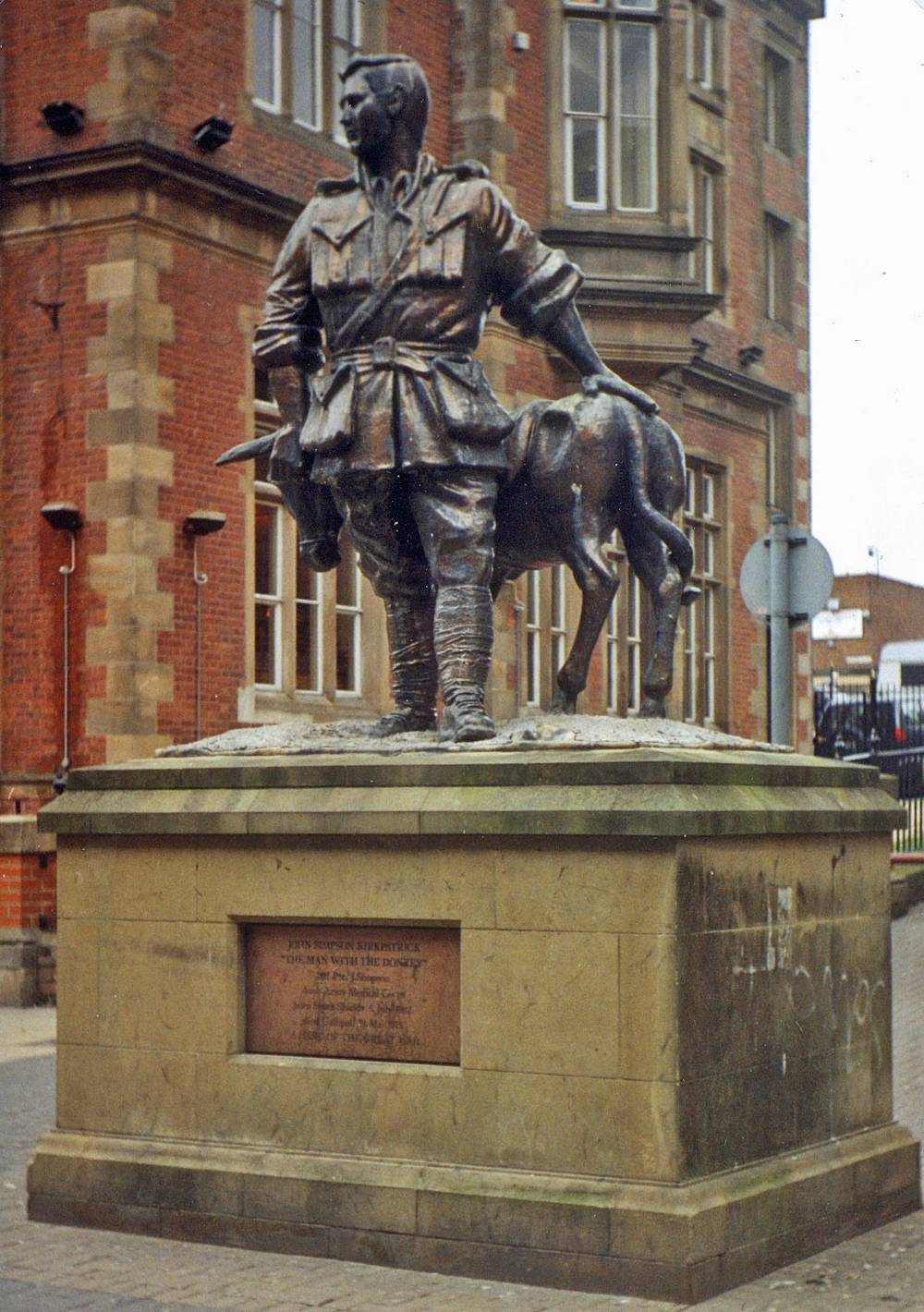
Notes: 1. There is also a bronze statuette inside the South Shields Museum.
2. The donkey, called Murphy, was awarded the Purple Cross for Animal Bravery in Australia in 1997.
3. There was a move to try and have a posthumous Victoria Cross awarded to Kirkpatrick. However it was denied.
4. There is a statue of John Kirkpatrick in Victoria, Australia. Carved out of a tree by John Brady, it stands at Lakes Entrance.
5. A musical based on Private Kirkpatrick was shown in Australia from April 2011, entitled “Three Weeks in Spring: the Gallipoli Story”, written by Ian Gerrard.
6. A play entitled “The Man and the Donkey” written by Valerie Laws, was given a premiere in the Customs House in South Shields in February 2011. It was staged again in May 2015 in the Custom House, South Shields, to mark the centenary.
7. Some items of memorabilia were handed to South Shields Museum & Art Gallery by Keith Smiles and Quinns Rock Returned and Services League, based in Perth, Australia. The items include a $5 Australian coin, a series of celebratory stamps, and Kirkpatrick’s official Army records.
8. He resided at 14 Bertram Street in South Shields.
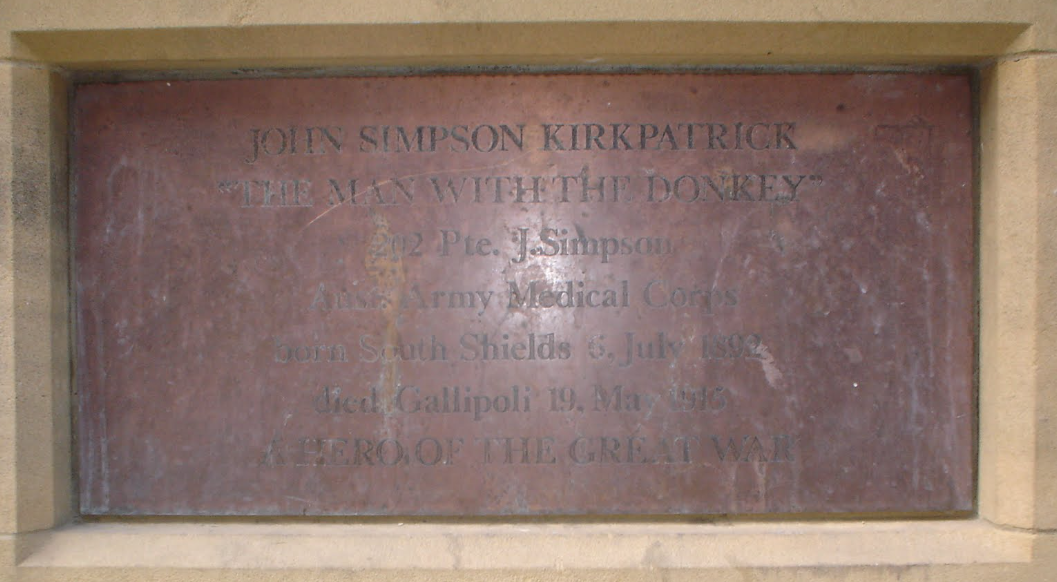
9. He was born on the 6th July 1892, son of a Scots merchant seaman Robert Kirkpatrick, who had settled in Durham, bringing with him his Scots wife, Sarah. Simpson’s father suffered a crippling injury in 1904 which resulted in his death in 1909. The impression has been given that he grew up in a harsh and deprived childhood. In the 1901 the Census shows the family employing a live-in servant, 15 years old Ellie Crozier. His father was a merchant captain in the coastal trade and would have been reasonably well paid. A happy and loving family in which, while there was never much extra cash, there was always enough for the food and rent, Simpson had 2 elder siblings as well who contributed financially.
10. There was a service of remembrance at the memorial on May 19th, the centenary of the death of Kirkpatrick.
11. In 2013 various items were handed to the South Shields Museum and Art Gallery.
12. Private Victor Laidlaw, with the 2nd Field Ambulance, wrote in his diary of Simpson’s death: “Another fatality I found out today – was a private in the 1st Field Ambulance, he had been working between the base and the firing line bringing down wounded on a donkey, he had done invaluable service to our cause. One day he was bringing down a man from the trenches and coming down an incline he was shot right through the heart, it is regretted on all sides as this chap was noticed by all, and everybody got to know him, one couldn’t miss him as he used to always work with his donkey, cheerful and willing, this man goes to his death as a soldier.”