
Memorial
Book of Remembrance 1914-18 Royal Grammar School
Jesmond
Memorial Name: Book of Remembrance 1914-18 Royal Grammar School (J1.19)
NEWMP Ref No.: J1.19
Parish: Jesmond
Royal Grammar School. Eskdale Terrace, Jesmond, Newcastle upon Tyne NE2 4DX.
1914-18
Published May 1923 at the price of 2 shillings.
Paper
Royal Grammar School
Present Condition: Good
Printed by the Northumberland Press Ltd., Thornton St., Newcastle upon Tyne.
Ownership and Maintenance: Royal Grammar School
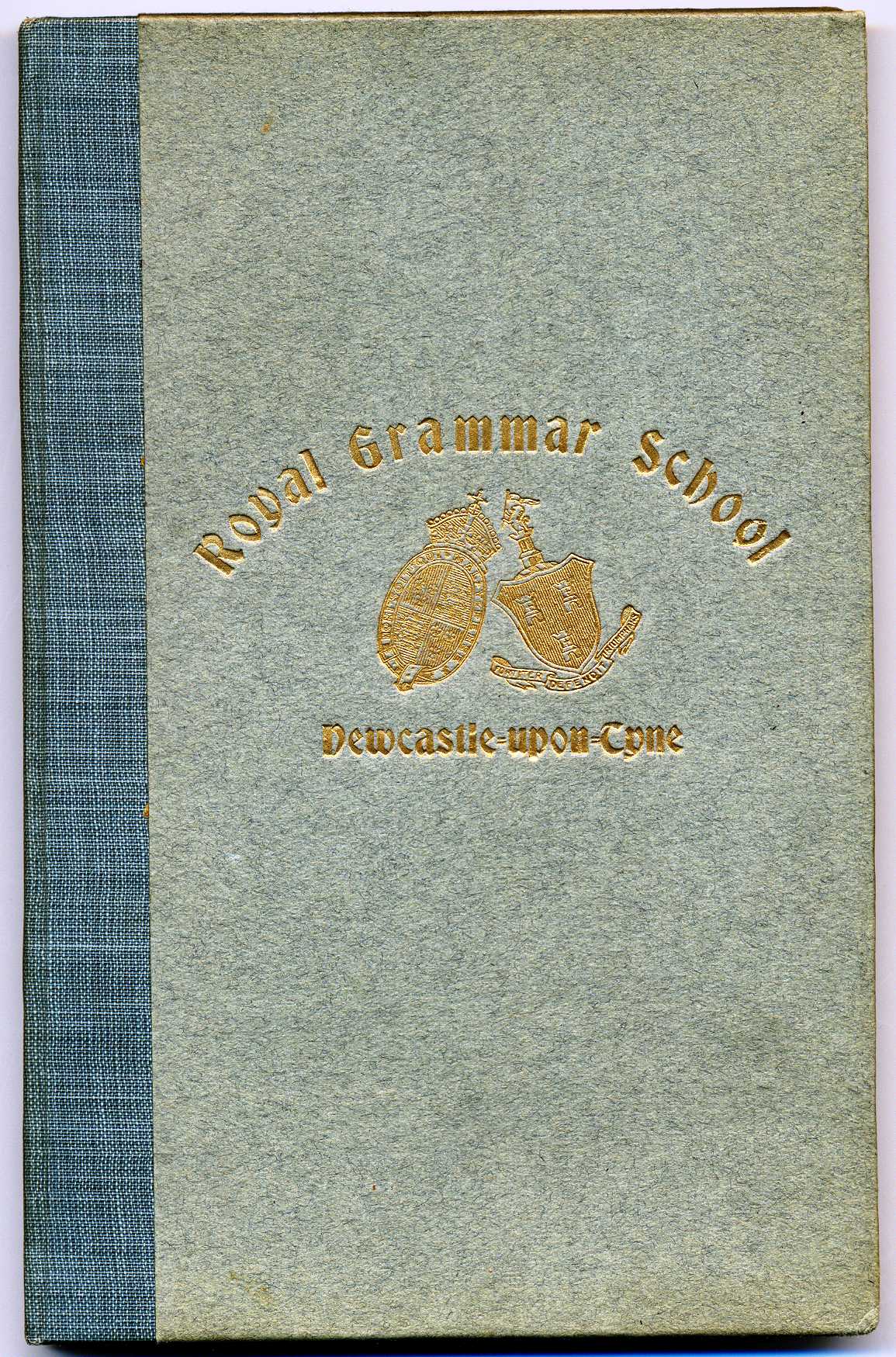
Outer front cover:
Royal Grammar School
Newcastle upon Tyne
Flyleaf
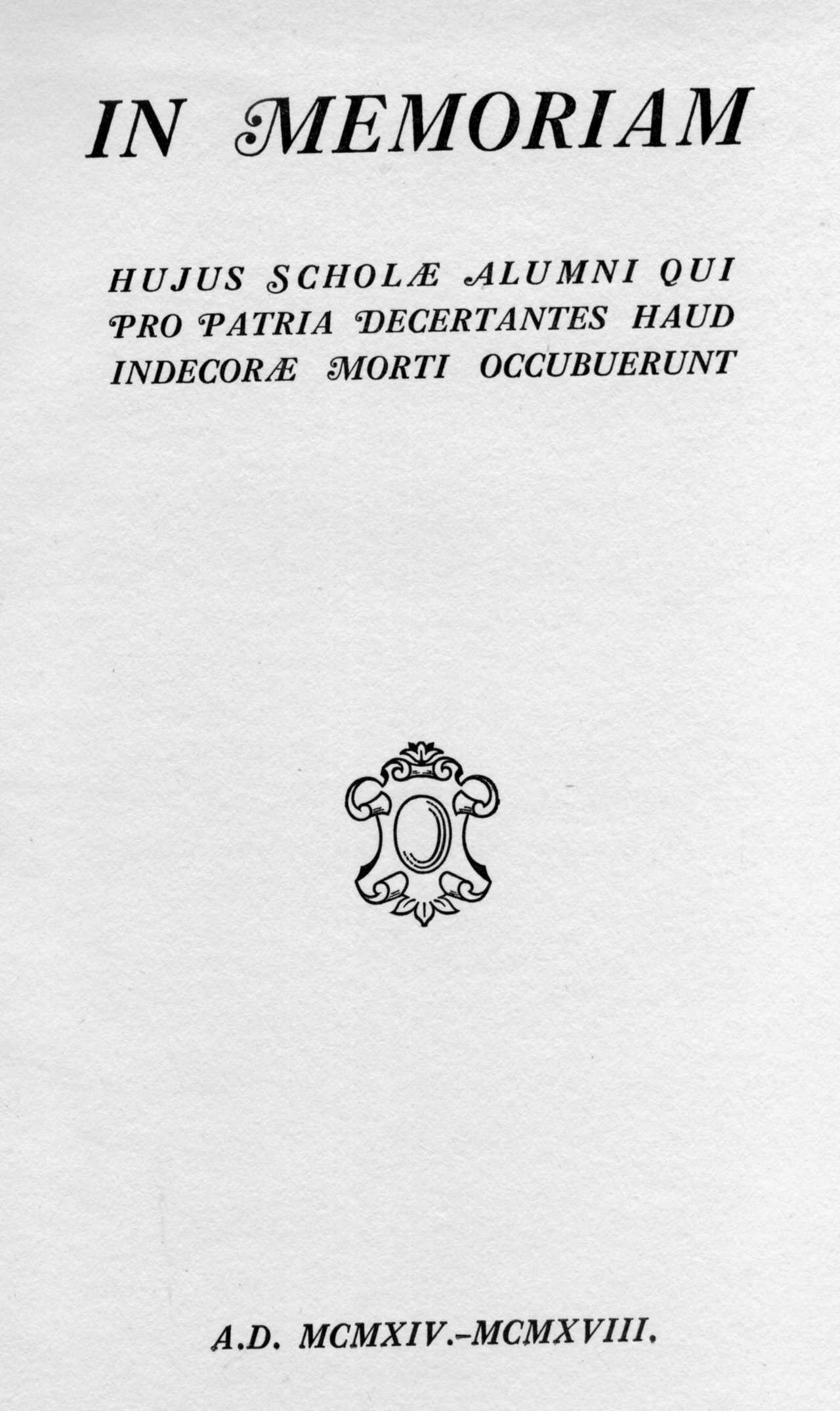
In Memoriam
Hujus scholae alumni qui
pro patria decertantes haud
indecorae morti occubuerunt
A.D. MCMXIV – MCMXVIII
Second page
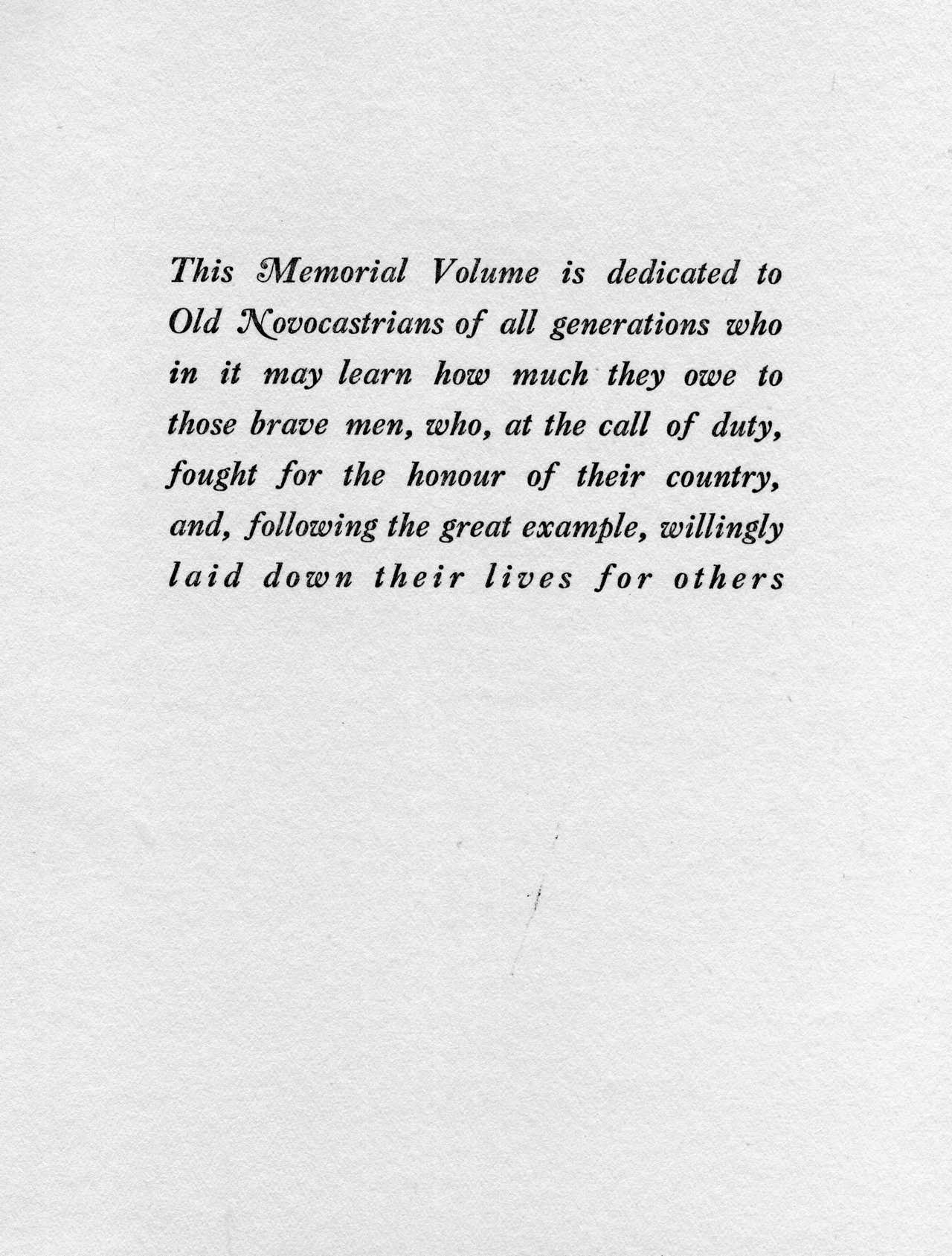
This Memorial Volume is dedicated to
Old Novocastrians of all generations who
in it may learn how much they owe to
those brave men, who, at the call of duty,
fought for the honour of their country,
and, following the great example, willingly
laid down their lives for others
Book, A5 size, hardback cover, with the front cover having the name of the school and the school badge impressed in gold. 60 pages long.
The dedication is on the flyleaf.
The book contains biographical notes on the men who died in the Great War, with an appendix at the back naming those who died after the war from as a result of the war.
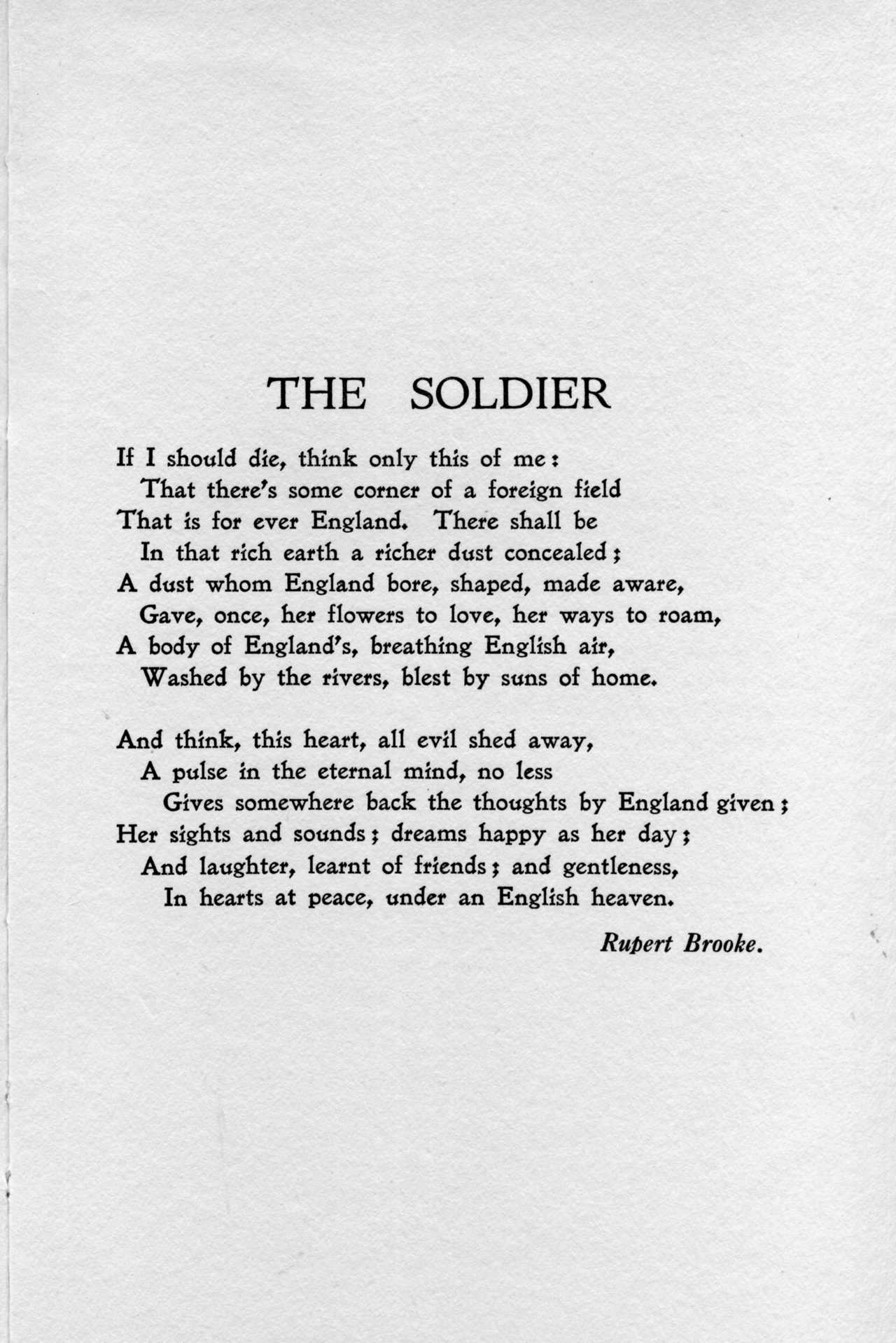
At the front is printed the poem “The Soldier” by Rupert Brooke.
156 of those killed in the war,
6 names of those who died afterwards,
plus a member of staff.
See Transcript
1. A copy of the book was presented to the relatives of those killed. Copies could be obtained from the Headmaster, post free.
2. There are some errors in the Obits, page 52, A.E. Tanner was not wounded on June 1917, but was mortally wounded on the 7th July.
History of the Grammar School.
Illustrated Chronicle
28/05/1923 reports publication
Newcastle Weekly Chronicle
02/06/1923 reports publication.
.
Additional Research Documents
J1.19 Photos of All Pages
Brian Main, RGS;
Muriel Sobo;
Tony Harding;
Dorothy Hall
If you are researching this memorial please contact 2014@newmp.org.uk
JESMOND Royal Grammar School
Front cover
ROYAL GRAMMAR SCHOOL
NEWCASTLE UPON TYNE
———————————————————-
Title-page
In Memoriam
Hujus scholae alumni qui
pro patria decertantes haud
indecorae morti occubuerunt
A.D. MCMXIV. – MCMXVIII.
———————————————————-
Half title-page
This Memorial Volume is dedicated to
Old Novocastrians of all generations who
in it may learn how much they owe to
those brave men, who, at the call of duty,
fought for the honour of their country,
and, following the great example, willingly
laid down their lives for others
———————————————————-
Page 7
THE SOLDIER
If I should die, think only this of me:
That there’s some corner of a foreign field
That is for ever England. There shall be
In that rich earth a richer dust concealed;
A dust whom England bore, shaped, made aware,
Gave, once, her flowers to love, her ways to roam,
A body of England’s, breathing English air,
Washed by the rivers, blest by suns of home.
And think, this heart, all evil shed away,
A pulse in the eternal mind, no less
Gives somewhere back the thoughts by England given;
Her sights and sounds; dreams happy in her day;
And laughter, learnt of friends; and gentleness,
In hearts at peace, under an English heaven.
Rupert Brooke.
———————————————————-
Page 9
AITCHISON, OSWALD (‘07)*, joined the forces soon after
the outbreak of war as a Private in the 16th Com-
mercial Batt. N.F. He was wounded in 1915, and
was again wounded in the attack on Thiepval on
July 1st, 1916. He died a week later and lies
buried in Doullens Cemetery.
ALLAN, ALEXANDER HUGH (‘93), joined the forces on
March 1st, 1915, in the A.S.C., went to Rouen
in November of the same year, and was there until
September, 1917, when he was transferred to the
Artists’ Rifles. He was killed in the battle for the
Passchendaele Ridge on October 30th 1917.
ALLEN, ROBERT (‘97), volunteered on the outbreak of
war for service in the Navy, and early in
November, 1914, received his commission as
Sub-Lieutenant, R.N.V.R., and was appointed
to the Tyne Patrol. He was later transferred to
the Nore Forces and there engaged in mine-laying
and patrol work. Early in 1918 he was lent to the
Dover Patrol and was engaged in the English
Channel and on the Belgian coast. During the
operations against Zeebrugge on St George’s Day,
1918, he was one of the four mine-layers of
Captain Collins’ unit which directed the Vindictive
and screened her while she was alongside the Mole.
After these operations he returned to the Nore
Patrol. Late in November, 1918, while on patrol he
contracted a severe chill which developed into
pneumonia, and on November 23rd, 1918, he
died in the R.N. Hospital, Chatham.
“Kindly, unaffected and straight in every act,
Robbie Allen won the love and respect of all who
knew him.”
———————————————————-
Page 10
ANDERSON, FRANCIS WILLIAM (‘95), served with the
forces through the South African War and the
campaign in East and West Africa. He died at
the Military Hospital, Durban, on April 26th, 1917.
ATKINSON, F.P. (‘06), enlisted as a Private in the
9th Batt. N.F. He has been officially reported as
Missing since the Somme Battle of July, 1916.
BAILES, FRANK G. (‘04), Lieutenant, D.L.I., died of
wounds after the fight at Ypres.
BARNES, HARRY SCOTT (‘06), received his commission as
Second-Lieutenant, 16th N.F. in September, 1914,
and served with the battalion until it left for France
in November of the following year, when he was
transferred to the training camp at Hornsea. In
January, 1917, he was sent to France to join the
1st Batt., and on Easter Monday of that year he
was killed in action at Arras, and was buried in
the cemetery there, aged 19 years.
BARTRAM, FRANK (‘08), enlisted in the Public Schools’
Battalion, Royal Fusiliers, and went to France with
them on July 23rd, 1916. Serving first as a
Bomber, he became later a Lewis-gunner, and was
wounded whilst attaching the German lines on
April 16th, 1917. He died of his wounds and was
buried at Fontaine-les-Croiselles.
BASTOW, NORMAN (‘09), had served his apprenticeship
at Wallsend Slipway. He obtained a commission
as Second-Lieutenant in the 3rd West Yorks and
went to France, where he was attached to the French
Mortar Battery. He went to the front in June, 1915,
being temporarily attached to the N.F. He was
killed in action, December 23rd, 1916. His Com-
manding Officer writes: “He was leading his
section, and, utterly regardless of his personal
safety, got out of the trench the better to supervise
operations, when he was shot through the heart and
died immediately.”
———————————————————-
Page 11
BELL, WILLIAM MARCUS (‘09), enlisted in the Sherwood
Foresters, April 15th, 1917, and after two serious
illnesses left Dover for France on August 23rd, 1918.
He was wounded and gassed at the battle of
Cambrai on October 25th, 1918, and died on the
following day in the General Hospital at Etaples,
aged 19 years.
BLENKINSOP, WILLIAM M. (‘05), joined the Durham
University O.T.C. in October, 1914, and was
gazetted Second-Lieutenant in the 12th D.L.I.
before the end of the year. In January of the
following year he was serving with his regiment as
Transport Officer at Aldershot. Promoted
Lieutenant he was sent to France, and after a
year’s service there, proceeded to Italy. He was
twice mentioned in despatches. On October 29th,
1918, he was severely wounded in the head and died
ten days afterwards. He lies buried at Carita, near
Treviso, in Italy.
BOOKLESS, ALEXANDER FREDERICK (‘10), joined as a
Private in the 7th N.F. in August, 1917, went
overseas in April, 1918, and was taken prisoner
near Rheims a few weeks later. He died of
dysentery in the Trelon Hospital on September
10th, 1918, aged 19 years.
BROWN, GEORGE RUSSELL (‘09), enlisted in September,
1914, received his commission in the N.F. a month
later, and in November, 1915, was ordered to join
a battalion of his regiment at the Dardanelles.
After serving for some time on the Suez Canal,
he was in France in 1916 with a Trench Mortar
Battery, and during the attack at Mouquet Farm
was wounded and invalided home. In the follow-
ing year he was again in France and served
with his regiment in the fighting at Passchen-
daele Ridge and Cambrai. He attended a Lewis-
gun course at the base, and returning to his
regiment served with it near Arras until February
———————————————————-
Page 12
11th, 1918, when he was killed while in com-
mand of his company. He was in charge of a
working party engaged by day at a spot under
distant observation of the military lines. They
had to take cover from shell fire several times
during the afternoon, and, according to the account
of one of the men, Lieutenant Brown, having given
orders to cease work for the day, ordered the men
under cover, and waited to see them in their places
before taking cover himself. He was hit by a
bursting shell and was killed instantaneously.
“He was a jolly good pal,” an officer writes, “one
of the very best, with ever a cheery word and a
smile when the “dumps” were prevalent.” His
soldier servant relates that among the men he was
best known as “Old Cucumber,” on account of
his coolness when under fire.
BULLEN, HARRY STANLEY T. (‘06), received his commis-
sion in the Northumberland Howitzer Brigade,
R.F.A., in September, 1915, and went to France
a few months later. He was promoted Lieutenant
in March, 1917, and was killed at the battle of
Arras, April 14th, 1917, aged 20 years, and is
buried in Beaurains Cemetery, near Arras.
BURKE, WILLIAM H. (‘08), joined the 6th N.F. on
June 26th, 1916. He was soon in France and wrote
On October 6th, 1916, from the base that he was
ready to leave for the trenches at any moment.
He died on December 7th, 1916, from wounds
received November 15th, in the battle of the
Somme. “He was a brave and plucky lad,”
writes the Q.M.S., “and even when he was hit
displayed the greatest courage. After being
attended to by the Medical Officer he walked
to the advance clearing station; in fact he came
back to the Sergeant-Major’s dug-out and squared
everything up, even to putting into good order
some effects of other poor lads who had paid
the full penalty.” Private Burke showed much
———————————————————-
Page 13
promise as a scholar, and had been reading for
Classical Honours at Armstrong College. He
had qualified by examination for the B.A. degree,
taking the prize for French. Of a modest and
retiring disposition he had exercised much influence
for good and had won the respect of both dons and
undergraduates.
BURN, JOHN CULBERTSON (‘09), enlisted in the
2/1st Northumberland Hussars when 18 years of
age, and proceeded to France in March, 1917.
He was gassed at Ypres on July 13th, and on his
recovery was posted to the 9th N.F., with which
battalion he served until a few days after the
evacuation of Armentieres, when on April 18th,
1918, he was wounded and invalided home. He
was again drafted to France about the end of July
when he joined the 12/13th N.F., and was killed
in action on August 22nd, 1918, on Beaucourt
Ridge.
BURTON, REGINALD COOKSEY, B.Sc. (‘05), gained a
Science Research Scholarship while at Armstrong
College, and was later appointed Deputy Super-
intendent of the Indian Geological Survey. Eight
months after the outbreak of war he was permitted
to join the Indian Army, and proceeded to
Mesopotamia. On April 7th, 1916, a month after
he had obtained his Second-Lieutenancy, he was
shot in the head by a Sniper, and died after remain-
ing unconscious for two days. His brother officers
and also the Chief of Survey in India bore
testimony of his brilliance and foresight in
whatever he did.
BUY, KENRIC E.G. (‘04), joined the Northumberland
Hussars and went to France in 1917. He obtained
A commission as Second-Lieutenant in the
4th Batt. Border Regiment. He fell “while
gallantly leading his men into action,” and died
on the field near Bellenglise, on the Hindenburg
line, October 1st, 1918.
———————————————————-
Page 14
CAMPBELL, IAN STUART (‘06), joined the 16th (Com-
mercial) Batt. N.F. on its formation in August,
1914, and was commissioned as Second-Lieutenant
in the 23rd Batt. N.F. (Tyneside Scottish) in the
following October. He went to the front with his
regiment in the early part of 1916, and was killed
on Thursday, June 29th, during a night raid,
planned anticipatory to the big attack of July 1st,
1916. He was seen lying in “No Man’s Land,”
but next day he was missing, and nothing has
been heard of him except an unconfirmed report
that he had been buried near Albert.
CHAPMAN, JOHN CLIFFORD (‘06), was an aviation pupil
and was killed while on a trial flight for his certify-
cate as Pilot. On May 10th, 1916, he was flying on
a Hall-Cauldron at Hendon when his machine
touched the wing-tips of a biplane which was under-
going a test by Mr Courtenay, the newly appointed
instructor. The two machines fell from a height
of about two hundred and fifty feet and Chapman
was killed.
CHAPMAN, WILLIAM A. (‘91), joined up in September,
1914, and went to France with the 5th Batt. N.F.
in April of the following year, when that battalion
went straight into action at Ypres. He was
invalided home towards the end of the year, but
returned to France two months later. He was
killed during the fight on the Somme on September
15th, 1916.
CHAPPY, ATHOL I. (‘11), Royal Military College, Sand-
hurst, was commissioned Second-Lieutenant May,
1917, in the Essex Regiment, and served in Egypt
(February, 1918). He returned to France in June of
that year, and was killed on September 24th, 1918,
while his regiment was attacking a strong and
intricate point which was eventually captured.
CHRISTOPHER, RICHARD (‘07), enlisted in the 27th N.F.,
and was gazetted Second-Lieutenant in November,
———————————————————-
Page 15
1916, in the Machine Gun Corps (Heavy Section)
for service in the Tanks. Later he was promoted
to lieutenant and attached to the 16th Batt. Tank
Corps, and served in France on the Cambrai, on
the St Quentin front, and on the Hindenburg line.
He was killed in action on September
29th, 1918.
COULL, JAMES C. (‘98), Second-Lieutenant in the
3/1st Northumberland R.F.A., was promoted
Lieutenant July, 1917, and later posted to the
R.F.A. signalling training centre. He died of
pneumonia on February 13th, 1919, at the Gosforth
War Hospital.
CURRY, Percy J. (‘00) was a Lance-Corporal in the
16th Batt. N.F. He was reported missing on
July 1st, 1916, and the authorities have sent the
information that he was killed in action on that
day.
CURTICE, FREDERICK RUSSELL (‘05), joined the R.F.A.
soon after the outbreak of war and served eighteen
months in France. He held the rank of Lieutenant
in 1916, and died on November 17th of that year
of wounds received three weeks previously just
before the last advance on Beaumont Hamel. A
brother officer stated that he left the gun position in
order to go to the observation post where he was
to register the battery’s guns for the bombardment.
The road was a very dangerous one and stretched
across a mile and a half of country so thick with
mud that one had to keep above the trenches and
not in them as they were simply running rivers of
clay and water. For at least two hundred and
fifty yards he was under direct observation from the
German side, and it was while crossing this most
dangerous part of the road that he received the
shell wounds that unfortunately proved fatal.
DAVIDSON, ROBERT CHRISTOPHER (’04), went to
France in 1915 as a Sapper in the R.E. From May, 1916,
———————————————————-
Page 16
he was attached to the 35th Division R.E., and was
engaged in the Somme battle of 1916, the German
retreat, 1917 and the Ypres to Renaix offensive,
1918. He died in France on March 14th, 1919.
DAVISON, CHARLES MONTAGUE(‘09), finished a credit-
able career at school as a prefect and Company
Sergeant-Major in the O.T.C. He early answered
the call to military service, and obtained a com-
mission in the 4th Batt. N.F. in March, 1917. In
the Army he was eminently successful, and at the
front was loved and trusted by his men as he had
been by the boys at school. By his kindly nature,
his sympathy with and his interest in others, his
courage and consistency, he won on the battlefield
the reputation as an officer of sterling qualities and
a gentleman.
He went to the front in May, 1917, and died on
April 10th, 1918, of wounds received that day in
action. The chaplain of his battalion writes: “He
was one of the most loved of our officers, partly
for his boyishness, partly for his delightful person-
ality and manners – some of us called him the
“Prince” – but chiefly for his fine soldierly
qualities. Few officers were more courageous in
the line.”
DAWSON, WILLIAM ATKINSON (‘06), was training with
the 6th Batt. N.F. in September, 1914, and went
to France with the 50th Division in April of the
following year. He was wounded at the battle of
St Julien, and during the second advance on the
Somme he was killed at High Wood, September
15th, 1916. “I see him now,” said a friend, “as
he was then, calmly binding up the wounds of the
injured (he was a stretcher-bearer), and unselfishly
helping them under that awful death-hail. He
always did his work well and was indeed a brave
man.”
DITCHBURN, W. (‘05), Private, 6th N.F., reported
missing, presumed killed in action, April 27th, 1915.
———————————————————-
Page 17
DIXON, Charles John (‘08), on leaving school com-
menced the study of music in which he attained
some success. On returning to Newcastle he
obtained a commission as Second-Lieutenant in
the D.L.I. on May 8th, 1917. He went to France
in the following June, and a fortnight later, on
June 22nd, was killed by a bomb while in the
trenches with a working party.
DIXON, GEORGE (‘92), was manager of collieries in
Nottingham, but enlisted immediately after the
outbreak of war in the Coldstream Guards, and was
in France early in 1915. His abilities were soon
recognised, for in the April following, he held
a commission as Second-Lieutenant, R.E., in the
Second Division, 1st Army Corps. He was killed
in action at Cuinchy, August 6th, 1915, and was
buried in the Military Cemetery at Cambrai. “No
matter how hard the work to be done,” says one
who knew him, “he always went straight on with
it – thoroughness characterised all his work.” “He
was greatly beloved, a gallant gentleman who
humbly and nobly did his duty.” “He was one
of the most unselfish men I have known,” said
another, “and he was always ready to help others
and do them a good turn.”
DIXON, JOHN G. (‘10), served at first as a Private in the
6th Batt. N.F., and on the completion of his train-
ing was sent to Lichfield Cadet School. He
obtained his commission in the 3rd Batt. N.F., but
was afterwards attached to the 13th Batt. He
was killed while leading his company in an attack
on Fontaine-les-Croiselles on June 16th, 1917. “It
was his first time of leading and his behaviour was
that of an old soldier.”
DOBSON, SYDNEY (‘05), joined the forces as a Private
and was soon promoted Sergeant Instructor in the
M.G.C. He was drafted to France in July, 1917,
and was reported missing on March 21st, 1918.
———————————————————-
Page 18
For some time it was thought that he was a
prisoner of war in Germany, but in November his
parents received word that he had been killed. He
had been captured along with others, and as they
were being marched away a German machine-gun
opened fire and Sydney was mortally wounded.
DODDS, JOHN H. (‘94), enlisted as a Private in the
23rd N.F., and was killed in action on July 1st, 1916,
at the battle of the Somme.
DOUGLAS, LESLIE HALL (‘95), after leaving school
became an assistant surveyor of shipping, and was
one of the first to volunteer his services when
hostilities commenced, enlisting as a private in
the 2nd Field Co., Northumberland Div., R.E. In
September, 1914, he held the rank of Second-
Lieutenant, and went to France in April, 1915. He
was later promoted Lieutenant, but on July 9th,
1915, he was killed in action near Dranoutrè,
Belgium.
DOUGLAS, ROBERT (‘04), joined the 15th Batt. N.F. in
1915. He was twice wounded at the battle of the
Somme. Later he served with the British troops
at the crossing of the Piave river. On the night
of October 26th, 1918, the N.F. were engaged in
action, and during the advance on the following
morning Corporal Douglas was one of the first to
fall – shot through the heart.
DOUTHWAITE, ERNEST E. (‘92), joined the forces
in Canada where he had been living for several years,
and was attached to the 27th Canadian Batt. of
Infantry. He was killed in action on April 10th,
1917. An officer writes: “We captured a trench
on Vimy Ridge quite close to Farbus, a small
village in Farbus Wood. The trench was our
objective on the 9th, and we held it until the 11th
when we were relieved. The trench was furiously
shelled for five hours, and the enemy had the exact
range; consequently we lost a lot of men. Douth-
———————————————————-
Page 19
waite was killed during those five hours. Before
he was killed the boys saw him do a very fine piece
of work with a rifle grenade. He put out of action
a German machine-gun which had been very
troublesome, and so saved many of our men’s lives.”
DOWNIE, PHILIP (‘03), served as a Private in the
16th N.F. He was officially reported missing on
July 1st, 1916, and in June 1917, he was reported
as having been killed on that day in the Somme
Battle. He lies buried at Lonsdale Cemetery,
north-east of Albert.
DRYDEN, NORMAN McLeod (‘95), obtained his commis-
sion as Second-Lieutenant in the old 3rd (Vol.
Batt.) N.F. On the outbreak of war this battalion
became part of the 6th Batt. N.F., and he was then
Captain of “A” Company. The 1/6th Batt. N.F.
will always be remembered for its glorious work
when first in action in April, 1915. On the 24th
of that month they were moved up to the Ypres
salient to hold what had become at that time a
serious situation. On the morning of the 25th,
the 6th and other N.F.’s, together with the D.L.I.
and Yorkshire Regiments, went into action at
St Julien. Captain Dryden was severely wounded
in this engagement. Later in 1915 he was appointed
to the signalling section of the Farnley Park
Bombing and Signalling School at Otley. He died
of meningitis, contracted at Otley, on November
23rd, 1915, while on a visit to his brother at Selby,
and was buried there with full military honours.
DUNFORD, ROY CRAIG (‘96), became a chartered
accountant on leaving school and later acted as
secretary to various companies. Being an old
volunteer he obtained a commission in the N.F.
at the outbreak of war. He went to France in
May, 1915, was wounded slightly, but returned in
the January following. In September, 1916, he
was engaged near High Wood, and on the 15th
got his company out of an awkward predicament,
———————————————————-
Page 20
showing wonderful courage and resource. For
this he was awarded the D.S.O. -”For three days
prior to an attack he directed the digging of assault
trenches under heavy shell fire. During the attack
his personal direction of his company resulted in
heavy losses to the enemy and the capture of a
hundred and fifty prisoners. Finally he was shot
through the body whilst organising his defences.”
On November 10th, 1916, he succumbed to these
wounds in the spine.
DUNN, ARTHUR GIBSON, M.D., B.S. (‘95) had had a
most promising career at the Medical College,
Newcastle, and having qualified as M.R.C.S. and
L.R.C.P. he became resident Medical Officer at
the Newcastle Dispensary. After being for some
time at the Northumberland War Hospital, he
joined the R.A.M.C. in 1917 and was attached, as
Lieutenant, to the 129th Field Ambulance. He
was killed on September 5th, 1917, at Alonette
Farm, near Langemarck, by a shell bursting near
the dug-out door. Only one hour before his almost
instantaneous death he had taken the post of a
Medical Officer wounded in action.
DUNN, FREDERICK O. (‘98), joined the forces immedi-
ately after war was declared, and was commissioned
in the 4th Batt. Tyneside Scottish (23rd N.F.)
Early in March, 1916, he attained his First-Lieuten-
ancy and was appointed Brigade Bombing Officer.
On March 19th, 1916, while engaged on a new test
with a trench catapult and a percussion bomb, the
latter exploded prematurely and killed him instan-
taneously. He lies buried at Erquinghen, France.
DYSON, NORMAN R. (‘97), served as a Gunner in the
West Lancashire Regiment R.F.A. early in 1916,
and went to France in February, 1917. Later he
was attached to the 315th Brigade R.F.A. and saw
much active service in many parts of the western
front. He was offered a commission but preferred
to remain as a Private. His influence for good
———————————————————-
Page 21
was much appreciated by the men of his regiment,
and his officers had the very highest regard for
him. He was killed in the Cambrai sector on
September 20th,1918.
FARTHING, ALFRED (‘09), joined the 31st Batt. N.F. in
November, 1915, and proceeded to France on
July 3rd, 1916, where he was transferred to the
1/4th Batt. K.O.Y.L.I. (Signalling Section). He
took part in the first battle of the Somme, and
during the fight at Nieuport on July 22nd, 1917,
he was gassed, and died two days later while being
conveyed to hospital. He lies buried in Le Treport
Military Cemetery, France.
FLETCHER, JAMES NEVILLE (‘98), enlisted in the 6th Batt.
N.F. in September, 1914, and went to France as
Corporal in April of the following year. He was
wounded in the head a St Julien, and died at
Chatham on May 28th, 1915.
FOGGIN, GEORGE W.D. (‘10), trained for an infantry
commission and later transferred to the R.A.F.
He was gazetted Second-Lieutenant in September,
1917, and attached to the 48th Squadron. Killed
in action in France, July 14th, 1918, aged 19 years.
FOTHERBY, REGINALD S. (‘07), Driver, 2nd Field Com-
pany R.E. (Northumberland Division). After
eighteen months’ service in France he was wounded
in September, 1916, at the battle of the Somme. He
was sent to Mesopotamia in April, 1917, and died
of dysentery at Basra on March 16th, 1918, aged
25 years.
FOX, CEDRIC EARLE (‘05), Flight Sub-Lieutenant, R.N.
Born December 27th, 1894. Drowned January 7th,
1918. Cedric Fox was a law student and had passed
his intermediate examination when he joined the
University and Public Schools’ Batt. – 21st Royal
Fusiliers in September, 1914. He went to France
in 1915, and was recommended for a commission in
April, 1916. After having trained at Trinity
———————————————————-
Page 22
College, Cambridge, he was gazetted to the N.F.,
but transferred to the R.N.A.S. which he had long
been keen to join.
He took a first class certificate as pilot and was
attached to H.M.S. Manxman – a sea-plane carrier.
Later he was loaned to the 6th Wing, stationed
at Taranto, Italy.
On January 7th, 1918, an enemy submarine was
sighted and Sub-Lieutenant Fox took out a machine
with an observer in pursuit. He left the station
about 2 p.m., and a wireless message was received
from them about an hour later. They must have
had mechanical trouble about 3.45 p.m. when they
had to make a forced landing which they did in
spite of a heavy sea. A pigeon was liberated with
this message: “Down on surface seven miles
S.S.W. Saseno.” Unfortunately, owing to the
storm or darkness the pigeon did not land at the
station, forty miles away, until the next morning.
When the boats reached the spot they found
nothing but wreckage, which, however, was
identified.
FUTERS, NORMAN RATCLIFFE (‘10), on the outbreak of
war was a first year’s engineering student at Arm-
strong College. He joined the Durham University
O.T.C., and was commissioned on November 26th,
1915, to the 3rd Batt. N.F. (Reserve of Officers).
In July, 1916, he was in France attached to the
16th Batt. N.F. He was wounded during the
attack on Nieuport in July 1917, and for some time
was in the Military Hospital at Glasgow. Recover-
ing he returned to France in the following
November, and was posted to the 20th Batt. N.F.
and promoted Acting Captain. The break up of
the battalion, however, saw him reduced to the
rank of Lieutenant once more with the 18th Pioneer
Batt. Later he served with the 1st Batt. N.F.
where he commanded “W” Company, being
gazetted Acting Captain on September 17th, 1918.
He was killed whilst leading his company in the
———————————————————-
Page 23
advance on Ribecourt on September 27th, 1918. A
fellow-officer writes: “He was commanding “W”
Company at the time, and his company contributed
very materially to the magnificent success
which the battalion achieved on that day.”
GANDY, CLEMENT JOSEPH, M.C. (‘00), received a com-
mission in the Special Reserve of Officers on
October 1st, 1914, and later joined the Royal
Engineers. After special preparation at Chatham
he was sent to France. In December, 1916, he was
awarded the Military Cross for work thus described
in the London Gazette – “He led his section and
working party by compass bearing all night through
heavy fire to the newly captured line. He and his
party worked hard throughout the night consolidate-
ing the trenches won.” He was killed on July 31st,
1917, by a shell, while reconnoitring in the Steen-
beck Valley, near St Julien.
GIBB, JOHN HARDIE (‘08), joined an O.C.B. in 1916,
received his commission in the King’s Royal Rifles
and went to the front in May, 1917. He took part
in the battle for Messines Ridge, and was killed on
July 31st, 1917, when leading his men in an attack
on the village of Hollebeke. Aged 19 years.
GIBSON, GEORGE H. (‘05), went to sea as an engineer
and was off Constantinople when war broke out.
After reaching home he took the first opportunity
of entering the Naval Service (December, 1914) as
an Engineer Sub-Lieutenant, R.N.R. on H.M.S.
Vicknor, an auxiliary cruiser, which, it is feared,
was lost on January 25th, 1915, in the Irish Sea.
GIBSON, JOHN (‘97), on leaving school took up motor
racing. In 1912 he had a serious accident while
racing in the Isle of Man. At the outbreak of war,
however, he enlisted in the 2/7th Devon Cyclist
Corps as a despatch rider, and served with that
regiment for over eight months, being present at
the Hartlepool bombardment. He as then
gazetted Second-Lieutenant in the same regiment,
———————————————————-
Page 24
serving as Transport Officer. He was next trans-
ferred to the R.A.F., and early in 1916 was sent
to France where he was accidentally killed on
June 19th, 1916. He was commencing a flight and
on leaving the ground his machine collided
with a hay-mower. The aeroplane was completely
smashed, the observer sustained only a few bruises,
but Lieutenant Gibson was so injured that he died
almost immediately.
GILCHRIST, FRANK (‘90), Private in the Canadian
Infantry, killed in action.
GRAY, J. MARSHALL (‘01), enlisted as a Private on
September 3rd, 1914, in the 16th Batt. N.F. He
proceeded with his battalion to France in November,
1915, and was killed by a bomb on March 21st,
1916, while his battalion was holding the line in
front of Albert.
GREEN, CHARLES ARTHUR, M.C. (‘06), only son of the
late Arthur Green, M.B., B.S., of Gateshead, was
born on April 28th, 1897. He became a member of
the school O.T.C. on its inception, and a few years
later obtained a scholarship to Bromsgrove School,
Worcestershire. When war broke out he was a
classical scholar of Worcester College, Oxford.
He joined the Royal Horse Guards, O.T.C., in
February, 1916, and was gazetted Second-Lieutenant
Special Reserve of Officers on August 11th, and
attached to the R.G.A. after two months’ training
at Shoeburyness.
He was in France in January, 1917, attached to
the Lowland Heavy Battery as forward Observation
Officer, and during the battle of Arras in April
and May gained great distinction and was awarded
the Military Cross. The London Gazette for
June 26th, 1917, says: “Charles Arthur Green,
Second-Lieutenant Royal Garrison Artillery, Special
Reserve: For conspicuous gallantry and devotion
to duty whilst forward Observation Officer with
Infantry during attack. Four times he came back
———————————————————-
Page 25
with valuable information through the heavy enemy
barrage and, at a critical moment when our attack
was strongly held, once more returned through
the barrage, and informed the Infantry Brigade
Commander that reinforcements were urgently
required, thus relieving a very serious situation.”
Seventeen days later (July 13th, 1917) he fell in
action at Arras. He and others belonging to his
battery were a little way from their guns when a
German shell burst close to them, killing him and
Two of his men, and seriously wounding several
others. His Colonel wrote: “He was our best
Observing Officer, and did excellent work in all the
operations near Arras in April and May, 1917.
He displayed great gallantry on several occasions
for which I am glad to see that the Military Cross
was awarded. Cheerful at all times and wiling to
undertake any work, he was much respected by both
men and officers and we all regret his loss. He has
been buried close to the spot where he was killed.”
GUTHRIE, HERBERT (‘97), joined up as a Private in the
R.M.L.I. on January 4th, 1917. He was killed at
Passchendaele, October 26th, 1917, aged 33 years.
HALL, CHARLES EDW. RUSSELL (‘09), when war broke
out was at the Bank of Montreal in British
Columbia. He immediately enlisted, then eighteen
years of age, in the Medical Corps of the 2nd
Canadian Mounted Rifles. He suffered from two
attacks of trench fever, and was subsequently trans-
ferred to the 3rd Batt. Field Ambulance for service
in France and Flanders. In his work of succouring
the wounded he sacrificed his life near Cambrai on
September 27th, 1917, aged 22 years.
HALL, GEORGE HANNAY (‘06), joined the London
Scottish in 1912. When war was declared he
volunteered for service and went to France with
the 1st Batt. in September, 1914. In September,
1915, he was wounded at Loos, and on recovery
was given a commission as Second-Lieutenant in
———————————————————-
Page 26
the 24th Middlesex Regiment. He joined, how-
ever, the Indian Army Reserve of Officers, and in
May, 1917, was ordered to India, being attached
to the 1/39th Garhwal Rifles. On the outbreak of
trouble on the North-West Frontier he was sent
there with the 4/39th Batt. Garhwal Rifles, and
remained there till ordered to proceed to England
for demobilisation. He unfortunately contracted
enteric and died on board the S.S. Manora in the
Red Sea on December 6th, 1919. His rank was
then that of Captain.
HALL, PERCY GEORGE (‘04), on leaving school joined
the Merchant Service, and was at sea when war
broke out. On his return he obtained his com-
mission in the Tyneside Scottish in 1915, and went
to France with them in January, 1916. In the
early part of June the Brigade was moved to the
front line trenches at La Boisselle in contemplation
of the Somme offensive. On June 28th, 1916, it
was found that German wire entanglements in front
of their lines had remained untouched by our
artillery fire owing to the formation of the ground.
Engineers were detailed to go out at midnight to
clear the ground of these obstacles, but previously
a raid on a large scale was conducted by Tyneside
Scottish troops which raised the German fire and
activity. Volunteers were called for, to act as a
covering party to the Engineers. Second-Lieutenant
Hall immediately offered and was accepted, and the
men of his platoon were eager to go with him. He
made his dispositions so well that the operation was
successfully accomplished, but while leading his
men Lieutenant Hall was shot by a Sniper and died
a few minutes later. His comrades, officers, and
men paid a high tribute to his skill, courage, and
care. As an instance of his fearlessness in leading,
his Company Commander subsequently reported
that, in the dispositions for the opening of the battle
on July 1st, the 4th Batt., being close to the German
lines, was ordered to lead the Brigade into action,
———————————————————-
Page 27
with Lieutenant Hall’s platoon (the 11th of “C”
Company) in the van, for his men would follow him
anywhere.
HALL, WILLIAM B. (‘06), joined the D.U.O.T.C. in the
early part of 1915 and was gazetted to the 3rd Batt.
Tyneside Scottish. He was transferred to the
Army Cyclists’ Corps for the 34th Division when
it was first formed, went to France in January,
1916, and was with this corps till it was disbanded
in March, 1918, when he was Captain and Lewis-
gun Instructor. He was severely wounded on
August 22nd when he was serving with the 24th
Batt. London Regiment, and died on August 25th,
1918.
HALL, WILLIAM GASTON DUVAL (‘06), enlisted in the 6th
Batt. N.F. a few days after war was declared and
served in France until March 23rd, 1918 – a very
disastrous day for the 6th Northumberlands. He
was engaged as a runner and after having taken
despatches, had returned and taken more. It is
officially presumed that he was killed on that day.
HAMER, ARTHUR DERRICK (‘04), on leaving school,
proceeded to Queen’s College, Cambridge, where
he was reading for the theological tripos with a view
to ordination and work in the foreign mission field,
when war broke out at the end of his first year.
He offered his services on the day war was declared
and soon afterwards received his commission in the
Northern Cyclists’ Battalion. He was gazetted
Captain in June,1917, and went with the
Manchester Regiment to France three months later.
His Commanding Officer writes: “He was killed
in an attack on the morning of November 6th, 1918,
near Maubeuge, leading his company with
unequalled bravery. He showed an absolute dis-
regard for his own safety, his one thought being to
lead his men and to gain his objective, and as a
soldier and a Christian he was an example to all
of us.”
HANSON, JOHN (‘05), was a Private in the 6th Batt. N.F.
———————————————————-
Page 28
in August,1914, and died of wounds received
during the attack on St Julien, in the second battle
of Ypres, April 28th, 1915. He was buried at
Bailleul in France.
HARKER, GEORGE ERNEST (‘03), became a mining
engineer after leaving school. He obtained a
commission in the R.F.A. in October, 1914, and
was promoted Lieutenant in February, 1916. He
went to the front in January, 1915, and was wounded
on February 16th, 1917, and again two months
later. On May 19th, 1917, he was killed in action,
aged 24 years.
HARKER, GEORGE ALFRED (‘88), joined the N.F.
on October 6th, 1916, and was transferred on November
16th following to the Yorkshire and Lancashire
Regiment. He went to France in January, 1917,
and was reported missing at Bullecourt on May
3rd, 1917, aged 44 years.
HARRISON, EDWARD (‘09), obtained a commission in the
R.E., afterwards being transferred to the R.A.F.
In May, 1918, his squadron, the 24th, was
stationed in the Somme district. Units scouted
daily, making bomb attacks on Chaulnes, at that
time about twelve miles within the enemy lines.
On the 17th, Lieutenant Harrison and eight others,
were attacked by enemy machines while returning
to their base. They rose to seventeen thousand feet
when Lieutenant Harrison was shot down, near
East Vermando Villas.
HARVEY, William (‘09), was commissioned as Second-
Lieutenant 3rd N.F. on October 12th, 1915. He
had been in France about four months and had
been engaged in some of the heaviest fighting on
the Somme front when he was severely wounded on
October 12th, 1916. Writing a few days later his
Commanding Officer says: “It is with great regret
that I have to write and tell you of the death of your
splendid boy. On the evening of the 12th inst. he
was one of four officers and a hundred men detailed
to make a raid on the enemy trenches. He went
———————————————————-
Page 29
off in most splendid spirits and it was due to his
fine example that the party did so well. He was
badly wounded just above the knee, and his
Sergeant who was also wounded, brought him out
into “No Man’s Land”, and then our Padre went
out and fetched him in. He was taken to the
hospital at Armentiers and next day sent to the
Australian hospital at “Trois Arbres,” Steenwerck.
I went over to see him on the 13th but was not able
to do so. I regret to say he died the same night.
I saw the poor lad laid to rest alongside many
another good fellow who had made the supreme
sacrifice for his country.”
HASLAM, ARTHUR DIXON (‘03), was Captain both of the
school cricket and football teams and on leaving
was awarded the Collingwood prize. When war
was declared he was holding a science scholarship
at Armstrong College. He was gazetted Second-
Lieutenant in the 8th Batt. N.F. on September
15th, 1914, and a week later was transferred to the
9th Batt. N.F. He gained his Lieutenancy June
1st, 1915, and went to France with the 9th N.F.
in July, 1915. He was wounded in February,
1916, while fighting in the International Trench at
“The Bluff.” After being in hospital at Boulogne
he was invalided home but returned overseas
in September, 1918. He was severely wounded in
October of that year and died on November 2nd,
1918, aged 26 years.
An Old Boy writes: “ ‘Kiddy’ – we shall
always remember him by that name. At its every
mention we recall the little interesting scenes of our
school-boy life. It was chiefly upon the playing
fields that we knew him and watched the develop-
ment of his manhood. There he was an example of
self-forgetfulness, and we never knew him to hesitate to
sacrifice, that we might gain. Not of strong
physique, he possessed something greater which
we call ‘pluck’. But the secret of the nature which
made us love ‘Kiddy,’ and which made him the
———————————————
Page 30
confidant of many a schoolboy secret, was his quiet
reserve. We can fully believe from our knowledge
of him that in a critical time he would serve for
duty and usefulness rather than ‘showiness.’ We
accept the mystery of his call to a Higher Service
in the knowledge that he would humbly make the
great sacrifice with the highest sense of duty.”
HAVELL, ERIC TUNBRIDGE (‘09), entered the service of
the London County Council in 1913, and soon after
the declaration of war, on October 9th, 1914, joined
the 10th Batt. Royal Sussex Regiment. Some
time was spent in training at home and it was not
until the end of August, 1915, that he was sent to
France. At the battle of Loos, on the 25th of the
following month, the 9th Royal Sussex was one of
the battalions in reserve, and in the early afternoon
was moved up into the trenches. In the evening
the battalion received orders to take part with the
rest of the Brigade to which it belonged in relieving
the troops who had taken “Fosse Eight” near the
Hohenzollern Redoubt. On the following morning
the Brigade was heavily bombarded by the
Germans, and just before midday Private Havel [sic]
was hit by a bursting shell. He was instantly
killed, September 26th, 1915, aged 22 years.
HAVELL, REGINALD BEAUMONT (‘08), after leaving school
went as a farm pupil in Cumberland and then to
Uckfield, intending subsequently to settle in
New Zealand. He joined the Middlesex Regiment
in June, 1916, and went to France in the November
following, just after his nineteenth birthday. He
returned home in April, 1917, suffering from blood
poisoning, but was back again at the front in
August. He was posted as a bomber in the 2nd
Middlesex Regiment. After being in the heavy
fighting at Passchendaele with the 8th Division he
spent four months in hospital in France. He
rejoined his regiment in May, 1918, and became a
Lewis-gunner. He fell mortally wounded in the
German attack near Rheims on May 28th, 1918.
———————————————————-
Page 31
HEDLEY, JOHN RALPH, D.S.O. (‘84), was born in Berk-
shire and came to the Grammar School on coming
to live in Gateshead. On leaving school he entered
the firm of Messrs Anderson & Lee, auctioneers,
and finally became a partner in the firm. About
1896 he obtained a Lieutenancy in the 3rd Batt.
N.F. (volunteers). He left Newcastle in 1910 to
take up an important government appointment at
Hull but still kept up his connection with his old
regiment. The outbreak of war found him a
Captain in the 6th Batt. N.F. He was soon made
Major and went with them to the front, and was
with them when they went so gallantly into action
at the second battle of Ypres in April, 1915. “In
that action outside St. Julien the territorials lost
their Commander, Brigadier General Riddell, and
the story of the battle is one which will always
redound to the credit of the fighting sons of
Northumbria.” After surviving the dangers of the
Ypres salient, Hooge and Vimy Ridge, he obtained
his Lieutenant-Colonelcy and was attached to the
5th (Cumberland) Batt. Border Regiment. He had
been four times mentioned in despatches, and in
June, 1916, he was awarded the D.S.O. He returned
to France with the Borderers and a year later, on
July 15th, 1917, laid down his life in the service of his
country. “To his friends he had qualities of kind-
ness, loyalty, straightforward speech and thought,
which secured him unalloyed regard, even when we
failed to acquiesce in all his views,” says his friend
the Right Honourable Walter Runciman. “He
loved the open air, whether on a cricket field or on
a golf course, on horseback, or with a gun. He
hated crooked methods and low standards and
everything unclean, and he has left with his friends
the memory of an upright, wholesome man.”
HENDERSON, FRANK (‘12), enlisted at the age of seven-
teen in the R.M.S.M. and trained at Aberdeen,
Cromarty Bay and the Tyne, and then transferred
to the R.M.L.I., training at Plymouth and Deal.
———————————————————-
Page 32
He applied for a commission in the Navy and while
waiting to know the result of his application he
volunteered for the naval raid on Zeebrugge. He
was killed during the raid, April 23rd, 1918, aged
19 years, and now lies in the family burial ground
at Wallsend.
HERBERT, CHARLES STANLEY, M.C. (‘10), was gazetted
Second-Lieutenant in the D.L.I. in January, 1915;
proceeded to France, October 1st, 1915, and was
transferred to the 15th Batt. D.L.I. He was men-
tioned in despatches July 1st, 1916, and won the
Military Cross on Passchendaele Ridge on October
5th, 1917, being promoted to Captain on the same
day. On October 9th, 1918, he obtained a Bar to
the Military Cross on Kemmel Hill. He was
killed in action on May 27th, 1918.
HOGG, ROBERT WALLACE (‘11), Northern Cyclists’
Batt., served in Lincolnshire until December,
1916. He then joined the M.G.C. (Heavy
Brigade) – afterwards the Tank Corps – and went
with it to France on July 22nd, 1917, being for
a few months on the Ypres section and then in
the Cambrai front where he was engaged in the big
attack in November of that year. He attained the
rank of Sergeant, and was engaged as a Gunner
in the heavy fighting near Bray-sur-Somme.
He was in action from March 21st, 1918, till the
afternoon of the 25th inst. when he was killed.
HOLDSWORTH, Ernest (‘12), served in a cadet unit of
the R.A.F. in October, 1916, and received his com-
mission as Second-Lieutenant in February, 1917,
gaining his wings three months later. He went
to France in July and was killed while engaged
in an air-fight in Flanders on September 23rd,
1917. He had been mentioned in despatches, and
his Commanding Officer wrote: “He was a very
efficient officer, and did excellent work whilst at the
front. Upright in character, noble-minded and
generous-hearted, pure and bold in purpose,
———————————————————-
Page 33
devoted to his duty, he was found faithful unto
death in his country’s cause.
HOLDSWORTH, WESLEY COPE (‘07), received his com-
mission as surgeon probationer when he had passed
his second examination as a medical student of
Glasgow University. He joined H.M.S. Begonia
on September 19th, 1917, and wrote on the 27th
of that month that he had returned to port, and that
all had gone well. On October 15th information
was sent from the Admiralty that the Begonia was
missing – feared lost with all on board. A sailor in a
sister-ship informed Lieutenant Holdsworth’s father
– the Rev. J. Forster Holdsworth – that they were in
search of the Begonia for several weeks, and all
they could learn was that she was “spoken” in
mid-Atlantic on October 6th. Six months later,
word was sent from the Admiralty that Lieutenant
Holdsworth was killed on or about October 6th,
1917.
HUGHES, JOHN, B.A., B.Sc. (‘01), joined the Northern
Cyclists’ Batt. in 1915, was drafted to France,
attached to the 25th Batt. N.F., and took part in
the actions near Albert. On the night of
September 8th, 1916, he was sent out with a cover-
ing party to a position near Contalmaison, on the
Somme. It was a brilliant moonlight night, but
they had to go forward. The Germans waited till
they got within range, and then let go a hail of
shell-fire for twenty minutes. The Lieutenant
signalled his men to retire, sending Lance-Corporal
Hughes and another to bring up stragglers.
Neither ever returned. The war office records:
“Lance-Corporal Hughes, presumed killed in action
September 8th, 1916.” An officer in his battalion
says: “He has proved himself an Englishman in
every sense of the word. He had the respect of
every one of us in “D” Company, officers and
men alike.” He was a teacher under the Newcastle
Authority, and had devoted much time to voluntary
work among the children.
———————————————————-
Page 34
HUNTER, ARNOLD COLTMAN (‘94), decided on leaving
school to take up work in Canada. After a period
on a farm he joined the Royal North-West Mounted
Police for three years. When the King’s pro-
clamation reached Canada he enlisted in the
152nd Batt. Canadian Infantry and was promoted
Sergeant. He reached France on the 16th February,
1917. His last entry in his diary states: “28th
March, 1917. Practising going over to-day and
left for trenches at 6 a.m.” He was killed next
day, March 29th, 1917, near Villers-au-Bois. His
Commanding Officer writes: “Although he had
been with the company but a little time” (he had
been transferred to the 46th Canadians), “I had
come to regard him very highly. No task was too
unpleasant, and everything he did was done cheer-
fully.”
HUNTER, ARTHUR LAWRENCE (‘03), volunteered as a
Private in August, 1914, in the 9th Batt. N.F., and
went to the Ypres front in July, 1915. After a
short training at home he was gazetted Second-
Lieutenant, February, 1918, in the 9th Batt. Royal
Fusiliers and again went overseas. He was killed
on August 8th, 1918, in the advance near
Morlancourt.
HUNTER, GEORGE EDWARD (‘96), became an architect
on leaving school. Later he joined his father’s
firm, and in 1913 became a partner in the business
of Hunter & Henderson, Stockbrokers of Newcastle.
He received his commission in the 6th Batt. N.F.
in 1904 and was gazetted Captain in 1908. He went
overseas with that battalion, and was killed in
action near St Julien in the second battle of Ypres,
April 26th, 1915. A brother officer writes: “He
led his men with great courage and a total dis-
regard for himself, and was right in front of the
enemy’s position when he was killed by a shell
fired at short range.”
HUNTER, HOWARD TOMLIN, M.B., B.S. (‘96), became a
———————————————————-
Page 35
medical student on leaving school. He qualified
for the M.B., B.S., in 1910, and afterwards studied
surgery at St Bartholomew’s, London, and in
Vienna. He received his commission in the
6th Batt. N.F. in 1906 and was gazetted Captain
in 1912. A writer in the Durham College of
Medicine Gazette says: “We have all heard with
pride and aching heart of his entry into action.
The first torrent of bullet and shell only seemed to
increase his absolute indifference to danger, and his
example and courage infected the whole company.
He led his men through a crossfire of machine-
guns and shrapnel, trying to reach the German
trenches by a series of rushes. When close to his
objective he was struck on the leg but stuck to his
job, gamely cheering on his men. We can imagine
his bitter disappointment when he had to fall out
so near the end of his task. While being helped
to the rear he was struck again in the chest and
almost immediately dropped dead.” This was in
the action near St Julien on April 26th, 1915, at
the second battle of Ypres.
HUTCHINSON, GEOFFREY D. (‘08), served in the 21st Batt.
King’s Royal Rifle Corps as a Corporal. He was
wounded on September 15th, 1916, and died three
days later in hospital at Amiens, aged 20 years.
HUTTON, ANDREW DONALD, M.A. (‘01), was a student
of Glasgow University when he was sixteen years
of age, and showed much promise of being an
unusually able man. His arts course was just
completed when war broke out, and it was while
he was training as a soldier in 1915 that he
graduated M.A. He intended to practise law
at the Scottish bar, and in addition to his successes
in arts he had been equally successful in the work
for his LL.B. degree. He went to France in
November, 1915, as a Subaltern in the 15th Batt.
Highland Light Infantry. There he attained the
rank of Captain, and while leading his company on
———————————————————-
Page 36
the morning of July 3rd, 1916, he was killed at
Thiepval on the Somme. He lies buried in the
Military Cemetery at Bouzincourrt.
IRVIN, THOMAS WILLIAM (‘97), soon after leaving
school commenced to study for the ministry in the
Presbyterian Church of England, but gave it up
for a business career and became a director of
Richard Irvin & Sons, one of the largest fishing-
vessel firms in England. In December, 1914, he
obtained a commission as Second-Lieutenant in the
5th Batt. Gordon Highlanders and was promoted
Lieutenant in May, 1915. In January follow-
ing he crossed to France, and was in the front line
till his death on May 20th, 1916. The circum-
stances which preceded his death were tragic. His
company had to go to a rest camp for a week, but
the relieving company was short of officers and
Lieutenant Irvin volunteered to remain. Some of
his men were wounded by a trench mortar, and
while attending to them he was himself wounded.
While being carried out of the trench he begged his
bearers to look after those who were worse off than
himself. This was on May 15th. He died five
days later. An officer wrote: “So pure in life and
lofty in ideal, he has lived and died for those great
aspirations which he cherished.”
JACKSON, HERBERT Wm. (‘09), joined the D.U.O.T.C.
in 1915, was commissioned to the 3rd Batt. N.F.
as Second-Lieutenant in August, and went to France
in May, 1916, attached to the 13th Batt. N.F.
Towards the end of the year he was promoted
Lieutenant, and posted to the 97th Field Company
R.E. He served with his battalion until January
20th, 1918, when he was killed in action while
under shell fire in the Cambrai district. An officer
writes: “He had done splendid work with the
R.E. We shall all miss him, for in addition to
being a most gallant leader, he was a true comrade
dearly loved by both officers and men. He always
————————————————-
Page 37
did his best for the regiment of which he thought
so much. He died as he has lived a brave and
gallant representative of the Fifth Fusiliers.”
KNOTT, ROBERT CECIL (‘07), enlisted in the 9th Batt.
N.F. on September 6th, 1914, and received his
Second-Lieutenancy in the 19th Batt. three months
later, being placed in charge of the Signalling
Company. He was promoted Lieutenant in April,
1915, and Captain on June 15th of that year. On
his recovery after an operation for appendicitis he
went to France on July 11th, 1916, and was attached
to the 20th Batt. N.F. (Tyneside Scottish). He
was killed in action on August 14th, 1916, and was
buried with military honours at Cabaret Rouge
near Souchez. Captain Knott had a very lovable dis-
position, and was a favourite with all who knew
him. His Colonel wrote: “I loved him as if he
were my own son.”
LITTLEFAIR, JOHN JAMES (‘10), enlisted as a Private in
the 7th N.F., and was killed at Ypres on April 26th,
1915.
LONG, ARTHUR Wm. EMMANUEL (‘10), joined the
colours on December 24th, 1914, as a Private in the
15th Batt. Royal Warwickshire Regiment and
received his commission in the 8th Batt. Queen’s
Royal West Surrey Regiment in September, 1915.
In June, 1916, he proceeded overseas and was killed
in action on the Somme, near Albert, on August
24th, having served his regiment in France
less than two months. The Chaplain wrote: “In
the great attack he raced over the open, followed by
his platoon and was killed instantaneously by a
shell. His gallant conduct largely helped to make
the attack a great success. He impressed every one
with his singular courage and devotion to duty.”
LONGHURST, ROY CRESSY (‘97), was a member of the
D.U.O.T.C. in August, 1914, and a few months
later received his commission in the 23rd Batt.
———————————————————-
Page 38
N.F. (4th Tyneside Scottish). He was promoted
Captain while undergoing preliminary training at
Alnwick, and went to the front in January, 1916.
He was engaged in the heavy fighting at Arras,
Albert, and La Boisselle, and was gazetted Major
on the field and subsequently acting Lieutenant-
Colonel. In October, 1917, he was granted six
months’ leave of absence in England and appointed
Commandant of the Training School for the
Durham Auxiliary Volunteer Forces being attached
to the 3rd Batt. N.F. He had been mentioned in
Sir Douglas Haigh’s despatch of November 13th,
1916, and during his Colonel’s illness was
personally complimented by Sir Douglas Haig for
his work.
He was accidentally killed on March 8th, 1918,
whilst on military service, by colliding with a tram-
car, when travelling on his motor-cycle from
Newcastle to Benton during a snowstorm at night.
His Colonel said: “I need not tell you how I
appreciated and valued Major Longhurst as a
comrade at the front, but far beyond that was his
splendid loyalty and affection for his regiment, and
all ranks of the 4th Battalion Tyneside Scottish
have lost one of their very best friends. You
perhaps do not know how he devoted his spare time
to the men’s comfort and well-being and what
valuable work he did in this way”.
LUNN, HERBERT CHARLES, B.A. (Cambridge) (‘98), was
a Private in the Public Schools’ Battalion in Sep-
tember, 1914, and rose to the rank of Sergeant.
He obtained his commission in the Tyneside
Scottish in 1915 and at the beginning of the follow-
ing year was transferred to the 3rd Batt. Royal
Scots Regiment. He proceeded to France, attached
to the 11th Batt., was wounded at the battle of the
Somme in July, 1916, being mentioned in des-
patches for his work at this time, and was reported
wounded and missing in a raid near Arras on
———————————————————-
Page 39
March 21st, 1917 – nothing has since been heard of
him. He was twenty-four years of age.
McARTHUR, WILLIAM (‘05), joined the R.F.A. and was
killed at Arras during the night of August
21/22nd, 1918. He was then serving in the
123rd Brigade, 37th Division, and held the rank
of Bombardier.
MACLAGAN, JAMES G. (‘07), was at the Armstrong
College when he applied for a commission. Fail-
ing to obtain it he joined the ranks and was drafted
to the R.A.M.C. at Aldershot, being at that time
unfit for foreign service. In January, 1916, he was
gazetted Second-Lieutenant in the King’s Own
Royal Lancaster Regiment and being passed fit
was sent to France attached to the 4/5th Batt.
Loyal North Lancashire Regiment in February,
1917. In the following autumn he was promoted
Lieutenant, working hard and gaining the esteem
and affection of officers and men alike by his cheer-
ful evenness of temper and devotion to duty.
Recovering from an attack of trench fever, he was
again sent into the front line, and was killed
instantaneously by the bursting of a shell while
leading his company in an attack near Arras on
August 1st, 1918.
MARKS, JAMES ALBERT (‘07), was sent to the East soon
after receiving his commission as Second-
Lieutenant in the 10th (now 7th) Batt.
North Staffordshire Regiment. While in Mesopo-
tamia he was twice wounded, at the attempt to
relieve General Townsend, besieged at Kut, and
subsequently contracted enteric fever. He spent
several months at Bombay, in India, and was
afterwards ordered again to Mesopotamia where,
gallantly leading his men in some of the severest
fighting, he met his heroic death before Baghdad on
February 25th, 1917.
MARKS, JOHN (‘08), trained with the D.U.O.T.C. and
———————————————————-
Page 40
was commissioned as Second-Lieutenant in the
D.L.I. in May, 1917. He was wounded during the
German offensive on March 21st, 1918, and went
overseas again immediately after his recovery at
home. He was killed in action on October 23rd,
1918.
MARKS, LEONARD GEORGE (‘07), joined the 12th Batt.
N.F. and was transferred to the 17th Batt. Royal
Sussex Regiment. He was a Corporal when he
went to France in August, 1917, and was killed in
action while serving near Armentiers on October
10th, 1918.
MERSON, DAVID (‘00), served as a Private with the
Australian Imperial forces and was killed in action
April 16th, 1918.
MERSON, JAMES LESLIE (‘97), joined the Australian
forces and attained the rank of Sergeant. He was
killed in action on August 31st, 1916.
METCALFE, FRANK, M.B., B.S. (‘00), joined the 1st
Northumbrian Field Ambulance in September,
1914, as a Lieutenant, and was promoted to the
rank of Captain six months later. He went to
Flanders in April, 1915, and was mentioned in
despatches for his splendid work. In September
of the following year he was invalided home and
was treated at Newcastle. He made an apparent
recovery, and although he knew he had not long to
live, he returned to France at his own request in
the Autumn of 1917. He went through the fight-
ing of the following winter and also the German
offensive of March, 1918, but was again invalided
home. He died at Framlington House, Newcastle,
on July 10th, 1918. A writer in the Durham
College of Medicine Gazette says: “Metcalfe
was of a very retiring disposition, but the quiet
exterior concealed a strength of character that he
only revealed to his intimate friends. He was
kind, genial, and possessed of considerable moral
———————————————————-
Page 41
courage and grit and staying power; yet his out-
standing characteristic was his strict sense of
honour. No man played the game better than
Francis Metcalfe.”
MILLER, HERBERT (‘96), received his commission as an
Assistant Paymaster R.N.R. in November, 1914,
and after a few weeks spent at Portsmouth was
sent to the Lowestoft Naval base. In July, 1917,
he was promoted Paymaster-Lieutenant, and early
in the following year was appointed secretary to
Commodore Alfred A. Ellison, C.B., R.N., Senior
Naval Officer at Lowestoft and Great Yarmouth
naval bases. He died of pneumonia supervening
a bad attack of influenza on December 6th, 1918.
MILVAIN, CHARLES EDWARD FRANCIS (‘97), took up the
profession of an electrical engineer and in April,
1912, went out to Canada. On the outbreak of war
he joined the 1st Canadian contingent. On reach-
ing England he received a commission as
Sub-Lieutenant in the R.N.V.R. and was attached
to the “Hawke Battalion” which sailed for
Gallipoli in May, 1915. He, after some weeks of
severe fighting, was wounded on June 19th
while leading his men on a night attack on the
Turks. During the whole time they were under
heavy shell fire and only one Officer of the company
was left. Lieutenant Milvain was removed to
Ras-el-tin hospital, Alexandria, where he arrived
on his thirty-first birthday, and died on the follow-
ing day, June 25th, 1915. A brother Officer
wrote: “During the time he was with us we had
learned to appreciate him, to value his efficiency as
an Officer and to esteem him as a good comrade.”
MOFFAT, WILDON DAVID (‘04), joined up at the 62nd #
Casualty Clearing Station, R.A.M.C., on March
10th, 1915, and proceeded to France on January
9th, 1917. He was promoted Sergeant, and
appointed senior and confidential clerk to his
———————————————————-
Page 42
Colonel. Whilst he was stationed at the 62nd
Casualty Clearing Station, near Haringhe,
Belgium, the hospital was bombed by enemy air-
craft on November 29th, 1917, and he was mortally
wounded. His Colonel wrote: “The death of
your son is a personal loss to me; his work in life
requires no praise, and his death is beyond all
praise.”
MORLAND, ALBERT (‘12), joined the 3rd Batt. Cold-
stream Guards as a Private on February 15th, 1917.
He was drafted to France in the October following
after training at Windsor. While taking part in
the Cambrai action of November, 1917, he was
wounded in the head. He fell in action to the east
of Cambrai on October 9th, 1918.
MORRISON, EDWARD FITZHENRY (‘99), after leaving
school went out to New Zealand where he joined
the forces. He was a Corporal in Lord Liverpool’s
Own Regiment when he was sent to France in
1917. After being transferred to the Rifle Brigade
he was employed as a stretcher-bearer. While
engaged in his duty he was hit in the head by a
bursting shell and died fourteen days later.
MORTON, WILLIAM A. (‘05), enlisted in the 1st Life
Guards in December, 1915, and was trained at
Windsor. He went to France in November, 1916,
and was killed in action on December 10th of that
year.
MURRAY, ARTHUR ERNEST (‘07), was a medical student
when he joined the D.U.O.T.C. in 1914. He
served in France with the 2/8th Batt. London
Regiment and was killed near St Julien on
September 5th, 1917.
NESBITT, FRANK WALLACE ROWLANDS (‘10), was com-
missioned as Lieutenant in the 7th Batt. D.L.I.
He was wounded on the morning of April 12th,
1918, while in action near Melville on the Lys and
was taken prisoner. According to a report received
———————————————————-
Page 43
seven months later he died in the Polytechnic
Hospital, Lille, on April 19th, 1918.
OLLIFF, William (‘98), volunteered in the Victoria
Rifles, in British Columbia in 1914, and came to
England in the following year, being one of a
hundred picked men for Princess Patricia’s Light
Infantry. Drafted to the Canadian Scottish
(Gordon Highlanders) he went with them to France
in 1915 and was killed by an explosive shell on the
night of April 26/27th, 1915.
ORD, B. PAGET (‘05), Private in the 9th Batt. N.F., was
killed in action on October 2nd, 1915, at “Hill 60”
whilst rescuing a wounded comrade whose life he
saved but lost his own in so doing. A comrade
writes: “He was a splendid fellow, always cheery
and a real help. His death was a fine one – he went
to help another man who was wounded and was shot
whilst helping him.” Another comrade says:
“This was a bad day for the Quaysiders as early
in the morning we lost a couple of men. Paget
Ord, who was held in high esteem by all, was said
to be ‘the little man with the big heart,’ and quite
true, as he had no fears whatever when in the
trenches.”
PARK, ANDREW (‘01), joined as a Private in the Tyne-
side Commercials (16th Batt. N.F.) on September
8th, 1914, and proceeded to France with the rank of
Second-Lieutenant. He was killed in action at
Ovillers on July 14th, 1916, aged 25, after only
eight months’ service in France.
PAXTON, SAMUEL T. (‘12), joined up in the 6th N.F. in
November, 1914, when only 17 years of age. In
January, 1916, he obtained his Second-Lieutenancy
in the 9th Batt. D.L.I. He went to France with
them five weeks later and was killed in action at
Butte de Warlencourt on November 5th, 1916.
PIRRIE, ROBERT BOURN (‘04), was gazetted Second-
Lieutenant in August, 1914, and attached to the
———————————————————-
Page 44
1st Batt. King’s Shropshire Light Infantry. He
was posted to the 3rd Batt. Border Regiment and
obtained his Lieutenancy. A few weeks later he
was serving in France, and during an assault on
the Hooge trenches on August 10th, 1915, he met
his death, aged 21. A writer in the College of
Medicine Gazette says: “His keen sense of
humour, his warm responsive nature, his great love
of all true sport, and above all, his unfailing cheer-
fulness endeared him to us, and earned for him the
wide popularity which he enjoyed from the time of
his entrance into the College. No one was keener
to do his duty, no one more determined to fight
than ‘young Pirrie’ as we always called him.”
PRESTON, WALTER (‘12), joined the forces in the early
part of 1917, and after training at Hornsea was
posted to the 9th Batt. D.L.I. He went overseas
in January, 1918, and was engaged in the battle
of the Marne in July of that year. He was killed
whilst fighting with the Durhams at La Maisonette
on July 23rd, 1918. “Always bright and cheerful
he endeared himself to all who knew him,” said
one who knew him well.
PRINGLE, GEORGE (‘07). A few weeks after leaving
school in February, 1914, he joined the 6th Batt.
N.F., and was called out on mobilisation, becoming
attached to the machine-gun section. He left
England with the Northern Division in April, 1915,
and went straight into the fighting of the second
battle of Ypres. In September, 1916, he was pre-
vailed upon to take a commission, and was about to
return to England for training. On November 14th
he was engaged, being then Sergeant, in a heavy
charge near Butte de Warlencourt. Twice on that
day he was seen to be wounded, but was able to
attend to his wounds. Nothing has since been
heard of him.
PRITCHARD, RALPH BROOMFIELD, D.S.O., M.C. (‘02),
enlisted as a Private in the 16th Batt. N.F. in
———————————————————-
Page 45
September, 1914, and was commissioned to the
27th Batt. in May of the following year. He was
promoted to Captain in February, 1916, and Acting-
Major in October, 1917. He took part in the “Big
Push” on the Somme front in July, 1916, and was
awarded the Military Cross for his gallantry and
good work on July 1st, being also mentioned in
Sir Douglas Haig’s despatch of the 4th January
following. While engaged in the hard fighting
near Ypres on April 16th, 1918, he was severely
wounded and died ten days later. He was at this
time attached to the 2nd Lincolnshire Regiment,
and for his work was awarded the D.S.O. in
May, 1918, and mentioned in Sir Douglas Haig’s
despatch of December 27th, 1918. The London
Gazette says: “When the battalion was ordered
to fill a gap in the front line, this officer, in charge
of the advance guard, acted with such dash that it
was mainly through his fine work that his battalion
was able to do so. Later he advanced again and
occupied the old line, getting in touch with the
flanks, and capturing three men of an enemy patrol.
He held the line for the next four days while under
heavy fire, and was severely wounded when leading
his company in a counter-attack when it gained
its first objective.
PRITCHARD, WILLIAM ALWYN (‘02), enlisted as a Private
in the 3rd Batt. NF. in January, 1916. He was
wounded at the battle of the Somme in July, 1916,
and in November, 1917, was gazetted Second-
Lieutenant in the 3rd Batt. D.L.I. After the
fight at Mont Kemmel on April 26th, 1918, the
day on which his brother, Major Pritchard, died
of wounds received in action, he was missing, and
the authorities have concluded that he was killed
on that day. He was at that time attached to the
1st Wiltshire Regiment.
PROCTER, CHARLES GORDON (‘08), joined the Royal Air
Force, and was gazetted Flight-Lieutenant. On
———————————————————-
Page 46
Sunday, February 20th, 1916, he was taken up
twice, on the first occasion for half an hour’s
instruction in flying, and afterwards for instruction
in landing. He had full control of the machine the
whole time, framed well and was very promising.
Being considered proficient he then went up alone,
and rose to the height of three hundred feet, when
going round the aerodrome the second time, the
machine nose-dived to the ground. Lieutenant
Procter must have fallen out as the machine turned
over in mid-air, for he was picked up fifty yards
from the wrecked machine. He was buried on
February 24th in Benton Churchyard.
RAYNES, Robert (‘07), joined the Duke of Wellington’s
Regiment as a Private in August, 1914, and
obtained his commission in the 14th Batt. D.L.I.
in January, 1915. In the following September he
proceeded to France, and within ten days of land-
ing was engaged in the attack on Loos, when he
was shot in the head. A fellow-officer carried him
to the shelter of a haystack where he remained for
thirty hours. He died at Le Treport, near Loos,
on September 28th, 1915.
RICHARDSON, Arthur (‘02), joined the R.A.F. in
Canada and was accidentally killed in Deseronto
on October 4th, 1918.
RIDLEY, PATTISON REAY, M.C. (‘93), joined the
Northern Cyclists’ Batt. in 1912, and volunteered
for service overseas with the 62nd Division in July,
1916, having attained the rank of Lieutenant. He
was later on attached to the 2/5th West Riding
Regiment (Duke of Wellington’s), and while with
them was awarded the Military Cross. “On the
evening of 27/28th February, 1917,” says the
Gazette announcement, “he was in charge of three
officers’ patrols, of one officer and one hundred and
fifty ranks, detailed to rush Orchard Valley from
Gudgeon Trench. Lieutenant Ridley was respons-
ible for maintaining the direction, marching on a
———————————————————-
Page 47
compass bearing for five hundred yards across
unknown and difficult country. This officer led
his party with great dash, shooting one German
and capturing another on entering the trench. He
showed considerable coolness and ability in the
attack and in organising the defence of the trench.”
The Commanding Officer heartily congratulated
him on being the first officer of the battalion to be
awarded an honour for distinguished service in the
field.
On May 3rd, 1917, Lieutenant Ridley was
reported wounded and missing, and since that date
no further news has been received.
ROBINSON, ARTHUR (‘05), entered the accountants’
department of the North Eastern Railway after
leaving school, and on November 10th, 1915,
enlisted as a Private in the Argyll and Sutherland
Regiment. After training at Edinburgh he went
to France on Good Friday, April 21st, 1916. He
was posted to the 2nd Batt., and went into action
near High Wood on the Somme. On August
18th, 1916, he made the supreme sacrifice. He
went into action on that day, and was last seen
crossing “No Man’s Land.” Many letters re-
ceived from his associates in the Army testify that
he had earned their good will to a very high degree.
ROBINSON, GEORGE (‘05), Quartermaster-Sergeant,
Army Cyclist Corps, died.
ROBSON, ERNEST WEATHERSTONE (‘97), was a resident
student at the Hartley Primitive Methodist College
and Victoria University, Manchester, when, with
twenty-five others, he enlisted in the 135th
Division, Field Ambulance, R.A.M.C., in
October, 1915. He went overseas on June 1st,
1916, and died of wounds received while acting as
stretcher-bearer in the battle of Cambrai, November
24th, 1917, aged 25. Many letters have come to
hand since his death which reveal how greatly he
was admired and loved.
———————————————————-
Page 48
ROSS, JOSEPH (‘09), Private in the 15th Welsh
Regiment in 1917, was later on promoted Lance-
Corporal. He was killed in action May 10th, 1918,
and was buried near Martinsart, north of Albert.
ROUTLEDGE, JOHN FREDERICK (‘94), joined the Duke of
Lancaster’s Yeomanry when war broke out and was
afterwards gazetted Second-Lieutenant in the 13th
Batt. N.F. Later he was attached to the Nigerian
Regiment and served in the Cameroons. He pro-
ceeded to France early in 1917, and was killed in
action on September 3rd of that year, aged 34 years.
SAUNDERS, KENNETH (‘99), obtained a commission as
Second-Lieutenant in the 16th N.F. (Commercial
Battalion) and was in training at Alnwick. On New
Year’s Eve, 1914, he went out with a fellow Officer
on a motor-cycle, and when returning in the early
evening from Newton on the Moor, the cycle, after
skidding several times, eventually overturned.
Lieutenant Saunders was found dead beneath the
machine on the road side. He was buried at St
Andrews’ Cemetery, Newcastle upon Tyne.
SELLERS, JOHN HARRISON (‘09), held a scholarship at
Armstrong College, had passed his first B.Sc
examination and was at Messrs Swan Hunter and
Wigham Richardson’s works when war broke out.
He was one of the first of the D.U.O.T.C. to apply
for a commission, which he obtained on August
15th, 1914. He had joined the 3rd Batt. N.F. but
was attached to the 2nd Batt. and left England for
France on May 12th, 1915. He was killed on May
24th, 1915, on the eve of the eighteenth anniversary
of his birthday.
SHACKLETON, WILLIAM LAUNCELOT COLLIER (‘97),
received a commission as Second-Lieutenant 26th
N.F. (3rd Tyneside Irish) in December, 1914,
and was promoted Lieutenant in April, 1915. He
proceeded with his battalion to France in January,
1916, was wounded, and returned to England in May
———————————————————-
Page 49
of the same year. On his recovery he resumed
duties at Hornsea, and then went to France again
in October, 1916. He was again wounded on April
23rd, 1917, and, after having his wounds dressed,
rejoined his men, and fell mortally wounded on the
following day.
SHUTTLEWORTH, WILLIAM M. (‘12), joined the forces as
a Private in the 15th Batt. D.L.I. From June to
September, 1918, he had seen much fighting. On
September 9th, 1918, he was killed while going over
the top during an attack on Chapel Hill, near
Villiers Guislain, aged 19 years.
SMALLWOOD, ROBERT (ROBIN) HENRY (‘07), joined the
16th N.F. (1st Commercials) as a Private in October,
1914. He received his commission in the 16th Batt.
N.F. in September, 1915, and went to France in
May of the following year. He was engaged in the
great attack against Thiepval on July 1st, 1916,
when he was slightly wounded, but remained on
duty. Before the end of the month he was suffer-
ing from trench fever and was sent home. He was
gazetted Lieutenant on March 18th, 1917, and went
overseas in the following September attached to the
4th Batt. N.F. Later he was Acting-Captain with
the 50th Division, and while engaged at the Chemin-
des-Dames on May 27th, 1918, he was severely
wounded, and died after being taken prisoner.
Writing of him, the Chaplain says: “He was a
man of real capacity and force of character, and
soon won and sustained his place.”
SMITH, WILLIAM DAVIDSON, B.A. (‘03), being rejected
for a fighting unit, enlisted in the R.A.M.C. on
Whit Monday, 1915, was promoted Corporal and
proceeded to France with the 92nd Field Ambulance.
He was engaged in hospital work in Albert and was
sent with his unit to the advanced dressing-station
on July 1st, 1916, when the great advance on the
Somme began. About eleven p.m. on that day he
———————————————————-
Page 50
was killed by a piece of German shell while engaged
in dressing the wounds of a soldier in the open field.
He lies buried at Bouzincourt, near Albert.
SPENCER, HARRY JOHN (‘86), joined the 16th N.F. (Com-
mercial Batt.) in September, 1914, and a few weeks
later was promoted Sergeant. He obtained his
commission as Second-Lieutenant in the D.L.I. in
November, 1914. In July of the following year he
went overseas and served in the Ypres salient. He
was severely wounded in June, 1916, whilst fight-
ing in the neighbourhood of Kemmel, and was sent
home. He returned to France in September, 1916,
and was promoted Captain, being transferred to the
150th Brigade, Trench Mortar Battery, Northum-
brian Division. He was killed while fighting near
High Wood on the Somme on November 17th,
1916, aged 42 years.
STEPHENS, LINDSAY NELSON (‘05), was one of the first
to commence training under Colonel W.H. Ritson
on the outbreak of war. He joined up in the Quay-
siders Company of the 9th N.F. and went to France
with that battalion. On Saturday, May 6th, 1916,
he was out in charge of patrol, putting out wire in
front of the trenches, when he was shot and
instantly killed. His Captain says of him: “I
had hoped that he might get his commission any
day, and no one deserved to get one more than he.
He did extraordinarily well when in the trenches
and I knew his sterling worth. No one worked
harder than he for the welfare of the battalion and
I owe a great debt of gratitude to him for his help.
His was indeed a splendid disposition and a fine character.”
STEPHENSON, ROBERT BREWIS, M.C. (‘10), enlisted as
a trooper in the Northumberland Hussars before the
outbreak of war. He went to France in January,
1915, and was transferred in August, 1916, to an
Officers’ Cadet Batt. He obtained his com-
mission as Second-Lieutenant in the N.F., returned
———————————————————-
Page 51
to France and was wounded on June 6th, 1917. He
won the Military Cross on October 10th, 1917, and
shortly afterwards was reported as dangerously
wounded. A few days later his death in hospital
was announced. The Gazette announcement
of the M.C. is as follows: “Second-Lieutenant R.
B. Stephenson for conspicuous gallantry and
devotion to duty in leading his men to the attack
at Passchendaele. As soon as the objective was
reached he pushed forward with his platoon,
harassing the enemy as they retired, and inflicting
heavy casualties. He afterwards, on his own
initiative, organised two bombing posts and beat
off a counter attack.”
STEWART, VERNON F. (‘07), joined the D.L.I. shortly
after war broke out and was for a time Battalion
Bombing Officer. He transferred to the R.A.F. in
May, 1916, and obtained his wings in a little more
than two months. Before going to the front he
was in the London Night Flying Squadron. By
November, 1916, he was Second-Lieutenant,
R.A.F., and in France. He took part in the heavy
aerial fighting during the May offensive of 1917,
and was brought down on several occasions with
damaged machine. He was killed in action on May
13th, 1917, aged 24. His Commanding Officer
writes: “He was always keen and thorough, and
has done splendid work during the eight months
he has been with the squadron. I could always
rely on his carrying out efficiently any duty which
I gave him, and in many cases he succeeded in his
work in the face of hostile opposition which would
have justified him in abandoning all attempts.”
STOPHER, F.C. (‘12), joined the D.U.O.T.C. and then
volunteered for the R.A.F., but on being sent to
Hastings for training for a commission, was rejected
on account of ear defects. He was transferred,
first to the 19th, and later to the 29th, London
Regiment. He died of pneumonia in Colchester
Military Hospital, December 17th, 1918.
———————————————————-
Page 52
STROUD, HENRY CLIFFORD, B.A. (Cambridge), B.Sc.
(Durham) (‘05), spent two years in the D.U.O.T.C.
and was gazetted Second-Lieutenant in the
Northumbrian Division, R.E., in June, 1912. On
the outbreak of war he volunteered immediately for
foreign service. He went to France with the 1st
Field Company, N.R.E., and was severely wounded
on February 8th, 1915. He was in hospital at
Versailles until April 30th, 1915, when he was sent
to Birmingham and thence to Newcastle. On his
recovery he acted as Instructor in field engineering,
and from November, 1915, to July, 1916, was
engaged in the Northern Command Bombing
School, and was promoted Captain, June, 1916. As
his wounds prevented his engagement in active field
work he felt it his duty to join the R.F.C. This he
did in July, 1916, and by September 22nd he had
qualified for his wings and been gazetted Pilot. In
the early autumn of 1917 he joined the defence of
London, and was stationed at Rochford Aerodrome.
He was engaged in practically every raid till the
penultimate one, on the moonless night of March
7/8th, 1918, when he was killed in action.
TANNER, ARTHUR EDWARD (‘09), was a Lance-Corporal
in the 6th Batt. N.F. on August 4th, 1914, and was
engaged on defence work between Newcastle and
the coast. He went to France as Company-
Sergeant-Major in April, 1915, and took part in
the second battle of Arras. Invalided home in
July, 1915, he returned to France as Second-
Lieutenant in September, 1916, and was attached
to the 16th Batt. N.F. He served in the Beaumont
Hamel and Serre districts, afterwards taking part
in the advance on St Quentin, He fell mortally
wounded on June 10th, 1917, during the heavy
attack on Nieuport.
TAYLOR, RONALD WOODHOUSE (‘04), was a medical
student when war broke out. He was gazetted
Second-Lieutenant in March, 1915, to the 11th Batt.
N.F., and went to France a few months later.
———————————————————-
Page 53
From that time onward he was engaged in much
fighting, not only through the autumn, but through
a long and trying winter. At length, on July 7th,
1916, in the battle of the Somme, he went over the
top for the last time in the third wave of a direct
attack upon the German lines. He was struck by
machine-gun bullets in the chest, and as he lay
dying, just before losing consciousness, he said to
a companion who survived, “Anyhow, we have
taken the trench.” It was thus he gave his life for
his country. His Commanding Officer wrote:
“He was a gallant lad and died a gallant death.
He was a great favourite with everyone.” He had
taken the Collingwood prize on leaving the school.
TELFORD, HILTON R. (‘02), went to France with the
Northumberland Hussars in October, 1914. He
was transferred to the N.F. (Tyneside Scottish) and
received his commission as Second-Lieutenant,
acting as Transport Officer to the battalion. Twice
he was invalided home but again went overseas
in February, 1917, and took part with the Northum-
berlands in their brilliant attack on September 8th,
1917, when he was fatally wounded. Captain
Telford lies buried in the British Cemetery at
Tincourt.
TELFORD, ROBERT BERNARD (‘88), volunteered for
France in 1917 as a surveyor of road construction,
being attached as Second-Lieutenant to the D.L.I.,
and was transferred to the R.E. with the rank of
Lieutenant. He came home on February 16th,
1919, and died five days later of pneumonia caused
by exposure during eleven days’ journey from
Spa.
TELFORD, WILLIAM (‘93), served as a Private in the
Gordon Highlanders, and was killed in France,
September 20th, 1917.
———————————————————-
Page 54
THOMPSON, ARTHUR (‘05), joined the 16th Batt. N.F.
in September, 1914, and on obtaining a commis-
sion was gazetted to the 24th Batt. N.F. He had
attained the rank of Captain when he was killed
in France on July 1st, 1916, at La Boisselle.
THOMPSON, WILFRID TAYLOR (‘07), was in the
D.U.O.T.C. when war broke out, and was soon
After commissioned to the 14th Batt. D.L.I.
During the following winter he was promoted
Lieutenant, having come under the notice of the
General commanding the division while drilling
his men. He crossed to France on September 11th,
1915, and the division was rapidly brought forward
to the firing line prior to the great attack upon
Loos and “Hill 70”. In spite of hardship and
privation the division fought magnificently,
though advancing more or less in the open. At
dawn on Sunday, September 26th, Wilfrid Thomp-
son shared command of the first line reserves, and
led his men to the charge with great dash and
courage. There was no holding him back. He
was seen rallying his men after three successive
assaults in the last of which a ridge of Hill 70
was taken. Unhappily, when firing over the
parapet of a captured trench he was shot in the
head and instantly killed. One who met him speaks
of him as “A fine fellow, dignified, reserved, always
a gentleman, and an example of what a man and a
soldier should be.” A brother officer says: “He
had sound judgement and winning ways, with brains
and will power enough to do well and wisely in any
circumstances.”
THWAITES, HARRY HUTCHINSON (‘97), joined the
Northumberland Hussars Imperial Yeomanry on
the declaration of war, and went with them to the
front as a Trooper. He was in the thick of the
fighting in the vicinity of Ypres, and it was not
far from that town that he met his death on
———————————————————-
Page 55
November 6th, 1914, through the bursting of a
shell whilst having their first night’s rest after
nineteen days hard fighting.
TRIMMER, E.H., M.C., B.Sc. (‘10), on leaving school
entered Armstrong College. He obtained a com-
mission as Second-Lieutenant in the East Lanca-
shire Regiment, and was subsequently promoted
Lieutenant. He was mentioned for his good work
in Sir Ian Hamilton’s despatch of February, 1916,
and was subsequently given the Military Cross.
He died of wounds received in action.
VINCENT, THOMAS ARUNDEL COLLIER (‘10), was a
Private in the 1/4th Leicestershire Regiment before
he was seventeen years of age. He was killed on
October 13th, 1915, in an attack led by the 4th
Leicesters on the Hohenzollern Redoubt.
WALLER, HERBERT WILLIAM, M.C. (‘00), obtained his
commission as Second-Lieutenant in the 21st N.F.
(2nd Tyneside Scottish) on March 8th, 1915. He
went to France in January of the following year,
having attained the rank of Captain, and took part
in the memorable battle of the Somme. In
January, 1917, he was awarded the Military Cross.
Concerning the attack on Vimy Ridge, General
Ferna says: “Captain H,W. Waller, who had
returned duty with the 2nd Batt. as a Company
Commander, on one of those occasions (i.e., when
an attempt was made to drive us off the ridge)
greatly distinguished himself both by the excellence
of his dispositions and by his gallantry and initia-
tive in a personal encounter which had disastrous
results for the Huns.” At the battle of Arras on
April 10th, 1917, he had taken his men into action
and had gained his objective. Of the battle
General Ternon writes: “To my extreme regret,
among the officers killed, alas, was Captain H.W.
Waller, a serious loss indeed not only to his
battalion, but to the Brigade. Owing to his being
———————————————————-
Page 56
from time to time attached to the Brigade Staff one
had got to know him well and to value his sterling
qualities. Always deeply interested in his work,
highly principled, greatly liked and respected by his
superior officers and his subordinates as a brave and
thoroughly efficient officer, he had made his mark
and his advancement was assured. He met his
death while engaged in hunting down an enemy
Sniper who had been giving trouble on the top of
the ridge, after the enemy had retired and the battle
was over.”
WALLER, THOMAS WILLIAM (‘09), was a Private in
the N.F., and after serving twelve months in
France was drafted to Italy where he was killed in
action on October 27th, 1918. He had become a
Signaller, and during the advance on the Piave, an
Austrian gun, hidden behind a house, opened fire,
and he was shot through the head.
WARRENER, G.V. (‘05), joined the Australian Army
Medical Corps in September, 1914, and three
months later was sent to Egypt. He served in the
Dardanelles, and in November, 1916, was attached
to the 4th Australian Field Ambulance in Belgium
and later in France. He was killed at the battle
of Messines, June 7th, 1917, while carrying a
wounded comrade.
WATSON, NORMAN OCTAVIUS (‘08), joined the 16th
Batt. N.F. (Commercials) in August, 1914, and was
drafted to France in 1915. He was killed in action
on March 3rd, 1916, and was buried at Millencourt,
near Albert.
WATSON, RAYMOND VICTOR (‘10), was in the
D.U.O.T.C., but decided to join the ranks. He
was later transferred from the 6th N.F. to the West
Yorkshire Regiment, and went with them to France
in August, 1916. He was gassed at Thiepval, and
returned to England towards the end of the year.
At the beginning of 1917 he was gazetted Second-
———————————————————-
Page 57
Lieutenant and attached to the 8th Batt. N.F. On
June 24th he left with a draft for France, and fell
in action at St Julien on August 16th, 1917.
“Your son was killed,” says a fellow-officer,
“while leading his men into action. All who were
with him when he fell are either killed or wounded.
He was a good soldier and a good comrade; always
keen and eager to do his best, he worthily upheld
the traditions of his regiment and his country –
even unto death.”
WEST, H.M. PELHAM (‘07), carried with him the
Collingwood prize when he left school for Hertford
College, Oxford. When war broke out he applied
for a commission, and in November, 1914, was
gazetted Second-Lieutenant in the N.F. In the
June following he was promoted Lieutenant, and
went with his battalion to France in August, 1915.
He was later invalided home with trench fever,
But returning, was wounded during the battle of the
Somme. He again rejoined his battalion at the
front, holding then the rank of Captain. On
September 20th, 1917, his battalion was called upon
to attack a very strong position. During the fight
he was twice wounded, but refused to go back. He
gained his objective, but was fatally hit soon after.
WILKINSON, MAURICE HEWSON, M.C. (‘87), was
engaged in mining work in China at the outbreak
of the war. He returned home and obtained a com-
mission in the South Wales Borderers, afterwards
transferring to the R.E. He went to the front in
June, 1915, and after two years’ service, during
which he was wounded and gassed, had attained
the rank of Major, and had won the Military Cross.
He fell in action on July 31st, 1917.
WILKINSON, THOMAS HERBERT (‘09), joined the Army
Cyclists’ Batt. when he was 18 years of age, and
was afterwards transferred to the Loyal North
Lancashires with whom he went to France. He
———————————————————-
Page 58
died of wounds received at Messines on June 7th,
1917.
WILSON, JOHN BRADY (‘98), served with the Royal
Scots and with them went to the front. He was
killed in action on September 20th, 1917.
WOOD, THOMAS CHARLTON (‘98), left his farm in
Canada in March, 1915, and joined the 191st Batt.
Canadians. He went overseas, attached to a reserve
of the 50th Batt. While acting as stretcher-bearer
after the great fight for Passchendaele Ridge he was
wounded in the head and died a fortnight
after wards at Camiers Hospital, and was buried in
Etaples.
WOODMAN, W.E. (‘00), joined the N.F. as a Private
and was recommended for a commission. Before
he was gazetted he was ordered to proceed to
France – he was then Lance-Corporal. Six days
after leaving England, he fell in action at St Julien,
on April 26th, 1915, while carrying a message to
his General during heavy rifle and machine-gun
fire, for which he was subsequently mentioned in
despatches. His Captain wrote: “He was a
gallant soldier and one who was always the first to
do any work that was required.”
WOOLF, BERTIE GORDON (‘00), was with the 2nd
Brigade Canadian Field Artillery prior to going to
the front in September, 1916. He was wounded in
April, 1917, and had just rejoined his battery when
he was killed in action at Vimy Ridge on May 9th, 1917.
YEAMAN, DENIS JOHN (‘10), was gazetted Second-
Lieutenant in the N.F. in June, 1915, and in the
following autumn was transferred to the 21st King’s
Royal Rifles. He went to France in September,
1916, and three weeks later, on October 6th, was
killed in action at Flers, north-east of Albert.
———————————————————-
Page 59
We record with much regret the loss of those old boys
of the School, whose names follow. They lost
their lives subsequent to leaving the Army or after
the close of the War, but in most cases from sick-
ness engendered by the War.
————-
BELL, WILLIAM (‘03), M.B., B.S., joined in February,
1915, as Surgeon, R.N., being attached to H.M.S.
Victory at Haslar Hospital, Portsmouth. Two
months later he was transferred to the light cruiser,
H.M.S. Talbot, and left for the Dardanelles. He
returned to England in October, 1916, and after
serving eighteen months at Portsmouth, joined
H.M.S. Thunderer in the Grand Fleet, till demo-
bilised , 1919. He then went through a
special medical course at Oxford, but his health had
been so undermined that he succumbed to an attack
of pneumonia January 6th, 1922
BATES, JOHN (‘93), enlisted in the Northumberland
Yeomanry but was discharged as unfit for further
service. He emigrated to Australia, where he was
accidentally killed on the railway at Culcairn,
N.S.W., on May 30th, 1919.
FINNEY, HENRY GEORGE R. (‘11), was a Sapper in the
Northumberland Division, R.E., but was dis-
charged as unfit for further service. He died June
11th, 1918.
GIBSON, CHARLES (‘68), M.D., J.P., was Physician at
the Royal Baths Hospital at Harrogate. During
the war he organised the Medical Board at Ripon,
———————————————————-
Page 60
was Consulting Physician at the Furniss Auxiliary
Hospital for Officers, and Honorary Secretary of
the local Medical War Committee. He died at
Harrogate on October 1st, 1921.
KENT, GORDON (‘05), obtained a commission as Second-
Lieutenant in the N.F. and went to France in June,
1916, being attached to a trench mortar battery.
He resigned in May, 1917, on account of ill health,
and died on July 8th, 1918, from pneumonia.
LISTER, G.D. (‘86), youngest son of the late Canon
Lister, chose the army as a career. He was
Gazetted Second-Lieutenant in the 3rd D.L.I.
Militia in November, 1892, and in 1896 was trans-
ferred to The Queen’s Own (Royal West Kent)
Regiment. He fought through the campaign in
South Africa, and proceeded to France as Captain
with his regiment on August 23rd, 1914. He was
badly wounded and taken prisoner at Mons. After
suffering severely at the hands of the Germans he
returned to England in June, 1918. He was given
command of the battalion, and proceeded with it
to Calcutta in February, 1920. There he had two
severe illnesses, and on returning to England
Lieutenant-Colonel Lister died at Netley Hospital,
on November 21st, 1921.
* The date refers to the year of entrance to the School.
————-
The School deeply regrets the loss of one member of the staff.
MACKENZIE, B.S.M., Second-Lieutenant in the
Queen’s Royal West Surrey Regiment, was killed
in action on March 28th, 1918.
NamesJ1.19
War Memorial Indexes

County Durham Index

Newcastle Index

Northumberland Index

Over The Tees Index
This is a work in progress. Interested in helping, contact 2014@newmp.org.uk
