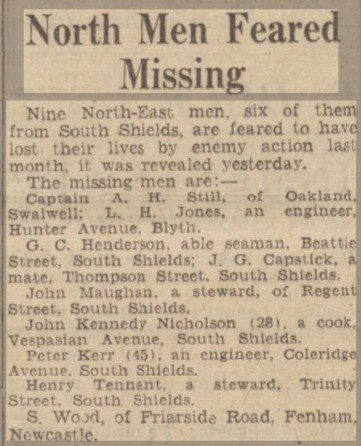
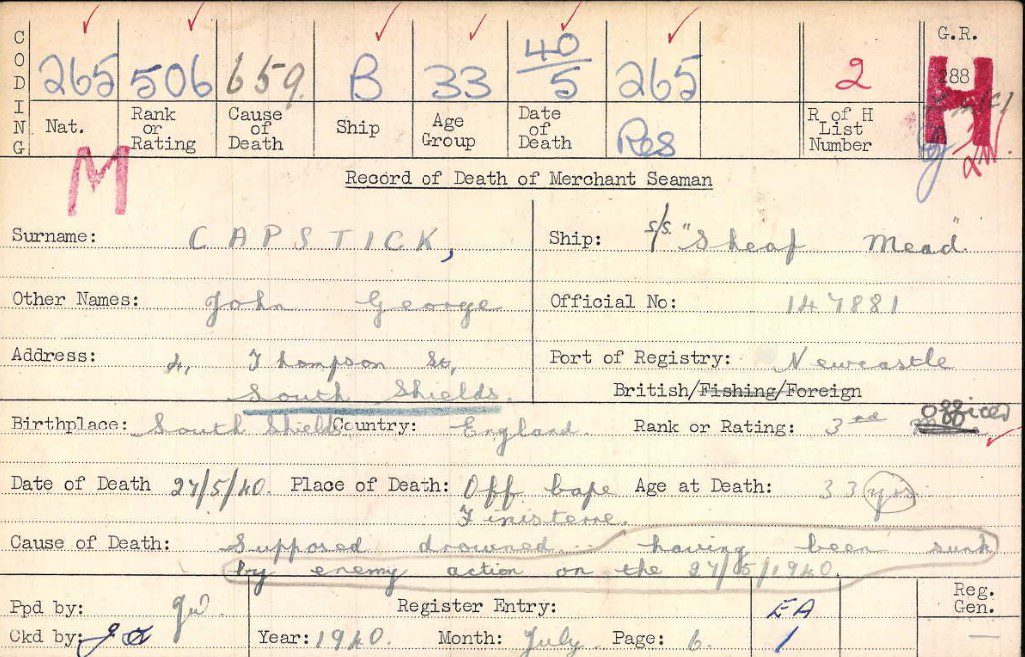
On the Tower Hill Memorial is the name of Third Officer John George Capstick, serving on S.S. Sheaf Mead (Newcastle upon Tyne) with the Merchant Navy who died 27/05/1940.
He was the son of George and Agnes Capstick and the husband of Isabella Rutter Capstick, of South Shields, Co. Durham.
John George Capstick was born on the 3rd January 1907, the third youngest child of six children of George, born 1881, and Agnes nee Templeman, born 1884. The other children were Mary Capstick, born 1903, William, born 1911, Robert, born 1904, and Agnes born 1915.
In 1911 John George Capstick was residing at 25 Thames Street, South Shields. Agnes and George were married in 1904, and were residing at her widowed Grandfather’s house Robert Templeman, born 1857. John George Capstick married Isabella Rutter Lowrey, born 30th October 1907, in 1930.
In 1921, John was residing at 19 Charlotte Street. John George joined the Merchant Marine on the 21st September 1926 at Hull. His first ship was the ss Jebba, ship number 142300. In 1930 he had a shop, and was now residing at 27 Pollard Street, Harton, South Shields. In 1939 John and his wife were residing at 4 Thompson Street, South Shields, with two children.
John joined the SS Sheaf Mead, ship number 147661, on the 15th May 1940, The SS Sheaf Mead was on route from Swansea to Philadelphia carrying ballast, when on the 27th May 1940 at 15.51 hours the unescorted Sheaf Mead (Master Alexander Henderson Still) was hit in the stern by one torpedo from U-37, commanded by Fregattenkapitän Victor Oehrn, and sank capsizing after a boiler explosion at 15.54 hours about 180 miles from Cape Finisterre. The Germans tried questioning the survivors on a raft, but they did not answer the questions. The master, 30 crew members and one gunner were lost. Five crew members were picked up by Frangoula B. Goulandris and landed at Queenstown, Cork on 31 May.
Source: U-Boat.net
Built as Gretaston for William S. Miller & Co, Glasgow. 1939 sold to W.A. Souter & Co Ltd, Newcastle upon Tyne and renamed Sheaf Mead.
John left £803 7 shillings to his wife Isabella in his will.
Acknowledgement: Barney Rice/James Pasby.
Simon McGurk has added the following:
John was my grandfather’s older brother and he always spoke about how close they were. My grandfather, Robert Templeman Capstick was also in the Merchant Navy but survived the war and lived all his life in South Shields.
John and the other crew from the Sheaf Mead were killed by a U Boat which shelled the boat and then, as we were told, finished off surviving crew using boat hooks. The case was heard at the Nuremberg War Trials in the trial of Admiral Doenitz:
“The British S.S. Sheaf Mead was torpedoed without warning on 27th May, 1940 – ”
THE PRESIDENT: This is the German account, is it not?
COLONEL PHILLIMORE: This is actually in the form of a British report. It includes the German account in the shape of a complete extract from the log.
THE PRESIDENT: It bears the words, Top Secret?
COLONEL PHILLIMORE: Yes, my Lord, this was at the time a top secret document. That was some while ago.
“The British S.S. Sheaf Mead was torpedoed without warning on 27th May, 1940, with the loss of 31 of the crew. The commander of the U-boat responsible is reported to have behaved in an exceptionally callous manner towards the men clinging to upturned boats and pieces of wood. It was thought that this man was Kapitanleutnant Ohrn of U-37: The following extract from his log for 27th May, 1940, leaves no doubt on the matter and speaks for itself as to his behaviour.”
Again, turning to the relevant extract from the log, on the second page, the time is marked on the document as 15.54.
“Surface. Stern is under water” – referring to the ship which has been torpedoed – “Stern is under water. Bows rise higher. The boats are now on the water. Lucky for them. A picture of complete order. They lie at some distance. The bows rear up quite high. Two men appear from somewhere in the forward part of the ship. They leap and rush with great bounds along the deck down the stern. The stem disappears. A boat capsizes. Then a boiler explosion. Two men fly through the air, limbs outstretched. Bursting and crashing. Then all is over. A large heap of wreckage floats up. We approach it to identify the name. The crew have saved themselves on wreckage and capsized boats. We fish out a buoy. No name on it. I ask a man on the raft. He says, hardly turning his head -‘Nix Name.’ A young boy in the water calls ‘Help, help, please!’ The others are very composed. They look damp and somewhat tired. An expression of cold hatred is on their faces. On to the old course. After washing the paint off the buoy, the name comes to light: Gretastone, Glasgow, 5,006 gross registered tons.”
“On to the old course” means merely that the U-boat makes off.
Of note re the ships crew remembered at the Merchant Navy Memorial at Tower Hill are the several Arabic names recorded which presumably record Yemeni sailors who were part of the large Yemeni community in South Shields and who gave their lives in the First World War.
John George Capstick is remembered at Newcastle on NUT015, at South Shields on S86.036, at Westoe in W101.08, page 15 and in our List of Ships’ Crews.