Every Name a Story
Joseph Harbottle Halliday
Every Name a Story
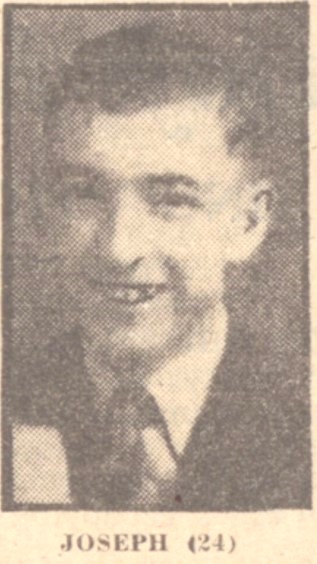
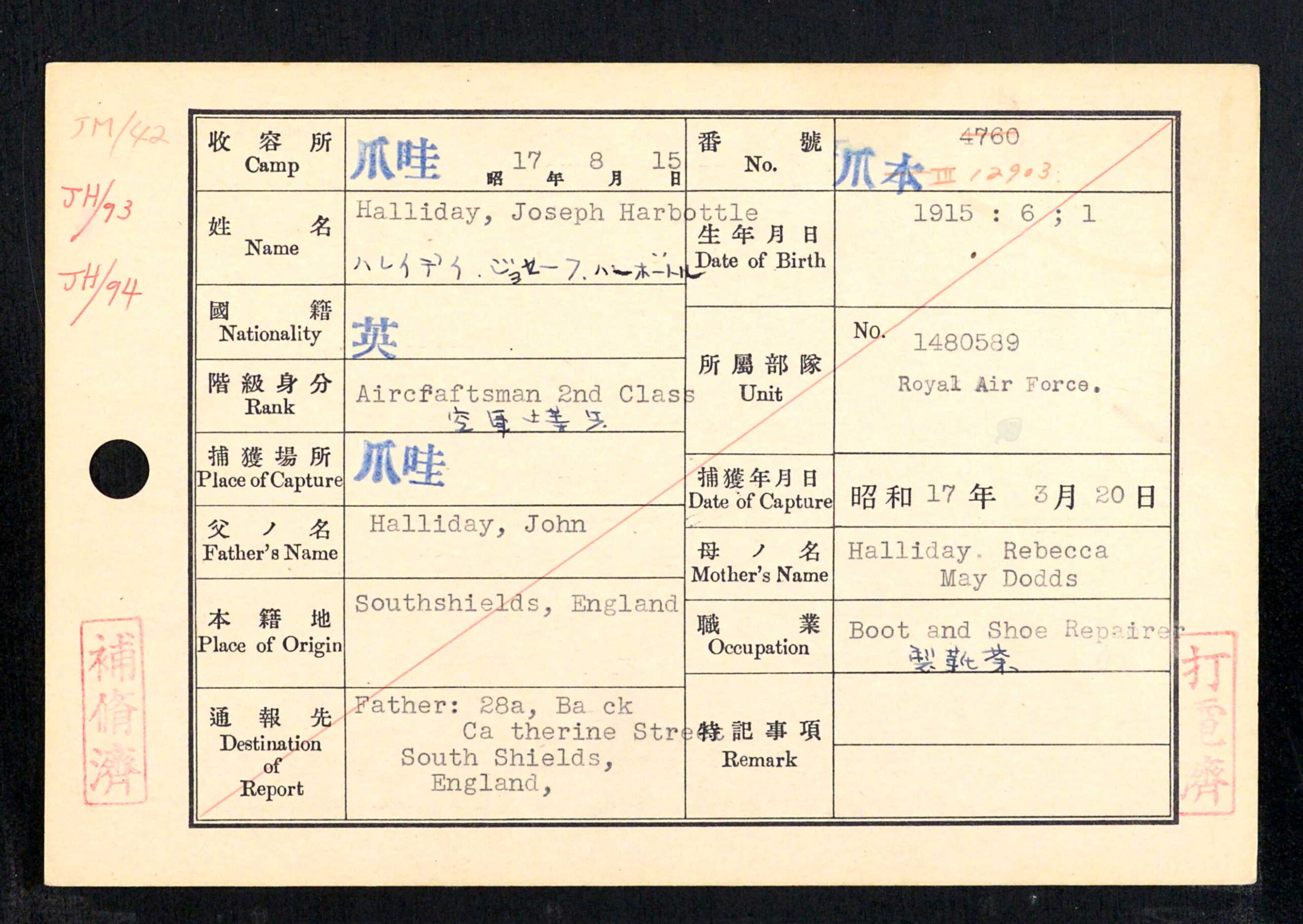
On the Singapore Memorial is the name of 1480589 Aircraftman Second Class Joseph Harbottle Halliday, serving with the Royal Air Force Volunteer Reserve who died 29/11/1943.
Joseph Harbottle Halliday was born on the 28th April 1921, at 33 Reed Street, South Shields, the third youngest son of four children of John Halliday, born 8th October 1880, died 1951, and his wife, Rebecca May Halliday, nee Dodds, born Sunderland, 14th April 1895, died 1969. They were married in 1918 at South Shields.
The other children were:-
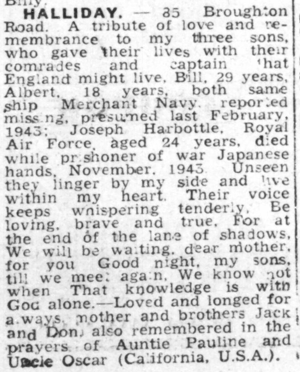
- Albert Halliday, born 21st May 1924, died 21st February 1943.
- William Halliday, born 4th July 1913, died 21st February 1943.
- John Halliday born 3rd January 1918, who was born paralysed and incapacitated.
Joseph Harbottle Halliday was an apprentice shoe repairer, and in 1921, he was residing at 33 Reed Street, South Shields, with his brothers William and John. The father was employed at St Hilda’s Colliery, at South Shields as a Miner Hewer for Harton Coal Company.
By 1939 the family had moved to 85 Broughton Street, South Shields. Joseph was conscripted after September 1939, into the Royal Air Force with the official number 1480589. He was captured by the Japanese in Java, and died presumably at sea onboard the Suez Maru.
Most of the Suez Maru men were taken prisoners of war on the 8th March 1942, on the surrender of Java, by Dutch command, and thousands were held at various Prisoner of War camps on Java camp. The Prisoners of War were not treated well, as is relatively well-known, and their captivity in Java was appalling; however, it would become very much worse when these men were transported to the Moluccan island of Ambon, in the spring of 1943, as part of the ‘Thousand Men of Liang’.
My great uncle was one of these thousand, also known as the Liang Marchers, so I have researched this time in detail.
These men travelled in two packed transport ships – the Mayahashi Maru or the Nishi Maru, after suffering as PoWs for just over a year in Java.
The transport ships docked at the tiny island of Ambon, and the thousand men were ordered to unload the cargo, which took two days. Then, without food or water, they were force-marched for two days across the island and north, to a clearing, near a village called Liang. It was here they would spend some seven months, first building their camp, then cutting a swathe through coconut trees to build a runway for a planned Japanese invasion of Australia.
After seven months of starvation rations, back-breaking work, rampant (avoidable) disease and inhuman brutality from the Japanese, 548 men were selected to return to Java on a ‘sick draft’, as they were too ill to work. These men were in a desperate condition as they boarded the Suez Maru on 25 November. They were packed into the rearmost holds, three and four. The ship, captained by Commander Tamaki Shirakawa, set sail for Surabaya, Java, escorted by one Japanese Navy minesweeper named W12, captained by Osamu Kawano. A Japanese officer, transport commander Masaji Iketani, was promoted to oversee the welfare of the PoWs on board. He would ultimately betray every single PoW in his care.
On the night of the 28 November, the American submarine, USS Bonefish, sighted the two ships ‘making heavy black smoke’ on the horizon and tracked them until dawn. At 9.17am the sub captain, Commander Hogan, ordered four torpedoes to be fired. The first two missed, but the third torpedo hit amidships, and the fourth struck and exploded in the rear of the Suez Maru, killing everyone in hold four. Those PoWs in hold three tried to escape. As the ship opened up in her mid-section, the stern began to pull the ship down, the bow rose up 90 degrees in the water, and then the whole ship slipped away under the waves of the Java Sea.
Some 250 PoWs floated in the open water, while the Japanese occupied lifeboats and life rafts, and wore life preservers. Over the following seven hours, the PoWs gathered together ‘in long lines in the water’ and tried to help each other. The minesweeper had been pursuing the submarine, dropping depth charges, and now returned to begin the rescue of Japanese. PoWs who tried to climb aboard were pushed back down.
Sometime later, when all Japanese were rescued, Kawano and Iketani discussed what to do with the c250 PoWs in the water, and Iketani declared that they must be killed. Gunnery Officer Dasio Yatsuka was summoned, and he ordered twenty riflemen to stand at the gunwale, and for two machine guns to be set up on the lower bridge.
At around 5.30pm, the PoWs in the water witnessed the minesweeper coming about, and expecting to finally be rescued, they moved towards it. They were met with a hail of bullets, and men were thrown in every direction. The massacre took around two hours, and I will not describe to you the detail given in later sworn statements, as it is too graphic and upsetting. However, some of the men, knowing they were to be shot, stood up on the now vacated lifeboats on which they’d taken refuge and bared their chests as targets in acts of bravery and defiance. Every last man was killed.
The lifeboats were rammed, and the minesweeper cut through the PoW bodies in the water and sailed away to Java, where the captain would log a falsified report that all the men were kept locked in the holds due to security, and that they all went down with the ship.
The entire atrocity would never have been known but for a Japanese serviceman, Yoshio Kashiki, aboard the Suez Maru, who was rescued by the minesweeper. As he sat shivering on deck, he overheard the entire conversation between Kawano, Iketani and Yatsuka, and then witnessed the massacre. He informed the war crimes section in Tokyo post-war and was ostracised by his family for doing so, and died of TB sometime later.
The Australian war crime section investigated thoroughly, and a prima facie case was prepared, Kawano and Iketani were tracked down, and their statements taken, in which they confessed. They were held in Sugamo Prison awaiting trial as war criminals. However, the Far East Commission had taken the decision to cease WC trials only four years after the war, with very many pending prosecutions still outstanding (in contrast to European war crime trials, the most recent of which was in 2022).
The British government was asked for permission to proceed to trial beyond the termination date, which was refused, with the British Secretary of State for War, Emanuel Shinwell, citing concerns that “Either way, as I see it, we must be prepared to face criticism. If we started a new trial now, we would be open to attack for waiting more than four years after the end of the war to deal with a crime committed six years ago. And in the contrary event, the relatives of the murdered prisoners of war might well cause questions to be asked if they heard that those responsible would never be brought to justice”.
Source: E-Mail from Jacquelyn Frith-Crofts BSc MPhil FRGS
AC2 Halliday was killed when the Japanese ship the S.S. Suez Maru was torpedoed and sunk by the American submarine U.S.S. Blowfish. The ship was carrying 548 British and Dutch Prisoners of War from Japanese work camps, as well as several hundred sick and wounded Japanese troops, when it was torpedoed near Kangean Island. The American submarine was unaware of the presence on board of the Allied men. Around 200 of the prisoners managed to escape, but the Japanese minesweeper, W.12, which came to the rescue, only picked up Japanese and Korean survivors. The minesweeper’s captain order that any Allied prisoners in the water should be machine gunned – all those who survived the sinking were killed.
South Shields Gazette Monday 05/07/1943 reports:
“One of Three Shields Missing Sons is Prisoner.
News that one of her three missing sons is a prisoner of war in Japanese hands has been received from the International Red Cross by Mrs. R.M. Halliday, of 85, Broughton Road, South Shields.
Nothing has been heard from the other two since they were reported presumed lost at sea last February.
A/C 2 Joseph Harbottle Hall (sic) the son known to be a prisoner, has been missing for 15 months. He volunteered to serve overseas when he had been in the R.A.F. for six months, Aged 22, he was a shoe repairer in civil life.
His two brothers, William and Albert, were serving in the same ship when it was presumed lost. William, who is 30 tomorrow, has been going to sea since 1936. Before joining the Merchant Navy he worked for John Redhead and Sons, Ltd., shipbuilders. Albert, aged 19, has been going to sea since last October. He formerly had a window-cleaning business. The boys’ last words before they left home were: “so long, mother, till we meet again. God bless you and keep you safe.”
Sources: Simon Glancey; Jacquelyn Frith-Crofts BSc MPhil FRGS; British Newspaper Archive; Bill Lumsden
Joseph Harbottle Halliday is remembered at Westoe in W101.08 page 41.
In 2013 a memorial to the crew of Suez Maru was unveiled in the National Memorial Arboretum bearing names of all those who died.
First Name: Joseph Harbottle
Last Name: Halliday
Service Number: 1480589
Which War: Second World War 1939-45
Died: 29/11/1943
Age: 22
Rank: Aircraftman Second Class
Regiment: Royal Air Force Volunteer Reserve
Served in: Air Force
Links to Source Material