Every Name a Story
Daniel Laidlaw
Every Name a Story
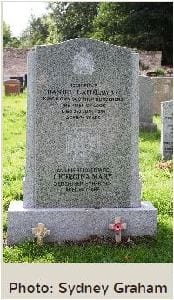
In St. Cuthbert’s Churchyard is a family headstone for Laidlaw bearing the VC emblem which reads:
15851 Piper
Daniel Laidlaw VC
King’s Own Scottish Borderers
The Piper of Loos
Died 2nd June 1950
aged 74 years
and his beloved wife
Georgina Mary
Died 2nd September 1947
Aged 64 years
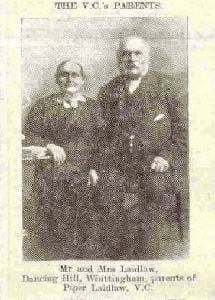
Daniel Laidlaw was born 26th July 1875, at Little Swinton, near Berwick upon Tweed, Berwickshire, the son of Robert Laidlaw, born 1847, and his wife Margaret, nee Turnbull, born 1852, died March 1927 age 75.
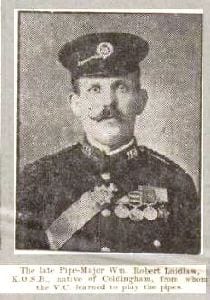
Daniel had three other brothers, the eldest of whom, William Robert*, joined the K.O.S.B., at sixteen. It was his advice that persuaded Daniel to switch regiments, and it was William also taught him to play the pipes. The other two brothers were James, who was a Farrier in the Royal Horse Artillery, and George, who was in the Royal Engineers. He also had four sisters, Isabella born 1873, Alice, Mary and Margaret.
* William Robert was a Sergeant, eventually becoming Pipe Major, service number 927, in the 2nd Battalion K.O.S.B. He was a native of Coldingham, and had served 21 years. He was awarded 5 medals: Egyptian Medal, Khedive Medal and the Indian (Punjab) Frontier Medal with clasps, Relief of Chitral, 1895 and Tirah 1897-98.
He was also in the Sudan Campaign. [It was reputed he was the strongest man in the Regiment. After leaving the Army he became the appointed Keeper of Newburn Bridge].
Daniel’s father Robert, was a Quarryman, and in 1881 was living at 11 College Place, Berwick upon Tweed. By 1891 he was an engine driver at Messrs H.O. Short and Son’s Mills in Tweedmouth. He worked there for 21 years before retiring and, as of 1916, he was ‘enjoying’ his pension. He and his wife were living at Dancing Hall, Wittington.
Daniel was educated at the Church of England primary school at Lesbury, now a village Hall, and at the National School Berwick. In 1891 the family was living at Bilton Banks, Lesbury. George became an apprentice Miller at the Lesbury Flour Mills.
By 1901, Isabella and Daniel were no longer living at this address. James, one of Daniel’s brothers, was an agricultural labourer. In the census it also shows their son-in-law William Quince? and their grandson Henry staying with them.
Daniel enlisted in to the 2nd Battalion Durham Light Infantry on the 11th April 1896, service number 2/4242, and was posted to India, spending two years over there until June 1898. In Daniel’s home in his cottage at South Doddington hung a framed certificate, stating that he was employed on plague duty in Bombay from March 22nd, to May 1st 1898. It is signed by the Secretary to the Governor, the late Mr. A. Woodburn, at whose funeral, several years ago afterwards, Laidlaw played a dirge on the pipes. In September 1896, Bombay was hit by a bubonic plague epidemic where the death toll was estimated at 1,900 people per week. About 850,000 people fled Bombay and the textile industry was adversely affected.
When Daniel returned to the UK, Daniel’s elder brother Pipe Major William Robert Laidlaw, see bottom photo on the right, who joined the K.O.S.B., at age 16, gave his advice that persuaded Daniel to switch regiments to the King’s Own Scottish Borderers.
Daniel served until the 11th April 1912, then was placed in the reserve.
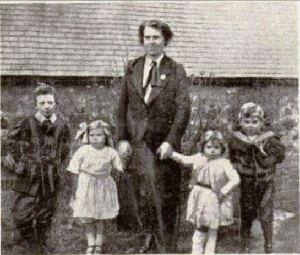
Daniel had worked for Alnwick Co-operative Store as a warehouseman and prior to this worked at the Flour Mills at Lesbury. Daniel married Georgina Mary nee Harvie, on the 11th April 1906 at the Baptist Church, Alnwick. They had six children, Andrew Laidlaw,born 3rd April 1906, John Laidlaw, born 29th July 1910, Margaret Laidlaw, born 21st August 1911, Georgina Laidlaw, born 10th December 1913, May born 1914? and Victor born 1920.
They were all residing at South Doddington, near Wooler.
Daniel was now working at a farm employed by Messrs A. and P.H. Porter sons, a Berwickshire farmer who had died a few years before. [Other sources say he was employed as a Canteen Manager and at a horse breeding centre but these are unconfirmed].
When war broke out, he mentioned to his wife that he was thinking of re-joining. His wife replied “Yes, go, and good luck to you, we’ll get along all right.”
Daniel re-enlisted on the 5th September 1914, at Berwick upon Tweed, for one year with the Army Reserve (Special Reservists), stating his trade as a Groom. He was aged 39 years 41 days. His service number was 15851. His religion was Presbyterian. Distinguishing marks were recorded as ‘Emily’ and ‘D.L.’ with a Heart tattooed on left forearm. He was 5 feet 6 inches tall with a weight of 122 lbs. He had hazel eyes and dark brown hair.
On the 9th September 1914, he was posted to the 7th (Service) Battalion, King’s Own Scottish Borderers and appointed Acting Corporal on the 26th September 1914.
Because of drunkenness in his billet, at 10.15 pm on the 19th February 1915, whilst he was in Winchester, he was reverted back to private from Corporal as part of his punishment. He was in ‘B’ Company at this time.
He was posted to France embarking at Folkestone, on the 9th July 1915 and was in France until the 1st October 1915.
The attack on the French village of Loos on the 25th of September 1915 was the first time the British had used poison gas. The gas was released and due to a change in the weather, instead of heading towards the enemy the gas came towards the allies. It was a savage battle involving the use of 140 tons of chlorine gas. Unfortunately due to a shortage of men and artillery shells, the British could not exploit the breach they opened in the German line, and on September 28th the battle ended where it began, with the British pulling back to their original trenches.
His VC citation reads:-
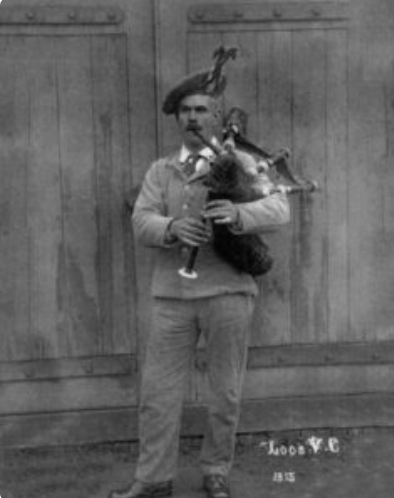
On 25th September 1915 near Loos and Hill 70, France, prior to an assault on enemy trenches and during the worst of the bombardment, Piper Laidlaw, seeing that his company was shaken with the effects of gas, with complete disregard for danger, mounted the parapet and, marching up and down, played his company out of the trench. The effect of his splendid example was immediate and the company dashed to the assault. Piper Laidlaw continued playing his pipes even after he was wounded and until the position was won. (London Gazette, 18 November 1915).
The above account of his actions was written by James Price Lloyd of the Welsh Regiment, who served with Military Intelligence. After the war, the government destroyed all the archives relating to this propaganda (section MI 7b (1)). They were regarded as being too sensitive to risk being made public. Remarkably these documents have survived in the personal records of Captain Lloyd.
Piper Laidlaw left an account of his VC action in his own words:-
On Saturday morning we got orders to raid the German trenches. At 6.30 the bugles sounded the advance and I got over the parapet with Lieutenant [Martin] Young. I at once got the pipes going and the laddies gave a cheer as they started off for the enemy’s lines. As soon as they showed themselves over the trench top they began to fall fast, but they never wavered, but dashed straight on as I played the old air they all knew ‘Blue Bonnets over the Border’. I ran forward with them piping all I knew, and just as we were getting near the German lines I was wounded by shrapnel in the left ankle and leg. I was too excited to feel the pain just then, but scrambled along as best I could. I changed my tune to ‘The Standard on the Braes o’ Mar’, a grand tune for charging on. I kept on piping and hobbling after the Laddies until I could go no further, and seeing that the boys had won the position I began to get back as best I could to our own trenches.
Second Lieutenant Martin C. De Bude Young, who had been severely wounded in the fighting but who insisted on walking to the dressing station rather than being stretchered there, died from loss of blood.
Whilst in France Daniel received a gun shot wound in the right foot, and also a shrapnel wound in his left leg. On the 25th September 1915 he was taken to the 46th Field Ambulance, then the 20th Casualty Clearing Station, before being admitted to the 12th General Hospital at Rouen, then invalided, returned to the UK to the Lord Derby War Hospital on the 1st October 1915. This was was situated on the Winwick Rectory Estate north of Warrington, Lancashire. [It was built as an asylum in 1896, but was also used as a military hospital with 2,160 beds during both World Wars. Between 1915 and 1920 over 56,000 wounded soldiers were treated there, and the hospital resumed it’s work as an asylum in 1921. The Hospital closed in 1997]. Daniel arrived there on 2nd October 1915, and was granted leave from the 16th December to the 25th December.
Piper Laidlaw had spent 11 weeks in the Winwick Hospital near Warrington before coming home on Saturday 18th December. Leaving Central Station for Morpeth, he was met by the Mayor, Alderman Edward Norman, and proceeded by motor car through the streets of Morpeth to the Marketplace where he was given a rousing welcome. He stayed with his brother-in-law Mr Joseph Harvey at Morpeth overnight then left at 1 o’clock for Alnwick where he entrained for Wooler, proceeding to Doddington to spend his ten days’ leave with his wife and family. He received a great reception from Wooler and Doddington, as he had at Morpeth and Alnwick on his way North. He was presented with an illuminated address at Doddington, the presentation being made by Col. Hon. F.W. Lambton, of Fenton’s. Since then, he was the centre of enthusiastic public ceremonies at Alnwick, Wooler, Duns and Manderston.
On the 6th January 1916, Col. Pennyman, Commanding Berwick Depot read the official record of the award of V.C. to Piper Daniel Laidlaw at parade, congratulated him on his bravery and shook hands with him. Piper Laidlaw was on light duties, he was still lame but was improving steadily.
On Saturday January 8th 1916 at 2.30 pm the Queen’s Rooms, Berwick, was booked for a public presentation of Piper Laidlaw, V.C., The Mayor of the Border Town (Ald. Plenderleith, J.P.,) would preside; Capt. Swinton, Superior of Swinton, would speak on behalf of the people of the Berwickshire village where the V.C., was born.
Piper Laidlaw, was invested with his Victoria Cross by King George V at Buckingham Palace on the 3rd of February 1916. After this on the 28th February, he received the Musicians’ Company’s Gold Watch, presented to him by the Lord Mayor at the Mansion House. On the 8th June 1916, Daniel was at the 2nd Scottish General Hospital at Edinburgh, having Skiagrams taken of his left forearm. This was contained in a report to the Officer in Command of the Auxiliary Hospital at Kinghorn, stating that “No Foreign body can be seen in the arm.”
On the 2nd October he was posted to the K.O.S.B., Depot at Berwick upon Tweed. On the 19th January 1916, he was transferred to the 9th Battalion and promoted on the 16th June 1916, once again to Corporal.
Daniel again was transferred on 1st September 1916, to the 9th Battalion K.O.S.B., attached to ‘A’ Company, 53rd Training Highland Light Infantry Battalion. The 9th Battalion on the 1st September 1916 became the 53rd Training Reserve Battalion in the 12th Reserve Brigade. He was appointed Acting Sergeant on the 28th November 1918.
The Berwickshire News 07/12/1915 had this story:-
The Hero’s Pipes. A welcome guest at Warrington Caledonian Association dinner on St Andrew’s night was Piper David Laidlaw, V.C., who has been for the last fortnight an inmate of Winwick hospital. He is now almost convalescent. His pipes were smashed at Loos, but have now been repaired, and his Colonel is having them silver-mounted.
His address then was South Doddington, Wooler, Northumberland. Whilst on leave. the hospital recommended that he was not likely to be fit for service overseas within 3 months.
He then remained in the UK until the 31st March 1920 when he was discharged.
Daniel was posted to Class ‘Z’ Army Reserve on the 30th April 1919 as recorded by a War Office letter dated 31st October 1944.
On the 6th May 1919, the Ministry of Pensions wrote to the War Office to advise them of his Pension. He was discharged on 30th April 1919, aged 47 and his address at this time was East Kirk, Newton, Wooler. His disabilities were described as Varicose veins and Rheumatism, and was classed with a 40% disablement. His weekly pension was assessed at 11 shillings a week plus an extra 8 shillings for the children, which was to commence from the 1st May 1919.
His discharge papers show an incorrect date of birth of 1873. The Royal Hospital at Chelsea S.W., wrote a letter dated 29th July 1919, to inform Daniel that his pension was being considered. 6d a day was awarded for Distinguished Conduct from the 1st May 1919 for so long as his disablement pension continued.
His address at this time was given as 11 South Terrace, Southwick, Sunderland, c/o of a Mrs Brown.
He was finally discharged on the 31st March 1920, Class Z. Para 392 XXVIII K.R.
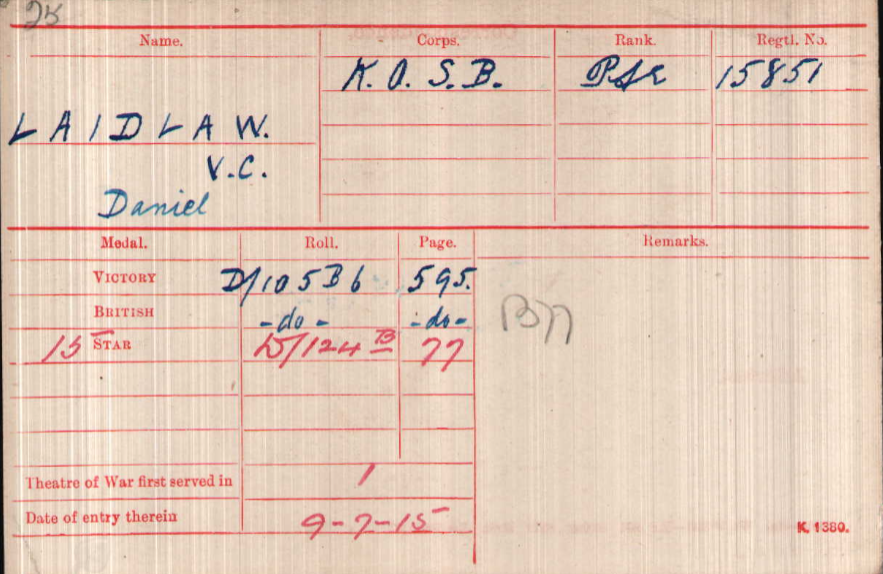
Daniel himself received his War Medal on the 23rd December 1920, prior to this date on the 19th March 1920 he received the Bronze 1914/15 Star.
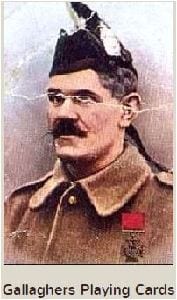
His medal collection consisted of the Victoria Cross, 1914-15 Star, British War Medal (1914-20), Victory Medal (1914-19) + MiD Oakleaf, Defence Medal (1939-45), King George VI Coronation Medal (1937) and the Croix de Guerre (France).
Daniel had written a letter to the War Office.
After the War Daniel found it difficult to find regular employment and had worked for Wm Pickersgill and Sons Ltd, Shipbuilders and Repairers, at Sunderland for a while, after which he was unemployed for over 8 years.
In 1929, he re-enacted his VC action for the film Guns of Loos and in 1934 took part in the film Forgotten Men.
Lieutenant Colonel R.F.A., (T) Frank Pickersgill, from the company Wm Pickersgill and Sons Ltd, Shipbuilders and Repairers, wrote a letter on the company’s official letterhead, to the Infantry Record Office at Hamilton, dated 9th December 1920, stating “Ex-Sergeant Piper Daniel Laidlaw, V.C. Regimental No 15851 of the K.O.S.B., With reference to your memo of the 25th October, 1920, Army Form O.348, to the above, I would appreciate it very much if you would let me know what is the position in regard to the Service Pension which was then according to your memo, under consideration.”
On the 27th September 1935, a handwritten letter was received at the Information Bureau, War Office, Whitehall, London. Sent from ‘Northolme’ 1 Western Avenue, Perth, Scotland, which reads:- “Dear Sirs, I wonder if you could inform me of where I could communicate with the following. Piper Daniel Laidlaw, “The Loose [sic] V.C”, Lieut. G. S. M. Insall V.C., R.A.F. Major L.W.B. Rees V.C. {late of the R.A.F.} Lieut Alan Jerrard V.C. R.A.F. Lieut F.M.F West V.C. R.A.F. Yours Truly Jean P Keay.”
The official reply from the War Office, dated 8th October 1935 responded in return stating “Madam. With reference to your letter of 27th September, I am directed to inform you that the Department has a record of a No 15851, Daniel Laidlaw, V.C., King’s Own Scottish Borderers, who was transferred to Class ‘Z’ Army Reserve, on Demobilization on 30th April, 1919, and who might be identical with the subject of your enquiry. It is contrary to the general practice of this department to furnish the addresses of members or ex-members of His Majesty’s Forces, but a letter for the above named soldier would be forwarded to his last known address if enclosed in a stamped envelope bearing reference number Ham./15851/1584 (R. Records), and sent care of the Under-Secretary of State, The War Office, Records Section, Arnside Street, Walworth, London, S.E 17. I am Madam, Your obedient Servant, Sgd, V. Bovenizer.”
Daniel’s son Victor enlisted with the K.O.S.B., in 1940 when aged 20. Daniel had joined the local Home Guard.
In 1938, Daniel was a sub postmaster at Shoresdean, near Berwick upon Tweed and died at home on the 2nd June 1950.
When news of Laidlaw’s VC action became public, he became a national hero.
The “Berwick Journal and the “Berwickshire News” local papers, had opened a Shilling Fund for Piper Laidler, on December 1915, “in order that our readers and public generally may fittingly express their pride in the Border Hero”. The first subscriber was Captain Swinton, Superior of Swinton where Piper Laidlaw was born, 5s.
The Vicar of Doddington wrote “I found Piper Laidlaw, before he left for the Front, a most reliable man and with great social qualities. He made me 3 promises of a moral and spiritual character before he left Doddington. He wrote to my wife, when I was away in Egypt, and said-‘By God’s help I shall keep them.” When he got to France, and was going to the trenches, he asked Rev. T. Struthers Symington to write to me on his behalf. Mr Symington said of him (July 25)-“He is, I believe, striving to do his part not merely in the service of King and Country, but also of the Kings of Kings”.
The shilling fund closed in April 1916, with a £75 worth of Exchequer Bonds, gifts in kind and ready money about £20. The net result was £95. The gifts included a suitably inscribed Walking Stick, a Gold Brooch, inscribed and bearing the regimental crest of the K.O.S.B. for Mrs Laidlaw, a briar pipe, for Piper Laidlaw’s father and a pair of gold rimmed spectacles for Mrs Laidlaw senior.
The Newcastle Daily Chronicle 05/01/1916 reports:
Piper Laidlaw entertained at Wooler. Piper Laidlaw, V.C., was entertained at Wooler on Monday night. The Hon. F.W. Lambton presided over a large company, and a musical programme was sustained by Miss Millas and Messrs. Smith, W. Adamson, W. Dixon, J. Whittle, J. Young, W. Diamond, Revell and T. Robinson. Selections on the bagpipes were also played by the hero. During the proceedings the piper was made the recipient of a purse of money containing £16 10s., subscribed by Wooler friends, Miss Lambton making the presentation. A sum of £12, taken at the door, will be, at the request of Piper Laidlaw, devoted to a fund for the benefit of Wooler men at the front.
The Newcastle Daily Chronicle 10/01/1916 reports:
Public presentation at Berwick. Piper Daniel Laidlaw, V.C., the Piper of Loos, was on Saturday publicly presented by the Mayor of Berwick with Government scrip and other gifts from a fund organised by the Berwick Journal and the Berwickshire News. Letters of appreciation were read from the Foreign Secretary, the under-secretary for War, and the Duke of Northumberland. The Archbishop of Canterbury, Colonel E.D. Swinton, the original Eyewitness, and forty other relatives of Captain Swinton, of Swinton, where Laidlaw was born, were among the subscribers. The Mayor said the V.C. had never been more worthily won than by the Piper of Loos. Presents were also made to Laidlaw’s wife, father and mother.
The Newcastle Daily Chronicle 29/02/1916 reports:
Musicians gift to Piper Laidlaw, V.C.
Presented by the Lord Mayor of London.
Another of those interesting ceremonies which have been such a great feature of the civic calendar during the war took place at the Mansion House, London, yesterday. The occasion was the entertainment of a number of wounded soldiers from our various Colonies, and the special presentation to Pipe Daniel Laidlaw, V.C., the hero of Loos, by the Worshipful Company of Musicians, and by permission of the Lord Mayor (Colonel and Alderman Sir Charles C. Wakefield). Piper Laidlaw, headed by the pipers of the Lord Mayor’s recruiting bands, made his triumphal entry into the gilded chamber to the rousing cheers of the civilians and wounded soldiers who were present.
He was received at the platform by the Lord Mayor and Sheriff and by Mr. Charles L. Collard, M.A., Master of the Musicians Company. The latter, in presenting Piper Laidlaw to the Lord Mayor, said that it was a most interesting fact that this was the fourth occasion upon which the V.C. had been won by a soldier connected with music in the army. The Company was naturally proud of this, and still prouder that the greatest of all distinctions had been won by such a hero as now stood before them. In making the presentation of a gold watch to the heroic Piper, the Lord Mayor said that it gave the utmost pleasure to hand the token to such a brave soldier. Their eyes grew dim with pride and their blood flowed quicker through their veins when they read of such valiant deeds as those of Piper Laidlaw. They prompt us, added the Lord Mayor to do our duty as loyally as he has done. I hope you will wear this watch with pride and that it will be a further stimulus to do your best for King and country.
Piper Laidlaw, in accepting the gift with sincere thanks, said that he scarcely knew how to express himself. It had been said that there was no music in pipe, but the musicians of London thought different. I won’t take all the honours, he said. ‘if it had not been for the good work of my regiment, I doubt if I should have got my great reward’. The gallant Piper then played the Blue Bonnets, the tune which he played to his regiment, the Kings Own Scottish Borderers, on the parapets of the trenches at Loos.
Daniel Laidlaw had no headstone for many years. He had stated that he wanted an unmarked grave, however a ceremony took place at St. Cuthbert’s Churchyard, Norham, Northumberland, on the 2nd June 2002 to place a headstone over the grave of Piper Daniel Laidlaw VC – “The Piper of Loos”. The project was organised by the King’s Own Scottish Borderer’s Museum in Berwick upon Tweed and by members of the Laidlaw family.
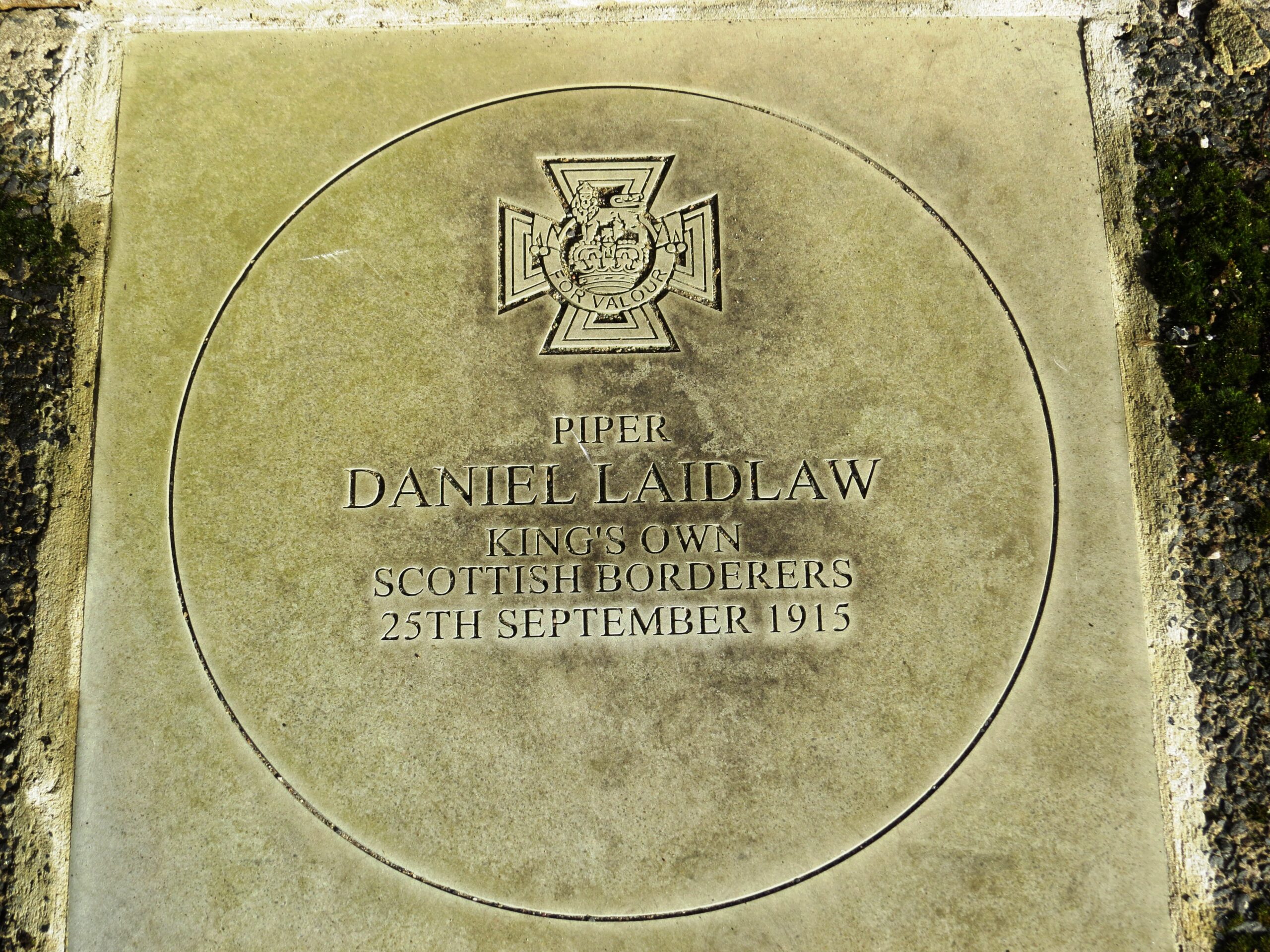
In addition, in 2015 a VC paving stone was laid at the entrance to the former school at Lesbury which he attended as a child. This was part of a past Government initiative to remember all the V.C.s for the Centenary of World War 1. The building is now the village hall.
A similar stone had been unveiled in Swinton, Berwickshire, where Daniel was born, as reported in The Berwickshire Times 28/09/2015.
Daniel Laidlaw is remembered at Norham in St. Cuthbert’s Church on N27.03 and at Lesbury on L9.07 and L9.08.
First Name: Daniel
Last Name: Laidlaw
Service Number: 2/4242, 15851
Which War: First World War 1914-18
Died: 02/06/1950
Age: 74
Rank: Piper
Regiment: King's Own Scottish Borderers
Served in: Army
Unit/Ship: 7th (Service) Battalion
Decorations: V.C. Croix de Guerre (France) Mentioned in Despatches