Every Name a Story
William Carrick
Every Name a Story
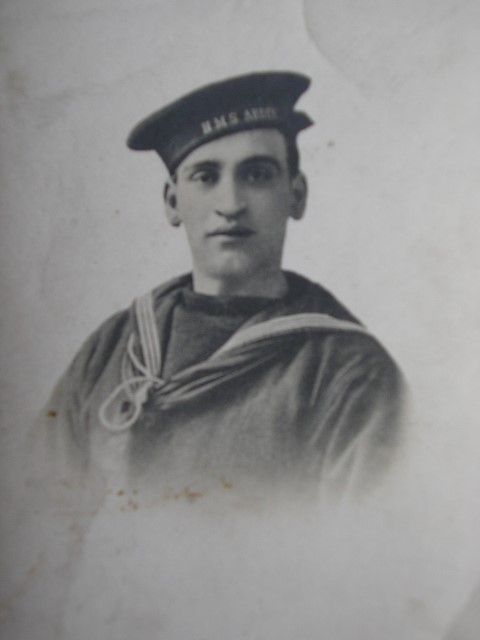
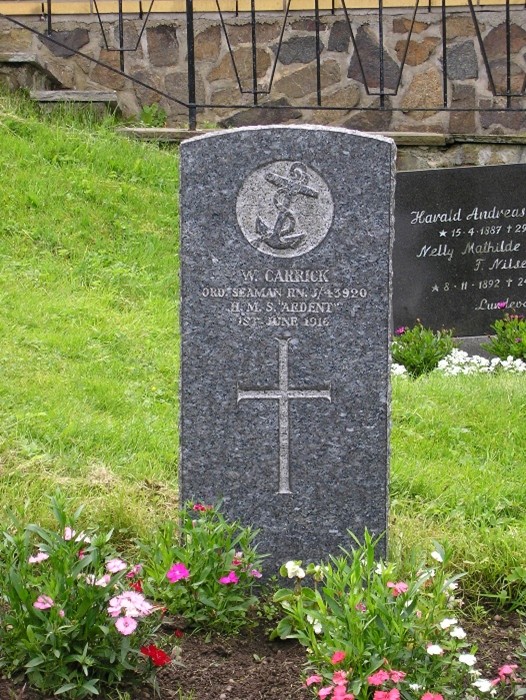
In Farsund Cemetery, Norway is the Commonwealth War Grave of J/43920 Ordinary Seaman William Carrick serving on H.M.S. Ardent with Royal Navy who died 01/06/1916.
Jean Longstaff has submitted the following:
William Carrick was born on 23rd March 1894 in Evenwood the son of local couple Joseph and Elizabeth Ann (nee Proud) Carrick. They had 15 children, all born at Evenwood, Margaret (b.1888), Edmund (b.1889), Ada (b.1892), William, Florence (b.1897), Barbara (b.1898), twins Wilfred and Alice (b.1901), John George (b.1902), Harry (b.1904), Joseph Ernest (b.1806), twins James and Mary (b.1907), Fred (b.1910) and Tom (b.1912).
In 1901, the family lived at the Bridge Inn, Ramshaw and father Joseph worked as a coal miner. By 1911, the family lived at South View, Evenwood and the two oldest boys Edmund and William were also working as miners.
Kevin Richardson has provided the following service information:
On 7th September 1915 William Carrick, along with two friends Andrew Lynas and William Purdy, enlisted into the Royal Navy. William Carrick with the service number J/43920 spent the first ten weeks at the training base HMS Victory. His first posting was on H.M.S. Ardent, which he joined on 24th November 1915 as an Ordinary Seaman.
The Battle of Jutland 31st May – 1st June 1916
At the end of May 1916 over 250 British and German warships were steaming on convergent courses to a rendezvous unanticipated by the Germans, off the Jutland coast of Denmark. Admiral Sir John Jellicoe was Commander of the British Grand Fleet which consisted of 28 Dreadnoughts, 9 battle cruisers, 8 armoured cruisers, 26 light cruisers, 78 destroyers, a seaplane and a minesweeper. Admiral Reinhard Scheer commanded the German High Seas Fleet, consisting of 16 Dreadnoughts, 6 pre-Dreadnoughts, 5 battle cruisers, 11 light cruisers and 61 destroyers.
HMS Ardent was part of the 4th Destroyer Flotilla along with another 18 destroyers.
HMS Ardent took part in the night battle of the 31st May/1st June. The Germans proved to be better equipped for night fighting with better co-ordination, star shells and searchlights The British destroyers were painted black, a bad colour for night fighting and after the battle they were repainted grey like their German counterparts. Whilst they attacked bravely their tactics were poor, usually approaching too close and launching their torpedoes at the wrong angles, enabling the Germans to fire first and avoid the torpedoes.
The 4th Destroyer Flotilla encountered the German van, including the 1st Battle Squadron. In terms of material losses, the British lost 3 battle cruisers, 3 armoured cruisers and 8 destroyers with loses of 6,097 British sailors. The Germans lost 1 battle cruiser, 1 armoured cruiser, 4 light cruisers and 5 destroyers losing 2,551 German men.
The first official British statement about the Battle of Jutland was issued 2nd June 1916 when it was confirmed that “The battle cruisers Queen Mary, Indefatigable and Invincible and the cruisers Defence and Black Prince were sunk. The Warrior was disabled and after being towed for some time had to be abandoned by her crew. It is also known that the destroyers Tipperary, Turbulent, Fortune, Sparrowhawk and Ardent were lost and six others are not yet accounted for.”
Sir John Jellicoe’s official report submitted 24th June 1916 includes the following statement: Officers and men were cool and determined with a cheeriness that would have carried them through anything. The heroism of the wounded was the admiration of all. I cannot express the pride with which the spirit of the Fleet filled me.
The Kaiser claimed victory, known to the Germans as “the Victory of the Skagerrak.” Jutland was undoubtedly a material victory for the German High Seas Fleet whilst being a strategic victory for the British Grand Fleet. The Germans had inflicted heavier losses on the numerically superior Grand Fleet and had escaped near destruction but had failed to break the British blockade or control of the North Sea. A German journalist described the action as “an assault on the gaoler, followed by a return to gaol.”
HMS Ardent
Lieutenant Commander Arthur Marsden, HMS Ardent commented on the morale of his crew: “It was a most inspiring fact for me as their captain to notice the smiles on everyone’s face; to see the cheerfulness and enthusiasm throughout the ship at the idea of at last having a go at the Germans. Though the prevalent thought throughout the Fleet was not so much the killing of Germans and sinking their ships as the thought that at last the navy was to have the chance of proving their worth and showing our folks at home that their continued trust in us was not misplaced. And further a feeling that at last we could show our professional skills against a strong adversary rather than any particular bitterness against them as individuals.”
H.M.S. Ardent, having lost touch with the rest of her flotilla, was steaming alone on a southerly course. Suddenly she saw smoke ahead, and, thinking it belonged to one of her consorts, steamed towards it. Then the huge form of a German ship loomed up, and without hesitation she rushed into attack, firing a torpedo as she closed. At that moment a blaze of searchlights split the darkness, revealing four German battleships in line ahead. From out of the darkness their guns rang out and in a minute the plucky little destroyer was reduced to scrap-iron. The enemy proceeded on his course, leaving the Ardent to sink (12.19). All her compliment, save only her commander Lt.-Commander Marsden and one man perished. With the loss of the Ardent, the work of the 4th flotilla came to an end. Alone it had tackled the whole of the German battle fleet, never flinching, until all its torpedoes were exhausted and nearly every ship a wreck.
It was clear to Lieutenant Commander Arthur Marsden, HMS Ardent 4th Flotilla that his ship would soon sink. Calmly he began to make his preparations for the end; hampered by the fact that he had been wounded in the leg, he made his way aft from the bridge. The morale of his men remained high but it soon became evident that it would be difficult to get them away safely. His report contained the following description: The ship was nearly gone so it only remained for us to try and save as many as we could. A terrible scene of destruction and desolation was revealed to me as I walked aft, with some difficulty. All boats were in pieces. The funnels looked more like nutmeg graters. The rafts were blown to pieces and in the ship’s sides and deck there were holes innumerable. In the very still atmosphere the smoke and steam poured out from the holes in the deck perfectly straight up into the air. Several of my best men came up and tried to console me and were all delighted that we at length been in action and done our share. But many were already killed and lay around their guns and places of duty. Most of the engine room and stokehold brigade must have been killed outright.
I walked right aft and sat down on the wardroom hatch. I could do no more as my leg was stiff and bleeding a lot. My servant and another seaman, both of whom have been with me for over two years came aft to look for me and to help me. I sent them forward and told them to pass the word for each man to look after himself. For a moment or two I was quite alone; the smoke cut me off from those further forward and there was absolute quiet and stillness.
Then all of a sudden we were again lit up by searchlights, the enemy poured in four or five more salvos at point blank range and then switched off her lights once more. This would be about 10 minutes from the time we were first hit. The Ardent gave a big lurch and I bethought myself of my Gieve waistcoat. I blew and blew without any result whatever and found that it had been shot through. Another lurch, which heeled the ship right over and threw me to the ship’s side. I could feel that she was going so flopped over into the sea, grabbing a lifebuoy that was providentially at hand. The Ardent’s stern kept up for a few moments then she slowly sank from view.
As the smoke and steam cleared off I could see many heads in the water – about 40 to 50 I should think. There was no support beyond lifebelts, lifebuoys and floating waistcoats, so I was afraid few of us could possibly survive, especially as I realised that all the destroyers has gone on and no big ship would dare stop, even if they saw us in the water. I spoke to many men and saw most of them die one by one. Not a man of them showed any fear of death and there was never a murmur, complaint or cry for help from a single soul. Their joy was and they talked about it to the end, that they and the Ardent had “done their bit” as they put it. While there were still many alive, a German came close and fired a star shell over us. I could see her distinctly and was all for giving her a hail but the men said, “No!” They agreed that they would sooner take the remote chance of being saved by an English ship rather than be a prisoner in Germany. I was nearly done in once or twice in the first hour by men hanging on to me in the last stages of exhaustion and I was separated from my lifebuoy and was pulled right over in the water but managed to recover myself and the buoy. None of the men appeared to have suffered at all; they just seemed to lie back and go to sleep. After a long weary while the sun got up and then I was feeling much more comfortable than two hours previously. I found a skiff’s oar floating past me and put it under my arms. I began to feel drowsy and dropped off into a sort of sleep several times, only to be awakened again by waves slapping my face. There was quite a swell but the surface of the water was smooth owing to the masses of oil floating about from our sunken ships. I woke again after what I felt to be a long time to hear a shout and could see ships a long way off. I took a sort of detached interest in them and gave an answering shout to, “Stick it Ardents!” to someone in the water nearby whom I could not see. I watched the ships disappear again without much interest and dozed off again. Once again I awoke to find a flotilla leader – the Marksman – close alongside me. I sang out for help and in reply got a welcoming and re-assuring shout, “You’re all right, Sir! We’re coming!” and once again I relapsed into unconsciousness.
Lieutenant Commander Marsden was picked up at around 06.00. There was only one other survivor from Ardent’s crew. Ordinary Seaman William Carrick and his good friend Andrew Lynas both perished.
The Auckland Chronicle for 15th June 1916 reported as follows with the headline The Fallen Brave: In the North Sea naval battle Evenwood lost three of its lads. They were Wm. Carrick, son of Mr. and Mrs. Joseph Carrick, South View; Andrew Lynas, son of James Lynas, Chapel St. and John W. Wren, son of Mr. and Mrs. Wren, Copeland Row. John H. Raine, son of Mr. and Mrs. Frank Raine and who was killed in France on 24 May, leaves a widow and two children. In honour of the fallen ones memorial services were held at St. Paul’s Church on Sunday afternoon and at the Wesleyan Church at night. Both were overcrowded. The village band played “Lead, kindly light” and the Dead March in “Saul” and the Boy Scouts sounded the “Last Post”.
The Evenwood Church Magazine, July 1916 reported on the Memorial Service as follows: William Carrick and Andrew Lynas went down with the torpedo boat “Ardent”. The exploits of this little vessel in the big battle were in accordance with the very highest traditions of the British Navy. She and her wonderful crew will never be forgotten in the pages of history. She is said to have sunk a huge German warship many times her own size and was in the thick of the fight until she disappeared literally knocked to pieces. The two lads named here were with us only a week or so before the battle looking hearty and well. William Carrick was for some time a member of our Parish Church choir and a very useful and popular member too.
Our Memorial Service for them and Lord Kitchener for great as he was, I am sure he would be proud to have his name commemorated in such company was one which was greatly appreciated. It was a wonderful service. We held it on Whit Sunday afternoon (June 11th). Every inch of room in the church was occupied. People came from far and near to do honour to the lads………very many who could not get into the building took what part they could in the enclosure outside……. We shall never forget the service nor the brave gallant ones whom we commemorated in it. I doubt if our dear Church will ever see a nobler day or a greater occasion.”
The October edition of the church magazine reported that (the body of) William Carrick who went down in the Ardent in the naval Battle of Jutland was recovered off the coast of Norway and was reverently interred by the Norwegian Government Authorities in Norwegian soil on June 30th, at Farsund. This kind and comforting fact was officially conveyed by our own Admiralty to Mr. Carrick (William’s father).
William Carrick is remembered at Evenwood on E69.01, E69.02, E69.03 and E69.04. and on our List of Ships’ Crews.
First Name: William
Last Name: Carrick
Service Number: J/43920
Which War: First World War 1914-18
Died: 01/06/1918
Age: 22
Rank: Ordinary Seaman
Regiment: Royal Navy
Served in: Navy
Unit/Ship: H.M.S. Ardent
Links to Source Material