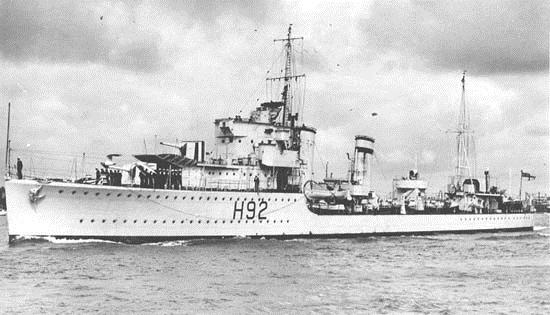
On the Portsmouth Naval Memorial is the name of P/SSX 22575 Able Seaman Basil Dowson serving on HMS Glowworm with the Royal Navy who died 08/04/1940.
He was the son of Sydney and Alice Ann Dowson, of Cockfield, Co. Durham.
Jean Longstaff has submitted the following:-
Basil Dowson was born on 20th October 1919 in Cockfield, the son of Sydney and Alice Ann (nee Wilson) Dowson. In 1921 Sydney was an out of work miner, and the family consisting of himself, Alice Ann and five sons, Jonas, Albert, Norris, Basil and Alan, plus two daughters Grace and Ada were living at 11 Wood Row, Butterknowle. By 1939, the family lived at 4 Staindrop Road, Cockfield with daughter Eva born on 8th May 1925 and Gordon, born in 1930. Sydney again was out of work.
Kevin Richardson has provided the following service information:
Basil Dowson served in in the Royal Navy on HMS Glowworm, a Destroyer Type Class G built in 1934 by Thornycroft of Southampton.
On the morning of 8 April 1940 Glowworm was on her way to rejoin Renown when she encountered the German destroyers Z11 Bernd von Arnim and Z18 Hans Lüdemann in the heavy fog before 8:00 a.m. The destroyers were part of a German naval detachment, led by the heavy cruiser Admiral Hipper, on its way to land troops at Trondheim as part of the German invasion of Norway.
Glowworm opened fire and the German destroyers attempted to disengage, signalling for help. The request was soon answered by Admiral Hipper which spotted Glowworm at 09:50. Hipper initially had difficulty in distinguishing Glowworm from von Arnim, but opened fire eight minutes later at a range of 8,400 metres (9,200 yds) with her 20.3-centimetre (8.0 in) main guns. Glowworm was hit by Hipper’s fourth salvo and she started making smoke. She turned into her own smoke in an attempt to break visual contact with Hipper, but the cruiser’s radar-directed guns were not affected by the smoke. When the destroyer emerged from her smoke the range was now short enough that the cruiser’s 10.5-centimetre (4.1 in) guns could fire. Glowworm‘s radio room, bridge, and forward 4.7-inch gun were all destroyed, and she received additional hits in the engine room, the captain’s day cabin, and finally the mast. As this crashed down, it caused a short circuit of the wiring, causing the ship’s siren to start a banshee wail.
At 10:10, Lieutenant Commander Gerard Broadmead Roope fired five torpedoes from one mounting at a range of 800 metres (870 yd), but all missed because Captain Hellmuth Heye had kept Hipper’s bow pointed at Glowworm throughout the battle to minimize his risk from torpedoes. The destroyer fell back through her smoke screen to buy time to get her second torpedo mount working but Heye followed Glowworm through the smoke to finish her off before she could fire the rest of her torpedoes. The two ships were very close when Hipper emerged from the smoke and Roope ordered a hard turn to starboard to ram the cruiser. Hipper was slow to answer her helm and Glowworm struck the cruiser just abaft the anchor. The collision broke off Glowworm‘s bow and the rest of the ship scraped along Hipper’s side, gouging open several holes in the latter’s hull and destroying her forward starboard torpedo mounting. One German sailor was knocked overboard by the collision. Hipper took on some 500 tonnes (490 long tons) of water before the leaks could be isolated, but was not seriously damaged. Glowworm was on fire when she drifted clear and her boilers exploded at 10:24, taking 109 of her crew with her.
Admiral Hipper hove to in order to rescue her man overboard and Glowworm‘s survivors. The German sailor was not found, but 40 British sailors were recovered, although at least six later died of their wounds. Lieutenant Ramsay, the senior surviving officer, told his rescuers that neither the helm nor the emergency rudder were manned when the ships collided so the destroyer’s turn towards Hipper was probably accidental. German accounts only mention four torpedoes fired by Glowworm, but British accounts say all ten were fired. This was confirmed by photographic evidence taken after the collision showing all of her torpedo tubes empty.
Roope, who drowned when he could no longer hang on to a rope whilst being pulled up the side of the cruiser, was posthumously awarded the Victoria Cross, thus becoming the first VC recipient of the Second World War. The award was justified, in part, by the recommendation of Heye, who wrote to the British authorities via the Red Cross, giving a statement of the valiant courage Roope had shown when engaging a much superior ship in close battle. Ramsay was also awarded the DSO. Both awards were made after the end of the war.
Basil Dowson is remembered at Cockfield on C112.01 and on our List of Ships’ Crews.